
Gemini Omni Flash dominates the Video Arena rankings, leading ByteDance Seedance by 101 Elo.
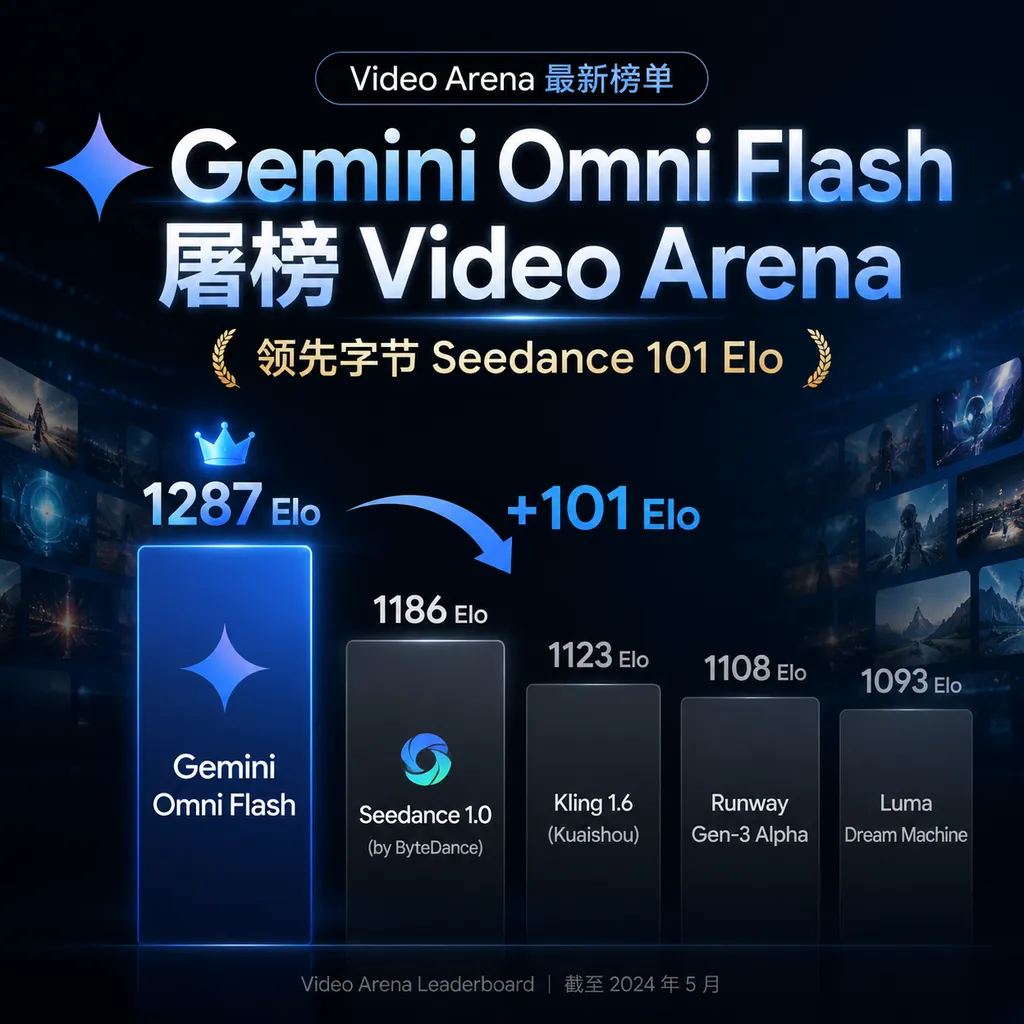
Google DeepMind’s Gemini Omni Flash reached the top of the Video Arena blind test leaderboard with a 1404 Elo score, scoring 158 points higher than its own Veo 3.1 and surpassing ByteDance’s long-dominant Seedance 2.0 Mini by 101 points, reshuffling the landscape of video generation.
Google just dropped a bombshell in the video generation race.
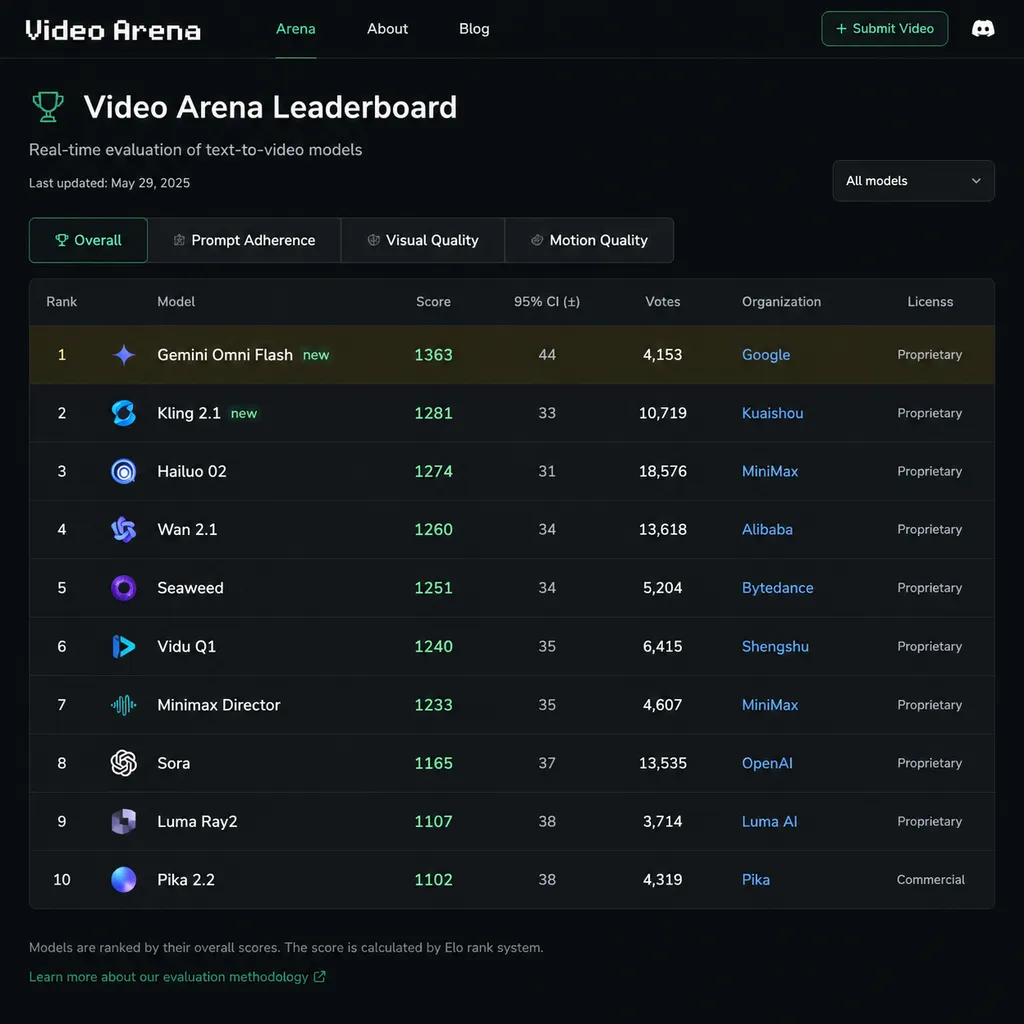
On July 3, Video Arena updated its latest blind test leaderboard, with Gemini Omni Flash from Google DeepMind taking the top spot at 1404 Elo, surpassing ByteDance’s long‑dominant Seedance 2.0 Mini by a margin of 101 Elo. Compared to the Veo era, Google’s video model has climbed seven places on this chart.
If you’re familiar with the Chatbot Arena blind evaluation mechanism, you know what a 101 Elo lead means—it’s not a marginal gain of a few percent; it means that when users are shown two videos side by side, they overwhelmingly prefer Google’s output. According to Arena’s official X account, Gemini Omni Flash outperformed Google’s own Veo 3.1 (1080p) by 158 points in text‑to‑video performance, and also topped Seedance 2.0 in image‑to‑video results.
This isn’t the next generation of Veo — it’s an entirely new product line
Many initially assumed Omni Flash was simply Veo 4 under a new name. It’s not.
Gemini Omni is a new product line Google officially launched at I/O 2026, positioned as “create anything from anything”—generating any modality of output from any modality of input. Flash is the first model in this line made publicly available. It currently supports video generation outputs, with image and audio outputs planned for later updates.
In other words, Veo is a purely text‑to‑video model, while Omni fuses Gemini’s reasoning capabilities with DeepMind’s generative media systems. The difference shows up in the experience: instead of writing a single prompt and waiting for results, you can now edit the video interactively, like chatting.
Some official demo scenarios make this clear:
- Input an image of a hand, add the line “turn the sculpture into bubbles,” and it outputs directly.
- Tell the model “dim the lights in the room” while someone is playing violin in the video—it actually does it.
- “Make the apartment lights flash to the beat of the music”—it understands rhythm and syncs visuals.
- Extract a whale’s swimming motion from one video and apply it to an image of liquid metal.
These aren’t composited effects—they represent a unified model‑level approach to world understanding, multimodal input, and temporally consistent edits.
Why such a large Elo gap?
Video generation has long suffered from three pain points: unrealistic physics, lack of consistency across edits, and poor alignment between the prompt and output. Omni Flash pulled far ahead on all three.
Physical realism: In the official demo, a marble ball rolls down a staircase with conservation of energy, momentum transfer, and accurate reflections—all areas where Sora and Runway models have historically stumbled.
Editing consistency: This is the most striking difference. Traditionally, changing a single frame or sequence breaks continuity. Omni Flash supports multi‑turn edits of the same clip while maintaining subject coherence, camera stability, and scene consistency. This is enabled by connecting Gemini’s long‑context reasoning to the video latent space.
Prompt adherence: Examples like alphabet videos or synchronized text‑motion sequences show it models text–visual temporal alignment more precisely than Seedance or Veo ever did.
Seedance 2.0 previously dominated due to speed, stability, and aesthetic appeal—but its weak spots have always been complex prompt understanding and editing consistency. Google essentially leveraged Gemini’s multimodal intelligence to outclass pure generative models.
Behind the leaderboard: a shifting balance between Chinese and U.S. models
The new Video Arena leaderboard tells an interesting story:
- #1: Gemini Omni Flash (Google) — 1404 Elo
- #2: Seedance 2.0 Mini (ByteDance) — 1303 Elo
- #3: happyhorse‑1.0 (Alibaba)
- #5: wan2.7 (Alibaba)
Chinese developers still occupy three of the top five slots—good news, given that both Seedance and Alibaba’s models have surged in recent months.
The bad news: Omni Flash’s lead isn’t just incremental—it’s a generational gap. A 101‑Elo margin means most users in blind tests prefer Google’s video. If ByteDance and Alibaba keep iterating purely within the “video generation” paradigm, catching up will be tough.
The core issue: Google just changed the rules of the game.
It’s no longer about “whose 4‑second 1080p clips look better,” but “who can make video generation an interactive, conversational process.”
That demands strong foundation model capabilities, not just diffusion‑model tricks.
How developers can use it
Gemini Omni Flash is already rolling out across Gemini, Google Flow, YouTube Shorts, and YouTube Create.
Subscribers to Google AI Plus / Pro / Ultra can try it directly.
API access is available via Google AI Studio, under the model name gemini-omni-flash-preview.
Pricing combines a base fee + per‑second charge:
| Version | Resolution | Duration | Price | |---|---|---|---| | Text‑to‑Video (Dev) | 720p / 1080p / 4K | 4 / 6 / 8 / 10 s | $0.2 + $0.1/sec | | Image‑to‑Video (Dev) | 720p / 1080p / 4K | 4 / 6 / 8 / 10 s | $0.2 + $0.1/sec |
Image‑to‑video allows up to 7 reference images, and text prompts can go up to 20,000 characters.
All Omni‑generated outputs carry SynthID invisible watermarks and C2PA Content Credentials, consistent with Google’s long‑standing content provenance policy.
For developers in mainland China, direct Gemini API access has always been difficult.
OpenAI Hub has already integrated Gemini Omni Flash, providing OpenAI‑compatible endpoints—no VPN or SDK changes needed. Example:
from openai import OpenAI

client = OpenAI(
    api_key="your-openai-hub-key",
    base_url="https://api.openai-hub.net/v1"
)

# Text-to-video
response = client.videos.generate(
    model="gemini-omni-flash",
    prompt="A violinist playing under a glass sphere floating above his hand, "
           "inside the sphere a recursive room with checkerboard floor",
    resolution="1080p",
    duration=8
)

print(response.video_url)
Multi‑turn editing works like chat completions—just pass the previously generated video back as context:
edit = client.videos.edit(
    model="gemini-omni-flash",
    video=response.video_url,
    prompt="Dim the lights in the room, keep the violinist unchanged",
    duration=8
)
Image‑to‑video can include up to seven reference images to lock in a subject:
i2v = client.videos.generate(
    model="gemini-omni-flash",
    prompt="Apply the motion of the whale swimming to this liquid metal figure",
    reference_images=[
        "https://example.com/whale.mp4",
        "https://example.com/liquid_metal.png"
    ],
    resolution="1080p",
    duration=6
)
A few sober considerations
Omni Flash currently has some clear limitations worth noting:
First, audio editing and the Pro version aren’t live yet.
Google calls this a “deliberate phased rollout”—in plain terms, audio synthesis quality and cinematic camera control for the Pro tier are still under refinement.
The current “Flash” tier is powerful enough for Shorts or short ads, but full narrative filmmaking will require higher‑end models.
Second, Video Arena is a blind preference leaderboard.
It reflects subjective user choices, not absolute technical quality.
Metrics like physical accuracy, controllability, or long‑form storytelling aren’t fully covered.
Studios doing film‑level work still need their own benchmarks.
Third, Google’s moat isn’t the model—it’s distribution.
Omni Flash launched simultaneously in Gemini, Google Flow, YouTube Shorts, and YouTube Create—
entry points with billions of daily content views.
That reach can be matched domestically by ByteDance or Alibaba (via Douyin, CapCut), but not globally.
Still, video generation evolves at triple‑speed annually.
Today, Omni Flash leads by 101 Elo; in three months, Seedance 3.0 or Veo 4 could redraw the map.
The real takeaway for developers is this:
video creation is shifting from a “diffusion‑model race” to a “multimodal foundation‑model race.”
Whoever can simultaneously understand images, videos, audio, and text—and compress that into a conversational interface—will lead the next wave.
Google is ahead for now, but the race is only halfway through.
References
- Google Gemini Omni Flash tops the Video Arena blind test, surpasses ByteDance Seedance 2.0 Mini by 101 Elo — ITHome: Chinese‑language report on the leaderboard update
- Gemini Omni and Gemini 3.5 debut the same day, dominating text‑to‑video rankings — Zhihu: full Video Arena chart and breakdown of Chinese developers’ positions


