
Alibaba Cloud Qoder Enterprise Edition Launch: Knowledge Base QMind with Pooled Credits

Alibaba Cloud today launched Qoder Enterprise Edition, integrating the enterprise private knowledge base QMind and the resource‑pool‑based Credits payment model into a single console, directly addressing two major pain points in the implementation of enterprise‑level AI programming.
Alibaba Cloud Qoder Enterprise Edition Launch: QMind Knowledge Base and Pooled Credits — A Clear Explanation of Two Key Things About Enterprise AI Programming
On July 3, Alibaba Cloud officially launched the Enterprise Edition of Qoder. This update skips the old playbook of “AI model arms race” and directly targets two of the most irritating issues in enterprise adoption: one, can AI actually understand our own code conventions and business documents; and two, how to distribute a big batch of purchased Credits among hundreds of developers without waste. The first is called QMind, and the second, Shared Add-on Credits (a pooled resource package).
If you haven’t followed Qoder before: it’s an intelligent programming platform where Alibaba Cloud unbundled and repackaged the enterprise capabilities from its previous Tongyi Lingma product. Qoder focuses on autonomous agents, tab completion, CLI and IDE multi-end integration, and BYOK (Bring Your Own Key) enablement. The significance of this Enterprise Edition is that Qoder is finally shedding its “personal developer plug-in” form and turning into organization-level infrastructure.
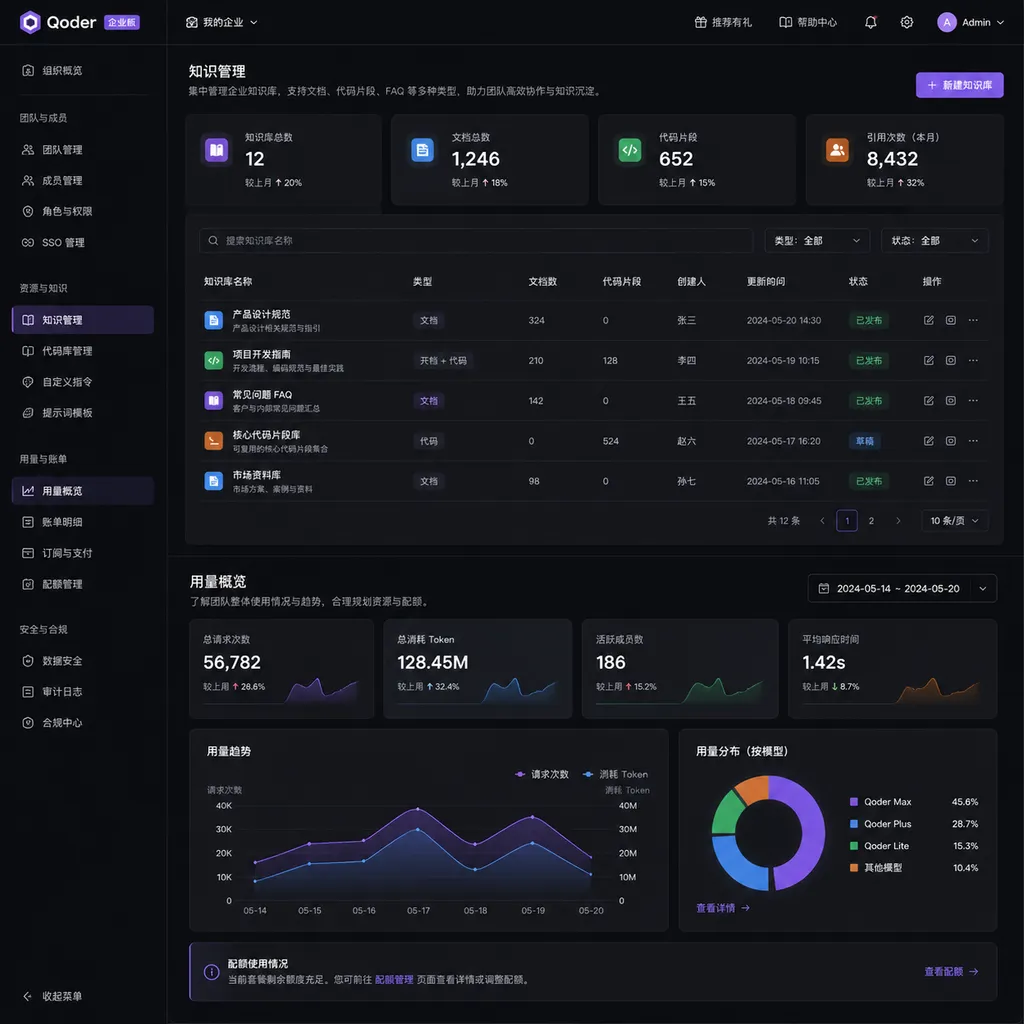
QMind: Not Just Another RAG, but a “Human-Centric” Cloud Knowledge Base
Let’s start with QMind. Officially, it’s described as a “personal cloud knowledge base,” but it supports cross-product, cross-device, and cross-user sharing — which, translated, means: it aims to accumulate developer-level knowledge assets, rather than the traditional project- or team-based knowledge base.
This is an interesting idea. Over the past two years, nearly all enterprise RAG (Retrieval-Augmented Generation) teams have fallen into the same trap: they build knowledge bases by department, so a single backend engineer involved in three projects ends up with three separate access permissions and views three different copies of overlapping content — and when asking about a cross-project API, they get five conflicting answers. QMind slices the granularity down to the individual level, effectively giving every developer a portable “memory backpack.” Whether you ask from your IDE, CLI, or a new machine, your context follows you.
Technically, QMind inherits the same enterprise knowledge base architecture used in Qoder CN and broadly covers:
- Document Formats: PDF, CSV, DOCX, TXT, Markdown — with Markdown officially recommended, as the hierarchical structure is most model-friendly;
- Two Main Use Cases: intelligent Q&A (onboarding, compliance, troubleshooting, internal API queries) and code optimization/generation (enforcing coding standards, security rule-based vulnerability scanning);
- Permission Model: public and private modes, with private allowing custom visibility; Alibaba recommends “private by default, public when needed”;
- Knowledge Layers: company-wide general knowledge base (coding/spec/security standards) + team-specific knowledge base (business docs, ops guides) + personal QMind — three layers combined.
One repeatedly emphasized point in the docs is worth highlighting: “Outdated or inaccurate information not only provides no value but may mislead the model.” This lesson was borne out painfully in countless enterprise RAG deployments — many companies found RAG’s first-year performance worse than the base model because they dumped their long-neglected SharePoint wikis straight in. Qoder now explicitly assigns knowledge governance to knowledge base admins — requiring clear document naming (no more “Standard 1/2”), proper use of multi-level headings, and avoidance of vague phrases like “same as above” or “see other module.” These are the ABCs of documentation engineering, but anyone who’s done enterprise rollout knows few companies actually enforce them end-to-end.
Under the hood, QMind’s document parsing uses Alibaba’s in-house Document Mind pipeline: electronic parsing + OCR/NLP hybrid, using GeoLayoutLM to extract hierarchical trees, exported as structured Markdown or JSON and then fed into chunking/vectorization. Alibaba has spent over two years building this chain — one of the few domestic solutions capable of unifying Office, PDF, HTML, and image inputs into a single structured object. That’s why Qoder confidently markets “reading your messy Word docs” — because it actually can.
Credits Pooling: Filling the Hole in SaaS Seat-Based Pricing
The second part — and arguably the smarter one — is pooled Credits.
Here’s Qoder’s current two-tier pricing:
- Teams Edition: USD $40/seat/month, each seat includes 3,000 Credits, resets monthly, cannot be shared;
- Enterprise Edition: USD $20/seat/month, no Credits included — all Credits are purchased as Shared Add-on packages, at $40 per 2,000 Credits, stackable.
See the pattern? The Teams version basically copies the seat-based model used by Cursor or GitHub Copilot — each user gets a monthly quota that expires. Fine for small teams, but once you scale to hundreds of developers, you hit a wall: some heavy users (architects, SREs) blow through 3,000 Credits quickly, while large numbers of regular devs only use AI intensively in certain sprints. Under the seat model, the company either pays for peak usage or throttles power users.
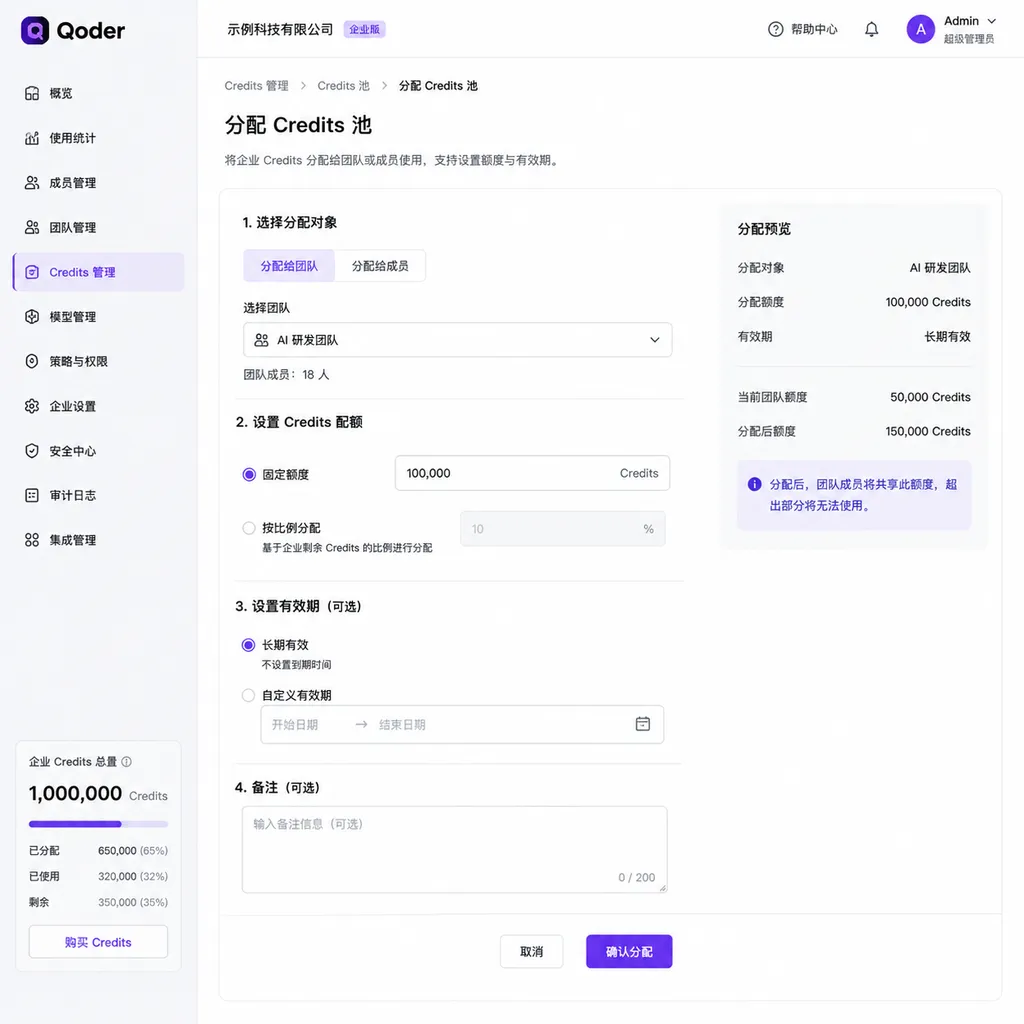
The Enterprise Edition flips that model: the seat fee is just an “access charge,” while Credits go into a shared pool that administrators can allocate dynamically with per-user limits. This model mirrors how cloud vendors sell CPU/GPU resources — buy the quotas first, then allocate as needed. It’s CFO- and FinOps-friendly, and heavy-user-friendly.
Here’s a quick calculation. Suppose a 100-person development team, each consuming 1,500 Credits/month on average:
- Teams Edition: 100 × $40 = $4,000/month, includes 300,000 Credits, but with non-shareable seats, actual utilization may be only ~60%;
- Enterprise Edition: 100 × $20 = $2,000 seat fee + 150,000 Credits ≈ $3,000 for resources, totaling $5,000/month, but Credits are fully distributed according to real usage.
At first glance, Enterprise seems pricier, but as soon as 20% of users are “power users,” pooling drives lower effective unit cost. The implicit message: Alibaba Cloud wants big companies to skip Teams and go straight to Enterprise.
Competitive Landscape: Where Cursor, Copilot, and Cline Stand
Zooming out, by early 2026, the enterprise AI coding space has become a red ocean:
- GitHub Copilot Enterprise: Deepest Microsoft integration, but knowledge base tied to GitHub repos, weakening experience for non-GitHub users;
- Cursor Business: Best model experience, but seat-based pricing + overage penalties make CFOs anxious, and its knowledge base features are weaker;
- Cline / Roo Code: Open-source self-hosted, highly flexible but lacks governance for enterprise environments;
- Qoder Enterprise: Supports Qwen3.7-Max (currently 50% off), Claude, Gemini, etc.; powered by Document Mind for knowledge base, and now offers the pooled pricing model.
Qoder's differentiator no longer lies in the models themselves — with BYOK, everyone’s using more or less the same ones — but in getting governance right: hierarchical permissions for the knowledge base, pooled Credits management, and consistency across CLI/IDE/plugin environments. Together, these are what corporate buyers actually care about. For domestic teams, especially those bound by data compliance, Qoder’s approach is much smoother than tunneling out to use Cursor.
Of course, there are drawbacks. QMind’s capabilities for code-specific knowledge accumulation aren’t fully rolled out yet; the official docs still describe a separate processing pipeline for code repositories. Cross-device sync on the CLI side wasn’t demoed in detail, so real-world performance remains to be seen. And slogans like “self-evolving agents that understand you better over time” — every vendor says it; real results depend on retention six months down the line.
Some Perspective
This update isn’t Qoder’s “flashiest moment” — no new models, no refreshed SWE-bench scores, no jaw-dropping demo videos. But if you’re actually responsible for driving AI programming adoption inside an enterprise, QMind’s layered knowledge model and pooled Credits system are exactly what you need. By late 2026, the competition in AI coding has shifted from “who has the smarter model” to “who can make both CTO and CFO nod in approval.” Qoder’s latest move hits that target precisely.
For teams wanting to try it out, new users still get 300 free Pro Credits, and the Qwen3.7-Max half-price promotion extends to the Enterprise Edition. Developers interested in benchmarking multiple models (GPT, Claude, Gemini, DeepSeek, etc.) with a single unified key can also use OpenAI Hub (openai-hub.com), which supports direct domestic access to all major models with OpenAI-compatible formatting — a big time-saver for multi-model testing setups.
References
Public information on this topic mainly comes from Alibaba Cloud’s official site and 36Kr news coverage. There are currently no in-depth discussions in major domestic developer communities; relevant links will be added once firsthand testing data becomes available.


