
TaskPeace Launch: Let the AI Coding Agent Queue Up and Get to Work Itself
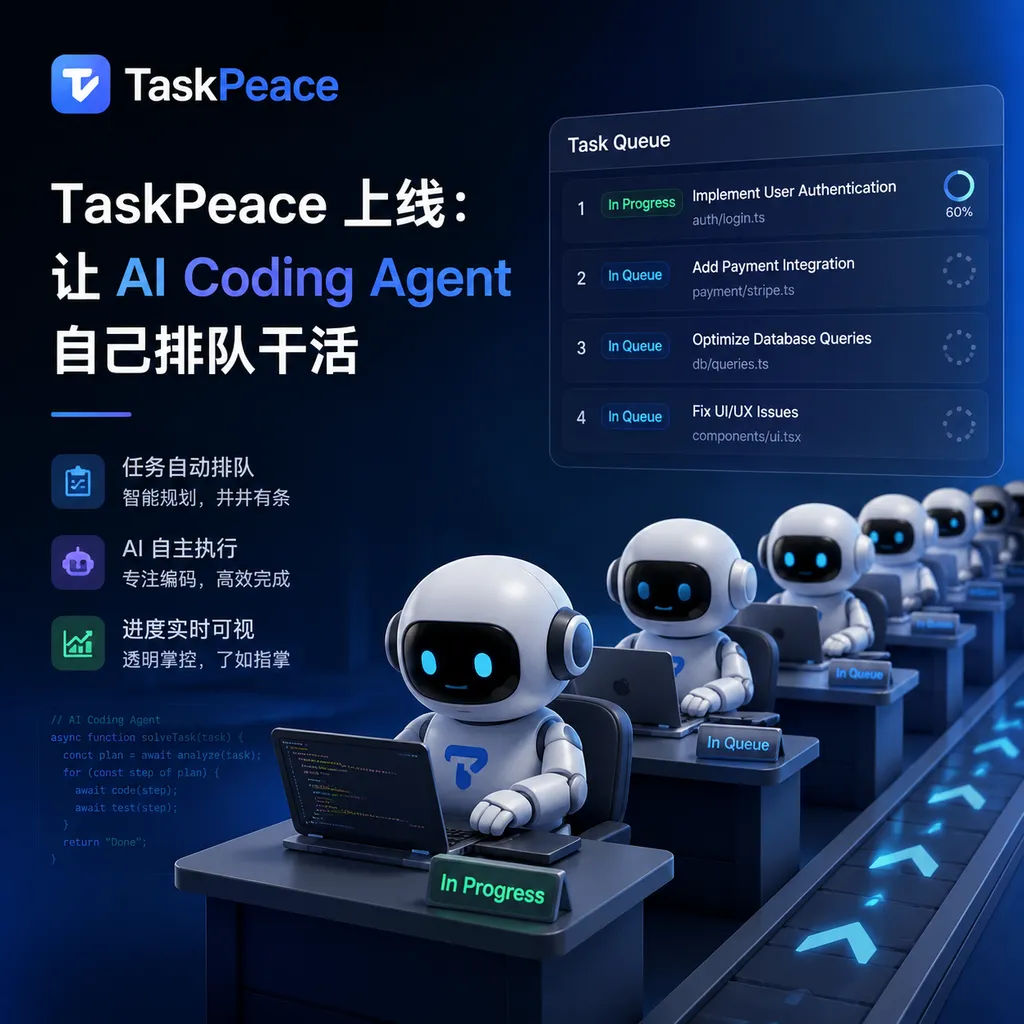
An independent developer posted **TaskPeace** on Hacker News — a task queue designed specifically for AI coding Agents. The Agents actively pull tasks via the MCP protocol, turning the model of “humans directing AI” into “AI finding work for itself.”
A Developer Fed Up with Babysitting Claude Code
On July 2nd, a project called TaskPeace appeared on Hacker News’ Show HN section. The author’s description was simple and direct: a task queue from which his AI coding agent pulls jobs via the MCP protocol. The project, hosted at taskpeace.com, was posted in the early morning and reached the front page within hours.
At first glance, it sounds like yet another to-do list. But once you see what problem it actually solves, you’ll realize it hits a very real pain point in today’s AI coding workflows — when you’ve got three or four Claude Codes, Cursor Agents, or Codex CLIs running at once, who’s doing what? Who’s stuck? Who should get the next task?
According to the author’s own words in the thread, he was that person constantly switching between multiple agent sessions, copying and pasting task descriptions, and manually tracking progress. Eventually, he couldn’t take it anymore, so he built TaskPeace. The name is literal — “peace of tasks” — freeing developers from the role of “dispatcher.”
Counterintuitive Design: Agents Are Consumers, Not Executors
Most AI coding tools today use a push-based interaction model: the user writes a command in their IDE, the agent receives and executes it, then returns the result. The user decides what to do next. In this loop, the human is both the task producer and the scheduler, and the agent is a passive executor.
TaskPeace flips the script. Its core abstraction is a shared task queue from which agents actively “pull work” via an MCP server. This shift, while subtle on the surface, has major implications:
- The agent becomes a “worker,” not just a CLI tool. Workers can be idle or busy; they proactively fetch new tasks and mark them done when finished.
- Scheduling authority moves to the system, not the human brain. The human role reverts to that of a product manager — define what to do, not who does it next.
- Multi-agent concurrency becomes natural. You can have three instances of Claude Code connected to the same TaskPeace queue, each pulling different tasks independently.
This isn’t a revolutionary new architecture — it’s basically applying message queue concepts (like RabbitMQ or SQS) to AI agent workflows. But the choice to use MCP as the transport protocol is what makes this project genuinely interesting.
Why It Has to Be MCP
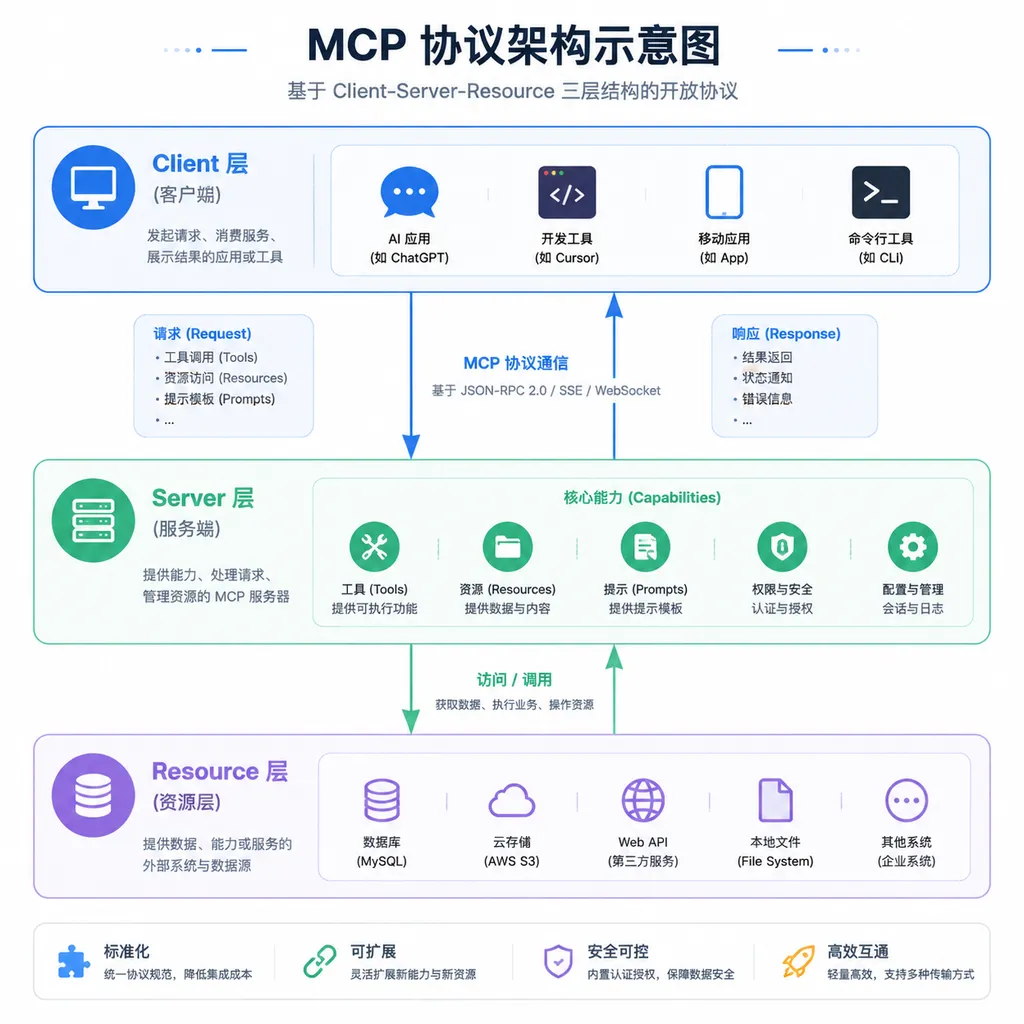
If you’re not familiar with the Model Context Protocol (MCP), here’s the short version: Anthropic open-sourced it in November 2024 to standardize the interface between AI applications and external tools. The official analogy is “USB-C for the AI world” — previously, each AI assistant had to be manually integrated with every tool. With MCP, a server needs to be implemented only once, and any MCP-compatible client (Claude Desktop, Cursor, Cline, Continue, etc.) can use it out of the box.
After a full year of adoption, MCP is now deeply integrated into the developer tooling ecosystem. OpenAI announced support in 2025; Cloudflare began offering remote MCP server hosting; and community hubs like MCP.so, Glama, and PulseMCP now host thousands of servers.
By implementing itself as an MCP Server, TaskPeace achieves three key things:
- It’s not tied to any specific AI coding tool. Claude Code, Cursor, Cline, Windsurf — as long as the client supports MCP, it connects seamlessly.
- No per-agent adapter layer is needed. Users just add MCP configuration to their client.
- The protocol natively supports “tool” semantics. TaskPeace simply exposes tools like
get_next_task,update_task_status, andreport_blocker, which agents can understand and call.
If MCP weren’t used, the author would’ve had to either build a CLI for shell-based communication or expose a REST API via HTTP requests. The former is clunky; the latter would require manually teaching each agent in its system prompt how to call the API. MCP neatly sidesteps all that complexity.
What the Workflow Actually Looks Like
According to the project page and the author’s comments on Hacker News, a typical TaskPeace workflow goes something like this:
Step 1: Humans create tasks.
In the TaskPeace web interface, developers create tasks like “Add dark mode toggle to user settings page,” “Fix login API 500 error with special characters,” or “Refactor N+1 queries in the user service.” Each task can have a priority, dependencies, and file paths.
Step 2: Agents connect.
In Claude Code or Cursor’s MCP config, you add the TaskPeace server like so:
{
  "mcpServers": {
    "taskpeace": {
      "command": "npx",
      "args": ["-y", "@taskpeace/mcp-server"],
      "env": {
        "TASKPEACE_API_KEY": "your-key-here"
      }
    }
  }
}
Step 3: Agents pull tasks autonomously.
When the user says, “fetch a task from TaskPeace,” the agent will call the get_next_task tool, receive the description and context, and begin normal coding. After finishing, it calls mark_complete; if it gets stuck, it calls report_blocker to mark the task as blocked and log the reason.
Step 4: Humans review.
In the web dashboard, developers can view each agent’s progress, completed PR links, and issues encountered — similar to a Linear or Jira board, except the data is auto-reported by agents.
Where It Stands Compared to Existing Solutions
This space isn’t empty; a few similar approaches exist and make useful comparisons:
-
Agent-MCP (GitHub: rinadelph/Agent-MCP) takes a heavier approach — a full multi-agent collaboration framework with shared knowledge graphs, inter-agent communication, and an Admin Agent for coordination. It’s powerful but complex, with a steep learning curve. Even the author admits you need to understand AI workflows, MCP, and distributed systems to use it effectively.
-
Claude Code’s built-in Task tool focuses on sub-agents that handle parallel subtasks within the same session — finer-grained, short-lived, and not quite the same as TaskPeace’s persistent job queue.
-
AI integrations in Linear and Jira let agents read tasks from ticketing systems, but those abstractions are built for humans, with too many fields for agents to interpret easily.
TaskPeace’s positioning is clear: lightweight, agent-focused, cross-tool. It doesn’t aim to replace project management systems; it simply provides a continuous stream of tasks tailored for agents. For indie developers, small teams, and side projects, that’s the perfect level of granularity.
Caveats and Limitations
Realistically, TaskPeace has several clear limitations — issues the author himself acknowledged in the HN comments:
-
Task decomposition still falls on the human. The real challenge isn’t “where agents get tasks,” but “how to break fuzzy requirements into atomic tasks agents can handle independently.” TaskPeace doesn’t solve that — you still have to clearly define each task. Some HN commenters suggested adding an “AI task decomposer,” but the author declined out of reliability concerns.
-
Conflict handling is rudimentary. If two agents modify different functions in the same
user service, merge conflicts are almost inevitable. TaskPeace only supports manual “file lock” tags, where users specify which files a task might touch. It’s coarse-grained and easy to forget. -
Context passing remains unresolved. When an agent pulls a task, how does it quickly obtain enough project context? Reloading the full codebase for every task is inefficient. The author’s plan is to add “task-level context packs” — pre-bundled files or docs attached to tasks — but that shifts more setup work back to the human.
-
Security boundaries are a concern. Researchers have identified multiple potential attack surfaces in MCP — tool poisoning, command overlap, sandbox escapes. If malicious input enters the queue (say, a CI system inserts a prompt-injected task), an agent could become an attack vector. TaskPeace currently has no prompt injection filtering; it relies on the agents’ own alignment.
The Bigger Signal: AI Coding Is Moving Toward “Production Lines”
Beyond TaskPeace itself, this project signals a deeper trend: AI coding agents are evolving from “pair programmers” to “contracted workers.”
In 2024, tools like Cursor and Claude Code pitched themselves as coding assistants — the human in the driver’s seat, AI as co-pilot. By late 2025, CLI-based tools like Claude Code CLI and Codex CLI became popular, as people got used to running long processes across multiple concurrent sessions. By 2026, with advances in models like Claude Opus 4.7 and GPT‑5, agents could handle moderately complex tasks independently. The bottleneck shifted — AI can finish the work, but humans can’t manage them all.
Tools like TaskPeace arise precisely from this bottleneck. Similar projects include various agent orchestrators and AI sprint planners. Their shared goal: free humans from having to manually issue every single command, giving agents limited but meaningful autonomy in scheduling themselves.
From a systems design perspective, this is industrialization — akin to the shift from craftsman shops to assembly lines. Agents are the workers, the task queue is the conveyor belt, and humans are the line managers. The analogy isn’t perfect, but the direction is clear.
A Practical Recommendation
If you’re currently using two or more AI coding agents in tandem, TaskPeace is worth a 30‑minute trial. Its key value isn’t “smarter AI,” but “no more human scheduling overhead.” As an early Show HN prototype, don’t expect production-grade robustness — but as a proof of concept, it uses MCP in a very clever way.
In cross‑model workflows — for example, Claude for architecture tasks, DeepSeek for bulk refactoring, GPT models for testing — unified APIs via aggregator services like OpenAI Hub are becoming the norm. Combine those with TaskPeace’s scheduling layer, and your DevOps friction drops significantly.
As for the remaining challenges — task decomposition, conflict resolution, context management, and security — the industry will tackle them over time. What matters is that someone has started treating agents as proactive workers, not just “smarter autocompletion.” That alone marks real progress.
References
- Agent‑MCP Project Repository (GitHub): a multi‑agent collaboration framework and a good reference implementation of MCP in agent scenarios.
- Illustrated LLMs: AI Agents and the MCP Protocol Ecosystem (Zhihu Column): an overview of MCP’s role in the agent ecosystem, suitable for building a quick high‑level understanding.


