
Ali Qoder Enterprise Edition Goes Global: Credits Pooling + Per-Repository Models
Yesterday, Alibaba launched **Qoder Enterprise Edition**, featuring **Credits-based resource pooling and billing**, a **user-and-repository distribution model**, and an **enterprise-exclusive Plugin marketplace**. Priced from **$20 per seat**, it directly addresses the compliance and cost pain points of deploying AI programming tools in enterprises.
Alibaba Qoder Enterprise Edition Officially Launched Worldwide: Returning “Accounts” and “Control” of AI Programming Tools to Administrators
On July 3, Alibaba Qoder officially launched the Enterprise Edition on its global site, with both Qoder CN and the enterprise version of Qoder going on sale simultaneously in the domestic and international Alibaba Cloud Marketplace. Following the milestone of surpassing five million global users in the first half of this year, this marks Alibaba’s direct push into the enterprise market within the AI programming field.
A few key phrases define it: Credits pooling, per-user and per-repository model distribution, an enterprise-exclusive Plugin/Skill marketplace, and a knowledge engine for repositories at the hundred-thousand level. Each points to the same thing—AI programming tools, once personal productivity toys, are becoming a standard IT asset on corporate procurement lists.
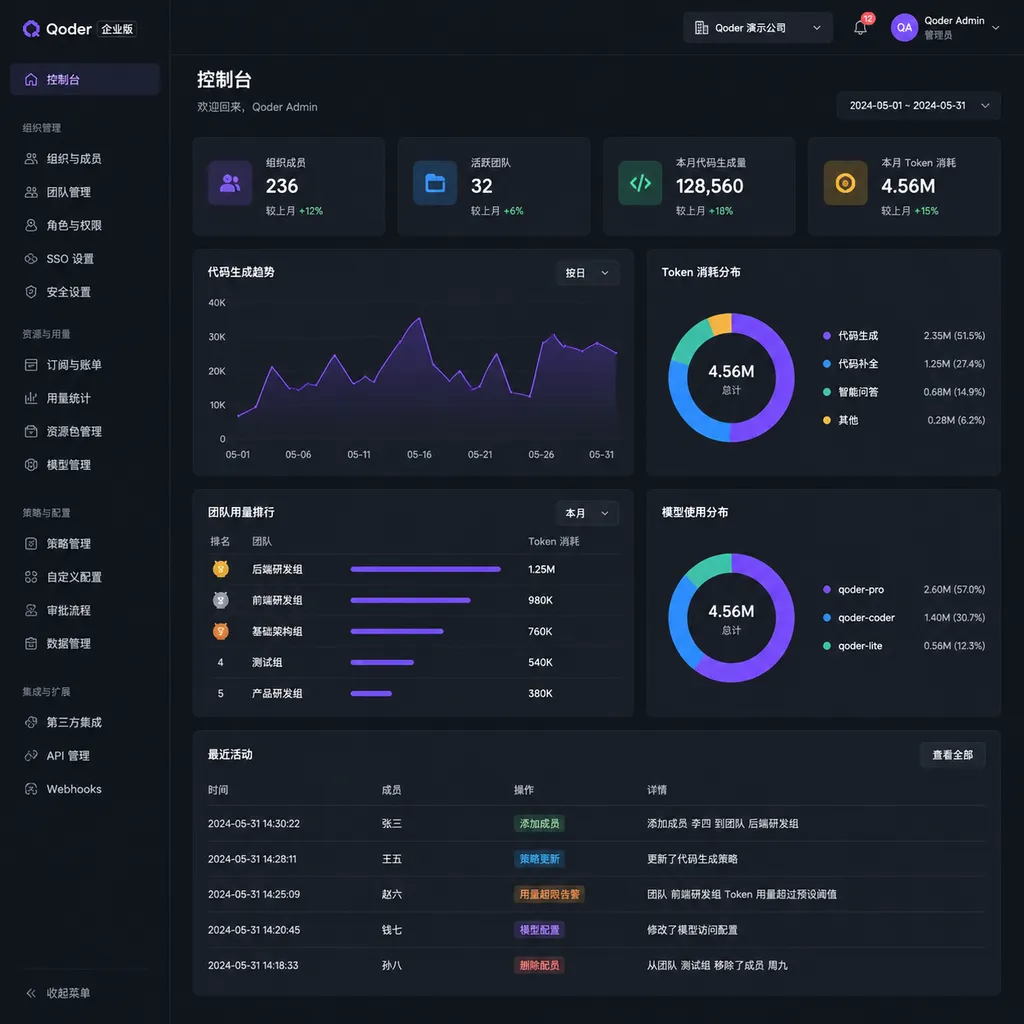
40 Dollars vs. 20 Dollars — Alibaba Clearly Differentiated Teams and Enterprise
Let’s start with pricing—the most direct window into understanding Qoder Enterprise’s design logic.
- Teams Edition: USD 40 / seat / month, each seat comes with a fixed monthly quota of 3,000 Credits, which do not carry over and cannot be shared among members
- Enterprise Edition: USD 20 / seat / month, seats come with no included Credits, computational units are billed separately through an “organization shared resource pack”
- Shared Resource Pack: USD 40 / 2,000 Credits, one-time purchase, stackable
This pricing structure is quite straightforward: Teams Edition is a “bundle plan” for small and medium teams—simple and all-inclusive; Enterprise Edition splits seat fees from compute fees entirely—seats are half the price, but compute capacity must be purchased separately for a shared pool.
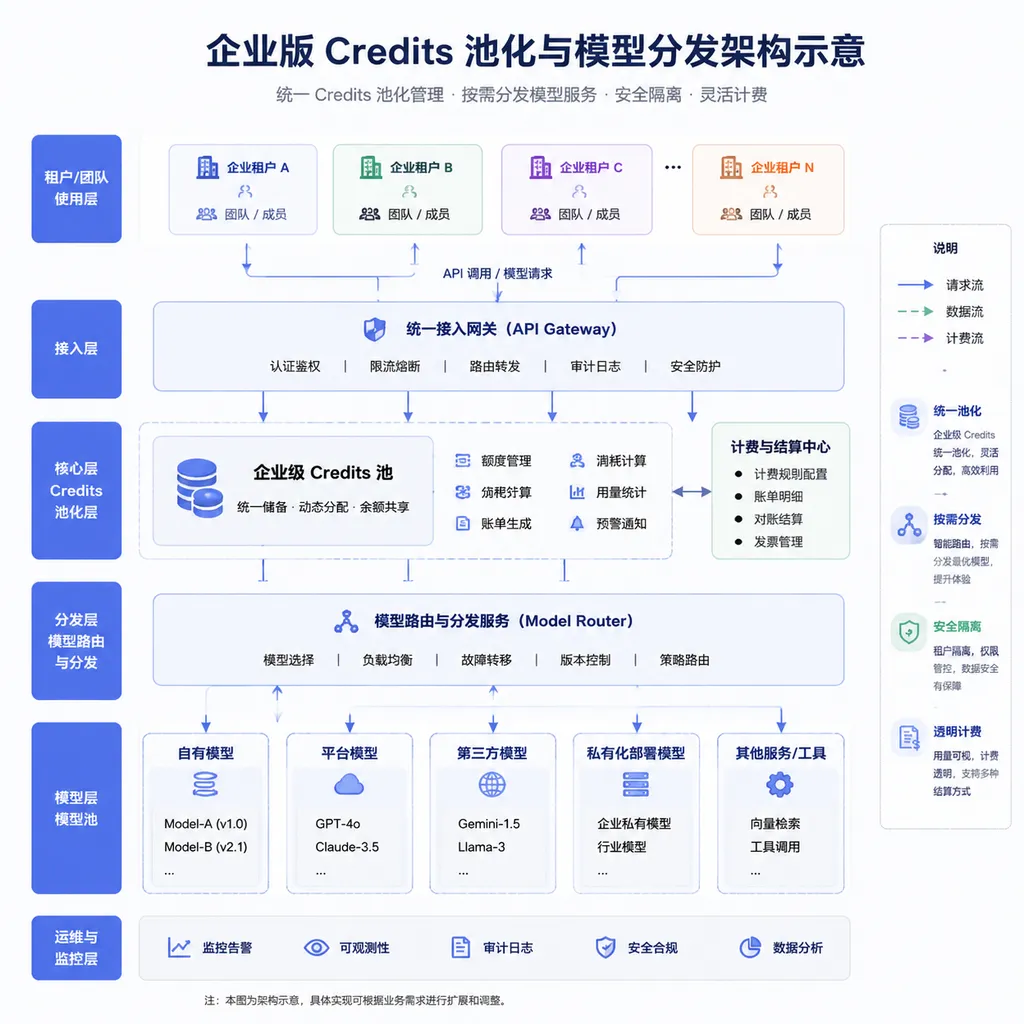
On the surface, it’s price differentiation; in essence, it reflects two different purchasing logics. For small teams, usage variance across members doesn’t matter—bundling is easiest. But when headcount reaches hundreds or thousands, finance won’t accept a wasteful “3,000 Credits per person, auto-reset monthly” model. The Enterprise Edition’s shared Credits pool allows administrators to allocate usage to members or billing groups as needed—standard practice for enterprises procuring SaaS: resources must be transferable, accountable, and auditable.
Another key feature is the redemption-code system through Alibaba Cloud Marketplace. Administrators can increase, decrease, or renew seats instantly in the backend in sync with team changes—without tedious contract renegotiation. For domestic enterprises already budgeting through Alibaba Cloud, this provides a near-frictionless procurement path.
“Per-User, Per-Repository Model Distribution”: Finally, Serious Control of AI Usage Boundaries
If Credits pooling solves financial concerns, then per-user and per-repository model distribution addresses data security and compliance issues.
Here’s the reasoning. Within enterprises, the toughest challenge around AI programming tools isn’t “whether they can be used,” but “who can use which model on what code.” For example:
- For a core payment system codebase, only company-deployed private models are allowed—no connections to any closed-source overseas models
- For front-end business code, employees can freely use Claude or GPT to speed up development; only architects can access the highest-tier (Opus-level) models
- For external contractors, their accounts can only access a few designated non-sensitive repositories, and may only use basic models
Previously, enforcing these policies relied on employee self-discipline, IT department hacky scripts, or simply banning AI tools altogether. Qoder Enterprise now embeds control into the product itself: built-in models can be grouped and selectively enabled or disabled, and model access can be distributed precisely by user or repository. In other words—model access, code assets, and role permissions are enforced to align.
This isn’t an earth-shattering breakthrough, but it’s a prerequisite for AI programming tools to scale enterprise-wide. GitHub Copilot Enterprise takes a similar path, and Cursor is working toward it as well, but Qoder’s granularity seems finer—especially on the “per-repository” level, directly mapping to enterprises’ asset management systems.
Enterprise-Exclusive Plugin/Skill Marketplace: Turning AI Workflows into Reusable Assets
The third noteworthy feature is the enterprise-exclusive Plugin/Skill marketplace.
Employees can directly invoke their organization’s accumulated AI workflow assets through Qoder Desktop or QoderWork. The concept mirrors the “enterprise app marketplaces” in SaaS products like Salesforce or Feishu—let internal experts build templates, then make them reusable organization-wide.
In the AI programming context, the value of this may be underestimated. Consider: within a large enterprise, different divisions have their own “prompt masters” or “agent orchestration experts.” Their fine-tuned code review, release ticket generation, or unit test completion Skills are practically useless if only shared through documentation. As a Plugin/Skill marketplace, these assets become distributable, versioned, and permission-controllable within the organization—thus forming organizational compounding returns for AI programming.
Of course, for the marketplace to thrive depends on Qoder’s plugin SDK usability and ecosystem growth—long-term factors not yet testable.
QMind Knowledge Engine for 100,000-Level Repositories: A Head-On Battle in Enterprise RAG
The Enterprise Edition also introduces the QMind knowledge engine, officially described as supporting “repositories at the hundred-thousand level.” If accurate, that means Qoder can handle massive enterprise-scale monorepos—think tens of thousands of files and millions of lines of code, where ordinary IDE plugins’ indexing systems collapse.
A codebase knowledge engine essentially combines code retrieval + semantic understanding + incremental updates. The challenges lie not in single-point tech but in:
- How long initial indexing takes for a 100,000-file repository—and if it’s acceptable
- Whether incremental updates run in real time after each commit
- How deep cross-file and cross-module semantic linking goes
- Where index data is stored, how it’s encrypted, and how multi-tenancy is isolated
Alibaba hasn’t released technical details, but based on comparisons, Sourcegraph Cody and Cursor’s Codebase Indexing have worked in this direction for years. Whether Qoder can deliver a “hundred-thousand-scale” smooth experience remains to be seen from enterprise feedback.
Security and Compliance: ISO 27001 Is the Entry Ticket, Not a Bonus
Lastly—the security framework. Qoder Enterprise claims full coverage of transmission encryption, identity and access control, AI runtime, data storage, and compliance auditing, and has obtained the ISO/IEC 27001:2022 international certification.
Frankly, ISO 27001 is now just the basic entry ticket for enterprise SaaS—it’s mandatory for most large-client procurement processes. Differentiation depends on finer points: SOC 2 Type II certification, configurable data residency regions, support for private deployment, assurance that customer code isn’t used for model training (particularly sensitive for AI coding tools), and detailed audit logs with proper retention.
From public info, Alibaba emphasizes “AI runtime” as an independent security domain—rare among vendors, who typically lump AI-related issues under “data security.” Isolating it for layered defense indicates awareness of new threat surfaces like prompt injection, model privilege escalation, and rogue agent execution—a definite plus.
Who’s Buying Qoder Enterprise Edition
Publicly named clients include China FAW and other major enterprises. Considering Qoder’s existing base of over five million users, it’s clear Alibaba has gone through a long PLG (Product-Led Growth) phase—getting developers onboard first, then converting organizations.
This is the same path pursued by GitHub, GitLab, and Notion, and currently by Cursor. In contrast, ByteDance’s MarsCode and Tencent’s CodeBuddy take a top-down, B2B-first approach. The relative merits of each strategy will become clearer over the next year or two.
For domestic teams, Qoder Enterprise Edition has two major advantages:
- Direct purchase through Alibaba Cloud Marketplace, using existing enterprise cloud budgets without overseas procurement hurdles
- Dual domestic/international sites, allowing cross-border teams to collaborate without switching account systems
Its disadvantages are also clear: as a newer product, its plugin ecosystem, model diversity, and community activity are still behind tools like Cursor. In enterprise procurement, “ecosystem maturity” remains a short-term gap.
A Bigger Signal
Placing this release within the broader AI programming landscape, one clear trend emerges: from late 2025 to mid-2026, AI programming tools are collectively shifting from “individual subscriptions” to “enterprise procurement.”
GitHub Copilot Enterprise, Cursor Business, Sourcegraph Cody Enterprise, and now Qoder Enterprise are all converging on the same enterprise feature matrix—SSO/SCIM, audit logs, role-based model permissions, organization-level quotas, and private knowledge bases.
The reason is simple: the individual subscription market ceiling is already visible—the real money lies with enterprise clients. And enterprises only pay big when they can ensure financial, permission, compliance, and audit control—the four “controllables” Qoder Enterprise is built to address.
For individual developers, this release might not feel as thrilling as GPT-5 or Claude 4.5; but for enterprise IT decision-makers, Qoder Enterprise provides one of the most complete “enterprise-readiness” checklists yet for AI programming tools. How high the score will be depends on client uptake over the next few quarters.
References
- Alibaba Qoder Enterprise Global Launch: Supports Credits Pool-Based Billing and Flexible Subscription Management - ITHome – Core report covering the key functions and compliance of the Enterprise Edition
- Alibaba Qoder Enterprise Global Launch (Mobile) - ITHome – Mobile version of the ITHome report, identical in content to the main site


