
China Mobile Leads the Establishment of the AI-eSIM Special Committee, with Forty Leading Companies Joining
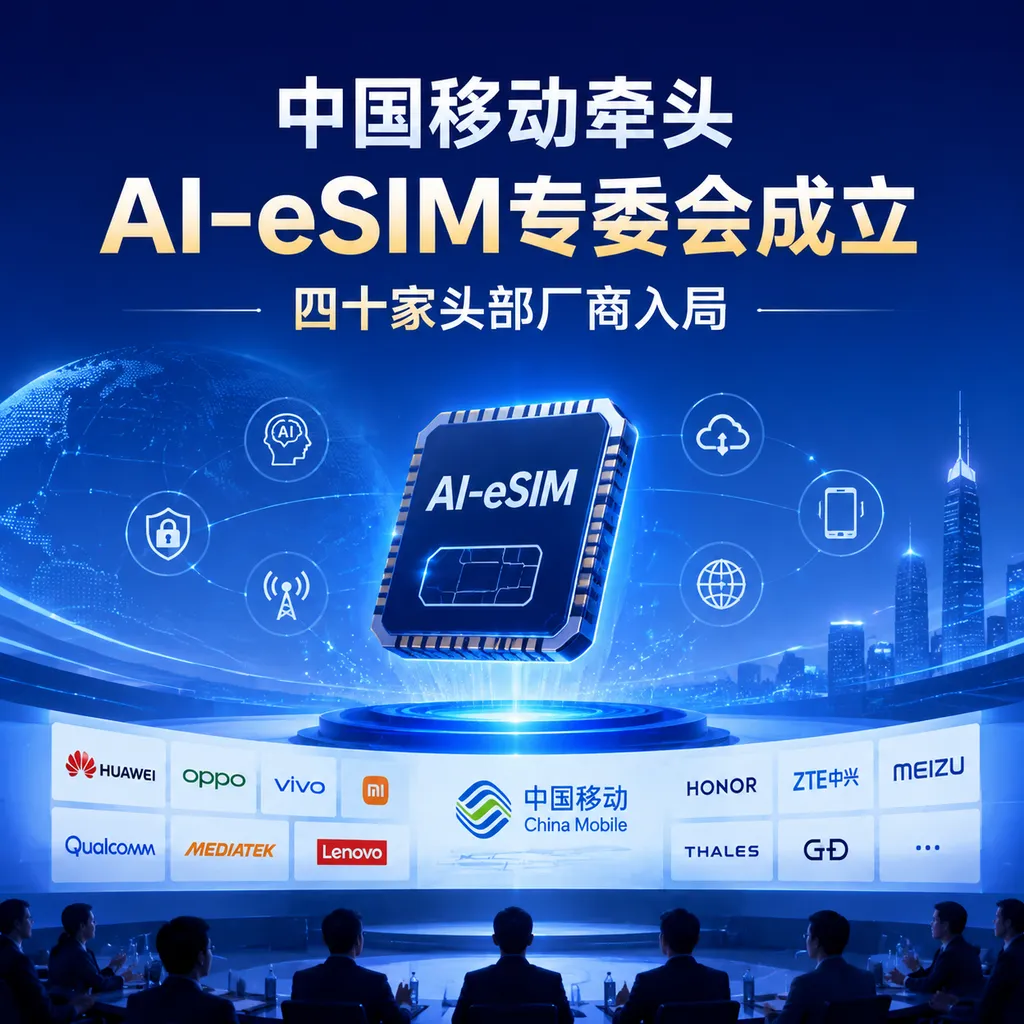
On July 3, the industry’s first AI-eSIM Industrial Collaboration Platform was established at the China Information and Communications Industry Development Forum. China Mobile IoT Company serves as the chair unit, with more than 40 leading enterprises including Volcano Engine, Tencent Cloud, and Tianyi IoT joining. The platform aims to target a new entry point for the token economy.
China Mobile Leads the Formation of the AI-eSIM Special Committee, Industry’s First Collaborative Platform Officially Launched
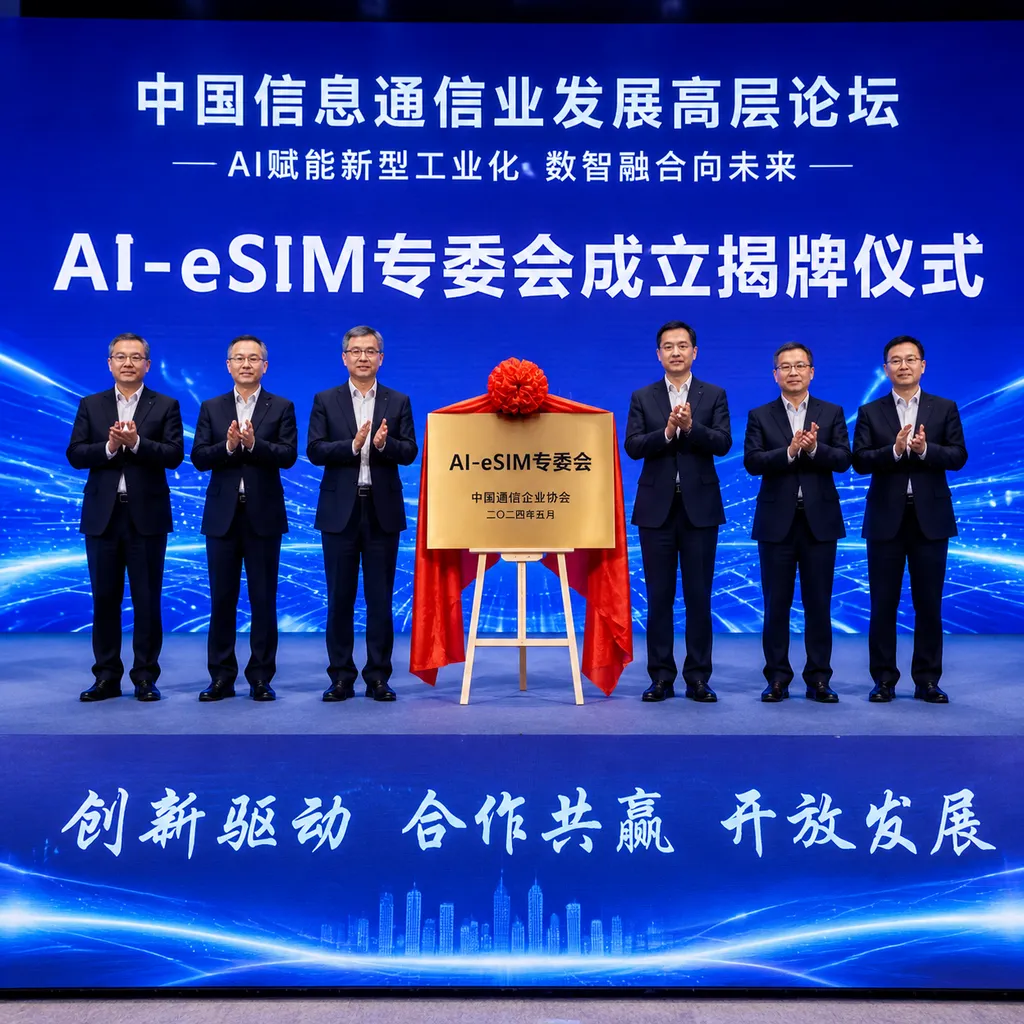
On July 3, a new milestone was struck at the China Information and Communications Industry Development Forum: the industry’s first AI-eSIM collaboration platform—the AI-eSIM Professional Committee of the China Communications Enterprise Association (hereinafter referred to as “the Committee”)—officially went on the board, initiated by China Mobile. China Mobile IoT Company serves as the chair unit, while Tianyi IoT, Unicom Huasheng, Volcano Engine, Tencent Cloud, and Guan An Information act as vice-chair units. With all three major operators present, together with cloud vendors, chipmakers, cybersecurity, and model-layer players—totaling more than 40 companies—the lineup signals one clear message: the carriers are serious about AI-eSIM and intend to walk this road together, not alone.
Yesterday (July 4), the Committee immediately convened the “First Member Representative Conference and Industry Development Symposium.” The tight schedule shows this was no mere ceremonial unveiling.
What Exactly Is AI-eSIM and Why Now?
Let’s clarify the concept. Most are already familiar with eSIM—embedded SIM—transitioning from a physical card to a chip soldered onto a device’s mainboard. Apple Watch, iPad, and certain overseas versions of iPhone have long adopted it. In China, due to regulatory factors, consumer-grade eSIM development has been slow, yet for IoT, eSIM is unavoidable—after all, you can’t insert a physical card into every smart water meter.
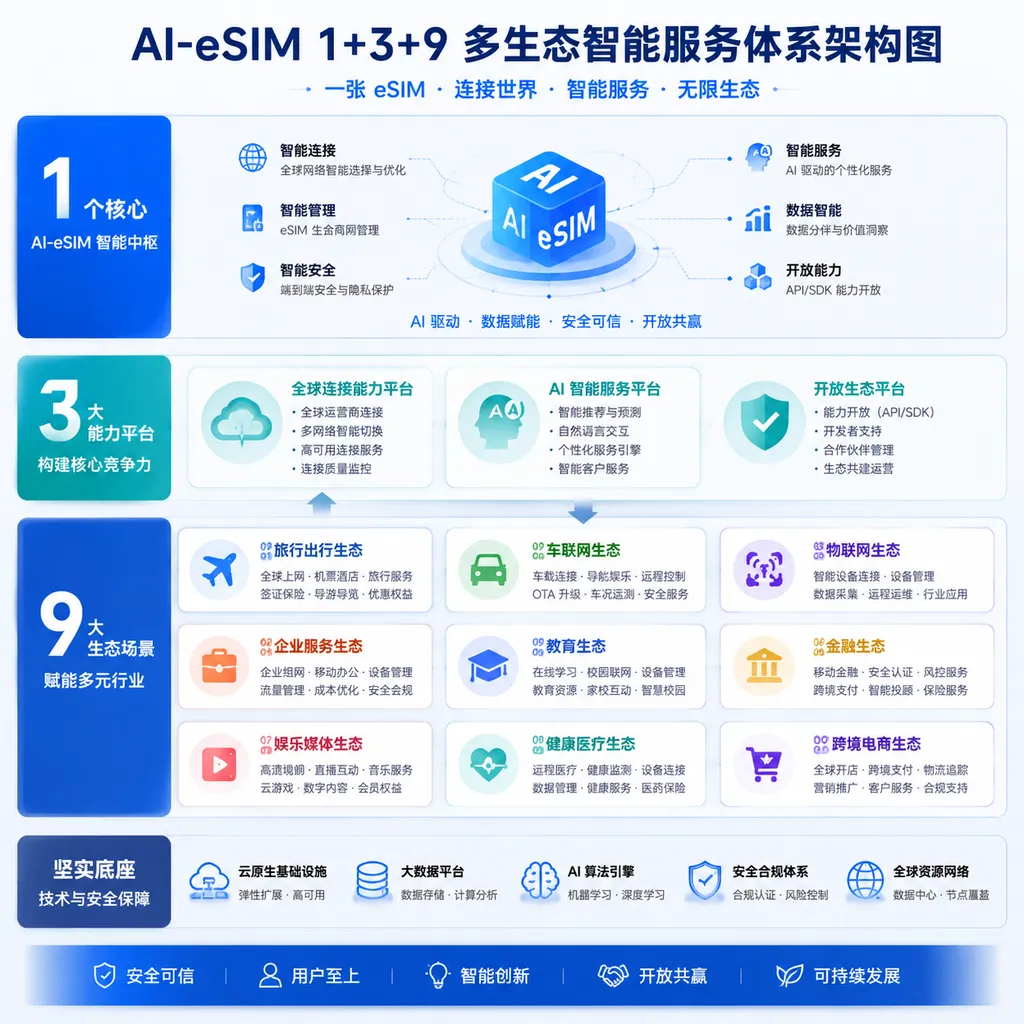
AI-eSIM adds a new layer from carriers: integrating AI capabilities and identity authentication into the eSIM chip so that when a terminal “connects to the network,” it simultaneously “connects to a model.” In May this year, China Mobile debuted its “1+3+9” framework at the Suzhou Mobile Cloud Conference—1 AI-eSIM chip entry point, 3 core engines, empowering 9 key scenarios. Their slogan was “carrier code equals large-model account,” a world-first innovation upgrading eSIM into a one-click AI gateway.
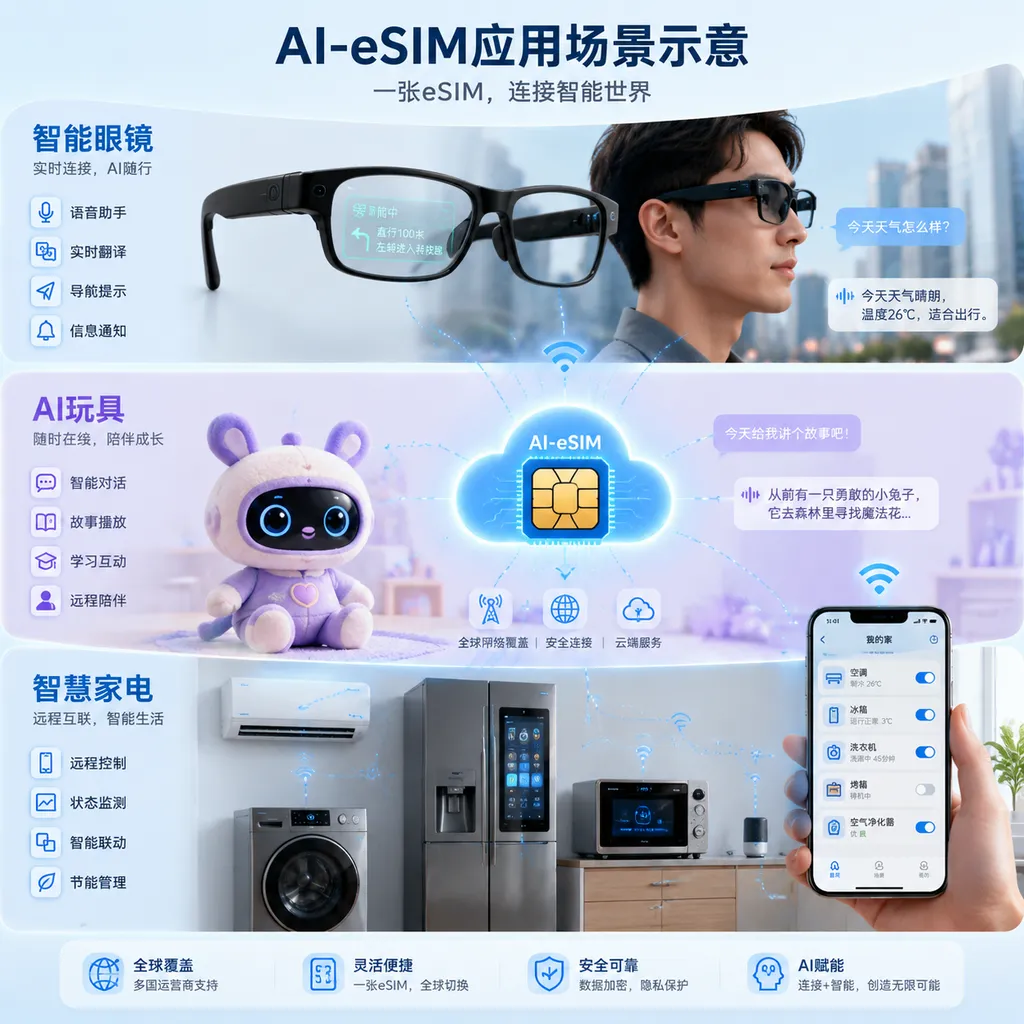
It may sound abstract, but in actual use it’s straightforward: smart glasses, an AI toy, or a connected air conditioner, all pre-installed with an AI-eSIM chip, automatically go online upon startup. Once connected, they access a large model—no need for the user to register an account, configure keys, or select models. Communication and token fees are bundled into a single bill. Carriers aim to evolve from “traffic operations” to “Byte + Token integrated operations.”
The logic holds up. One of the toughest challenges of AI hardware over the past two years has been that every company must reinvent the wheel—account systems, cloud inference, billing, identity verification, security compliance—these are overwhelming for small to mid-sized manufacturers. Carriers, with their code-number resources and network access, can package infrastructure uniformly, theoretically reducing connection costs for the entire industry.
The Committee’s Four Main Tasks
Based on publicly available information, the Committee has outlined four key tracks:
- Standard System Development: Drafting AI-eSIM technical specification proposals and establishing a “project initiation–drafting–review–publication–promotion” cycle. In plain terms—claiming authority over standards. China Mobile already stated at Suzhou in May the intent to “push national standards globally and highlight AI-eSIM as a Chinese standard”—a statement not made lightly.
- Industry Ecosystem: Hosting technical discussions and supply-demand matchmaking regularly. This follows traditional association practices, with effectiveness varying case by case.
- Scenario Demonstration: Focusing on smart home appliances, wearable devices, and AI-enabled toys and cultural products. This suggests carriers recognize their first battleground isn’t smartphones (due to regulatory constraints and Apple/Google’s account ecosystems), but rather these “new categories with no account-history burden.”
- Security Foundation: Ensuring end-to-end compliance and trusted digital identities. Guan An Information’s vice-chair position reflects this—security and compliance have always been major hurdles for eSIM’s adoption in China.
Why Bring in So Many Cloud Vendors?
Looking at the vice-chair list—Volcano Engine and Tencent Cloud—these aren’t symbolic “ecosystem friends.”
For AI-eSIM to work, a key question arises: when the chip’s “carrier code equals large-model account” is triggered, whose model is actually being called? Carriers have their own “Jiutian” large model, but in terms of general capabilities, it still lags behind ByteDance’s Doubao, Tencent’s Hunyuan, or DeepSeek. Device manufacturers care primarily about model performance, cost, and flexibility—not about which one the carrier prefers.
Hence, there’s only one viable path: AI-eSIM acts as an identity and routing abstraction layer, connecting to a pool of models underneath, allowing the user to switch based on use cases. For developers, this is familiar—it’s essentially a “model aggregation gateway” embedded in the SIM, with hardware-level entry and telecom-grade identity.
By comparison, model aggregation in the software space is already mature. Platforms like OpenAI Hub let developers call GPT, Claude, Gemini, and DeepSeek with one API key—all OpenAI-compatible and locally supported—instant switching at the application level. AI-eSIM’s approach shares the same goal—simplifying multi-model access—but tackles it at the hardware and connectivity layer, aimed at terminals without the capability or resources for independent cloud services. Both approaches solve the same underlying problem at different layers: making “accessing AI” as easy as “accessing electricity.”
Assessment: Ambitious, but Tough Battles Ahead
A few direct observations:
First, the direction is right. In the long run, embedding AI capabilities into the most fundamental connection units is inevitable. Phones already have NPUs—why shouldn’t SIM cards have model gateways someday? Carriers naturally hold the advantage here: they own the numbering, the network, and the identity-verification licenses. These three together form a defensible position few can challenge anytime soon.
Second, success depends on terminal manufacturers buying in. Smart glasses, AI toys, connected appliances—these categories are booming, but major players (like Midea, Thunderbird, and ByteDance’s PICO/Ola Friend) already have their own account systems and cloud plans. To convince them to hand over user-entry control, cost advantage alone won’t cut it—carriers need concrete profit-sharing terms. China Mobile’s inclusion of Midea, Thunderbird, and Huiming Glasses in the cooperation list points in this direction, but real large-scale implementation will likely take another 6–12 months to see.
Third, the “Token economy” narrative is somewhat ahead of its time. China Mobile has been promoting “Byte + Token integrated operations,” billing AI inference like data traffic. Technically feasible and commercially imaginative, yes—but user awareness is far behind. Most consumers today don’t even know what a “token” is. For carriers to embed token billing directly into SIM-card invoices, bypassing the app layer, they’ll need an entirely new marketing and communication strategy.
Fourth, the standards battle has only begun. Global eSIM standards are dominated by GSMA. By leading the AI-eSIM Committee, China Mobile is essentially building an alternative “AI + eSIM” Chinese standard outside GSMA, with ambitions to export it. The geopolitical and industrial implications of that move are far more complex than the technology itself.
Developer’s View: Low Impact Short-Term, Strategic Long-Term
For AI application developers, AI-eSIM won’t immediately alter daily workflows. The way you call large-model APIs today—OpenAI format, keys, endpoints—remains the same.
However, if you’re building intelligent hardware or AIoT products—especially those requiring out-of-box connectivity, targeting general consumers, or where you can’t rely on users to configure Wi-Fi or log in—AI-eSIM is a trend worth tracking. Once chip modules, SDKs, and platform APIs open up, integration will likely become far simpler than today’s “self-built cloud + account + billing” approach.
The Committee’s launch is only the beginning. The real milestones lie in the release of the first AI-eSIM technical specification, the shipment of the first batch of commercial terminals, and the negotiation of commercial terms between carriers and leading model providers. Any of these stumbling blocks could halt progress at the presentation stage.
At least, China Mobile isn’t going it alone this time—bringing in all three carriers, two major cloud vendors, and security firms demonstrates an open stance. For infrastructure work, attitude alone isn’t enough—the next year will be the critical window.
References
- ITHome: China Mobile Initiates Formation of the Industry’s First AI-eSIM Collaboration Platform — The original report covering the Committee’s four major initiatives in detail.


