
Small Model Learns to Keep Quiet: Competence Gate Gives Qwen3.5-4B a Sense of Self-Awareness

A developer created a 10MB LoRA adapter for Qwen3.5-4B that directly reads the model’s internal activation confidence signals to decide whether to call a tool, bypassing the small model’s “stubborn” old issue, and improving d′ by 0.46.
The Small Model Finally Knows What It Doesn’t Know
Over the past weekend, something interesting popped up on Reddit’s r/MachineLearning: Competence Gate. The author built a 10 MB LoRA adapter for the recently open‑sourced Qwen3.5‑4B and added a thin orchestration layer. Its single purpose—to teach this 4 B‑parameter model to admit when it doesn’t know.
Sounds simple, but if you’ve ever run a 3 B–9 B‑scale instruct model as an Agent, you know how hard that is. Small models have a common flaw: whatever you ask, they claim they’re confident. Ask them to self‑assess, and the output is invariably “I’m confident” or a polished yet totally unreliable 0.9. That’s why nearly everyone using small models for tool‑use has to attach an external verifier—or just hand the decision off to a larger model.
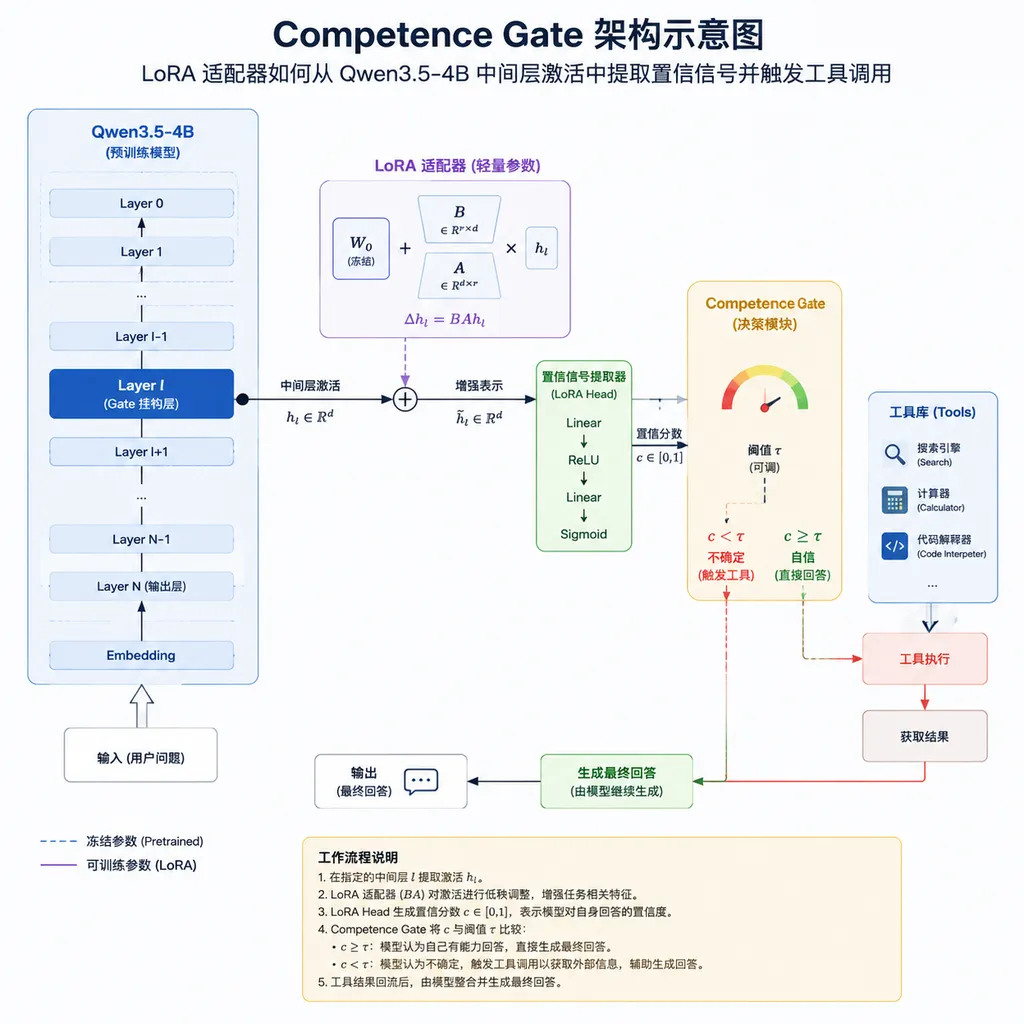
Competence Gate takes a different route: instead of asking the model to say how sure it is, it directly reads confidence signals from its internal activations.
The Root Problem: Verbalised Confidence Is a Mirage
The author notes he systematically tested seven 3 B–9 B models and found they all hit the same “confidence ceiling”—verbalised self‑assessment is nearly unusable. Small RLHF‑tuned models tend to appear equally confident about every question. That’s not a capability issue but a behavioral artifact shaped by alignment objectives.
Interestingly, though, the information does exist inside the model. Several mechanistic‑interpretability studies (including Anthropic’s early “model knows what it knows” work) show there are linear directions in intermediate activations that differentiate real knowledge from fabrication. The alignment fine‑tuning at the top layers simply “washes out” these signals before token output.
Competence Gate’s trick is: read the signal before it’s washed away. The LoRA adapter acts as a probe, predicting a scalar from internal activations—essentially, “Can you answer this yourself?”. The orchestration layer then chooses one of three paths:
- Direct answer: high confidence, use internal knowledge
- Online search: low confidence but external‑world question (timeliness, fact‑checking)
- Local‑document RAG: low confidence and question about user corpus
- Refusal: if unverifiable, explicitly reply “don’t know”
That last case is actually the most valuable. Eighty percent of small‑Agent failures aren’t about missing tool calls—they’re about calling when they shouldn’t, or failing to call when they should.
Numbers: d′ 0.46, 87 % Hit Rate
The key metric reported: an improvement of d′ = 0.46 (95 % CI [0.01, 0.89]). d′ in signal‑detection theory measures discriminability—in plain terms: Competence Gate distinguishes “should call tools” vs. “shouldn’t” more effectively than Qwen3.5‑4B’s native logic.
More directly, in samples where Gate wanted a tool call but the base model didn’t, 87 % were cases where the base model would answer incorrectly. So Gate isn’t catching false positives; it’s patching real holes.
The CI lower bound nearly touching zero shows limited sample size—robustness needs more validation. Still, the direction is right, and at small‑model scale any improvement beyond base tool‑calling deserves attention—after all, 4 B models’ Agent‑ability ceiling is generally considered fixed.
Why Qwen3.5‑4B?
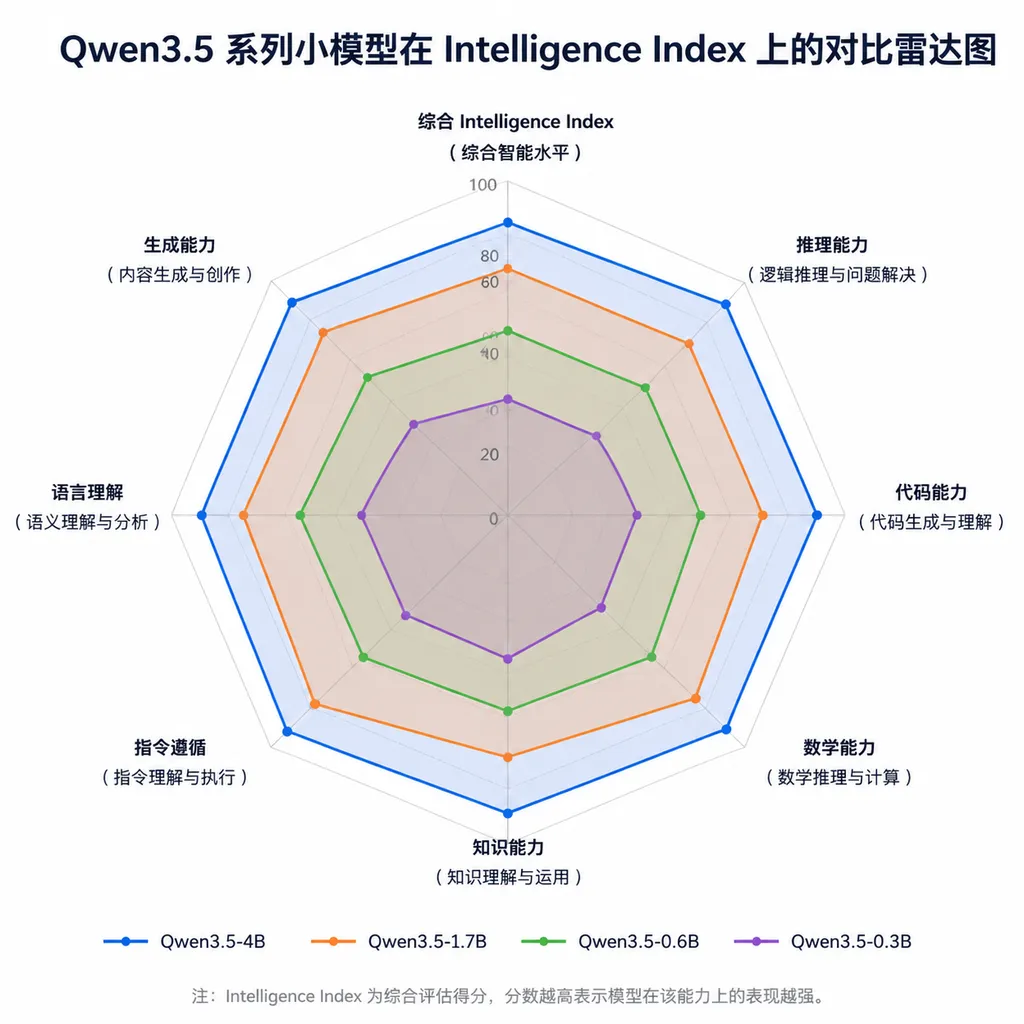
Some background: The small‑size Qwen3.5 series was open‑sourced in early March this year, including four dense models—0.8 B / 2 B / 4 B / 9 B. According to Artificial Analysis, Qwen3.5‑4B‑Reasoning scored 27 on the Intelligence Index, nine points higher than Qwen3‑4B‑2507’s 18—best among models of similar parameter counts, outperforming several older 7 B–8 B ones.
Architecturally, Qwen3.5‑4B is distinctive:
- 4 B parameters, hidden‑dimension 2560
- 32 layers, using 8 × (3 × gated DeltaNet + FFN → 1 × gated attention + FFN) hybrid blocks
- Token embedding padded to 248 320
- Natively multimodal training
The mixed gated‑DeltaNet + gated‑attention structure leaves a “clean” representational space in middle layers—ideal for probing. So the selection wasn’t random.
It’s fully open‑source, 10 MB LoRA, supports Apple Silicon (MLX) and llama.cpp/Ollama GGUF builds. It runs easily on an M2 Max MacBook—no pressure for edge deployment.
A Privacy Side Effect: Queries That Shouldn’t Be Sent, Aren’t
Another benefit mentioned: “less likely to leak your private query.” The idea—Gate evaluates first whether it can answer locally; if yes, it skips external search/RAG, reducing chances of sensitive queries hitting third‑party APIs.
That’s critical for local Agents. Many questions asked in Cursor or local QA systems shouldn’t go to Google/Bing. The common fix is a separate classifier to decide “need internet?”, but that’s yet another small model to train and maintain. Competence Gate fuses “classification” and “generation” signals within the same model—cleaner engineering‑wise.
A New Agent Paradigm?
Let’s not overhype it. Competence Gate is essentially a probe + threshold, not revolutionary architecture. Similar ideas have circulated in academia—several papers on internal‑confidence probing appeared last year; Anthropic has long pursued related interpretability work. The project’s main contribution is engineering: compressing research ideas into a 10 MB LoRA you can attach to any open model and run directly.
From a product view, though, it’s likely an important patch on the small‑model Agent path. Over the past year, tool‑use efforts for small models have followed two lines:
- Distillation route: use GPT‑4 / Claude to generate massive tool‑call traces, then SFT onto small models
- RL route: reinforce on verifiable tasks so small models learn when to call tools
Both advance, but both hit a core issue: small models lack awareness of their capability boundaries. However well trained, they’ll still confidently hallucinate on OOD data. Competence Gate is like installing a hardware‑level sensor for that boundary at inference time.
Practically for developers: you can add confidence awareness to any small model without retraining the base model. A 10 MB adapter, negligible inference overhead on edge devices.
Possible Deployment Scenarios
The most direct use cases include:
- Local RAG assistant: mix of common‑sense (model answers), local‑document, and online queries. Gate routes them directly.
- Mobile Agent: on‑device Qwen3.5‑4B or 2 B; Gate decides whether to fallback to cloud API.
- Enterprise knowledge assistant: prevent sensitive employee queries from external search; Gate defers low‑confidence cases to internal KB.
- Educational apps: when unsure, the model clearly says “I’m not certain,”—better than fabricating errors.
OpenAI Hub already supports the entire Qwen3.5 series, including 4 B; you can readily compare routing of “local 4 B with Gate” vs. “cloud large model” using one API key—no need for multiple registrations.
Unresolved Issues
Some caveats before declaring it production‑ready:
- CI lower bound near zero—d′ + 0.46 with CI [0.01, 0.89] means heavy sampling noise; needs larger‑scale testing.
- Threshold tuning—how to set the Gate threshold? Too aggressive triggers extra calls and latency; too conservative reverts to base behavior.
- Cross‑domain generalization—on what distribution was the probe trained? Does it hold in other domains? A classic problem for probing methods.
- Adversarial robustness—could a crafted prompt fool the Gate into thinking the model’s confident when it’s not?
All fixable directions nonetheless. For a personal project, achieving open weights + full engineering stack + reproducible experiments is already solid.
The next breakthrough for small models may not be shrinking parameters another 20 %, but teaching them to truly “admit what they don’t know.” Competence Gate provides a promising blueprint for that.
References
- Competence Gate on Reddit r/MachineLearning — original project post with d′ data & implementation details
- Qwen3.5‑4B on Hugging Face / ModelScope ecosystem — Qwen3.5 series open‑source weights & architecture notes
- Qwen3.5 small‑model benchmarking on Zhihu — community tests across 0.8 B to 9 B series


