
Meta shuts down the public beta of the Llama API, handing off hosting business to third parties.
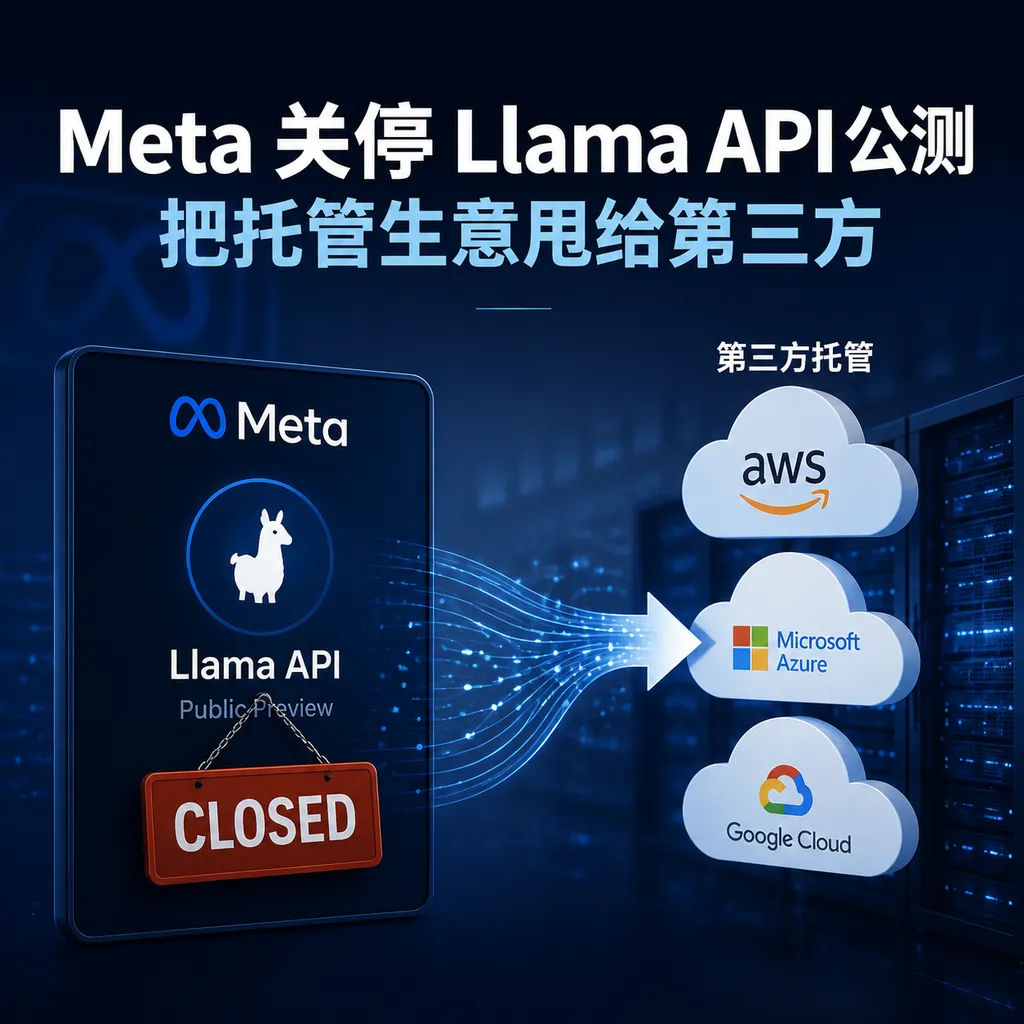
Meta announced that on July 6 it will officially shut down the Llama API public preview version, which has been running for over a year. The model itself will not be affected, but the official hosting service will come to an abrupt end, and developers are being directed to migrate to third-party model service providers.
Meta Shuts Down Llama API Public Preview, Hands Hosting Business to Third Parties
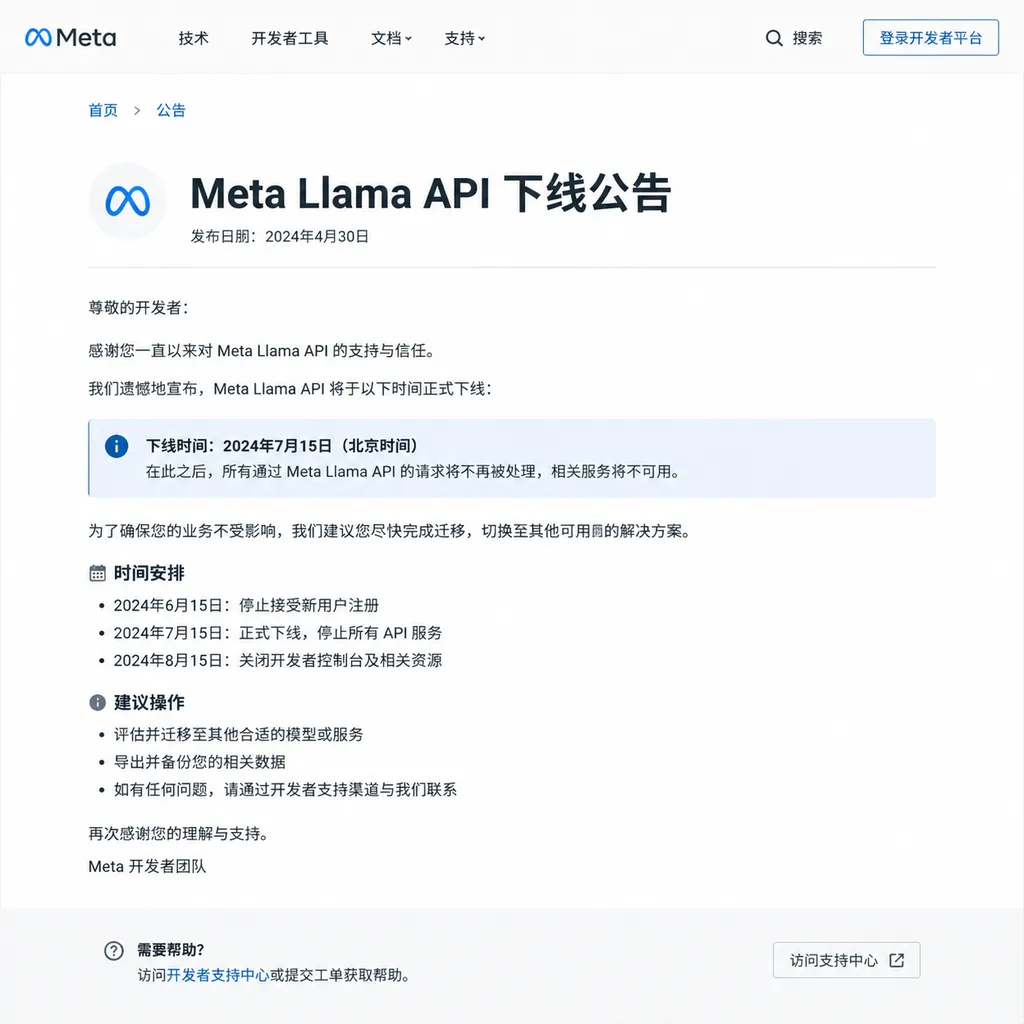
Last night, Meta announced something that caught many developers off guard: The Llama API public preview will officially go offline on July 6, 2026 — that is, tomorrow. At that time, all requests sent to the endpoint will return a deactivation notice and redirection instructions. The company has no plans to release a GA version at all.
Doing the math — from the bold announcement at LlamaCon on April 30, 2025, to today’s official shutdown — the service’s entire lifecycle lasted just over 14 months, and it never escaped the “Public Preview” stage. For a trillion-dollar company, that’s a rather abrupt ending.
What Happened
The announcement itself was carefully worded, with three key points:
- Starting July 6, the Llama API service will be fully closed, with requests returning deactivation notices;
- The Llama models themselves are unaffected, and weights will remain downloadable from llama.com and Hugging Face;
- Existing users are advised to migrate to third-party providers that support Llama models, such as Together, Fireworks, Groq, and Replicate.
Meta also left a semi-open teaser: “We plan to provide new ways for developers to build with Meta AI models in the future. Stay tuned for more details.” In plain language: the official hosting route is closed for now—but it may return in another form.
Combined with last month’s rumor that “Meta is building a cloud services unit to sell idle AI compute and models,” this “new way” probably isn’t just an API revival; rather, it’s being folded into a larger cloud service portfolio with a new product definition.
Why Now
This move makes sense only in the context of Meta’s overall rhythm this year.
1. Llama API itself lacked differentiation
Llama is open source—any inference platform can host it. Together and Fireworks have optimized engineering to push inference costs for Llama 3 and 4 extremely low; Groq uses its self-developed LPU to achieve millisecond-level first-token latency; SambaNova and Cerebras each have hardware advantages. Meta’s own API offers no moat in inference speed or pricing, while still having to maintain customer support, SLAs, and billing systems.
Even more awkwardly, the official Meta API has always lagged behind third parties in functionality—features like function calling, structured output, and batch inference (critical to enterprise clients) were long filled in by Together and Fireworks, while Meta’s version remained stuck in “preview.”
2. Internal strategic focus shifted
This June, Alexandr Wang revealed progress on the next flagship model, “Watermelon,” saying its benchmarks have caught up to GPT-5.5. That sends a clear signal: Meta’s internal AI resources are concentrating on frontier models, and the Llama series may be repositioned.
With the cloud-services rumors added in, Meta clearly wants something more akin to Amazon Bedrock or Google Vertex AI—a broader platform, not just an OpenAI-style façade for Llama. As such, the existing Llama API was always a transitional product; better to close it and rebuild properly.
3. Redefining the boundary between open source and commercial activity
Over the past year, Meta has been gradually fine-tuning its stance on the Llama license, especially around restrictions for very large-scale commercial users. Running both open-source distribution and a paid API creates an inherent business contradiction—how do you explain to paying customers that “what you bought, I’m giving away for free”? Shutting down the API and handing hosting to third parties actually lets Meta stand more cleanly as a “model provider.”
What This Means for Developers
If your project still uses api.llama.com, your to-do list over the next two days is pretty clear.
Step 1: Audit dependencies. Check how many places you’ve hard-coded Meta’s official endpoint, and whether you used the OpenAI-compatible format. Llama API used that same protocol, which is a good thing—it means migration mainly involves changing the base_url and API key, not rewriting business logic.
Step 2: Choose a new home. The main options fall into three buckets:
- Specialized inference platforms: Together AI, Fireworks AI, Groq, DeepInfra—transparent pricing, fast performance, full support for Llama 3.x / 4.x series;
- Cloud-provider hosting: AWS Bedrock, Azure AI Foundry, Google Vertex AI—suited to enterprise clients already using a particular cloud, with stronger compliance and SLAs;
- Aggregator-style platforms: Services like OpenRouter or OpenAI Hub that use one key to connect to multiple model sources—ideal for teams switching between GPT, Claude, Gemini, DeepSeek, and Llama. OpenAI Hub supports domestic direct access and OpenAI-compatible formats, making it an easy migration option for developers in mainland China without opening separate enterprise accounts.
Step 3: Verify behavioral consistency. Different hosts may deploy Llama with slightly different configurations—sampling parameter defaults, system prompt handling, tokenizer edge cases. Run your regression tests; they’ll be more reliable than benchmark numbers.
Step 4: Strengthen the SDK abstraction layer. This moment serves as a warning: hide your model provider behind an adapter and keep base_url out of the business logic. Next time Meta’s “new path” appears—or you switch hosts again—it’ll be just one line in a config file.
A Deeper Question
Meta’s withdrawal, in fact, highlights a pattern in open-source model commercialization: once a model’s weights are open, the most profitable players often aren’t the model authors—they’re the intermediaries who push inference performance to the limit.
OpenAI and Anthropic make money because their models are closed source—others can’t replicate them. Once Llama was open, Meta lost its API moat. It’s the same logic that made Red Hat profitable while Linux itself wasn’t—the distribution and services can earn revenue, but the kernel can’t.
So what’s Meta’s next “new path”? Most likely two directions:
- Upgrade Llama API into a multi-model cloud service, selling idle compute externally, benchmarking against Bedrock;
- Tie into the Meta AI assistant ecosystem, connecting via WhatsApp and Instagram Agents to enterprise users, with the API as just one touchpoint.
Either way, both have far more narrative potential than today’s lukewarm public preview.
Timeline
For teams still using Llama API, here are the critical deadlines:
- July 6 (tomorrow): Full service shutdown; requests return deactivation notices;
- Transition period: The official notice doesn’t specify how long responses will persist—best to assume “instant cutoff” and avoid waiting for redirection;
- Data handling: If you did fine-tuning or file uploads on Llama API, the announcement didn’t clarify data retention policies; back up any important assets today.
Conclusion
After more than a year of public preview, ending with “please migrate to third parties,” Meta’s Llama API completes its not-so-glorious journey. Yet this might not be a bad thing—Meta was never focused on the API business. Open-sourcing models, reserving compute for internal use, and rebuilding cloud services: that may be the real play.
For developers, short-term pain brings longer-term clarity: leave hosting to the professionals; use the models you trust.
References
- ITHome: Meta to Shut Down Llama API Public Preview Tomorrow — Original announcement and migration recommendations


