
LeRobot v0.6.0 Is Here: Let Robots Think Before They Act

Hugging Face released LeRobot v0.6.0, with the core idea of embedding the “imagine-evaluate-improve” loop into the open-source robotics stack. Policy evaluation, world models, and data pipelines have all been comprehensively upgraded, and open-source robot learning is starting to take on an industrial flavor.
Hugging Face released LeRobot v0.6.0 in early July, codenamed Imagine, Evaluate, Improve. This is not a routine version bump with a minor upgrade. From the dataset refactor in v0.4, to the introduction of Pi0-FAST and Unitree G1 support in v0.5, and now directly elevating “policy evaluation” and “data flywheel” to first-class citizens in the framework, the LeRobot team is trying to solve a long-standing problem the open-source robotics community has never been able to avoid: how do you know whether a trained policy actually works, and how do you improve it?
LLMs solved this problem long ago with a mature toolkit—benchmarks, eval harnesses, RLHF data feedback loops. Robotics, meanwhile, has remained largely trial and error. You train an ACT or Diffusion Policy, get a few successful runs and a few failures, with sample sizes so small they resemble coin tosses, and everything collapses as soon as the environment changes. What v0.6.0 aims to do is bring this industrialized evaluation-and-feedback workflow into embodied intelligence.
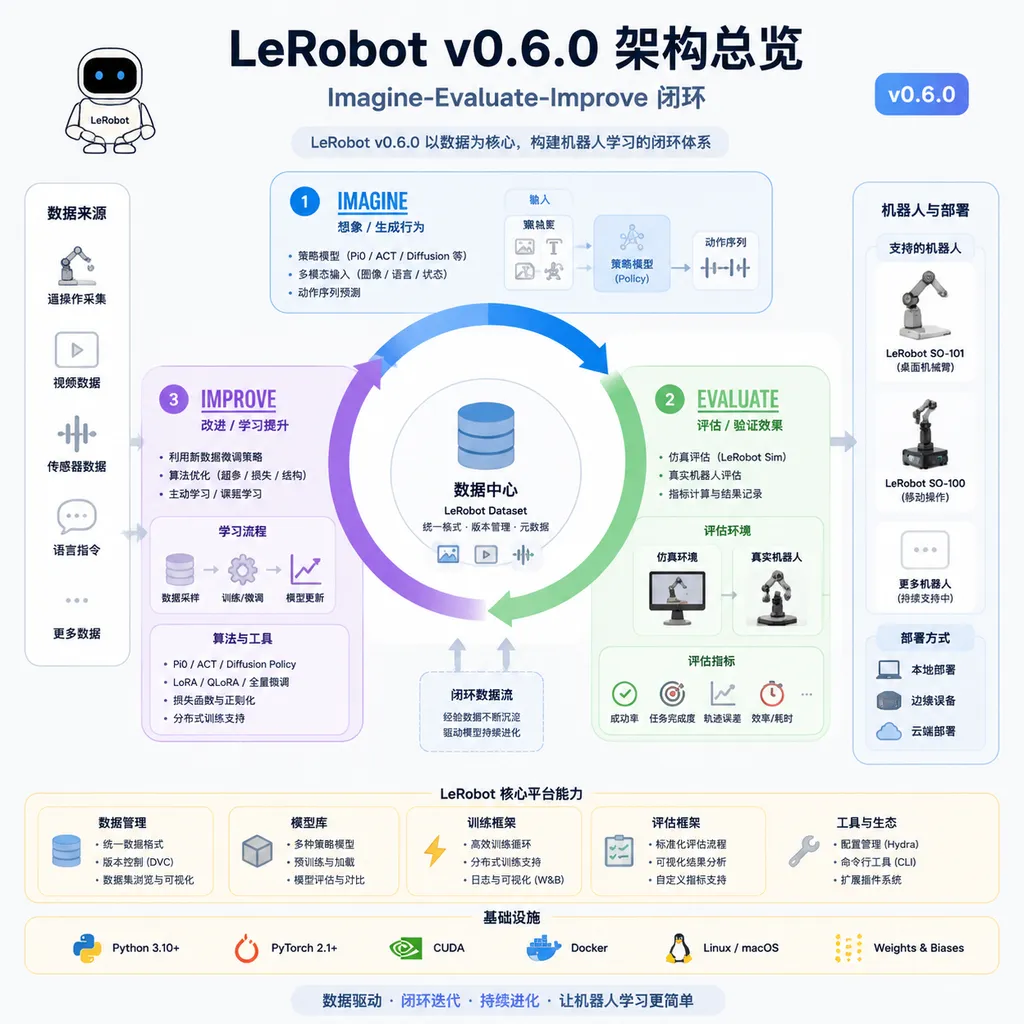
From “Can Run” to “Can Evaluate”: Policy Evaluation Becomes Core
The most noticeable change in v0.6.0 is the addition of a full-fledged Policy Evaluation module. Previously, evaluating a policy basically meant choosing between two approaches: either running hundreds of simulations to compute a success rate, or manually counting outcomes on real hardware. The former suffered from a massive sim2real gap, while the latter was slow and expensive.
This release introduces several key components:
- Standardized evaluation protocols: Unified evaluation interfaces for mainstream policies (ACT, Diffusion Policy, Pi0, Pi0-FAST, SmolVLA), expanding metrics beyond simple success rates to include trajectory similarity, task completion quality, recovery capability, and more
- Batch parallel evaluation: Using vectorized environments to run N rollouts simultaneously, tightening confidence intervals
- Failure mode clustering: Automatically grouping failed episodes by behavioral characteristics to help identify whether the issue stems from grasping, perception, or long-horizon planning
These additions may look straightforward, but they are significant for the community. Previously, if you uploaded a policy checkpoint to the Hugging Face Hub, nobody downloading it really knew whether it was any good. With standardized evaluation reports, pretrained models finally become comparable.
World Models Enter the Scene: Imagine Before Executing
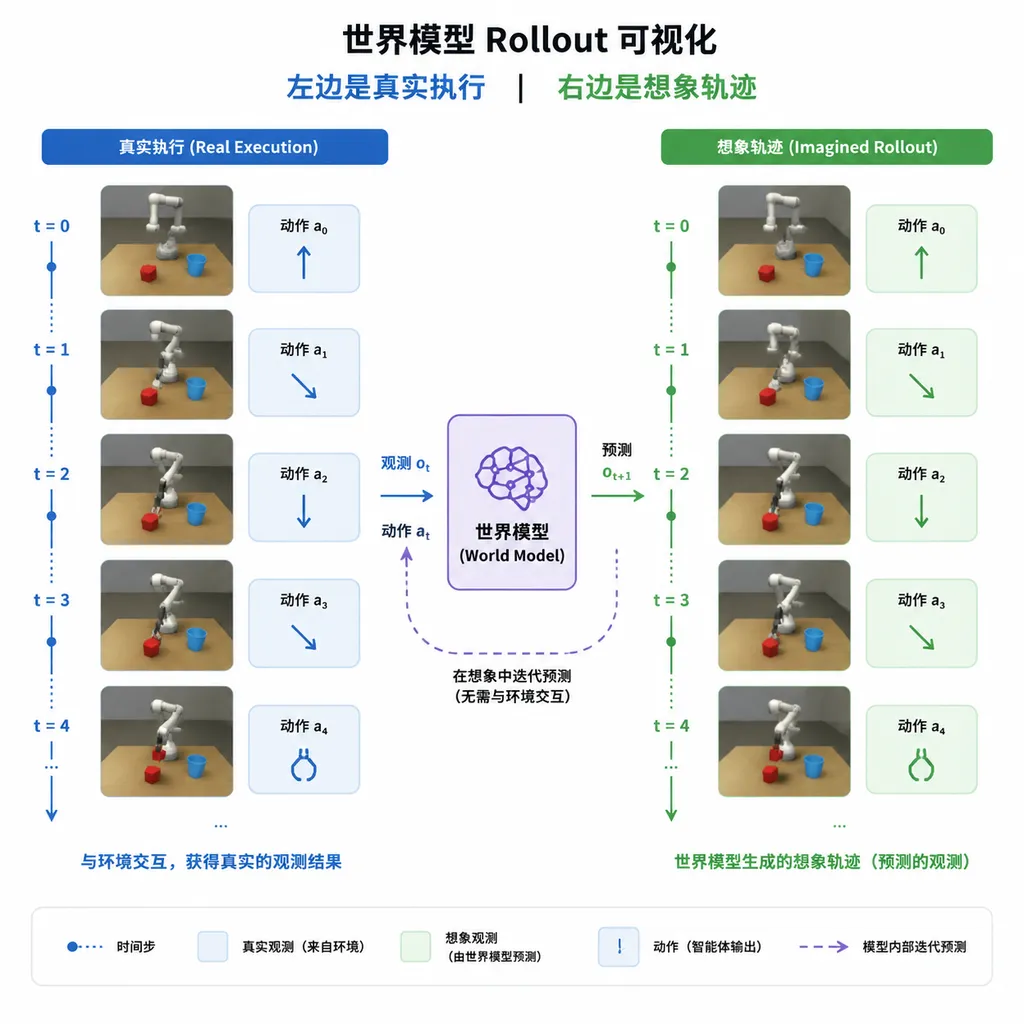
The word “Imagine” in the release title is not just rhetoric. v0.6.0 introduces world model integration, allowing policies to perform rollouts inside a learned world model before deployment to see what might happen.
This idea follows the same line of thinking as the Dreamer family and NVIDIA’s recent Cosmos effort—performing latent-space “rehearsals” before real-world execution, using predicted future states for action filtering or planning. LeRobot’s implementation is somewhat more engineering-oriented:
- Provides world model training scripts that directly consume LeRobotDataset-formatted data
- Supports attaching a world model behind any policy for rollout validation
- Offers imagination-based evaluation as a low-cost proxy for real-world evaluation
My assessment is that this feature is still more research-oriented in the short term. The fidelity of the world model itself has a huge impact on downstream planning, and in manipulation tasks—especially those involving contact dynamics—learned world models often diverge after only a few steps. But the direction is correct: real-world trial and error is too expensive, and the community needs an inexpensive “imagination layer” for preliminary filtering.
Data Flywheel: Connecting the Pipeline from Collection to Retraining
The third major upgrade is the Data Flywheel. Developers should already be familiar with this concept—the shadow mode + trigger + relabeling + retraining workflow from Tesla Autopilot has long been admired in robotics, but nobody had truly open-sourced it.
v0.6.0 introduces several concrete features in this area:
LeRobotDataset v3 Format Refinements
The dataset format underwent a major overhaul in v0.4; this time the changes are incremental:
- Enhanced episode-level metadata: Each episode can now store evaluation results, failure tags, human feedback, and reward signals alongside raw observations and actions
- Incremental append support: Previously, updating a dataset required repackaging the entire Parquet file; now streaming appends are supported, making online collection-and-training workflows practical
- Heterogeneous multi-robot merging: Data from different embodiments can coexist within the same dataset under schema distinctions, facilitating cross-morphology transfer
Interactive Data Editing and Filtering
The updated dataset viewer supports annotation, trimming, and relabeling directly in the browser. This sounds simple, but combined with the earlier failure mode clustering, it forms a complete pipeline: run eval → identify failed episodes → manually inspect a few examples → label causes → mix into the next training round.
DAgger-Style Online Data Collection
A new human-in-the-loop data collection mode has been added: the policy runs on real hardware, and whenever the operator sees trouble coming, they can take over instantly. The takeover trajectory is automatically labeled as a “correction” and added to the next fine-tuning round with higher sampling weight. This idea appeared in the Diffusion Policy paper, but LeRobot is the first to integrate it into a ready-to-use framework toolkit.
Smaller but Practical Updates on the Hardware and SDK Side
In addition to the three major themes, v0.6.0 includes a number of smaller but useful improvements:
- Teleoperation latency optimization: Master-slave teleoperation latency is reportedly reduced to under 20ms; SO-100/SO-101 users should notice the difference
- Real-Time Chunking (RTC) stabilization: RTC introduced in v0.5 occasionally stalled during long-horizon tasks; this release rewrites the async pipeline
- New hardware support: Koch Leader v1.1, Piper dual-arm systems, and several mobile bases
- Config system refactor: Migrated from Hydra to a lighter dataclass + CLI combination, resulting in cleaner startup scripts
# Example of the new evaluation workflow
lerobot-eval \
  --policy.path=lerobot/pi0_aloha_transfer_cube \
  --env.type=aloha \
  --eval.n_episodes=100 \
  --eval.batch_size=10 \
  --output_dir=./eval_results
How to View This Release
If v0.4 moved LeRobot from “able to run demos” to “capable of research,” and v0.5 connected it to the mainstream VLA ecosystem (the Pi0 family, humanoid robots), then v0.6 fills in the final and most difficult missing piece: the engineering feedback loop.
Compared to others in the same space: Nvidia GR00T is full-stack but closed-source, Physical Intelligence’s Pi0 released weights but not the engineering workflow, and Google’s RT-X series focuses more on datasets than tooling. LeRobot now occupies a position somewhat similar to the early Transformers library—not chasing the strongest model, but trying to standardize the entire development workflow so anyone can use it.
The real test remains deployment on actual hardware. No matter how elegant the evaluation protocol or how sophisticated the world model, what ultimately matters is whether the community’s pretrained policies can take an SO-100 sitting on your desk and fold a piece of clothing out of the box. v0.6.0 has not yet provided enough evidence on that front, but at least the tooling is now in place.
For developers working on embodied intelligence research or experimenting with open-source robotics, this version is worth upgrading to immediately—especially the evaluation module and DAgger-style data collection. Even if you never touch the world model stack, those two features alone are enough to improve day-to-day workflows.
References
- LeRobot Release 0.6.0 Roadmap - GitHub Issue #3134: Official v0.6.0 roadmap and feature list
- LeRobot Official Documentation - Hugging Face: Complete LeRobot framework documentation, including models, datasets, and tutorials
- LeRobot v0.5.0 Release Analysis - Zhihu: Feature breakdown of the previous v0.5.0 release for comparison reference


