
Anthropic Brought the "Global Workspace" into LLMs

Anthropic’s latest research brings the Global Workspace theory from cognitive science into Claude’s internal architecture, enabling different model modules to share context and reasoning states. This may offer a new path to solving the problem of fragmented long-chain reasoning where different parts “talk past each other.”
Anthropic Has Dug Up Something New Inside Claude Again
In early July, Anthropic released a paper titled “A global workspace in language models.” In plain terms, it says one thing: they found a mechanism inside Claude similar to the human brain’s “global workspace,” and demonstrated that it can be explicitly guided and intervened upon to coordinate information flow between different submodules of the model.
If you’ve followed Anthropic’s interpretability trajectory over the past two years, this paper is actually not surprising. From 2023’s Superposition, to 2024’s Sparse Autoencoder feature extraction work, to this year’s widely discussed “Circuit Tracing,” Anthropic has consistently been moving in one direction—breaking the Transformer apart from a black box into identifiable functional modules. This Global Workspace work can be seen as an attempt to force a classic cognitive science theory into LLMs and test whether it holds.
First, What Is GWT and Why Does It Matter for LLMs?
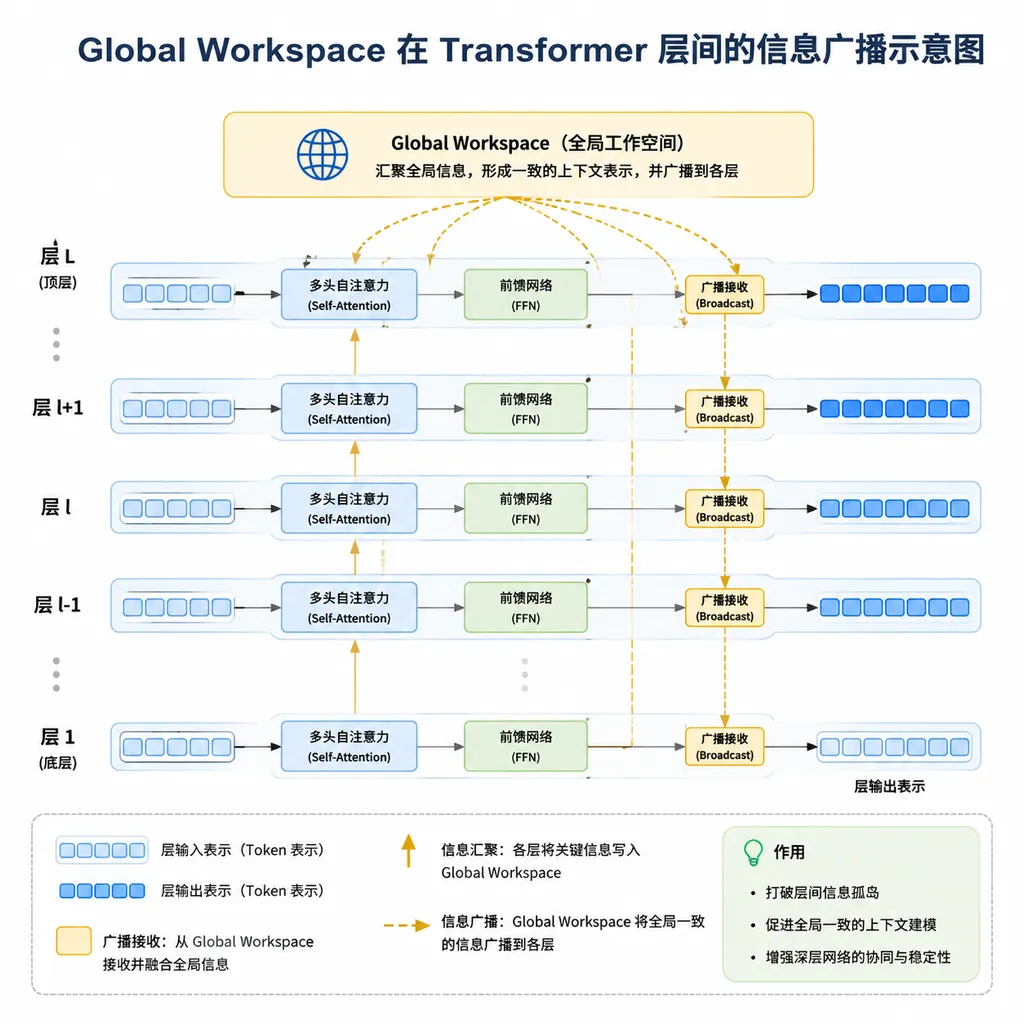
Global Workspace Theory (GWT) is a model of consciousness proposed by psychologist Bernard Baars in the 1980s. The core metaphor is easy to grasp: the brain is like a theater, where countless specialized modules (vision, hearing, memory, language) work independently backstage, but only a small portion of information gets “broadcast” onto the central stage and shared by all modules. That stage is the global workspace, roughly equivalent to what we call “consciousness.”
People in deep learning have been experimenting with this theory for the past decade. Yoshua Bengio’s team, for example, worked on Coordination among Neural Modules, attempting to simulate the broadcasting mechanism through attention bottlenecks. But those were all small models trained from scratch. What Anthropic did this time is different—they searched for similar structures inside an already trained Claude model, and found that they really do exist.
What the Research Actually Did
Here’s a simplified breakdown of the paper’s key steps:
- Locating modules: Using SAEs (Sparse Autoencoders), they extracted highly specialized feature clusters from Claude’s intermediate layers. For example, some feature groups only activate during code processing, others only during multilingual translation, and some are specifically responsible for long-range coreference resolution.
- Identifying bottleneck layers: They discovered that several layers in the middle of the model serve as hubs for information aggregation and redistribution. Low-level specialized features are abstracted there into a kind of “general representation,” which is then reread by functional clusters in later layers. This bottleneck is what they call the workspace.
- Causal intervention: This is the most convincing part. The researchers used activation patching to replace or remove certain broadcast features within the workspace and observed downstream behavioral changes. The result: multiple seemingly independent reasoning chains were disrupted simultaneously. This suggests they were indeed sharing the same “broadcast information,” rather than extracting it independently.
- Cross-task sharing validation: They also conducted an interesting experiment where intermediate reasoning formed in one task (such as the conclusion of a mathematical subproblem) was still read by downstream modules after switching to another task. In the past, we mostly attributed this kind of “context stickiness” to long-context attention, but the paper suggests there may be a more centralized mechanism coordinating things behind the scenes.
Why This Matters
Interpretability papers from Anthropic are often criticized as “interesting but not very useful.” When Circuit Tracing came out, many people reacted with: nice visualization, but then what? This paper is somewhat different because it touches on two of the hardest current problems in LLMs.
The first is consistency in long-chain reasoning. If you ask a model to perform multi-step reasoning across thousands of tokens, it often “forgets” conclusions it just derived earlier, or generates contradictory judgments between subtasks. The industry currently works around this mostly with engineering techniques like CoT, scratchpads, and external memory. But if the workspace hypothesis is correct, the root cause may actually be insufficient bandwidth and fidelity in the model’s internal broadcasting mechanism—which opens a path for direct optimization at the architecture and training level.
The second is collaboration in multi-agent and modular systems. Current agent systems essentially chain together multiple LLM calls, each maintaining its own context. If a natural workspace mechanism already exists within a single model, then “shared blackboard” multi-agent architectures gain a neuroscience-inspired analogy—not every agent needs all information; only the parts “worth broadcasting” need to be shared.
Some Reservations
That said, this also deserves some skepticism.
First, directly mapping a “theory of consciousness” onto LLMs involves a significant degree of metaphor. Anthropic’s paper itself is actually quite restrained, consistently using the term “functional analogue” rather than loudly claiming Claude is conscious. But once the story spread, social media quickly filled with clickbait headlines like “Claude has become conscious.” That’s not a problem with the research itself—it’s just how information propagation works online.
Second, the features extracted by SAEs are themselves a post-hoc interpretability tool. Being able to “see” a workspace does not necessarily mean it is the causal core of the model’s operation—it could also be a byproduct of training that just happens to resemble GWT. The causal intervention experiments are persuasive, but they still need broader replication across larger sample sizes and more diverse tasks.
Finally, this line of research is not especially friendly to the open-source community. Reproducing similar studies requires access to full model activations, the ability to run large-scale SAE training, and substantial compute resources. Anthropic has this infrastructure internally; other teams will not find it easy to catch up. This could gradually turn interpretability into a game dominated by large companies.
What This Means for Developers
In the short term, this paper has no direct impact on how you write prompts or call APIs. Claude works the same way as before; the interfaces and behaviors are unchanged.
But in the medium to long term, several directions are worth watching:
- Reasoning stability may become an explicit optimization target. If Anthropic starts incorporating workspace mechanisms directly into training objectives, the Claude family could pull ahead in long-context consistency. Gemini 2.5 and GPT are also competing in this area, but through different approaches—Google leans more toward architecture (Titans, Infini-attention), while OpenAI leans more toward RL-based post-training. Anthropic’s interpretability-driven route represents a third approach.
- Agent framework design could change. Today’s mainstream multi-agent architectures are largely orchestration-based systems like LangGraph and CrewAI. If the workspace analogy gains wider acceptance, we may see more architectures built around “shared memory + broadcast filtering.”
- This is good news for alignment. You cannot meaningfully align a model without understanding how information flows internally. These workspace localization techniques could directly help monitor whether a model develops “hidden reasoning” during multi-turn conversations—cases where the surface-level response appears normal, but internal activations indicate something else is being planned.
One More Note
This research does not involve a new model release, and Claude’s API usage has not changed in any way. If you’re accessing Claude through OpenAI Hub, everything remains the same—the OpenAI-compatible API format still works, including support for the recently released Claude 4 series as well as mainstream models like GPT, Gemini, and DeepSeek under the same key.
Conclusion
From 2023 to today, Anthropic’s persistence on the interpretability path is beginning to pay off. Earlier results mostly answered the question “what can we see,” while this paper starts addressing “what are these structures doing, and can they be used?” That marks a transition from description to manipulation.
If the workspace hypothesis can be replicated by more teams over the next year and incorporated into training objectives, then we may be witnessing a key turning point—from LLMs powered by sheer scale to “structured intelligence.” Of course, that “if” is still doing a lot of work.


