
Vercel CEO: Agents Are Decoupling from Models, and Production Environments Are Already Dominated by Multi-Model Routing
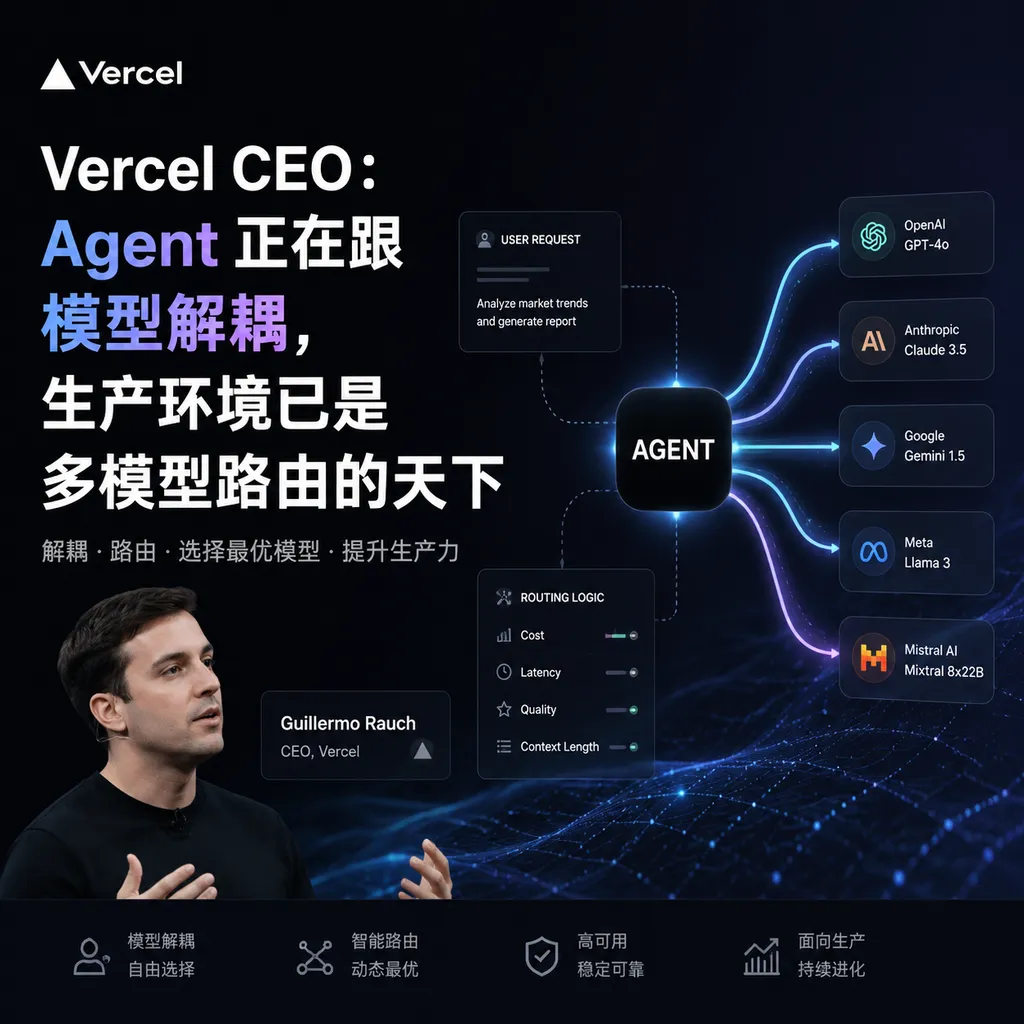
In a recent interview, Guillermo Rauch made a clear assessment: the agent layer and the model layer are rapidly separating, and the era of running a single model in production is over. Vercel’s data shows that high-traffic teams use an average of more than 35 different models in production, and fallbacks rescued 3.5% of requests.
Rauch’s Take: Agents Are No Longer Tied to a Single Model
On July 6, Vercel CEO Guillermo Rauch made a point in an interview with TechCrunch: Agents are decoupling from underlying models, and future production systems will all take the form of “multi-model routing.” His wording was direct: “When you optimize for production, you start caring only about price/performance.”
This is not just rhetoric. Back in 2024, people were still debating “Should we choose GPT-4 or Claude?” By mid-2026, the answer has become: “Use both — and know how to switch between them.” Rauch’s confidence comes from Vercel’s production index report released in May: high-traffic teams are running an average of more than 35 distinct models in production, agentic requests already account for 59% of total token traffic (double from six months ago), and AI Gateway’s fallback mechanism “rescued” roughly 3.5% of requests.
3.5% may not sound like much, but for a product handling tens of millions of daily calls, that means more than 300,000 inference requests that would otherwise have failed were successfully recovered. This is not optional. This is SLA territory.
Why “Decoupling” Is Inevitable
Looking back, early Agents were essentially bound in a “one Agent = one model” relationship. Products from the LangChain and AutoGPT era were fundamentally prompt engineering plus tool-calling glue built around GPT-4’s capability boundaries. Change the model, and all prompts had to be rewritten; even function-calling schemas needed updates.
By 2026, that approach no longer works, for very practical reasons:
- Price gaps have widened dramatically. For the same class of tasks, the per-token cost difference between small Haiku-style models and large Opus-style models can be one or even two orders of magnitude. Using Opus for intent classification is simply burning money.
- Capability specialization is becoming obvious. Claude excels at coding, Gemini at long-context retrieval, DeepSeek and Qwen at Chinese and math, GPT at multimodal tasks. No single model is optimal across every dimension.
- Availability problems are real. Every provider goes down at some point. OpenAI has gone down, Anthropic has gone down, Google has gone down. Production systems cannot entrust their fate to a single endpoint.
- Model iteration is too fast. New versions appear every two or three months. Locking yourself to one model means permanently chasing everyone else.
When Rauch says “price/performance,” what he’s really acknowledging is this: the model layer is rapidly becoming commoditized. The value of an Agent does not lie in the model itself, but in orchestration, scheduling, and graceful degradation when failures occur.
The Product Logic Behind AI Gateway
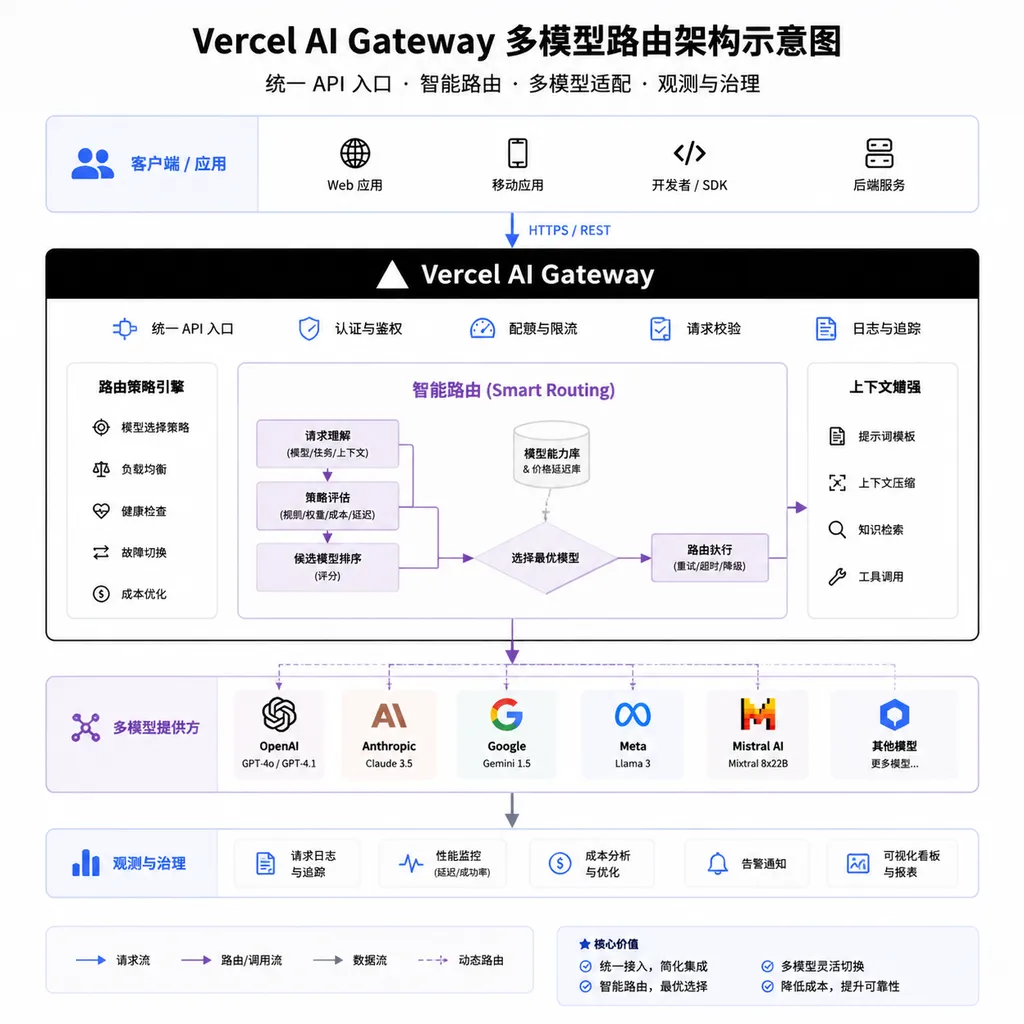
Vercel’s AI Gateway is built around this trend. Several aspects of its design deserve developers’ attention:
Pass-through pricing with no markup. Gateway does not take a cut on token pricing; it passes through upstream list prices directly. This is smart positioning — if Gateway made money through token markups, customers would eventually bypass it and connect directly. Anchoring value in routing logic is the only sustainable strategy.
Routing decisions, not model hosting. Gateway handles fallback, retry, and load balancing; it does not train models itself. This follows the same philosophy as traditional CDNs — “I don’t produce content, I just distribute it.”
A unified API for hundreds of models. Developers write code once, and switching models only requires changing one parameter. Two years ago this was a “nice-to-have”; today it is a “survival line.”
Incidentally, OpenAI Hub (openai-hub.com) is doing something similar — one key for GPT, Claude, Gemini, DeepSeek, all under an OpenAI-compatible format, with direct access from China. For Chinese teams, network-layer stability can matter even more than routing algorithms themselves.
What the Production Index Data Says About Industry Changes
Back to that production index report — several numbers deserve closer examination:
An Average of 35 Distinct Models
At first glance, this number looks shocking. Why would one team need 35 models? Break it down, and it makes sense:
- 3–5 primary models: default choices for different task types
- 5–10 fallback backups: prioritized fallback options when primary models fail
- 10+ specialized models: embeddings, reranking, image, speech, code completion — each with its own endpoint
- 5–10 experimental versions: A/B tests, beta releases, fine-tuned private models
Altogether, 35 is not excessive. This also explains why “manually managing model lists” is no longer viable — the scale has surpassed what an Excel spreadsheet can reasonably maintain.
Agentic Requests Account for 59%
This number is even more explosive than “35 models.” Six months ago the ratio was around 30%; now it’s already over half. This means:
- Sessions are getting longer. Traditional chat is single-turn Q&A; agentic systems execute autonomously across multiple steps.
- The structure of token consumption has changed. Tool-call intermediates, chains of thought, and self-reflection all consume tokens.
- Failure costs are rising. If an Agent crashes at step 8, the money spent on the first 7 steps is wasted. This is why fallback mechanisms have become critical.
A 3.5% Fallback Recovery Rate
Viewed another way, without fallback, your SLA ceiling is 96.5% — disastrous in any B2B scenario.
The Eve Framework: Conventions at the Agent Layer
Besides Gateway, Vercel also open-sourced the Agent framework Eve in mid-June. The idea is clear: “One folder is one Agent.” This is not wordplay — it’s saying that Agents should have explicit conventions, like Next.js’s pages directory, and be able to enter production directly.
Several design choices in Eve genuinely deserve the label “production-grade”:
- Sandbox isolation by default. Commands and code generated by the model are treated as untrusted input. Locally, they run in Docker/microsandbox; when deployed to Vercel, they run in Vercel Sandbox, with no business-logic changes required.
- instructions.md as a contract. By default it contains just one example line, but you can stuff hundreds of lines of behavioral rules into it. This follows the same philosophy as Cursor rules and Claude’s CLAUDE.md — context is code.
- No model binding. Eve itself does not assume any particular model provider. Combined with AI Gateway, multi-model routing becomes natural.
Viewed together, Eve and AI Gateway make Vercel’s strategy very clear: define standards at the Agent layer (framework + conventions), abstract the model layer (gateway + routing), and keep the two decoupled while designed to work together.
Vercel Agent: Agents Also Need “Operations”
Another easy-to-overlook product is Vercel Agent, positioned as “SRE for Agents.” It monitors traffic, traces requests, checks alerts, identifies issues proactively, and even suggests fixes.
The underlying assumption is this: as Agents enter production at scale, operational complexity will grow exponentially. Traditional APM tools are built for humans to inspect, but traces in Agent systems are filled with model outputs, tool calls, and state transitions. Manual debugging simply cannot keep up. So now Agents are needed to manage Agents.
Vercel has moved quickly here, and it fits its longstanding product philosophy — productizing “best practices” instead of leaving users to assemble everything themselves.
How Developers Should Adapt
If you are currently building Agent-related projects, Rauch’s perspective deserves consideration in your technical architecture decisions:
- Do not tightly couple Agent code to a specific model SDK. Use an OpenAI-compatible abstraction layer so you can switch providers anytime.
- Write fallback logic into the main execution path, not exception handling. Primary model 5xx errors, 429s, and timeouts should all have explicit degradation paths.
- Make model selection configurable, ideally layered by task type. Use small models for classification tasks and large models for reasoning tasks — don’t brute-force everything with one model.
- Collect comprehensive observability data. Record for every call: model, latency, token usage, whether fallback occurred, and final output quality. Without data, there is no optimization.
- Do not underestimate the network layer. Especially for Chinese teams, a stable access point matters far more than saving a few percentage points on cost.
One-Sentence Summary
What Rauch describes is not a prediction — it is already happening: the model layer is becoming commoditized, the Agent layer is becoming standardized, and routing is what binds them together. Whoever executes production-grade details best across these three layers will capture the next wave of opportunity.
The era of single-model systems is over.


