
Alipay AI Open Platform Opens Invitation-Only Beta: Integrate Once, Distribute Across Multiple Platforms
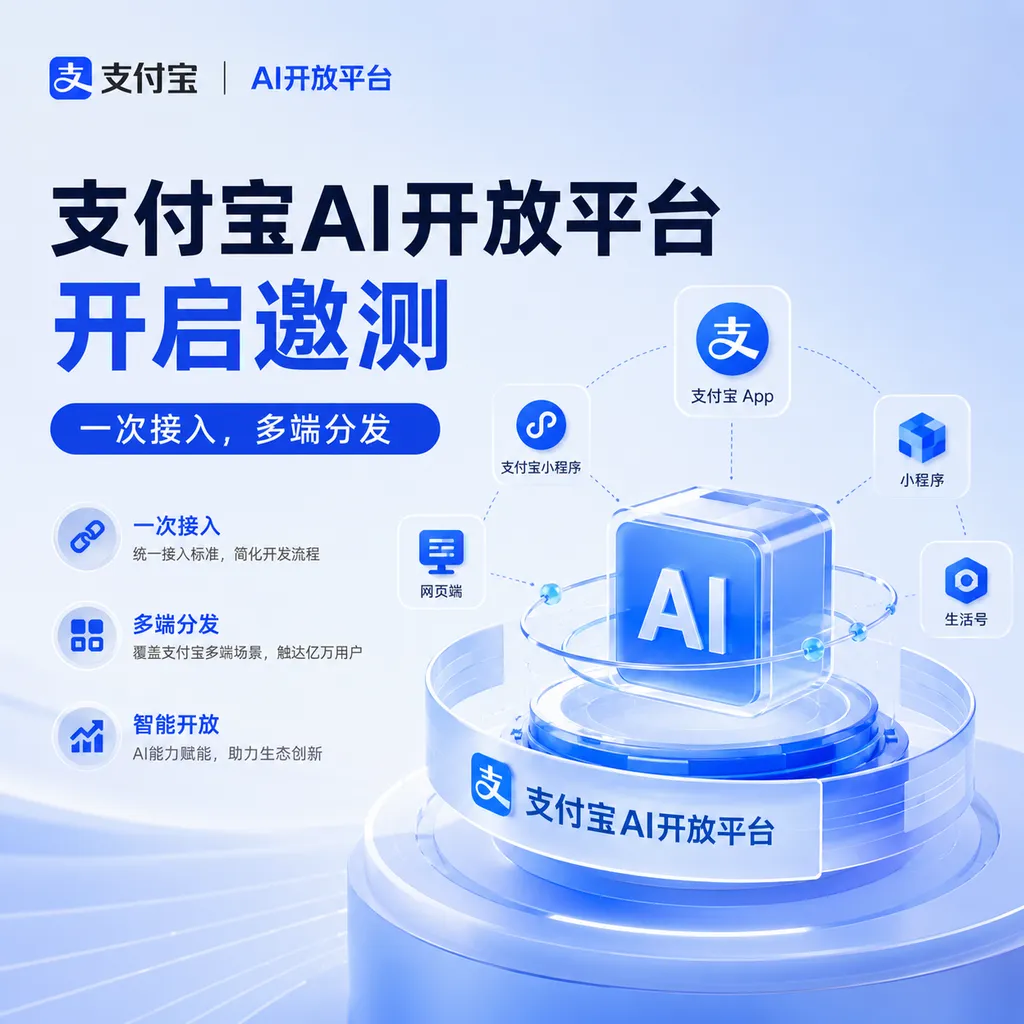
On July 7, Alipay launched its AI open platform and began invitation-based testing. Merchants can use "Abao" to upgrade mini programs and APIs into MCPs, Skills, or Agents, enabling distribution across multiple endpoints such as mobile phones, in-car systems, and AI glasses through a single integration.
Alipay AI Open Platform Opens for Invitation Testing: One Integration, Multi-Endpoint Distribution, as Alipay Pushes "Abao" to the Forefront
On the morning of July 7, Alipay officially unveiled the AI Open Platform it had been holding back for more than half a year, while simultaneously launching invitation-only testing. The platform is open to enterprise developers and development service providers, with access available at open.alipay.com/ai/ai-resource-center/welcome.
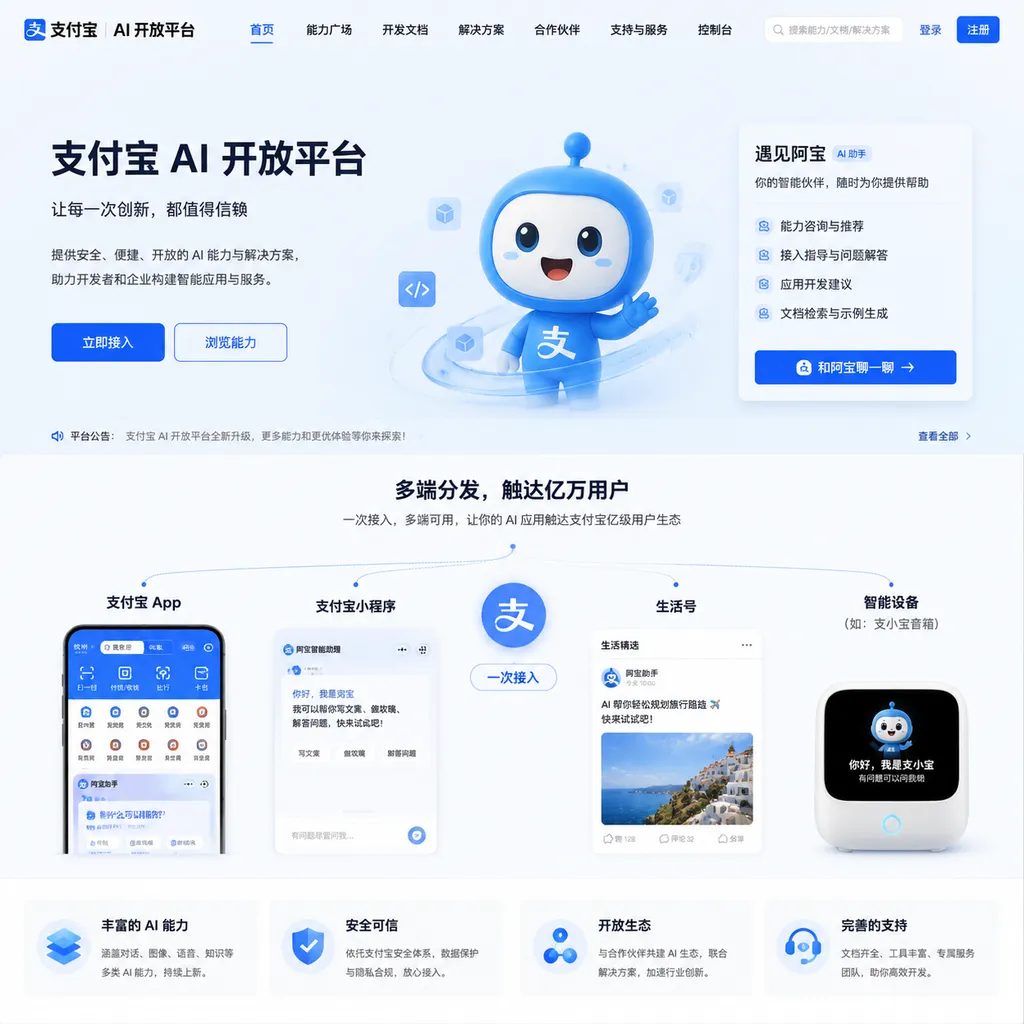
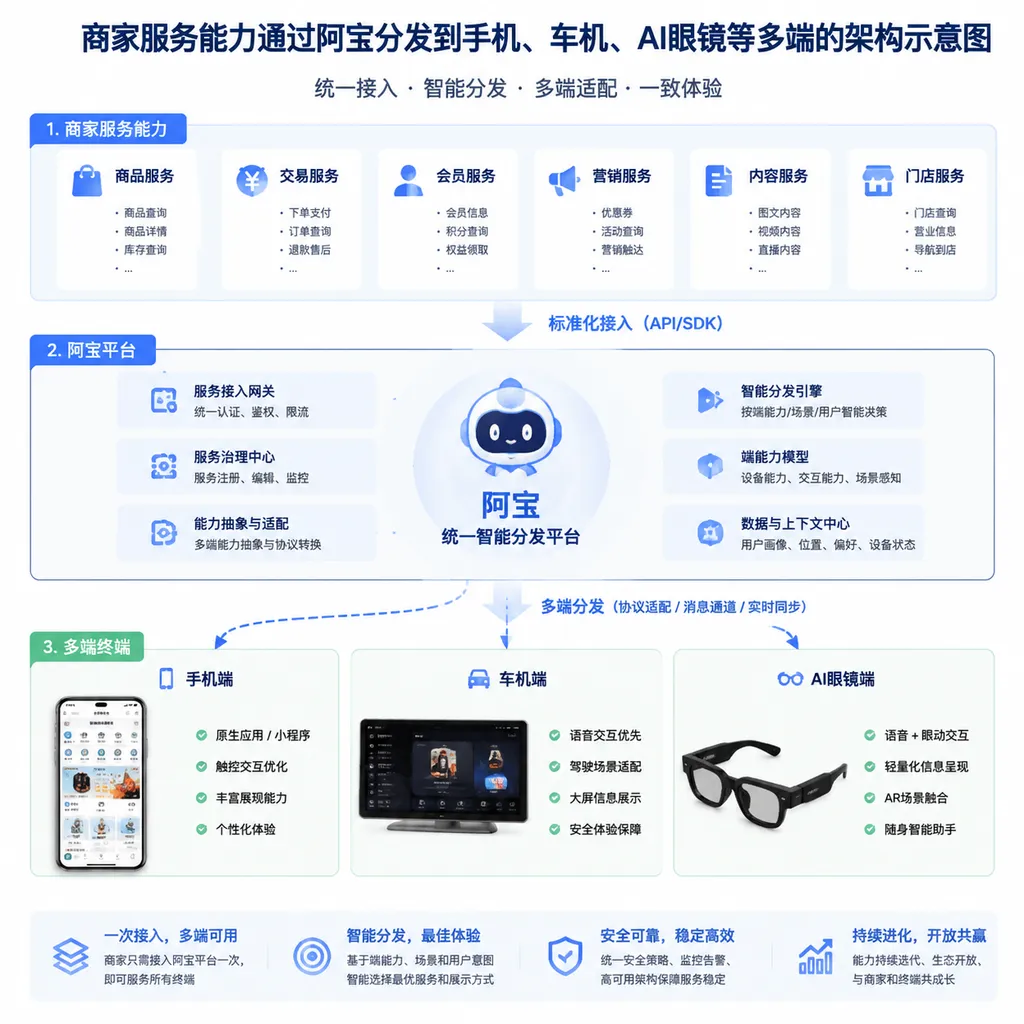
In one sentence, this move can be summarized as follows: Alipay wants to translate the mini program ecosystem it has built over the past decade into a language AI Agents can understand and invoke, then distribute it through an entry point called "Abao" to mobile phones, in-car systems, AI glasses, IoT devices, and even third-party large-model platforms.
Not Just Another Agent Platform — It’s About “AI-Enabling” Mini Programs
Alipay working on Agents is nothing new. At the Bund Summit in September 2024, Ant Group launched an intelligent agent development platform called "Baibaoxiang" (Treasure Box), focused on zero-code setup and creating an Agent in one minute, distributed through the Zhixiaobao app. At the time, the approach was still fairly “traditional” — embedding large-model capabilities into Alipay’s mini program ecosystem.
This time is different. The core proposition of the AI Open Platform is not “help merchants build an AI application,” but rather “help merchants upgrade their existing service capabilities into atomic capabilities schedulable by AI.” The three forms officially introduced are particularly interesting: MCP, Skill, and Agent.
- MCP: Anthropic introduced the Model Context Protocol at the end of last year, and it has now effectively become the de facto interface standard of the Agent era. Alipay maps mini programs and APIs directly into MCP Servers, essentially giving the service capabilities of its hundreds of thousands of merchants a pass that connects to all major large models.
- Skill: This can be understood as a skill package for Abao or third-party agents. Its granularity is coarser than MCP and closer to end-to-end scenario tasks.
- Agent: A complete intelligent agent form that can operate independently, be recommended, and be invoked.
This three-layer structure actually reveals Alipay’s judgment: in the Agent era, there will not be just one business model. Some merchants are willing to build their own Agents, while others simply want to expose interfaces for others to orchestrate. Alipay has decided to support all of them and become the “middle layer.”
“Abao” Is the Entry Point, Not the Destination
Anyone familiar with Alipay may recognize the name Abao. It evolved from the original Zhixiaobao and serves as the AI assistant entry point for Alipay’s one billion users. The integration logic for the AI Open Platform works like this:
- Merchants package their service capabilities into MCPs/Skills/Agents on the open platform;
- They are connected to Abao by default, serving the one billion users within the Alipay app;
- Merchants can then authorize third-party smart terminals and large-model platforms to invoke them.
Pay attention to the third step — this is the part of the release most worth examining. Alipay is not locking itself into a closed garden. It explicitly stated that it will connect to “mobile phones, in-car systems, AI glasses, IoT devices, and large-model platforms.” In practical terms: if you are an AI glasses manufacturer and a user says, “Help me book an in-home repair service,” you do not need to separately negotiate integration with Zhuomuniao Home Repair. You simply invoke the MCP from Alipay’s AI Open Platform.
Zhuomuniao has already joined. According to a Sohu report, it is one of the first batch of merchants on the platform, enabling voice-based repair booking through exactly this chain.
What This Means for Developers
Stripping away the business narrative, from a developer’s perspective the value of this system comes down to four keywords: protocol translation, identity verification, payment settlement, and distribution reach.
Protocol translation is the most tangible cost reduction. Multi-end adaptation today is extremely tedious — mobile voice assistants use one protocol, in-car systems another, and each glasses manufacturer has its own variation. Alipay is willing to become this middle layer: merchants write one MCP, and the platform handles the remaining translation work. The logic is exactly the same as when mini programs solved the problem of “multi-end app distribution.”
Payments and identity verification are Alipay’s traditional strengths, but they gain new significance in Agent scenarios. One unavoidable question in the Agent era is: if AI places an order on your behalf, how is payment deducted, how is identity verified, and what happens if disputes arise? OpenAI has also been pushing the Agentic Commerce Protocol recently, essentially addressing the same problem. Alipay controls China’s most comprehensive payment infrastructure and real-name identity system, which is its strongest advantage in building an AI Open Platform. The official wording around “transaction records and risk control” is not just marketing — it is a hard requirement for automated Agent transactions.
Settlement capabilities are equally critical. The open platform explicitly states that it will “provide foundational support for hosting, distribution, transactions, and settlement of service capabilities.” In other words, the platform tracks how many times your MCP is called by different Agents and how much transaction value each invocation generates, then handles settlement for you. This is the key step in turning APIs into businesses, and it is something many MCP ecosystems have not yet fully figured out.
Distribution reach speaks for itself: one billion DAU users, plus cross-end authorization, gives merchants user coverage that is difficult to match anywhere else in China today.
Several Issues Worth Watching Closely
Anyone who has followed enough AI open platforms knows that while the vision is compelling, reality often introduces several pitfalls.
The first issue is autonomy over authorization. Although the official position is that merchants can independently decide whether to allow third-party terminals to invoke their services, in practice Alipay, as the middle layer, will have enormous bargaining power within the ecosystem. If a third-party large-model platform wants to access a category of services, will it go through Alipay or negotiate integrations directly? This tension will likely persist for a long time.
The second issue is the risk of MCP ecosystem fragmentation. Is Alipay’s MCP truly standard MCP? Do invocation formats, authentication methods, and error codes contain Alipay-specific extensions? If so, then this is not really “one integration for multi-end distribution,” but simply another “Alipay dialect” developers need to adapt to. The documentation has not yet been fully released, so developers participating in invitation testing will need to verify this.
The third issue is its relationship with “Baibaoxiang.” Baibaoxiang, launched in September 2024, was a low-code Agent-building platform. The new AI Open Platform is more focused on opening up foundational capabilities. Alipay needs to clearly define the positioning and boundaries between the two internally, otherwise merchants will become confused — which platform should they actually use?
Some Industry Observations
Looking at the broader picture, the moves made by several major Chinese platforms over the past six months are remarkably similar: WeChat is turning mini programs into MCPs, Douyin is Agent-enabling local services, and now Alipay has joined in. Everyone has realized the same thing — the “service inventory” accumulated during the mobile internet era needs to be repackaged for AI. Whoever builds this layer most effectively will gain an advantage during the next interface transition.
Alipay’s advantage is that it is inherently a “service” aggregation platform rather than a “content” platform. The mini programs running on it are mostly essential services (medical appointments, bill payments, transportation, repairs, government services), and the commercial value of these services being invoked by AI is far greater than content-oriented services. But its weakness is also obvious: on the consumer side, the “Abao” entry point has not yet established strong user mindshare. Competing for conversational entry points against apps like Doubao, Tongyi, and Kimi is unlikely to be easy.
So the real strategic intention behind this AI Open Platform may not lie with Abao at all, but rather with the “authorization to third-party terminals” path. Becoming pure service infrastructure — allowing everyone else’s Agents to invoke Alipay’s services and payment capabilities — is the approach that most resembles Alipay itself.
For developers, if you are building Agents or smart hardware, this platform is worth checking out through the invitation testing program, especially for scenarios involving offline services and payment closed loops. If your needs are simply to invoke large-model APIs for upper-layer applications, then this release may not matter much to you — for that kind of requirement, aggregation platforms like OpenAI Hub that provide unified access to GPT, Claude, Gemini, and DeepSeek with a single key are sufficient. Each has its own role.
References
- Alipay AI Open Platform Launches, Merchants Can Connect to Phones, In-Car Systems, and AI Glasses Through “Abao” - IT Home — IT Home’s detailed report on this release, including the core capability list and platform access links.


