
Xiaomi MiMo-V2.5-ASR Launches: Tackling the Tough Problems at 0.5 RMB/Hour
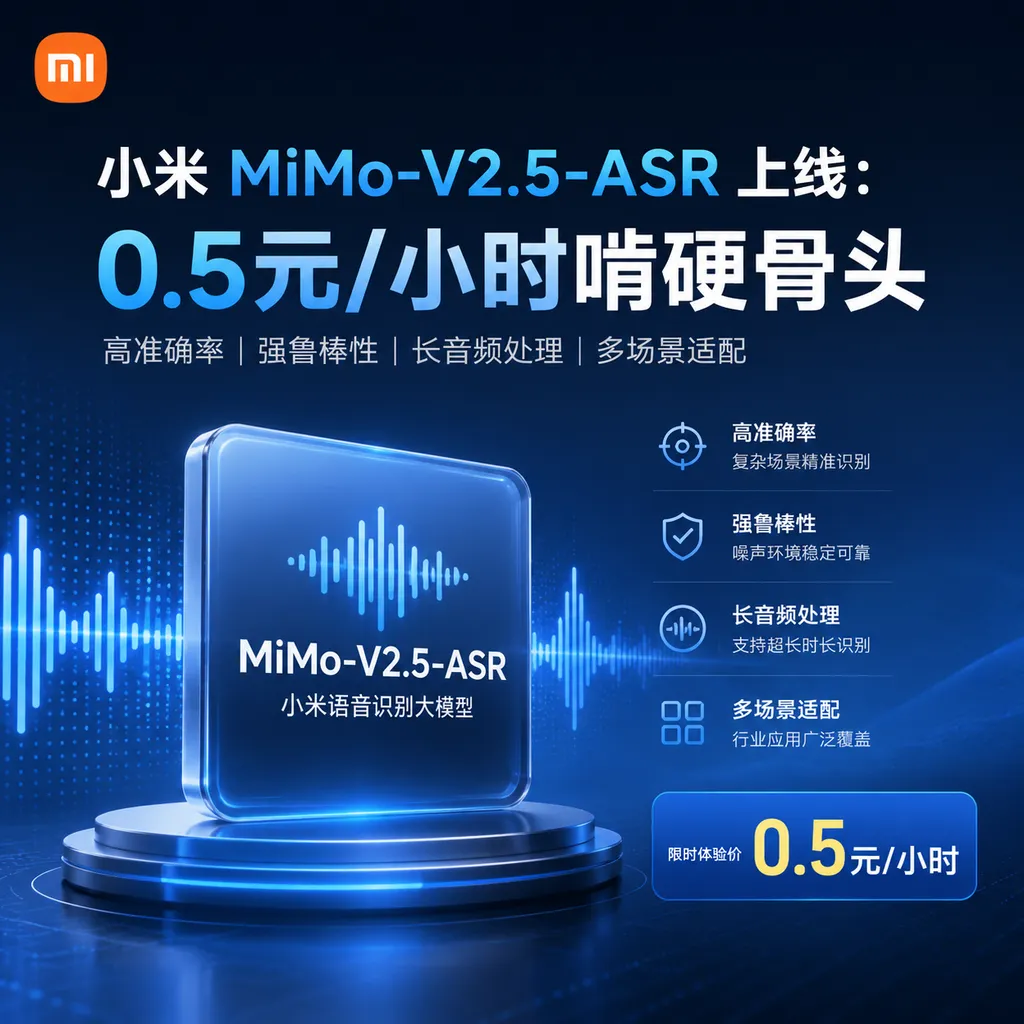
Xiaomi today launched the end-to-end speech and auditory foundation model MiMo-V2.5-ASR, focused on recognition in complex scenarios such as dialects, mixed Chinese-English speech, heavy background noise, and multiple speakers. Pricing is RMB 0.5/hour in China and USD 0.074/hour overseas, and the model weights have been open-sourced.
Xiaomi Has Driven ASR Pricing Down to RMB 0.5 per Hour
On July 7, Xiaomi’s MiMo team quietly launched MiMo-V2.5-ASR on its open platform. Following last month’s limited-time free access for the TTS series, this marks another major step in Xiaomi’s full-stack speech model lineup. The pricing is straightforward and aggressive: RMB 0.5/hour domestically, USD 0.074/hour overseas, billed by audio transcription duration.
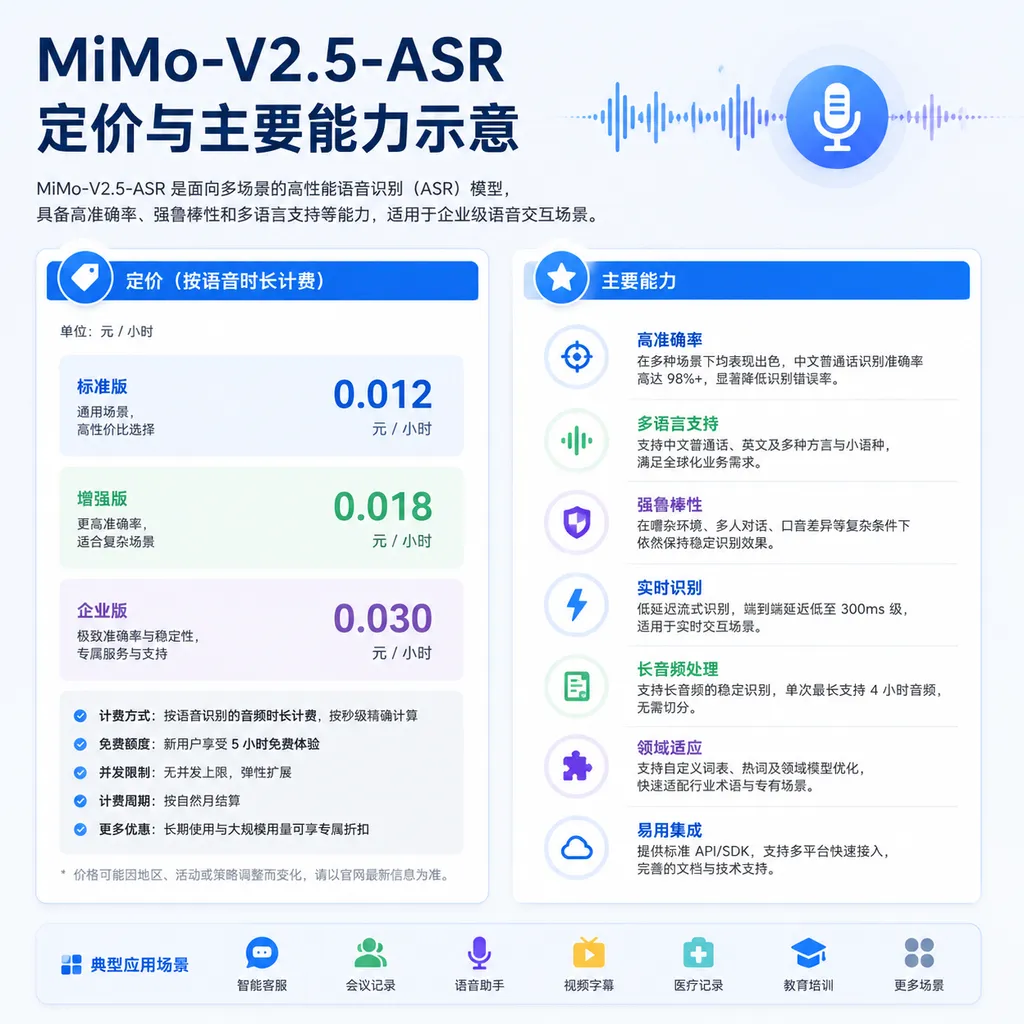
What does this price mean for developers? For comparison, OpenAI Whisper API costs USD 0.006/minute, which comes to USD 0.36/hour. MiMo-V2.5-ASR’s overseas pricing is roughly one-fifth of that. Domestically, compared with Alibaba Tongyi or Tencent Cloud ASR general recognition services (mostly in the RMB 1.5–2.5/hour range), Xiaomi is effectively pricing at about one-third. And this is not a temporary promotion — it’s standard pricing.
More importantly, MiMo-V2.5-ASR has already open-sourced both its model weights and code. In other words, teams willing to run their own GPUs can deploy it directly, while those who prefer simplicity can just use the API — both paths are available. This is still uncommon in China’s ASR space, where most vendors either provide only APIs while tightly guarding their models, or release a crippled “community edition” under open source.
What Can It Actually Understand?
Xiaomi positions this ASR system as the “auditory foundation for full-stack speech models.” The key phrase here is “foundation,” not “just another generic transcription tool.” The official capability list reads almost like a response to the biggest real-world pain points in speech recognition over the past few years:
- Chinese dialects: Native support for Cantonese, Wu Chinese, Minnan, and Sichuan dialects without switching language parameters
- Code-switching: Seamless Chinese-English mixed speech without predefined language tags (a long-standing challenge for traditional ASR)
- Song recognition: Can transcribe Chinese and English lyrics even when vocals and accompaniment are mixed
- Strong noise robustness: Reliable recognition for far-field audio pickup and noisy environments
- Multi-speaker support: Accurate transcription of overlapping conversations
- Knowledge-aware recognition: Precise handling of classical poetry, technical terminology, names, and locations
- Native punctuation: Outputs punctuated text directly using prosody and semantics, eliminating post-processing
At first glance, this looks like a standard ASR feature checklist, but several points deserve closer attention.
Dialects Are Not a Niche Problem — They’re a Real Business Need
Very few vendors actually handle dialects like Cantonese or Wu Chinese well. The reason is simple: training data is difficult to obtain, annotation costs are high, and demand tends to be region-specific. But in enterprise scenarios such as customer service QA, government hotlines, or elderly healthcare conversations, dialect recognition accuracy directly determines whether the system is usable. Xiaomi specifically listing Sichuan dialect suggests a clear focus on these industry customers.
Code-Switching Is an Entry Point for the Agent Era
Mixed Chinese-English speech is extremely common in meetings, technical presentations, and cross-border e-commerce customer service. Traditional solutions either perform language detection first and then switch models, or force everything into one language model — leading to absurd outputs like turning “Today we’ll talk about the attention mechanism in transformers” into something equivalent to “Today we’ll discuss the romance mechanism of teleportation.” MiMo-V2.5-ASR claims it works without predefined language tags. If real-world testing confirms this, it becomes a critical capability for agent applications.
Native Punctuation Sounds Minor — But Matters
Many older ASR systems output long blocks of unpunctuated text, requiring an additional punctuation restoration model afterward. MiMo-V2.5-ASR instead combines prosody and semantics to generate punctuation during decoding itself. That means one fewer processing step and punctuation placement that aligns more naturally with semantic boundaries — making the output ready for LLM ingestion without cleanup.
Positioning: Not Just Another Whisper Alternative
If you only look at the feature list, it’s easy to see this as a “Chinese Whisper alternative.” But judging from MiMo’s official messaging, what it really aims to become is the “auditory entry point” for agent applications.
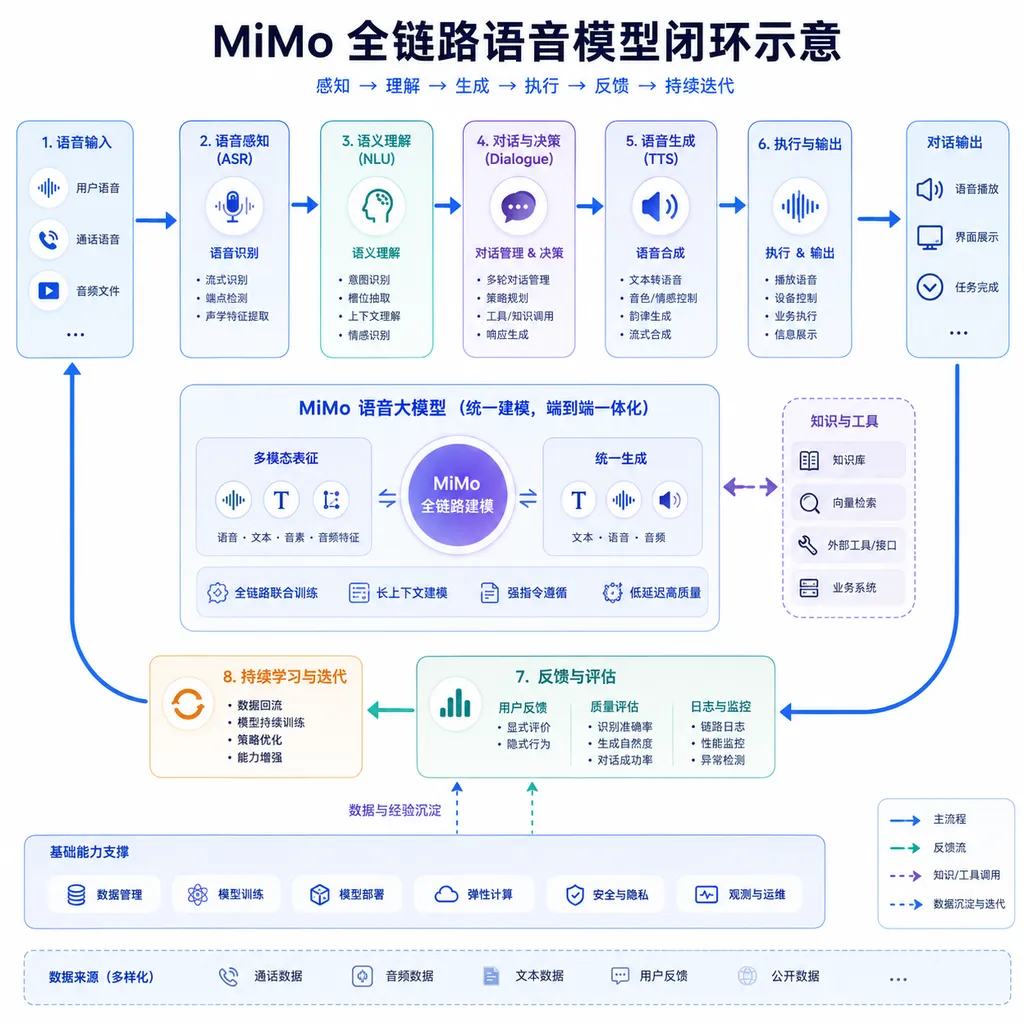
Together with the MiMo-V2.5-TTS series, Xiaomi has now assembled a complete speech loop:
- mimo-v2.5-pro handles planning, task decomposition, and script generation
- mimo-v2.5-tts / voicedesign / voiceclone handle voice and content generation
- mimo-v2.5-asr handles listening back, evaluation, and determining whether expression deviates from the original intent
The intent behind this stack is obvious: enable developers to build agents that can “hear, think, and speak” within a unified model ecosystem instead of stitching together APIs from multiple vendors. In this pipeline, ASR is not just converting audio to text — it also provides feedback signals to higher-level agents about whether “the performance was delivered correctly.” That’s why Xiaomi repeatedly emphasizes the term “auditory foundation”: it aims to become the infrastructure layer for the broader voice-agent ecosystem.
Integration Details: A Familiar chat/completions Interface
The integration experience is highly familiar for developers accustomed to the OpenAI SDK. Audio is passed directly through a chat/completions-style interface:
- Endpoint:
https://api.xiaomimimo.com/v1/chat/completions - Model name:
mimo-v2.5-asr - Audio formats: currently supports only
wavandmp3 - Audio input method: Base64 encoded, either as a data URL or raw Base64 plus a
formatfield - Single audio Base64 size limit: 10MB
For longer audio files (over 10MB), developers must split the audio and merge the results themselves. This is currently one of the more obvious limitations of the integration, and it remains unclear whether Xiaomi will later add long-file uploads or streaming decoding.
Billing is based on audio duration rather than tokens — giving developers predictable costs unaffected by dialect complexity or punctuation density.
Several Questions Worth Asking
The launch generated plenty of attention, but several important questions remain unanswered in the documentation and will require hands-on testing:
- What is the latency like? The official examples are all non-streaming calls. For scenarios like real-time meeting transcription or live subtitles, there’s still no clear data on whether streaming responses are supported or how low latency can go.
- Does multi-speaker support include speaker diarization labels? Xiaomi claims accurate transcription for multi-speaker conversations, but transcription and diarization are different tasks. If it only outputs all speech without identifying speakers, its value for meeting minutes is limited.
- Hotwords and domain customization: For terminology-heavy industries such as healthcare, law, and finance, support for vocabulary uploads or hotwords would significantly affect upper-bound accuracy.
- How does it compare with Whisper Large-v3 and Paraformer? Xiaomi’s blog mentions leading performance on Open ASR Leaderboards for English scenarios like AMI, but does not provide complete benchmark numbers. Third-party evaluations are still needed.
A Small Note
If you are already using OpenAI Hub (openai-hub.com) for unified multi-model access, MiMo’s OpenAI-compatible APIs are also supported — allowing direct model switching with a single key instead of applying for another set of credentials. However, ASR billing based on audio duration differs from chat-model billing structures, so checking the documentation first is recommended.
Summary
MiMo-V2.5-ASR itself does not introduce many surprising capabilities — dialect support, code-switching, noise robustness, and multi-speaker handling are all areas where leading ASR systems have been competing heavily in recent years. But Xiaomi combined three things at once: pricing at the industry floor, open-sourcing model weights, and integrating ASR with TTS + LLM into a complete voice-agent pipeline.
For developers, this means:
- During prototyping, there’s less need to debate “whether to run Whisper locally to save money” — an API priced at RMB 0.5/hour is far cheaper than self-hosted GPUs
- For private deployment, open-source weights are available for direct use
- For agent applications, a complete closed-loop workflow can exist within a single vendor ecosystem
Whether the real-world performance actually lives up to the marketing claims will depend on production testing. Dialects and code-switching will likely become the first true stress tests.
References
- ITHome: Xiaomi MiMo-V2.5-ASR Full-Stack Speech Model Auditory Foundation Launches at RMB 0.5/Hour — Original report containing pricing and capability details


