
OpenAI Pro is here: $100 unlocks unlimited GPT and 10× Codex quota.

OpenAI has introduced a brand-new **Pro** subscription tier between **Plus** and **Team**, priced at **$100 per month**, offering **unlimited GPT model usage**, **access to GPT-5.4-pro**, and **5× Codex credits** — temporarily increased to **10× credits** during the promotional period.
OpenAI has made a major move in its pricing structure.
Just in the past couple of days, ChatGPT’s subscription page quietly added a new tier—Pro, priced at $100/month, sitting between the existing $20 Plus and $200 Team/Enterprise tiers. This isn’t just a price hike or a rebranding; it’s the first time OpenAI has carved out a clear middle layer aimed at heavy users within its consumer product lineup.
What You Actually Get
The core selling points of the Pro tier can be summed up in three lines:
- Unlimited use of GPT series models, including the latest GPT-5.4-pro
- 5× Codex quota compared to Plus
- Unlimited image generation and Deep Research calls
You can tell what this means immediately if you’ve used Plus. Plus users often hit GPT-4o’s rate limits during peak times, and Deep Research has a fixed daily usage cap. Pro removes all these ceilings—at least according to the official description.
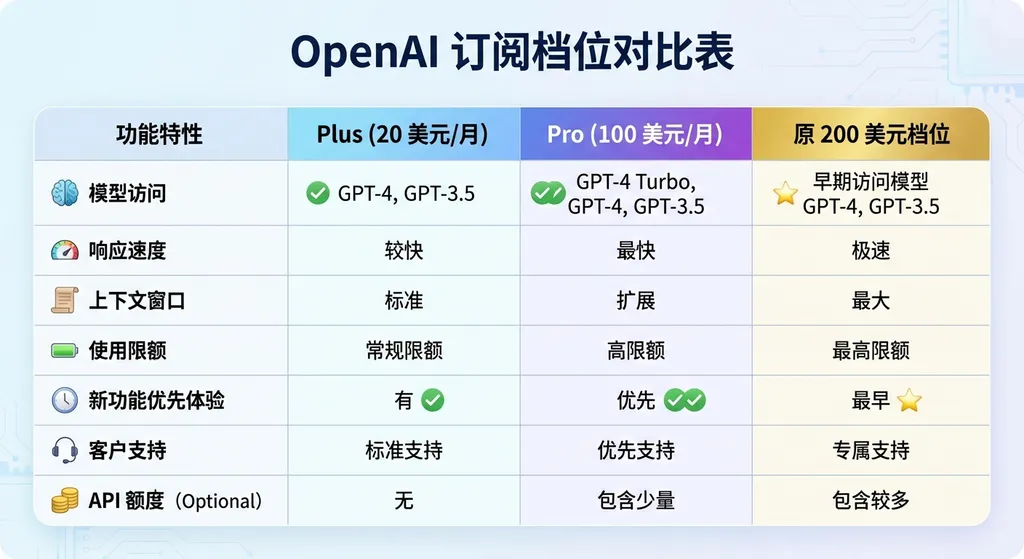
Even more notable is the limited-time promotion: from now until May 31, 2026, Pro users get double the Codex quota—which means 10× Plus’s capacity. The window isn’t long, but it’s more than enough to run a full project cycle.
What Is GPT-5.4-pro
This is currently the most powerful model accessible in OpenAI’s consumer products. Judging from the naming convention, 5.4 is an iteration in the GPT-5 series, and the “-pro” suffix signifies additional optimization in reasoning depth and context handling—similar to how GPT-4-turbo improved on GPT-4, but to a greater extent.
For developers, the practical meaning is this: the strongest reasoning capabilities available in ChatGPT’s web interface no longer require a $200 subscription to unlock. That may feel awkward for existing $200-tier users—OpenAI is effectively bringing premium perks down to a more approachable price range.
However, note that GPT-5.4-pro currently exists within ChatGPT’s product, separate from API-side models. Developers wanting the same features via API still need to check the official model list and pricing on the OpenAI API side.
How Codex Quota Is Calculated
Codex has been one of OpenAI’s most heavily invested directions in recent months. From early cloud-based coding agents, to CLI tools, IDE extensions, Slack integration, and the newly launched Codex SDK, OpenAI clearly envisions Codex as fundamental infrastructure for developers’ workflows.
But Codex has always had a quota problem. Each cloud task execution consumes tokens, and more complex projects—such as running sandbox tests, performing code reviews, or handling multi-file refactoring—burn through quota quickly. Plus users often run out within a couple of days of active usage.
Pro offers 5× the quota, and the promo doubles that to 10×. What does that mean in practice?
For example, if you’re a lead developer in a small or midsized team, using Codex daily for 3–5 code reviews, several rounds of automated testing, and routine technical debt cleanup, Plus’s quota likely won’t last a week. Pro’s 5× quota can comfortably last you a month, and 10× during the promo period essentially turns Codex into an on-call junior developer—no need to micromanage usage.
Of course, “no need to micromanage” doesn’t mean “never worry.” OpenAI’s quota mechanics remain opaque: exactly how much each operation consumes, and how usage scales per model, are vaguely documented. That’s unlikely to improve soon.
Latest Developments in the Codex Ecosystem
Since we’re talking about Codex, it’s worth mentioning its recent rollouts, as these directly affect the real value of a Pro subscription.
OpenAI just announced Codex General Availability (GA), along with three new capabilities.
First, Slack integration. You can @Codex in a Slack channel, and it automatically extracts requirements from context, selects an execution environment, then completes the task in the cloud and returns a link. The actual experience depends on your repo setup and Codex’s grasp of your project structure, but the direction is right—embedding coding agents into team collaboration tools rather than requiring developers to open a separate window.
Second, the Codex SDK, aimed at teams wanting to integrate Codex capabilities into their own tooling. In a few lines of code, you can access agent functionality just like the Codex CLI, with structured outputs and session restoration. Only TypeScript is supported for now, with other languages coming soon.
// Basic example of Codex SDK usage
import { CodexAgent } from '@openai/codex-sdk';

const agent = new CodexAgent({
  apiKey: process.env.OPENAI_API_KEY,
});

const result = await agent.exec({
  prompt: 'Refactor src/utils/parser.ts to replace all synchronous file operations with async versions',
  repo: '/path/to/your/repo',
});

console.log(result.diff);
Third, a new GitHub Action makes it easy to integrate Codex into CI/CD pipelines—for example, automatically triggering Codex for code reviews on each PR, or having it run security checks before merges.
Together with Pro’s 10× quota, these additions form a coherent narrative: OpenAI wants Codex woven into every part of the daily development workflow, and a Pro subscription is the admission ticket.
Is $100 Worth It?
That’s the pressing question.
Let’s look at competitors: Anthropic’s Claude Pro is $20/month, Google’s Gemini Advanced is in the same ballpark. So $100 sits at the top of consumer AI subscriptions.
But direct price comparison misses the point, because the Pro tier’s real value isn’t in chat—it’s in Codex. If you rarely use Codex and mainly chat or write, Plus’s $20 is plenty; Pro’s cost-performance is poor. But for heavy Codex users, the math changes.
Think of it this way: a junior developer’s monthly cost (salary plus overhead) in major cities is roughly ¥20,000–30,000 RMB. The Pro subscription equals about ¥700 RMB. If Codex can replace even 10% of a junior developer’s workload—handling code reviews, technical debt cleanup, and simple feature implementations—the ROI is compelling.
Cisco’s case proves the point: they used Codex for code review and cut review time by 50%. Instacart integrated Codex SDK into internal platforms to automatically clean deprecated code and expired experiments. These are tangible efficiency gains.
Of course, the prerequisite is that your workflow actually benefits from Codex. If your projects are mostly frontend pages, basic CRUD, or small codebases, Codex’s value drops. It shines most with large repositories, multi-developer collaboration, and frequent review/refactoring cycles.
What It Means for API Developers
The Pro subscription belongs to ChatGPT’s product side, but it signals OpenAI’s increasingly aggressive model stratification. With GPT-5.4-pro debuting in consumer tools, it’s likely the API line will soon get a corresponding version.
For developers accessing OpenAI models via API, choices have broadened. You don’t have to stick exclusively to OpenAI’s official API. Platforms like OpenAI Hub aggregate multiple providers—GPT, Claude, Gemini, DeepSeek, etc.—under one OpenAI-compatible interface, with direct connectivity (even from restricted networks) and better cost flexibility.
Example—using GPT for text generation, Claude for long document analysis, and DeepSeek for code tasks—all via an aggregated API key:
import openai

# Unified API call through OpenAI Hub; one key for multiple models
client = openai.OpenAI(
    api_key="your-openai-hub-key",
    base_url="https://api.openai-hub.net/v1"
)

# GPT model
gpt_response = client.chat.completions.create(
    model="gpt-4o",
    messages=[{"role": "user", "content": "Explain Python’s GIL mechanism"}]
)

# Switch to Claude with the same key
claude_response = client.chat.completions.create(
    model="claude-sonnet-4-20250514",
    messages=[{"role": "user", "content": "Analyze the core ideas of this technical document"}]
)

# Then to DeepSeek for a code task
deepseek_response = client.chat.completions.create(
    model="deepseek-coder",
    messages=[{"role": "user", "content": "Optimize this sorting algorithm’s time complexity"}]
)
Such flexibility is invaluable as OpenAI continues to adjust pricing and model policy—you don’t have to keep all your eggs in one basket.
What About the $200 Tier?
An interesting question. The Pro tier at $100 offers nearly all the privileges of the old $200 tier—so what’s left for Team/Enterprise?
The answer: management and compliance. The Enterprise and Business tiers aren’t about model access but about administrative capabilities—editing/deleting Codex environments at workspace level, enforcing security policies, setting managed configuration overrides, monitoring Codex executions, and access to analytics dashboards. These are essential for companies, irrelevant for individuals.
Also, Business and Enterprise have distinct data protection policies—by default, data isn’t used for model training, which is critical for teams handling sensitive code.
So Pro’s position is clear: it targets individual developers and small teams needing top-tier model performance but not enterprise management features. OpenAI has finally acknowledged the huge gap between $20 and $200 tiers.
Logic Behind the Promotion
Limited-time 10× Codex quota, ending May 31. This promotion is smartly designed.
OpenAI needs users to really use Codex. The value of a coding agent only shows up in real projects—and most developers are cautious about new tools. By offering a large quota window for nearly two months, OpenAI encourages deep exploration and habit formation. After the promo ends, even reverting to 5× quota, most users won’t want to downgrade back to Plus.
Classic SaaS growth play—but this level of intensity in AI coding tools is a first.
Additionally, all users’ Codex quotas have been reset in this update. That means even long-time users get their used-up quotas back. This detail shows OpenAI’s commitment—it’s not just selling Pro subscriptions; it’s reinvigorating the entire Codex ecosystem.
A Few Things to Keep in Mind
First, how “unlimited” is unlimited? OpenAI’s history shows that “unlimited” usually carries hidden Fair Use Policies. If you run GPT-5.4-pro 24/7 at high frequency, you’ll likely hit throttling. Keep that in mind before subscribing.
Second, Codex reliability. Official stats claim GPT-5-Codex processed over 40 trillion characters in its first three weeks with 10× daily usage growth, but volume isn’t quality. For complex projects, Codex’s code generation precision, contextual understanding, and edge-case handling still require developer validation. Treat it as a capable junior to review, not a senior engineer you can blindly trust.
Third, pricing stability. OpenAI has changed its subscription and quota schemes multiple times over the past year. Today’s Pro perks might shift within six months. If you pay annually, that’s a risk worth considering.
In Summary
OpenAI’s Pro subscription bridges the $20–$200 pricing gap, with a primary goal of driving deeper Codex adoption. At $100/month, it’s not cheap for individuals—but if your workflow fully leverages Codex’s abilities, the ROI is measurable.
The limited-time 10× Codex quota runs until May 31—now’s the best time to test the waters.
As for whether to upgrade from Plus, here’s the simple test:
If you “occasionally” use Codex, Plus is enough.
If you “use it daily and often hit quota limits,” Pro is well worth considering.
References:
- Discussion on OpenAI’s Pro subscription launch – Linux.do community thread analyzing Pro pricing and quotas
- Analysis of Codex quota adjustments – Zhihu article comparing Codex quota changes across plans


