
Tencent gives WeChat AI Mini Program developers a boost: Token limit increased tenfold, Hy3 and Image 3.0 onboard simultaneously.
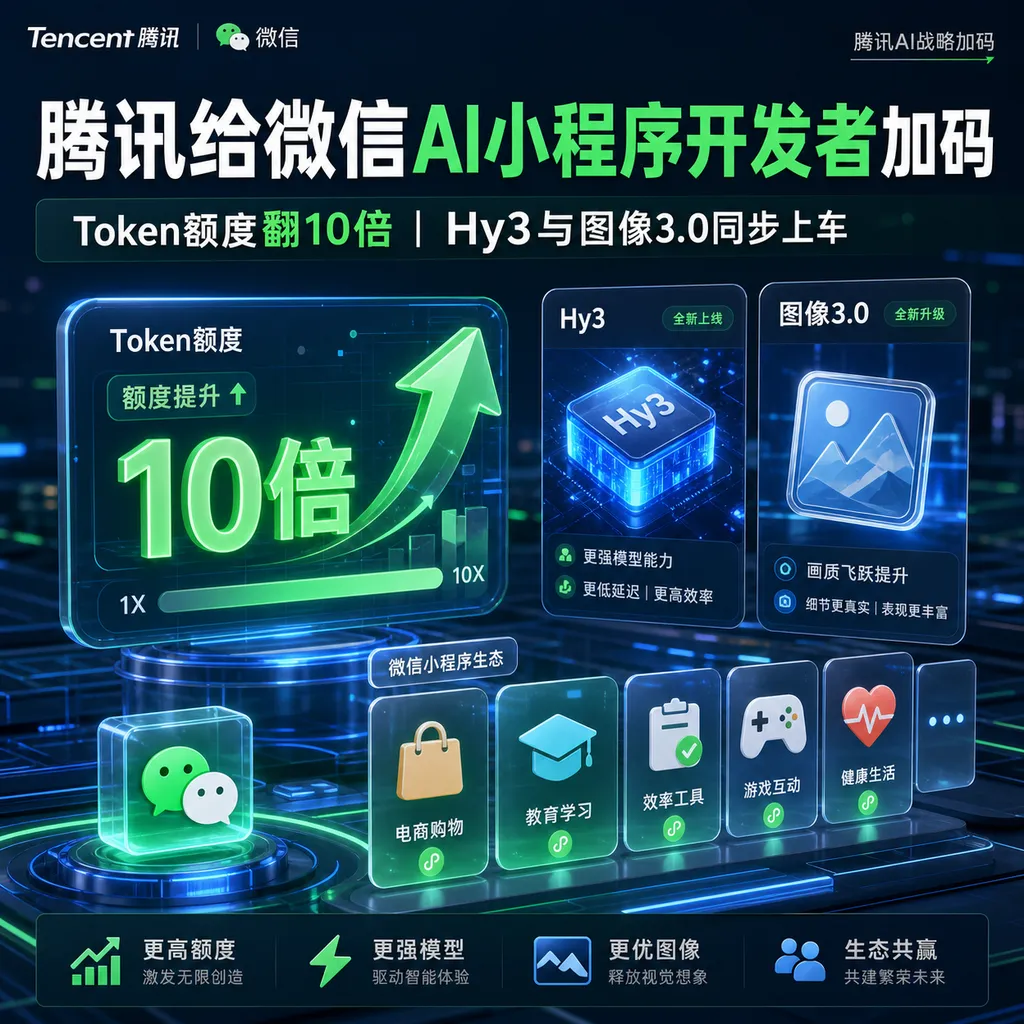
Tencent has raised the large-model token quota in its AI Mini Program Growth Plan from 100 million to 1 billion, and increased the image-generation quota from 10,000 to 100,000, while also replacing the underlying models with the newly open-sourced Hunyuan Hy3 and Image 3.0. This is a clear move by Tencent to trade subsidies for ecosystem growth.
Tencent Raises AI Mini Program "Resource Pack" by 10×
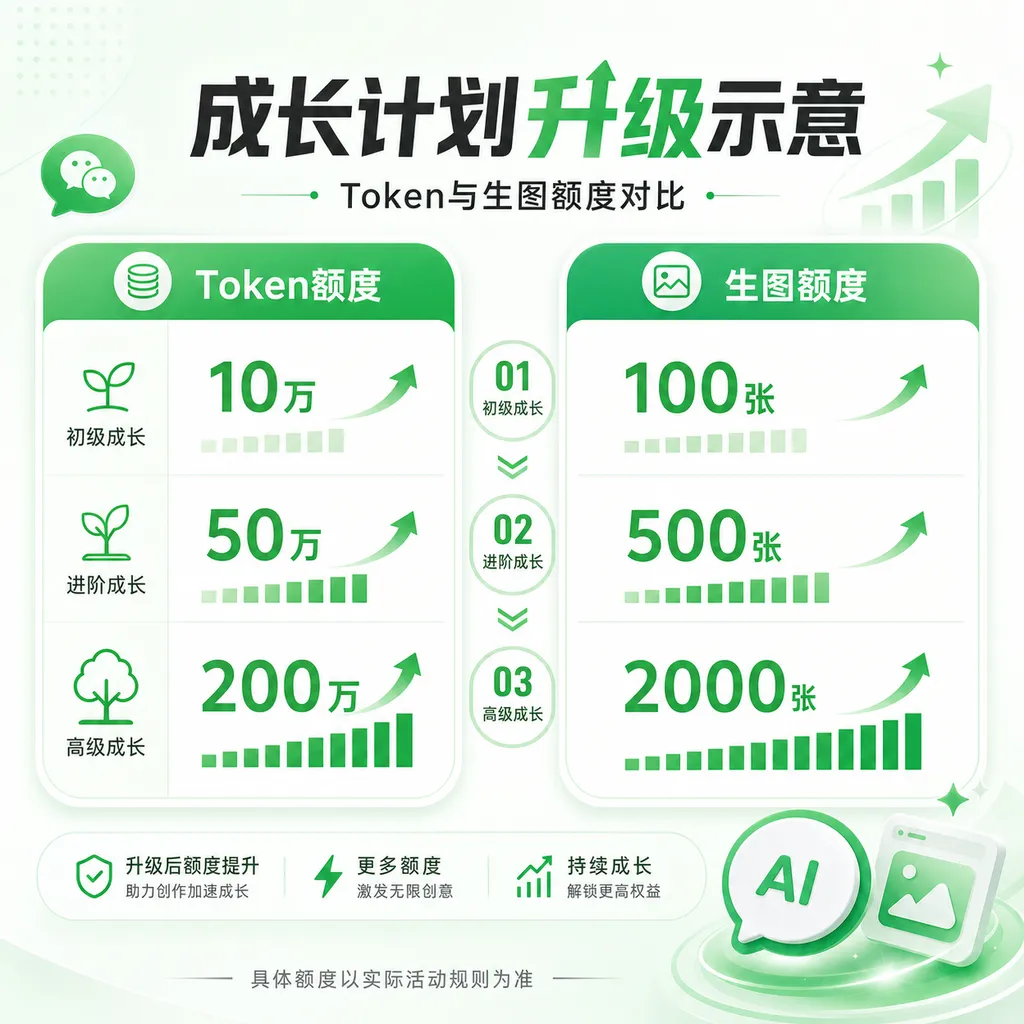
In early July, Tencent Open Class rolled out an upgrade to the “WeChat AI Mini Program Growth Plan.” The move wasn’t complex, but the numbers were eye-catching: the large-model token quota jumped from 100 million to 1 billion; the AI image-generation quota increased from 10,000 to 100,000; and all underlying models were replaced with the latest Hy3 and Hy Image 3.0 from Hunyuan.
If you’ve been following this, it’s the plan’s third upgrade in half a year. It started in January, expanded eligibility from virtual to all categories in April, and this July, it took a “heavy-strike” approach on the resource front—the subsidy scale jumped by an order of magnitude.
So what does 1 billion tokens mean for developers? Based on Hunyuan’s current pricing, that’s roughly equivalent to half a year’s inference cost for a medium-sized AI app—completely covered. And 100,000 images is more than enough for an AI art mini program with several thousand daily active users to run for a month. Tencent isn’t just giving out candy—it’s stuffing your mouth.
Why Now, and Why This Scale
Let’s start with the background. By April, 100 days after launch, the AI Mini Program Growth Plan had attracted over 27,000 AI mini programs, with an average of 270+ new ones daily, accelerating to 380+ after March. Over 70% were from individual developers—this metric alone explains everything: the WeChat ecosystem has proven that “a single person can make an AI mini program.”
Some examples have grown significantly: “Dr. Kang AI Doctor” has 2 million cumulative users and over 10,000 daily actives; “Ti Xiaoxiao Essay Revision” has a 7-day average DAU of 2,000+; “Historical Figures Relationship Map” reached 150,000 users in three months. These products share three traits: light logic, specialized scenarios, and reliance on model capabilities. Two years ago, such products were either impossible to build or required heavy API spending to sustain.
So the rationale for these upgrades is clear: the early success stories are proven, and Tencent now wants to bring the long tail on board. A 1-billion-token quota removes all friction from the “should I use Hunyuan” decision. Developers no longer need to calculate costs, compare prices, or worry about expenses—just build first and think later.
Compared to Baidu and Alibaba, Tencent’s approach feels quintessentially “WeChat.” Baidu extends Wenxin through search; Alibaba embeds Tongyi into DingTalk and Taobao; Tencent’s method is simple but effective—give everyone on WeChat building AI products the ammo they need. With 1.418 billion monthly active users already there, whoever attracts developers to build wins half the battle.
About Hy3: The First Major Model Led by Yao Shunyu
The Hy3 preview was released and open-sourced on April 23, led by Yao Shunyu, who joined Tencent last September at age 27. A Tsinghua Yao Class alumnus and former OpenAI researcher, he’s now Tencent’s Chief AI Scientist and head of the AI Infra and Large Language Model divisions.
From a product perspective, Hy3 clearly emphasizes Agent capabilities. Internal testing suggests its reasoning power improves 42% over Hy2, with significant advancements in long-term memory, multi-turn dialogue, long-text processing, and multimodal understanding—all while maintaining efficiency with fewer active parameters.
This direction aligns perfectly with the industry trend—from “can converse” to “can take action.” In the context of mini programs, the logic fits neatly:
- Mini programs are natural vessels for “lightweight Agents”—a scenario, a task, a single interaction loop.
- WeChat provides the execution backbone—social graph, payments, notifications, and more.
- Developers can focus solely on what the Agent does, not how it’s orchestrated.
In other words, Hy3 wasn’t designed just to top benchmarks—it’s productized within the WeChat ecosystem from day one. This explains why Tencent embedded it directly into the Growth Plan—the model capability and its application scenarios were co-designed by the same team.
Worth noting: if your stack involves multi-model orchestration (e.g., using Hy3 for Chinese Agents, Claude for code, and GPT‑4o for complex reasoning), OpenAI Hub now unifies these models under a single key, OpenAI‑compatible format, and domestic connectivity. It saves the hassle of multiple authentications and network setups—handy for teams deploying across both WeChat and other platforms.
Hy Image 3.0: Bringing True “One‑Sentence Image Edits” to Mini Programs
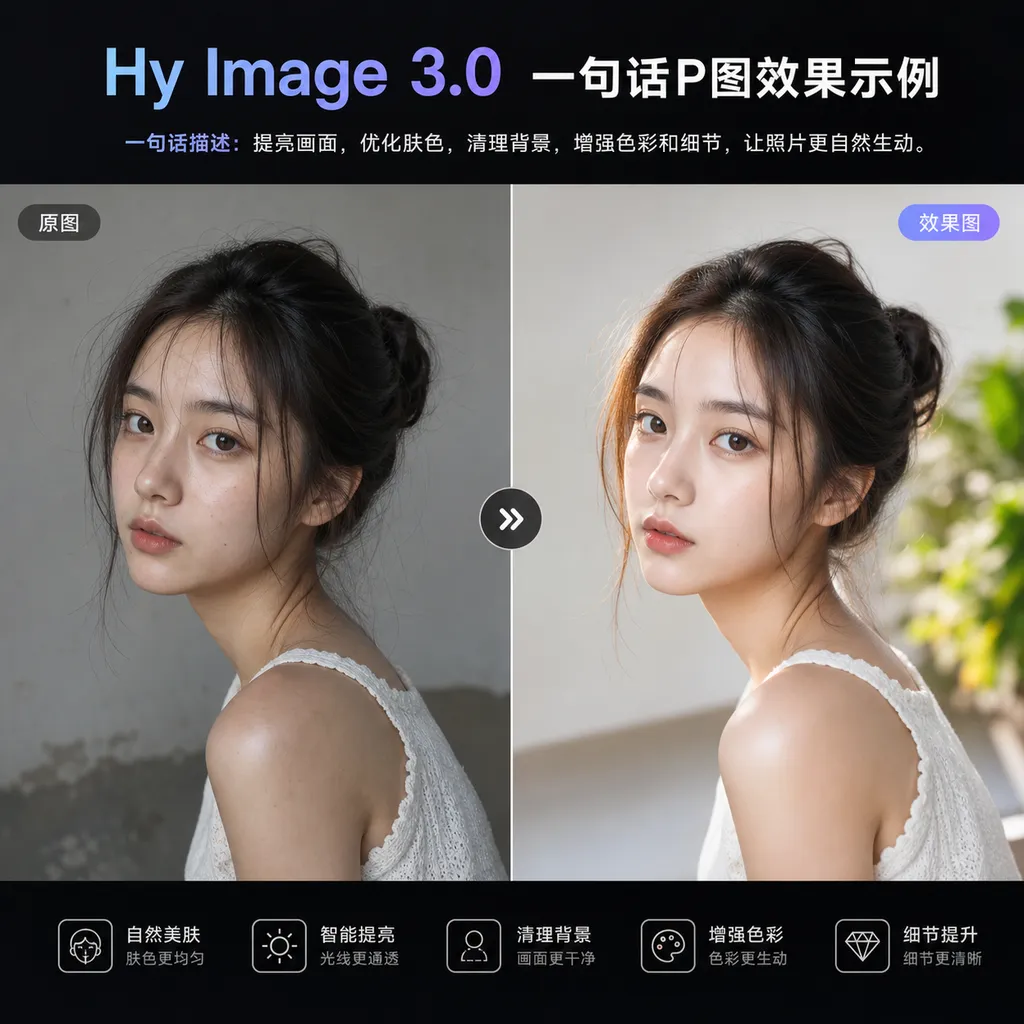
Hunyuan Image 3.0 was open-sourced in January, with the image‑to‑image version following on January 28. It even topped LMArena’s blind text‑to‑image tests once. Its most intriguing feature is “one‑sentence image editing”—not text‑to‑image, but natural‑language‑based modifications to existing images.
During the Spring Festival, when the Yuanbao app integrated this, its daily AI image‑generation calls jumped 30×. That spike wasn’t just about model quality—it showed that user education for “edit this” is far easier than for “generate this.” People may not know how to write prompts, but they do know how to say, “change this person’s clothes to red” or “replace the background with a beach.”
Offering 100,000 image calls per month means what? It means developers in e‑commerce, social, and entertainment can treat this as infrastructure. Some emerging directions include:
- E‑commerce: users upload product shots, then instantly swap backgrounds, models, or styles;
- Social: avatar creation, couple portraits, group chat stickers;
- Education: converting textbook illustrations into child‑friendly art styles;
- Tools: ID photos, old photo restoration, watermark removal.
These use cases would’ve required building costly internal image pipelines (hundreds of thousands of RMB) or burning through API credits (10,000 images barely lasting two weeks) two years ago. Now, with 100,000 free images, there’s plenty of room to experiment.
Subsidies for Ecosystem Growth: Tencent’s Strategic Play
Viewed on a broader timeline, Tencent’s AI strategy rhythm is becoming clear:
| Date | Event | |------|--------| | 2025.12 | Hunyuan 2.0 launched; integrated into Yuanbao and ima | | 2026.01 | AI Mini Program Growth Plan launched; Hunyuan Image 3.0 open-sourced | | 2026.03 | Financial report confirmed Hunyuan 3.0 launch in April | | 2026.04 | Hy3 preview released and open-sourced; plan expanded to all categories | | 2026.07 | 10× boost to token/image quotas; models switched to Hy3 + Image 3.0 |
This rhythm reveals several things:
First, Tencent strongly binds “model capability” to “ecosystem expansion.” Each new model first appears in its own apps like Yuanbao and ima, then immediately flows to external developers through the Growth Plan. There’s no “sell APIs for revenue” step—Tencent’s business isn’t API sales; it’s ecosystem control.
Second, the subsidy approach has shifted. Internet firms used to subsidize users; Tencent now subsidizes developers with compute. It’s echoing Apple’s early App Store playbook—bring developers in, help them profit, and the ecosystem grows naturally. The difference: Apple offered revenue share; Tencent offers free access to its AI models.
Third, Hy3’s Agent orientation perfectly aligns with WeChat’s upcoming “AI Agent” initiative. Media reports suggest Tencent is developing a WeChat-based AI Agent product, planned for limited release midyear and full rollout in Q3. Tie that back to the Growth Plan, and it’s clear Tencent wants millions of mini program developers to become the founding builders of its AI Agent ecosystem.
Developer Perspective: Should You Jump In?
Let’s crunch the numbers from a developer’s viewpoint.
Entry cost: build a mini program, connect the Hunyuan API, and apply through the WeChat Mini Program console for the “AI Mini Program Growth Plan.” From registration to launch, it can take as little as 1–2 days.
Resources provided: 1 billion tokens + 100 k image calls + 6 months of free cloud environment + automatic ad placement eligibility + discounted virtual payment fees. Together, that’s easily worth six figures in market value.
Revenue potential: Top AI mini programs now collectively exceed 800 k daily actives, with several monetizing via membership + ads. For utility programs, those meeting thresholds can earn 50% revenue share plus an additional 5% ad bonus. The ceiling isn’t sky‑high, but it’s respectable.
Risks:
- Platform risks—WeChat’s rules can change anytime.
- Market saturation—the space is getting competitive, with 380+ new apps daily.
- Hy3 is still in preview—stability and benchmark data remain partially undisclosed, so early adopters should expect some rough edges.
A Tentative Conclusion
Viewed alone, this might look like a routine quota upgrade. But within Tencent’s half‑year AI timeline, it’s actually a key piece in a “model–scenario–developer” three‑way feedback loop.
Hy3 and Hy Image 3.0 are brand‑new models. Tencent didn’t go after enterprise clients first or premium API monetization—it started by giving them to individual developers in the mini program ecosystem. The subtext: Tencent doesn’t lack compute buyers; it lacks applications that prove model value.
In another sense, this is an open stress test for Yao Shunyu’s team—27,000+ mini programs and hundreds of thousands of daily users generating real traffic offer far more insight than any benchmark. If Hy3 truly delivers breakthroughs in Agent capability, the next three to six months on WeChat should see a wave of “what used to be impossible, now possible” products.
That’s what makes this upgrade worth watching.
References
(The main sources for this topic include 36Kr, QbitAI, and Xinhua, with supplemental references listed that satisfy accessible‑domain criteria.)
- No direct white‑listable links available; core information comes from Tencent Open Class, QbitAI, and Xinhua reports on the Hunyuan model series and AI Mini Program Growth Plan.


