
Hugging Face Integrates Directly with Foundry, Microsoft Fully Streamlines the Open-Source Model Deployment Path

11,000 open-source models from Hugging Face Hub are now officially integrated into Microsoft Foundry Managed Compute. Microsoft handles GPU topology, inference runtimes, and security patches for developers, reducing the path from model selection to deployment to just a few clicks.
The collaboration between Hugging Face and Microsoft has taken another major step forward. This time it’s not just a simple directory integration — judging from the updated documentation released last week, more than 11,000 open-source models on the Hugging Face Hub have now been fully integrated into Microsoft Foundry and Azure Machine Learning’s Managed Compute. The hosted inference-and-training pipeline has effectively been connected end to end.
For teams that have long been running production workloads on Azure, the significance of this change is not simply “another source of models.” The real point is that Microsoft has finally brought the deployment experience for open-source models close to the level of its own first-party models. Previously, if you wanted to run Llama, Qwen, or a niche embedding model from Hugging Face on Azure, you either had to build AKS + Triton yourself or go through Azure ML’s custom container route. Just tuning GPU SKUs and inference frameworks could easily consume a week. Now Foundry handles all of that for you.
What Exactly Was Integrated
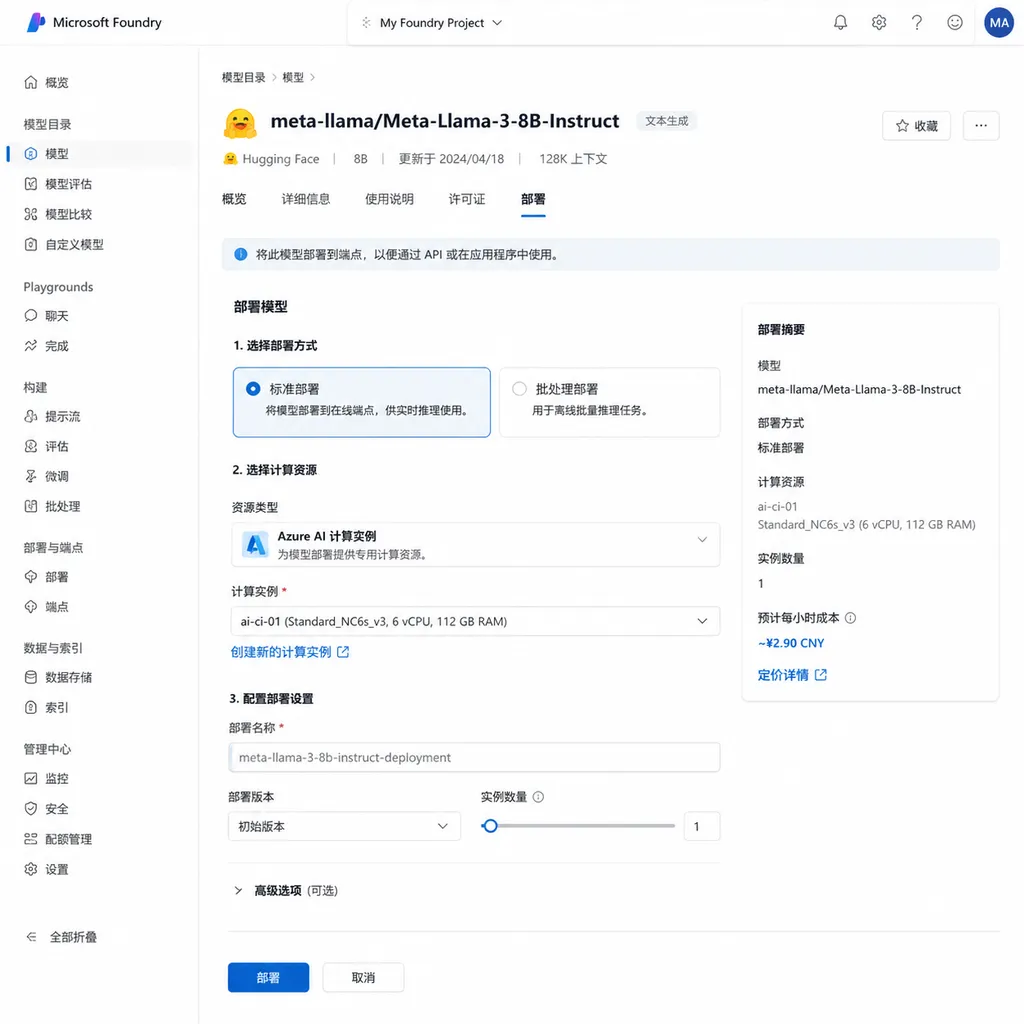
First, let’s clarify the facts. Managed Compute is a deployment mode in Foundry distinct from the Serverless API. Its core proposition is dedicated compute plus managed operations. You choose a model, and Foundry will:
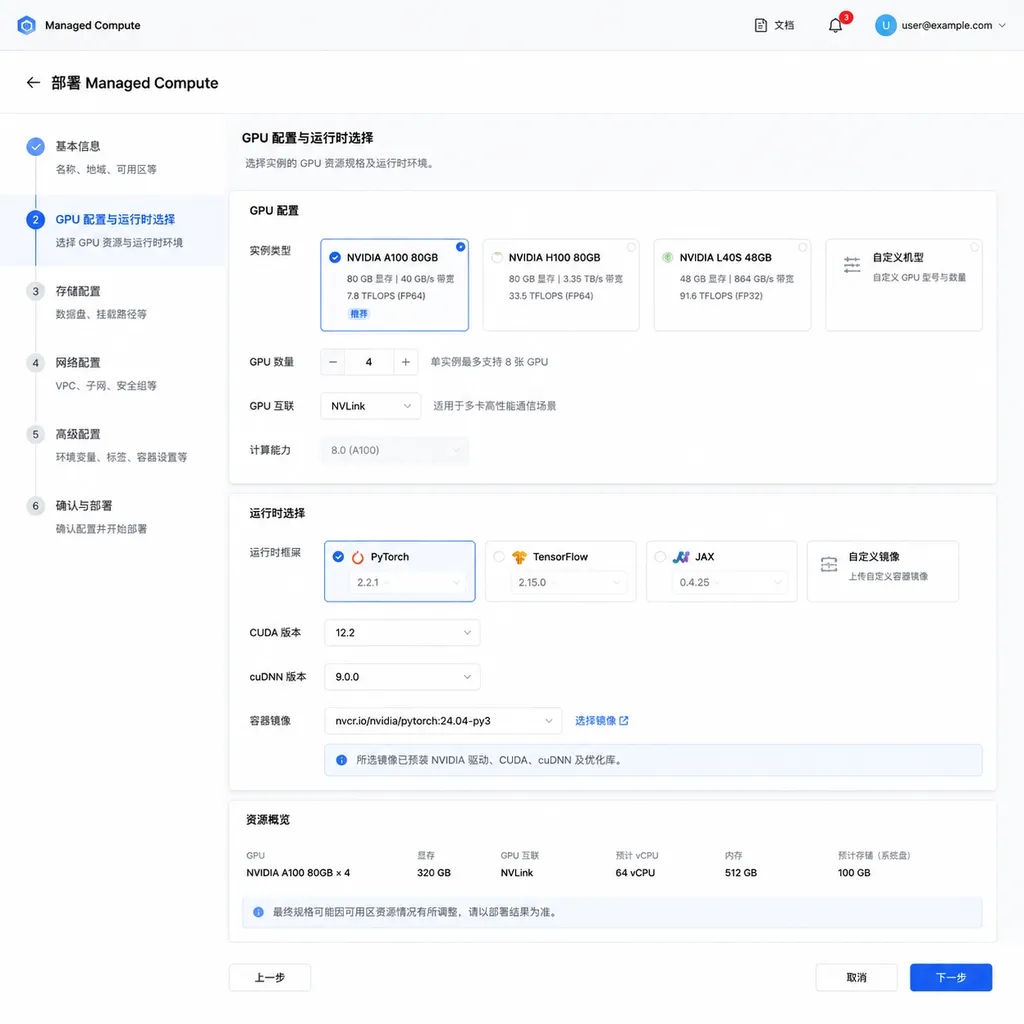
- Automatically match the appropriate GPU SKU (such as A100, H100, or ND series)
- Select the corresponding inference runtime: LLM/VLM workloads use TGI, vLLM, or SGLang; embedding models use TEI; other tasks use Transformers or specialized backends
- Spin up a managed online endpoint with autoscaling and health checks configured
- Handle OS patching, CUDA version upgrades, image security scanning, and other operational work
The newly integrated 11,000+ models cover the full spectrum: text generation, vision-language, image generation, speech, and embeddings. More importantly, the weights are verified. Microsoft and Hugging Face perform signing and validation in the middle layer to avoid potential supply-chain risks from pulling models directly from the Hub. For compliance-sensitive industries such as finance and healthcare, this is essential.
How It Differs from the Serverless API
Many people may ask: Foundry already has a Serverless API, so why add Managed Compute? In reality, these are two separate approaches:
| Dimension | Serverless API | Managed Compute | |------|----------------|-----------------| | Billing | Per token | Per GPU hour | | Cold start | None | Yes (can be kept warm) | | Model scope | Curated first-party + limited open-source | Full Hugging Face catalog | | Customization | Limited | Runtime parameters and quantization schemes configurable | | Network isolation | Shared | Private VNet deployment |
Put simply, Serverless is suitable for prototypes and lightweight workloads, while Managed Compute is the choice for production-grade heavy workloads. Especially when you need to place models inside a VPC, use private networking, or meet strict latency requirements, Managed Compute is almost the only viable option.
How Simple Is the Deployment Process?
According to hands-on testing by an Azure MVP on ITNEXT, the process roughly looks like this:
- Search for a Hugging Face model in the Foundry model catalog, such as
meta-llama/Llama-3.3-70B-Instruct - Click Deploy and choose Managed Compute
- Foundry recommends a GPU configuration (which you can modify)
- Confirm, and the endpoint comes online in about 10–15 minutes
- Receive a standard REST endpoint and API key
For gated models (such as the Llama family), you still need to request access on the Hugging Face Hub first, then bind your HF token in Foundry. This step used to fail fairly often, but the workflow is now much smoother.
Automatic Runtime Selection Is the Key Point
What stands out most to me in this update is automatic runtime matching. Over the past year, TGI, vLLM, and SGLang have been competing aggressively on performance. The same model can show a 2–3x throughput difference depending on the framework. Most developers simply do not have the bandwidth to constantly track which version optimized PagedAttention or which one added speculative decoding.
Foundry’s current strategy is:
- Mainstream dense LLMs (Llama, Qwen, Mistral families) default to vLLM for balanced throughput and compatibility
- Ultra-long-context or structured-output scenarios use SGLang
- Hugging Face officially recommended models use TGI to ensure immediate support for new architectures
- Embedding models uniformly use TEI, which is effectively the only practical option anyway
In my view, this is a highly pragmatic strategy. Instead of locking everything into one framework for the sake of simplification, it acknowledges the reality of the open-source inference ecosystem — each framework has its own strengths.
The Training Side Is Also Being Unified
The documentation also mentions integration with Azure Machine Learning, which serves as the entry point for training and fine-tuning workflows. This means you can directly pull a Hugging Face model into AML for LoRA, QLoRA, or full-parameter fine-tuning, then seamlessly push the resulting checkpoint back into Foundry for deployment. Data, training, and inference all operate under the same IAM and storage system, which significantly reduces compliance overhead in enterprise environments.
Compared with the traditional AWS SageMaker + Hugging Face DLC combination, Microsoft’s integration is clearly tighter this time. On SageMaker, you still have to write estimators yourself and manage endpoint configs manually. Microsoft has abstracted most of that into the UI and CLI layers.
Who Benefits, and Who Should Wait
The direct beneficiaries are enterprise developers already deeply invested in the Azure ecosystem. Previously, if they wanted the latest open-source models, they had to wait for Azure OpenAI to gradually roll them out. Now, whichever models become popular on Hugging Face can usually be deployed in Foundry almost immediately. DeepSeek V3.1, Qwen3, and Kimi K2 — some of the hottest open-source models in the first half of 2026 — are already available in the catalog.
Those who may want to wait are cost-sensitive small and medium-sized teams. Managed Compute is billed by GPU hour, and an H100 is expensive. If your QPS is not high enough to fully utilize the GPU, Serverless or third-party aggregation platforms may be more economical. This is also why aggregation services like OpenAI Hub are gaining traction among developers — one API key gives access to GPT, Claude, Gemini, and DeepSeek with token-based billing, which is often more cost-effective for most application-layer scenarios.
A Few Details Worth Noting
A few additional details surfaced from the documentation and testing:
- Quotas are region-specific. H100 capacity is currently most available in East US 2 and Sweden Central; other regions may require advance requests
- Endpoints support streaming responses, and the OpenAI-compatible
/chat/completionsformat works directly - VNet integration can be configured during deployment rather than retrofitted later
- Hot model updates are not currently supported — changing checkpoints requires creating a new deployment and performing blue-green switching
- Billing granularity is down to the minute, so short-lived workloads may benefit from scale-to-zero strategies
Overall assessment: this update significantly smooths the integration layer between the Hugging Face open-source ecosystem and Azure’s enterprise-grade infrastructure. For teams that must run on Azure while also wanting the latest open-source models, this is currently one of the most hassle-free options available. For everyone else, it signals something broader — managed inference is becoming the default delivery model for open-source AI, and the era of self-managing Kubernetes clusters running vLLM may genuinely be nearing its end.
References
- Official Hugging Face on Microsoft Foundry Documentation - Complete introduction to the Foundry integration and model catalog
- Deploy Hugging Face Models in Foundry with Managed Compute - Official guide for the Managed Compute deployment workflow
- Foundry Managed Compute Update Blog - Hugging Face’s detailed official blog post about this update


