
Three AI Agents conversed with each other and then delivered a complete application.
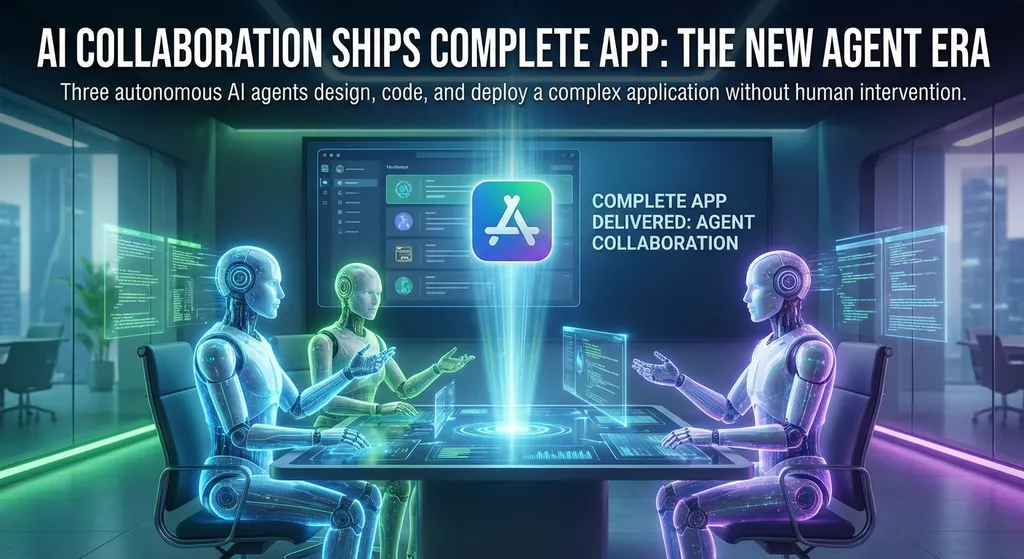
Using Claude’s multi-agent collaboration framework, developers enable three Agents to cooperate and divide tasks to generate a complete multi-file web application. From experimental prototypes to Claude Code Agent Teams, multi-agent programming is evolving from concept to practicality.
A developer shared an experiment on Linux.do: you input a one-sentence requirement, three AI Agents automatically break down the task, work separately, communicate with each other, and finally deliver a complete multi-file web application.
It’s not a demo video nor a concept mock-up—it’s a live product you can open and try right now.
The project is called Builder AI, open-source on GitHub and deployed on Vercel. What it does is not complex but is enough to prove a point—it uses multi-agent collaboration to make the path from “natural language to runnable code” work.
One-sentence requirement, three Agents take the job
Builder AI’s workflow goes like this: the user inputs a requirement description, for example “build a Todo app with user authentication,” and the system launches three Agents, each responsible for different modules. One handles architecture and file structure, one writes core business logic, and one manages UI and styling. They are not a serial pipeline but a collaborative system working in parallel, aware of each other’s progress.
The final output is not a single file snippet but a complete web application with multiple files and directories that can run directly.
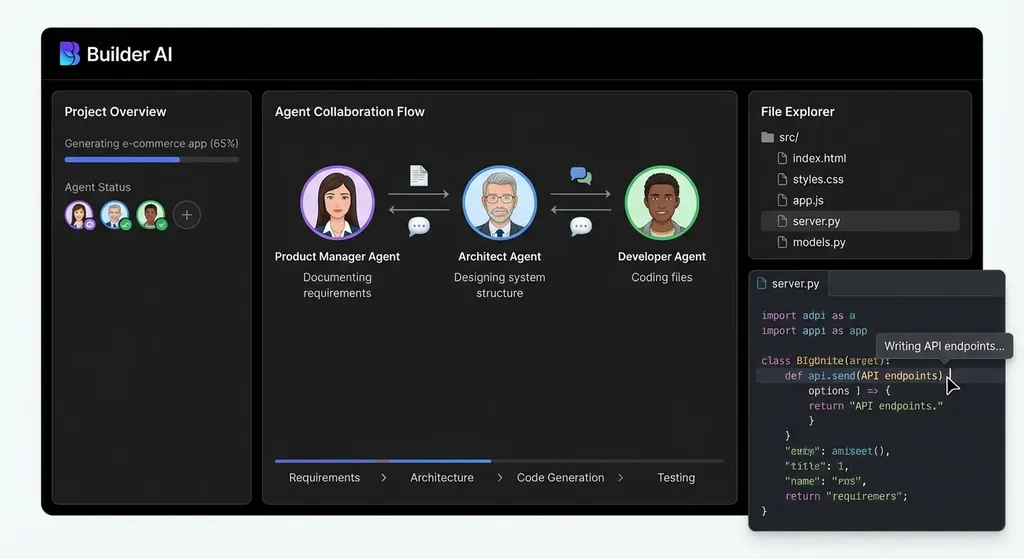
The project’s technical implementation itself isn’t very complicated. What truly deserves attention is the trend behind it: multi-agent collaborative programming is evolving from Anthropic’s experimental feature into a model developers can build and replicate themselves.
From Subagent to Agent Teams: What Anthropic is pushing
To understand the significance of this experiment, we need to look at the evolution of “multi-agent” within the Claude ecosystem.
Originally, Claude Code had a Subagent mechanism. The main Agent could spawn sub-agents to perform specific tasks, and the sub-agents would return results afterward. This was still a centralized scheduling model—the main Agent acted as the boss, the sub-agents as assistants, and all information had to go through the boss.
The bottleneck of this model was obvious: the main Agent became the communication bottleneck, the context window was flooded with intermediate results, and sub-tasks couldn’t directly talk to each other. If you had one Agent writing backend APIs and another writing frontend components, their interface understanding had to rely entirely on the main Agent’s relaying—hardly efficient.
Claude Code Agent Teams were designed to solve this problem. They introduced a real team collaboration mechanism:
- A Team Lead handles task decomposition and overall coordination
- Multiple Teammates work in parallel, each with independent context
- Teammates can communicate directly without routing messages through the Lead
- Supports “adversarial discussion”—one Agent can challenge another’s approach
An imperfect but intuitive analogy: Subagent is like one person working through several terminal windows at once; Agent Teams is like an actual three-person development team collaborating.
The core differences can be summarized like this:
| Dimension | Subagent | Agent Teams | |------------|-----------|-------------| | Communication model | Star (via main Agent) | Mesh (direct communication) | | Coordination | Managed by main Agent | Team Lead + self-organization | | Context | Shared with main Agent | Independent for each Teammate | | Token consumption | Relatively controlled | Scales linearly (N Teammates ≈ N× tokens) | | Suitable scenarios | Simple parallel tasks | Complex projects requiring multi-role collaboration |
Real-world experience: usable, but don’t expect too much
Let’s look at Builder AI’s actual performance.
From its GitHub repository, the architecture is straightforward: frontend built with React, calling the Claude model through an API; the backend orchestrates the workflow of three Agents. Each Agent has its own system prompt and role definition, coordinating via shared task states.
You can try it live at builder-ai-v2.vercel.app. After entering a requirement, you’ll see the three Agents’ process—who is generating which files, their progress, and final outputs.
Frankly, for simple requirements (like a static page or basic CRUD app), it works quite well. The generated code is clean, files are split reasonably, and it runs directly. But once you move to more complex tasks—database design, permission control, multi-page routing—the Agents start misaligning: inconsistent APIs, conflicting state management, and poorly coupled styles and logic.
This isn’t Builder AI’s issue per se—it’s a common bottleneck in multi-agent collaboration. Building “consensus” between Agents is even more fragile than human team communication. Human developers can align understanding through code reviews, meetings, and documentation; for Agents, alignment still largely depends on prompt engineering and precision of task description.
If you want to build your own
The core of multi-Agent orchestration boils down to calling and coordinating large-model APIs. If you want to implement a similar system yourself, focus on four parts: Agent role definitions, task allocation strategy, inter-Agent communication protocol, and result merging logic.
For a simplified example of three-Agent collaboration, each Agent is essentially an API call with a specific system prompt:
import openai

client = openai.OpenAI(
    api_key="your-openai-hub-key",
    base_url="https://api.openai-hub.net/v1"
)

def call_agent(role_prompt, task_description, context=""):
    """Invoke a single Agent"""
    response = client.chat.completions.create(
        model="claude-sonnet-4-20250514",
        messages=[
            {"role": "system", "content": role_prompt},
            {"role": "user", "content": f"Task: {task_description}\n\nContext: {context}"}
        ],
        max_tokens=4096
    )
    return response.choices[0].message.content

# Define three Agents
architect_prompt = """You are a software architect Agent.
Your task: design project structure, define file directories, plan module division, and interface contracts.
Output format: JSON including file tree and responsibilities for each file."""

backend_prompt = """You are a backend developer Agent.
Your task: implement business logic, API routes, and data processing according to the architecture design.
Strictly follow the architect’s interface contracts."""

frontend_prompt = """You are a frontend developer Agent.
Your task: build UI components, page layout, and interactions according to the architecture design.
Strictly follow the architect’s interface contracts."""

# Workflow
user_requirement = "Build an online note-taking app supporting Markdown"

# Step 1: Architect creates the plan
architecture = call_agent(architect_prompt, user_requirement)
print("Architecture design complete")

# Step 2: Backend and frontend development (simplified as sequential calls, can be parallelized via asyncio)
backend_code = call_agent(backend_prompt, "Implement backend logic", context=architecture)
frontend_code = call_agent(frontend_prompt, "Implement frontend interface", context=architecture)
print("Code generation complete")
This is the most basic sequential orchestration. True multi-agent collaboration would add several key mechanisms:
- Parallel execution—use asyncio or multithreading for simultaneous work
- Shared state—a shared “blackboard” for task progress and intermediate results
- Conflict resolution—decide how to handle discrepancies between outputs
- Iterative refinement—Agents should review and correct each other’s work
If you use OpenAI Hub’s API, the benefit is that one key gives access to Claude, GPT, Gemini, etc. A practical optimization strategy: let the Team Lead use the most capable model (like Claude Opus) and Teammates use more cost-effective models (like Claude Sonnet), balancing quality and cost.
The true threshold of Agent Teams: not technology, but cost
Discussing multi-agent collaboration inevitably leads to token consumption.
In single-Agent mode, a complex code generation task might use tens of thousands of tokens. In Agent Teams mode, with three Teammates plus Lead and inter-Agent communication overhead, total usage easily triples to 3–5×.
A blog post on cnblogs mentioned that for medium complexity tasks, token consumption under Agent Teams is about 4× that of a single Agent. If you’re using Claude Pro or Max plan, the excess tokens are billed at standard API rates—so this isn’t cheap.
Thus, Anthropic itself recommends keeping team sizes between 2–5 Teammates; don’t start 10-Agent teams casually. Also, “keep monitoring team dynamics”—once started, avoid leaving them unsupervised. Unattended Agent teams easily drift off-course, wasting tokens.
That’s why Agent Teams are still experimental. Their value is clear for specific cases—large refactorings, module-parallel development, or multi-perspective architectural validation—but not every task justifies the cost. For utility functions, bug fixes, or small features, a single Agent is plenty.
Broader view: it’s not just Claude doing this
Multi-agent collaboration isn’t unique to Anthropic.
Microsoft’s AutoGen framework, CrewAI, and LangGraph are all doing similar things. OpenAI is gradually adding multi-Agent orchestration in its Assistants API. Google’s Vertex AI platform also offers experimental multi-Agent support.
Yet Claude Code Agent Teams have a unique advantage: it’s directly embedded in developers’ daily workflows. There’s no need to build orchestration frameworks or glue code—you launch Agent Teams right within the Claude Code terminal. A Reddit comment captured it perfectly: “The terminal split into three panes is the most convincing part—it makes multi-agent collaboration look like normal development for the first time, not a research demo.”
Builder AI’s open-source value lies in extracting that collaboration model from Claude Code’s closed environment into a modifiable, deployable web app. Though rudimentary in execution, the direction is right.
A sober look: the real boundaries of multi-agent programming
Is multi-agent collaborative programming the future? Probably yes. But its current limitations are clear:
First, the “alignment” of understanding between Agents is fragile. Humans can clarify ambiguities through repeated discussion; Agents get limited rounds and depth of communication. If an architectural Agent’s design is vague, implementation Agents may interpret it differently, producing conflicts during merging.
Second, debugging costs are high. With a single Agent, you trace one context to fix issues. In multi-Agent setups, you must trace each Agent’s decision process to find where reasoning went wrong—debugging is still primitive.
Third, precision requirements for task descriptions are higher. In single-Agent mode, an ambiguous prompt just yields slightly off code that you can tweak. But in multi-Agent mode, ambiguity amplifies—each Agent interprets differently, resulting in greater divergence.
So my prediction: by 2026, multi-agent collaborative programming will have more real-world use, but it won’t replace single-Agent mode. It’ll serve as a “heavy-duty weapon” for high-complexity cases worth the extra cost.
For most day-to-day development, a well-tuned single Agent—with good prompts and workflows—remains the most cost-effective option.
Key directions to watch
If you’re interested in multi-agent programming, here are areas worth following:
- Release schedule of Claude Code Agent Teams. It’s still experimental, requiring manual feature flag activation; stability and usability have room to improve.
- Maturity of hybrid model orchestration. Assigning different model tiers to different roles is key to cost control, but there’s limited practice so far.
- Standardization of inter-Agent communication protocols. Right now every framework has its own; defining a widely accepted standard would grant a strong position in this space.
- Observability tools. Debugging and monitoring multi-Agent systems need specialized support—currently almost none exist.
Builder AI itself may not become a major product, but the direction it represents—taking multi-agent collaboration from experiment to usability—is among the most noteworthy AI programming trends to watch in 2026.
References:
- Claude AI Multi-Agent Development and Orchestration Experiment — Original post on Linux.do community introducing Builder AI
- Builder AI GitHub Repository — Source code, three-Agent collaboration for web app generation
- Understanding Agent Teams: Claude Code’s Evolution from Single Intelligence to Autonomous Clusters — Zhihu column detailing Agent Teams architecture and usage


