
Meta Integrated Muse Image into Instagram and WhatsApp
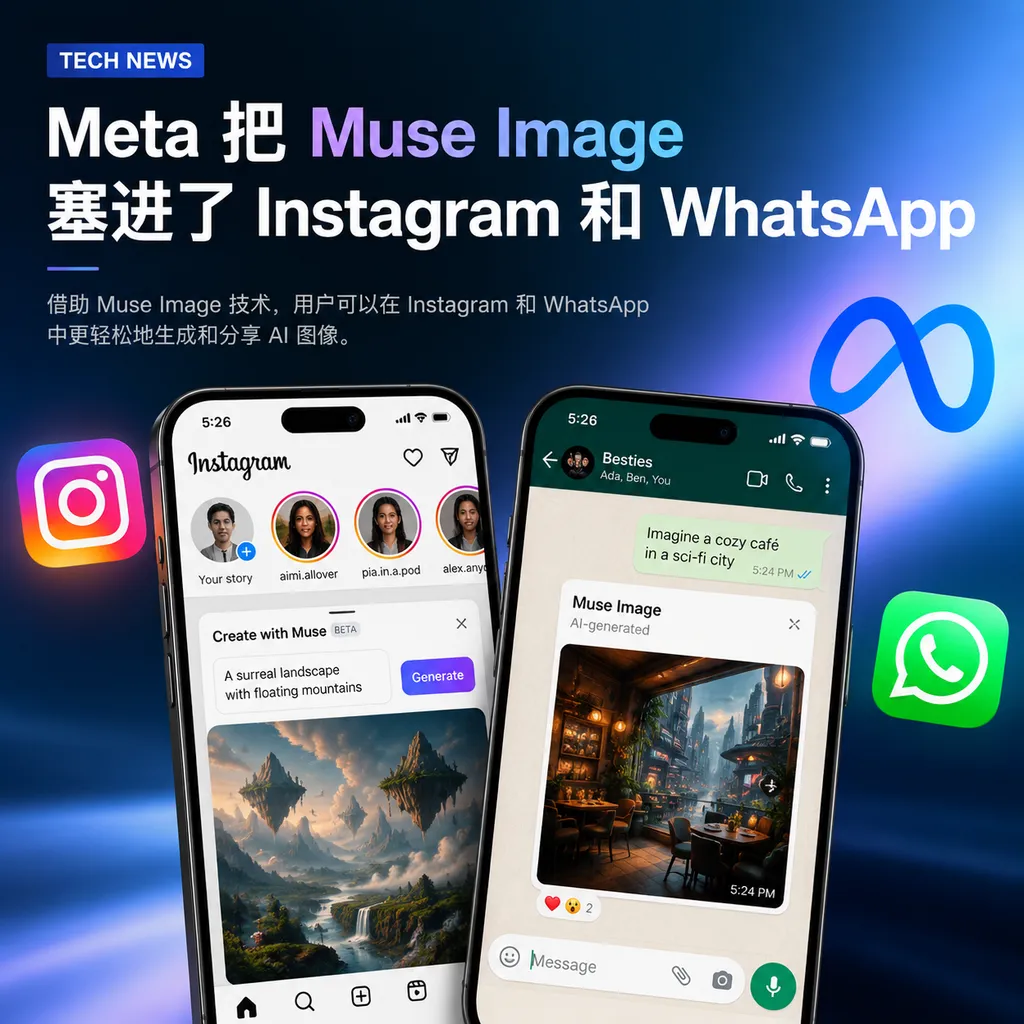
Meta Superintelligence Lab has released its first image generation model, Muse Image, fully taking over the image generation capabilities of Meta AI, Instagram, and WhatsApp. It emphasizes an "agentic" generation workflow and can even pull other users' faces into your AI-generated photos.
Meta Has Put Muse Image Into Instagram and WhatsApp — and It Can Even "Pull People Into the Frame"
On July 7, Meta officially released Muse Image — the first image generation model produced by Meta Superintelligence Labs (MSL). Following Muse Spark in April this year, this is the second shot fired by the Muse family, and also the second product delivered after Alexandr Wang took over MSL.
Starting today, image generation features in the Meta AI app, Instagram, and WhatsApp have all switched over to Muse Image, with Facebook and Messenger following in the coming weeks. This time, Meta is no longer going down the open-source route, nor is it releasing papers and model weights like in the Llama era. Muse Image is a thoroughly product-oriented model that runs exclusively within Meta’s own ecosystem.
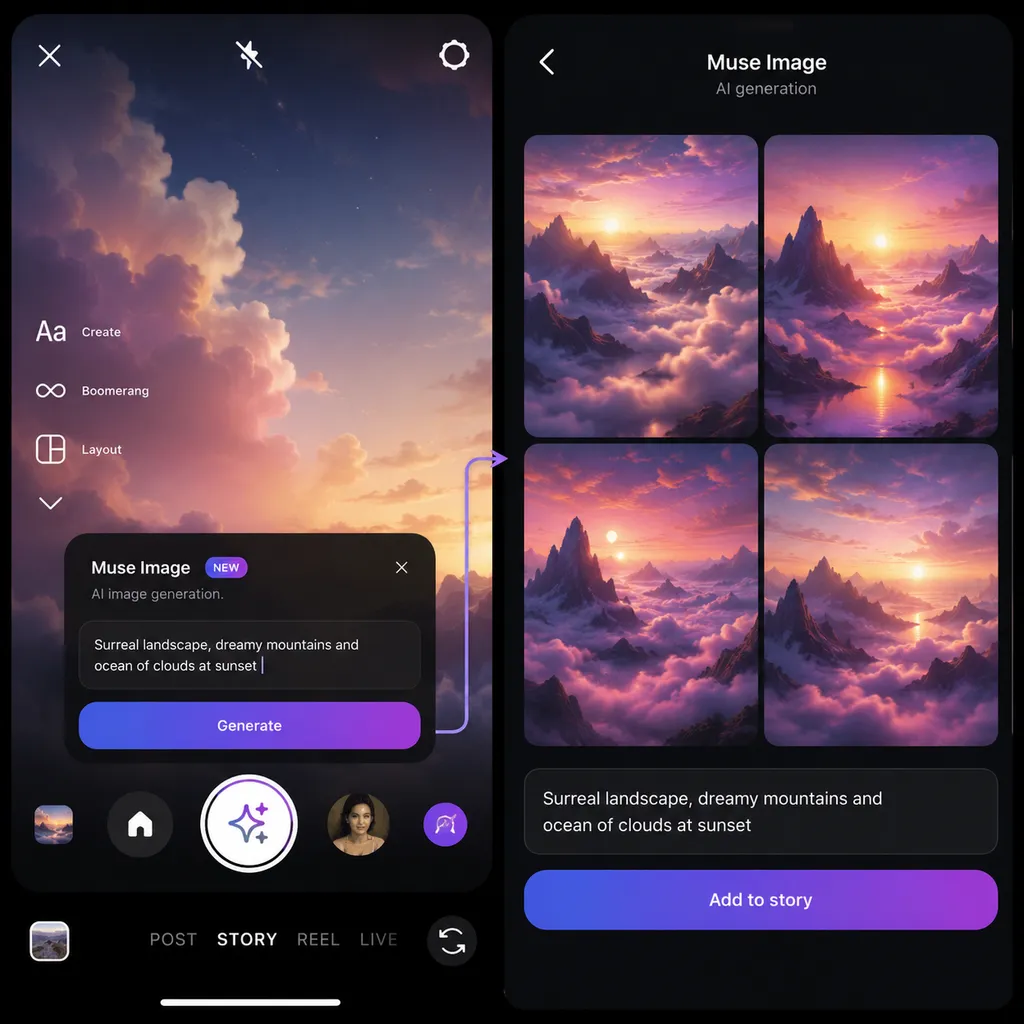
The Most Eye-Catching Feature: Pulling Other People Into Your AI Photos
Let’s start with the most viral — and most controversial — capability announced this time: Muse Image supports directly referencing the likeness of other Instagram users during image generation.
The workflow is simple: mention a user in the prompt with @username, and the model extracts facial features from that person’s public photos to generate an image containing them. You can place yourself and a friend on the streets of Tokyo, or generate content like “me on a film set with a creator.”
This may sound familiar. Google’s Gemini previously introduced similar multi-subject consistency capabilities, but those relied on locally uploaded photos. Meta skips the “upload your source material first” step entirely and treats the social graph itself as the asset library. That’s something OpenAI or Anthropic structurally cannot do — and it’s the core logic behind Meta playing this card.
Of course, Meta has implemented privacy controls:
- Users can disable being used in AI generations by others in settings
- Generated images will include visible Meta AI watermarks and C2PA metadata
- Mentioned users receive a notification before the image is published
But not everyone checks their settings page. This opt-out rather than opt-in default strategy will likely become a major focus of public debate over the next few weeks.
What Does “Agentic Image Generation” Actually Mean?
Alexandr Wang described Muse Image on Threads as “agentic.” The term is somewhat overused right now, but Meta’s definition is fairly concrete: Muse Image does not immediately start generating after receiving a prompt. Instead, it first invokes the Muse Spark large language model to do three things:
- Reasoning: Parse the intent behind the prompt. For example, if you say “make me a cyberpunk-style product poster,” it first determines what composition, lighting, and atmosphere should imply.
- Web Search: If the prompt involves specific people, places, or brands, it pulls reference information from the web first.
- Planning: Break the generation into multiple steps — for example, draft first, then refine materials, then handle text.
Essentially, this workflow embeds the old SDXL/Flux-era “prompt crafting” experience into the model’s own chain of thought. Users can provide looser input, and the model fills in the context itself.
Compare that with competing products:
| Model | Generation Mode | Context Source | |------|---------|-----------| | GPT-Image-1 | Single-step + embedded reasoning | Prompt + conversation history | | Gemini 3 Image | Multi-turn iteration | Prompt + uploaded images | | Muse Image | Agentic multi-stage | Prompt + Web + social graph | | Midjourney v8 | Single-step high aesthetics | Prompt + style references |
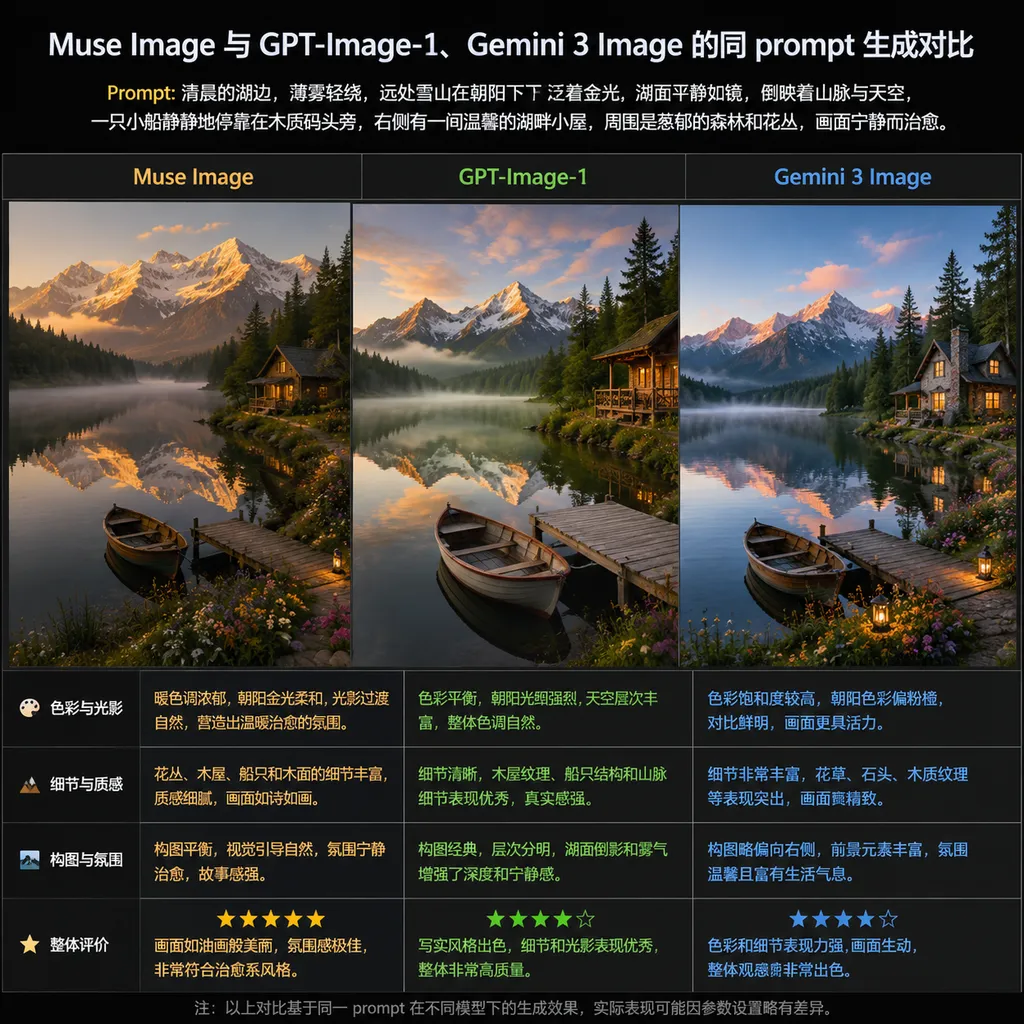
Meta’s differentiation is not image quality itself. Based on leaked samples, Muse Image competes closely with GPT-Image-1 in realism, though flaws are still visible in text rendering and complex hand details. Its true moat is the social context: only Meta has access to Instagram’s graph and WhatsApp’s conversational flow.
Why Release Muse Image Now
Looking at the broader timeline, the rhythm of Meta’s strategy is quite clear.
In April 2025, Meta released Llama 4, which received a lukewarm response and failed to energize the developer community. Zuckerberg subsequently adjusted course. In June of the same year, Meta acquired Scale AI, and Alexandr Wang became head of the newly established MSL. In April 2026, MSL delivered its first model, Muse Spark — closed-source, product-oriented, focused on efficiency rather than SOTA performance. In July, Muse Image arrived in Meta’s social products.
From Llama to Muse, Meta’s model strategy has shifted in three obvious ways:
- From open source to closed source: The Muse series is currently entirely closed-source. Official wording says “future versions may still return to open-source approaches” — which roughly translates to “not for now.”
- From general-purpose foundation models to product models: Meta is no longer chasing GPT-5 or Gemini 3 benchmark rankings, focusing instead on per-token cost and inference latency.
- From technical narratives to user growth narratives: Model evaluation metrics now revolve around Instagram DAU and WhatsApp session duration.
The cost of this shift is that Meta’s presence in the developer ecosystem has nearly disappeared. Llama once dominated Hugging Face, but now you cannot even access MSL model weights. Meta says it may expose Muse Spark capabilities through APIs to select partners in the future, but for now it remains a private preview available only to a handful of paying customers.
Technical Details and Benchmarks
Meta did not release a full technical report for Muse Image, but combining it with information disclosed about Muse Spark in April reveals part of the picture:
- Training compute: Meta claims Muse Spark achieved near-mid-sized Llama 4 capabilities using an order of magnitude less compute under its new architecture. Muse Image likely reuses the same infrastructure.
- Multimodal foundation: Muse Image shares a tokenizer and portions of the visual encoder with Muse Spark, which is why Muse Spark can directly invoke it.
- Inference architecture: Generation occurs in stages, and intermediate results from each stage can be checked and rolled back by the LLM.
For benchmarks, Meta highlighted several numbers:
- On GenEval (compositional scene understanding), Muse Image scored 0.87, slightly above GPT-Image-1’s 0.84
- On DPG-Bench (long prompt adherence), Muse Image achieved 88.2
- On the attribute binding subset of T2I-CompBench, it performed roughly on par with Gemini 3 Image
That said, image model benchmarks have always had limited practical value. Real-world experience depends more on in-the-wild samples. Reddit and X are already seeing the first wave of comparison tests. A common takeaway so far is that Muse Image performs noticeably better than GPT-Image-1 in character consistency and Asian faces, but falls behind the Flux series in realistic materials such as leather, metal, and glass.
What This Means for Creators and Developers
For ordinary users, Muse Image’s biggest advantage is “zero barrier to entry” — no need to learn prompt engineering; plain language is enough. For creators, the “pull people into the frame” feature will likely spark a wave of UGC formats, from meme collaborations to virtual crossovers.
But for the developer community, the signals from this release are frankly negative:
- Muse Image is not open-source — no weights, no paper
- The API is not publicly available — only select partners have access to Muse Spark
- Meta’s focus has clearly shifted from “providing infrastructure for developers” to “providing capabilities for its own products”
If you are a developer looking to integrate image generation into your own application, Muse Image is not currently an option. More practical choices on the market right now are still GPT-Image-1, Gemini 3 Image, Flux 1.1 Pro, and Kling. These models can all be directly accessed through OpenAI Hub with a single API key and OpenAI-format compatibility, avoiding the hassle of proxies and maintaining multiple SDKs.
A Final Take
Muse Image is a classic “platform-embedded” model — not necessarily the strongest technologically, but it sits atop 3 billion monthly active users, and that alone is the biggest distribution advantage possible.
The logic behind Meta’s strategic shift is actually straightforward: it can no longer outcompete OpenAI and Anthropic on foundation model capabilities alone. But when it comes to embedding AI into users’ everyday scenarios, Meta holds more cards than anyone else. Instagram and WhatsApp are naturally suited for AI image consumption, while Reels is naturally suited for AI video consumption (the Vibes AI video feature is also expected to connect to Muse soon). Rather than being fourth place in the API market, Meta would rather dominate on its home turf.
The cost is the developer ecosystem — but Zuckerberg has clearly run the numbers and decided it no longer matters. Whether that judgment proves correct in the long term is another question, but in the short term, Meta has at least made “we’re still at the table” sound louder than at any point in the past year.
The next things worth watching: whether Muse Image will launch a public API beta, when Muse’s video model will arrive, and whether the “pull people into the frame” feature will run into GDPR issues first in the EU.
Sources
- Meta releases Muse Spark, the first model developed by Superintelligence Labs - iThome: Complete technical details and benchmark data for Muse Spark, the first model in the Muse family, and essential background for understanding the architecture behind Muse Image


