
Microsoft MAI Quietly Takes Over Excel and Outlook, OpenAI’s Honeymoon Period Is Over

Microsoft has begun replacing OpenAI and Anthropic with its in-house MAI models in Excel and Outlook, processing tens of thousands of AI requests each week. Suleyman’s team has a clear goal: reduce the bills paid to Anthropic to zero.
Microsoft Makes Its Move
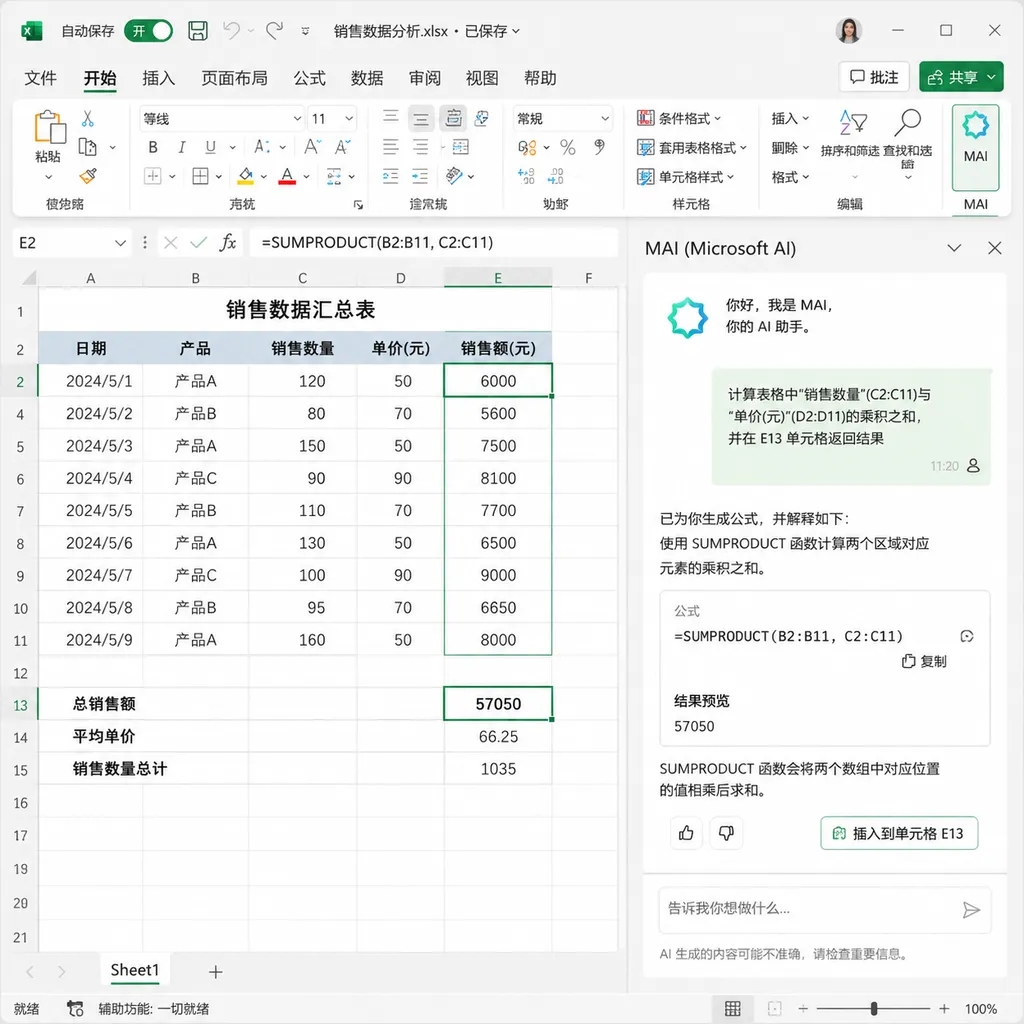
The news revealed by Bloomberg today (July 8) wasn’t exactly surprising, but the timing is worth noting: Microsoft has already replaced some OpenAI and Anthropic calls in Excel and Outlook with its in-house MAI models. At present, “tens of thousands” of AI requests per week are being handled by MAI — not a large share yet, but the direction is now clear.
Translated into plain terms, this means that the tough statement Microsoft AI chief Mustafa Suleyman made at the Build conference in June — “We pay Anthropic a significant amount of money, and our goal is to reduce and eventually eliminate that cost” — was not just talk. Within a month, MAI was already running inside two of Office’s core products.
From “Most Important Partner” to “Largest Cost Center”
To understand why Microsoft is rushing to build its own models, you have to look at the numbers.
OpenAI received $13 billion from Microsoft, while Anthropic received $5 billion. Over the past few years, the number of tokens Microsoft burned through for Copilot, Bing, and Office AI has been astronomical. Fortunately, a long-term agreement allowed Microsoft to access OpenAI models at discounted rates. But in January and April this year, the two companies revised their partnership terms twice:
- January: Azure changed from OpenAI’s exclusive cloud provider to merely having “right of first refusal.” OpenAI can now buy compute from AWS.
- April: Microsoft lost exclusive rights to OpenAI intellectual property and models, the revenue-sharing agreement was rewritten, and OpenAI even imposed a cap on payments back to Microsoft.
In simple terms, the window that let Microsoft “buy the latest models at wholesale prices” is closing. On top of that, OpenAI is highly likely to IPO in the second half of this year. Once its valuation skyrockets, negotiation leverage will tilt even further toward Altman.
Then there’s Anthropic. When Microsoft launched Copilot Cowork in March, its flagship feature used Claude rather than OpenAI models. That decision shocked many people at the time, but from an engineering perspective it made sense: Claude is genuinely more stable for long-context and agent tasks. The downside is that Microsoft now has to pay enormous monthly bills to a company in which it doesn’t own a large enough stake.
So Suleyman’s logic is straightforward: use both in the short term and pick the best option, but in the long run, build internally whenever possible.
How Good Is MAI Really?
At the Build conference in June, Microsoft released seven MAI models at once, covering reasoning, image, voice, transcription, and code:
- MAI-Thinking-1: Microsoft’s first reasoning model, mid-sized, focused on low token costs. According to Microsoft, evaluators in blind testing preferred it over Claude Sonnet Opus 4.6, with coding benchmarks coming close.
- MAI-Code-1 / MAI-Code-1-Flash: Coding models positioned against Claude Code, already integrated into GitHub Copilot.
- MAI-Image-2.5, MAI-Voice-2, MAI-Transcribe-1.5: The usual multimodal lineup. The transcription model is reportedly set to replace existing solutions in Teams meetings within the coming months.
Claims like “evaluators preferred it” should always be taken with a grain of salt — every company says this when launching new models. But judging from product rollout speed, the MAI series is clearly more mature than many expected. The team Suleyman brought over from Inflection, combined with two years of accumulated compute and data inside Microsoft, has delivered quickly.
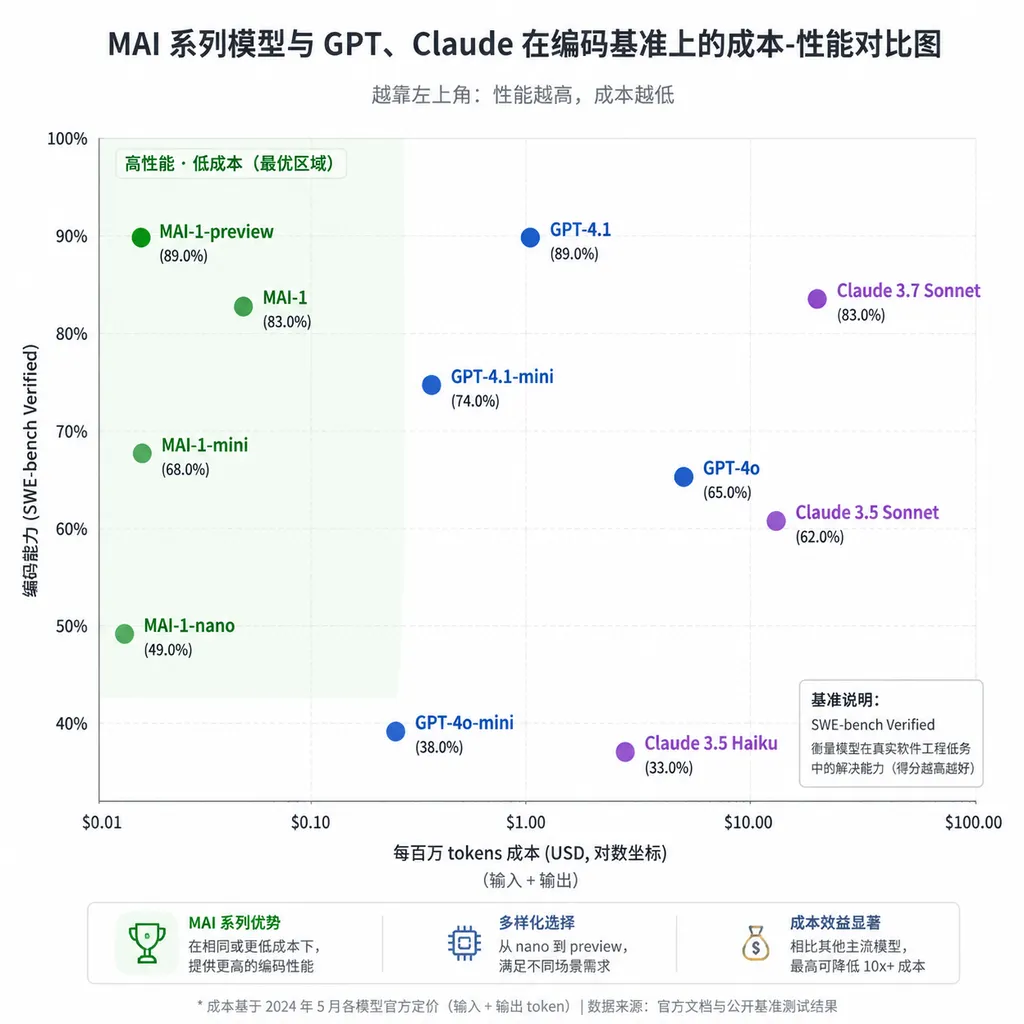
What’s really worth paying attention to is the cost structure. MAI-Thinking-1’s core selling point is low token pricing, and that’s no coincidence. Internally, Microsoft no longer evaluates Copilot models based on “which model is strongest,” but rather “how much money can be saved per 1,000 calls.” When your use case involves hundreds of millions of users typing =IF formulas into Excel and having AI autocomplete them, once model capability passes a certain threshold, marginal cost becomes the decisive factor.
Silicon Valley’s “Cost Reduction” Consensus
TechCrunch described Microsoft as “the latest” tech giant to join the AI cost-cutting wave. That wording is accurate.
Over the past six months, several trends have clearly tightened:
- In-house model development: Google has Gemini, Meta has Llama, and Amazon is betting on both Nova and Anthropic. Microsoft was the last hyperscaler to shift from “buying externally” to “primarily building internally.”
- Scenario segmentation: High-value scenarios (code generation, complex agents) use the strongest models, while long-tail scenarios (email summaries, spelling suggestions) use cheaper smaller models. Excel and Outlook clearly fall into the latter category.
- Inference optimization: Technologies like MoE, distillation, and speculative decoding moved rapidly from research papers into production over the past year.
In other words, the brute-force approach of “just throw the entire GPT-4 stack at everything,” common in 2024–2025, is no longer economically viable in 2026. Even a company like Microsoft, sitting on hundreds of billions in cash, has to calculate ROI.
What This Means for OpenAI and Anthropic
In the short term, not much changes. MAI currently handles only a “small proportion” of Microsoft’s total AI calls — Bloomberg’s wording, which probably translates to single-digit percentages. OpenAI and Anthropic are still collecting huge checks from Microsoft.
But the direction is irreversible. Here’s a plausible progression:
- 6–12 months: MAI’s share in general Office scenarios (spelling, summaries, simple formulas) rises to 30–50%.
- 12–24 months: GitHub Copilot’s default model shifts from Claude/GPT to the MAI-Code series, with external models reserved only for premium paid tiers.
- After 24 months: Nearly all core workflows under the Copilot brand run on MAI, while OpenAI and Anthropic become “premium options.”
For OpenAI, the situation is manageable because Microsoft is no longer its only channel. AWS integration, an upcoming IPO, and ChatGPT’s growing direct-to-consumer revenue all help diversify its position. But for Anthropic — whose revenue relies heavily on enterprise APIs, with Microsoft as one of its biggest customers — the impact could be more immediate.
The Developer Perspective
For those of us building systems, Microsoft’s move sends a simpler message: no model provider is irreplaceable.
Two years ago, many teams built their entire stack around “GPT-4 for everything,” with prompts tailored specifically to GPT’s behavior. Today, if you look at mainstream application backends, most use routing architectures — a Router layer decides whether a request goes to Claude, GPT, Gemini, DeepSeek, or a local small model based on task type, cost budget, and latency requirements.
This is also why aggregation layers are becoming more valuable. Platforms like OpenAI Hub exist for exactly this reason: one API key gives access to the full lineup of GPT, Claude, Gemini, and DeepSeek models, compatible with the OpenAI format and directly accessible domestically without dealing with proxies. Today you might use GPT-4o; tomorrow you may want to switch to Claude Sonnet for comparison — just change one model parameter line. No need to apply for new accounts or deal with overseas payments. As Microsoft’s replacement wave accelerates, if the MAI series eventually opens external APIs, these aggregation platforms will almost certainly integrate them immediately.
Architectures that remain stable in engineering are never the ones locked into a single provider.
A Slightly Off-Topic Observation
One final detail. In Suleyman’s June remarks, there was a phrase worth examining carefully: “ensure Microsoft will never again be forced to accept exorbitant prices set by leading AI labs.”
Behind that sentence is a shift in power dynamics. In 2023, Microsoft was OpenAI’s “savior,” and Satya Nadella could influence Altman’s decisions with a single sentence. By 2026, with OpenAI valued at over $500 billion, AWS competing for business, and exclusive IP licensing agreements expiring, Microsoft has realized it has gone from being “the client” to merely one client among many.
In that sense, building MAI isn’t just about saving money — it’s about regaining bargaining power. That’s the real significance of this news.
Sources
- ITHome: Microsoft’s In-House MAI AI Models Begin Taking Over Office Applications - First Chinese-language report on the event, including Suleyman’s June remarks and Build conference background


