
Rowboat Open Source: Bringing Agent Workflows Back to Local Environments
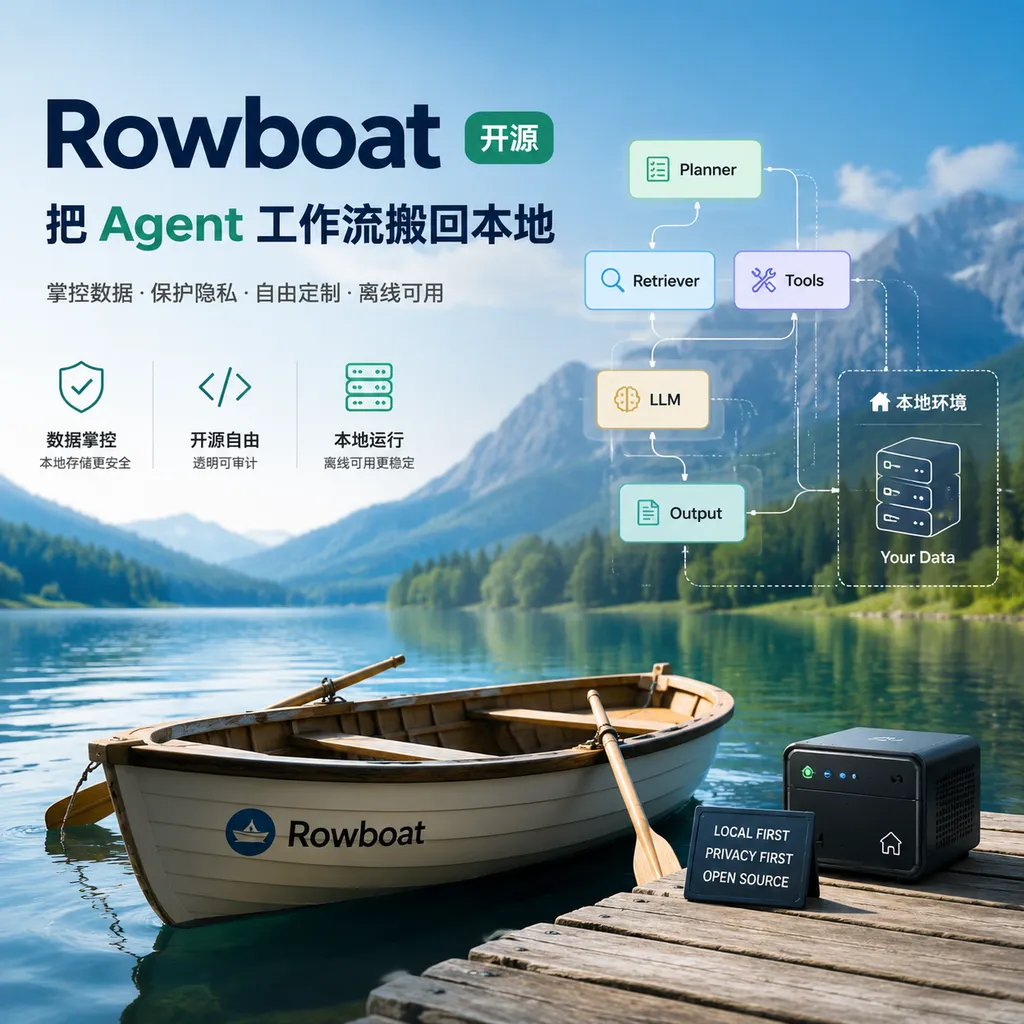
Rowboat Labs has open-sourced a local-first alternative to Claude Desktop, focused on offline agent workflow orchestration, directly entering the currently most crowded Desktop Agent space.
Rowboat Brings Claude Desktop’s Workflow Local
Yesterday, Rowboat Labs officially open-sourced their desktop Agent platform, Rowboat, on GitHub. The positioning is straightforward: a local-first alternative to Claude Desktop, focused on AI Agent workflows that can run offline. The project shot to the top ranks of Hacker News the same day it launched, and the most common comment in the discussion was: finally, someone is taking this seriously.
The timing is interesting. Just three months ago, Manus, Claude Cowork, ChatGPT Agent, Genspark, and Perplexity Computer were still battling aggressively over the $20/month desktop Agent subscription market, while YouTube was flooded with “which one should you choose” comparison videos. Rowboat flips the table entirely: stop subscribing, run the models and orchestration stack on your own machine instead.
What Problem Does It Actually Solve?
First, it’s important to clarify the current pain points of Claude Desktop. As Anthropic’s official MCP host, Claude Desktop fundamentally depends on two things: Anthropic’s cloud models and the MCP tool ecosystem. The former means every prompt you write and every document you mount passes through Anthropic’s servers; the latter may be an open protocol, but the host itself is closed-source. If you want to modify interactions or add custom orchestration logic, your only option is patching around the edges.
Rowboat completely separates these layers:
- Open-source host: The entire desktop app is built with Tauri + Rust, with a React frontend. All code is public, so you can fork and customize it however you want.
- Pluggable models: Supports local models through Ollama by default, while also supporting remote APIs, including Anthropic, OpenAI, and various OpenAI-compatible aggregation layers.
- Local workflow storage: Agent definitions, conversation history, and vector indexes are all stored locally using SQLite + LanceDB, so it continues working offline.
- Native MCP compatibility: Directly reuses Claude Desktop’s
claude_desktop_config.jsonformat, meaning your existing MCP Servers can be migrated with essentially zero effort.
That last point is the killer feature. All the MCP ecosystem tools that emerged over the past six months—file systems, Git, Playwright, database connectors, and more—can run in Rowboat unchanged, often without even requiring a restart.
Can “Local-First” Actually Perform Well?
This is the first question everyone asks when they hear “local-first.” Rowboat’s documentation gives a fairly honest answer: yes, but you need to choose your models carefully.
The repository README recommends Qwen3-Coder-30B or GLM-4.6-Air in 4-bit quantized form, running on an M3 Max/M4 Pro or an NVIDIA GPU with at least 32GB VRAM. Lightweight tasks like browser operations, file organization, and schedule management can be handled by 8B-class models, but heavy reasoning still benefits from cloud models.
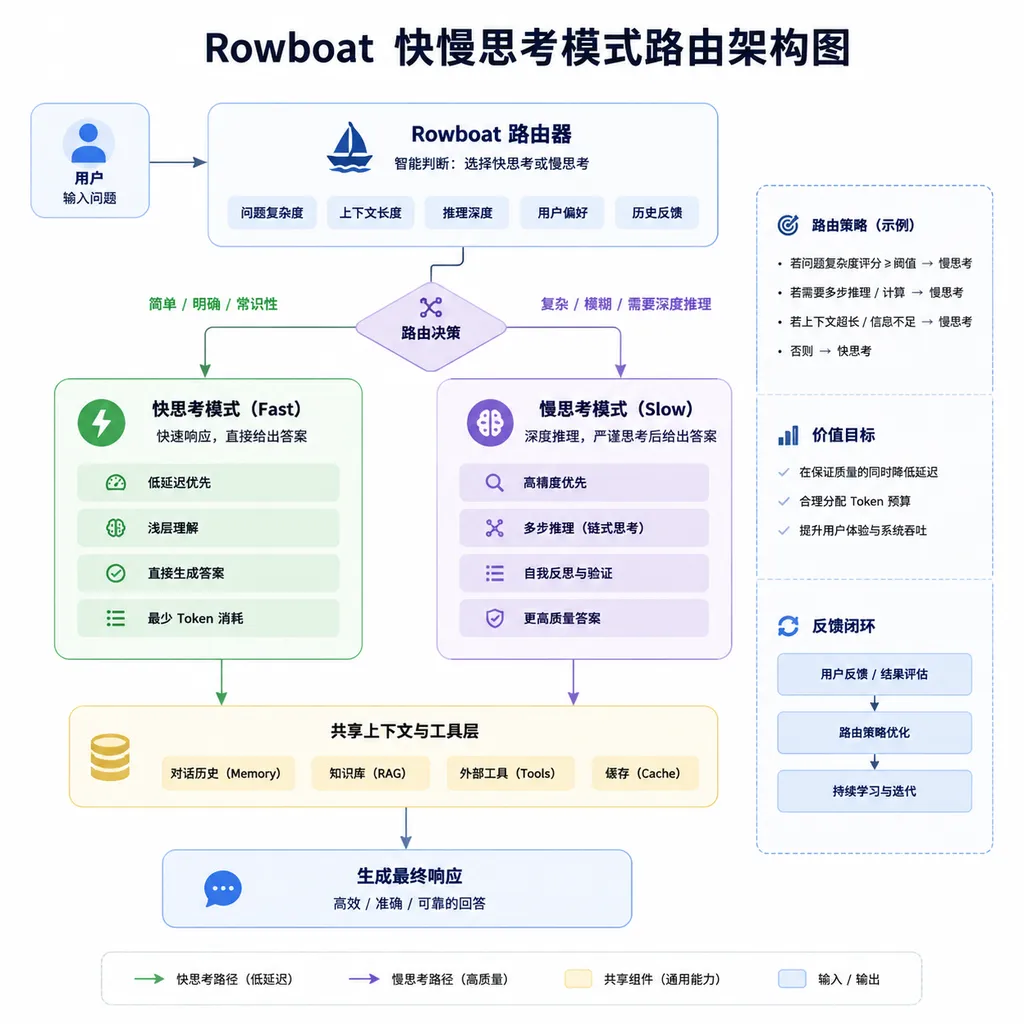
One particularly smart design choice is its fast/slow thinking mode switching. Simple instructions are handled instantly by smaller local models, while complex multi-step tasks are automatically routed to a configured remote large model. The idea resembles DeepSeek’s MTP + speculative decoding acceleration approach from earlier this year, but applied at the application layer.
The project also briefly mentions hallucination control. Internal benchmark data claims hallucination rates dropped from 12.5% to 5.4%, while multi-turn conversation failure rates fell from 17.4% to 7.9%. These numbers haven’t been independently reproduced, but they at least show the team understands that reliability matters more than raw intelligence in Agent scenarios. Anyone who has built Agents knows the reality: if one step fails in a ten-step chain, the whole workflow collapses.
What’s Different About the Architecture?
Looking through the code, Rowboat’s core abstraction consists of three layers:
1. Runtime Layer
A Rust-based execution engine responsible for tool call scheduling, MCP Server lifecycle management, and local model loading. The biggest highlight here is native support for a 256K context window, without truncation or crude sliding-window compression. Instead, it relies on an incremental KV Cache reuse mechanism to control VRAM usage.
2. Orchestrator Layer
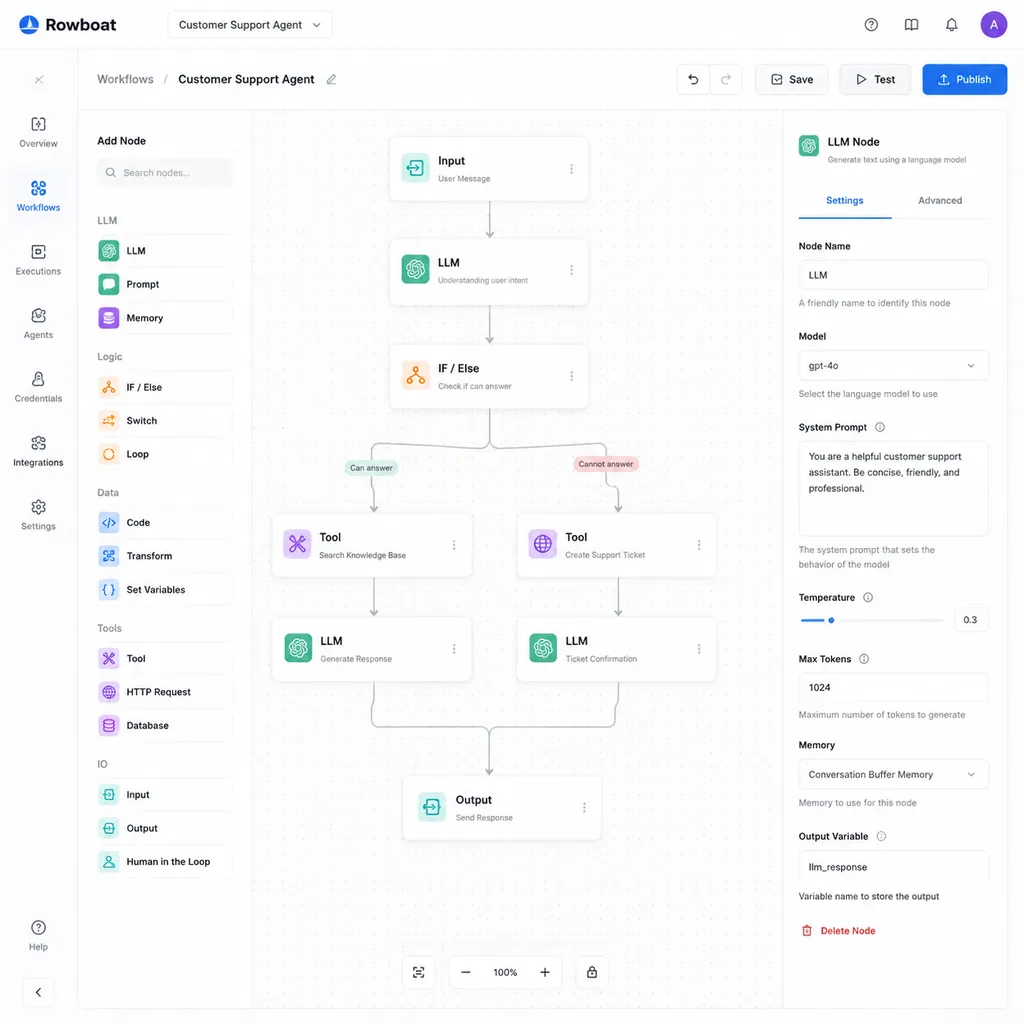
Workflow orchestration is visual and DAG-based, somewhat reminiscent of n8n but more Agent-oriented. You can define sub-agents, assign dedicated toolsets, and configure fallback strategies. The design is similar to open-source orchestration projects like ruflo and superset that gained attention earlier this year, but with the advantage of deep host integration, eliminating the need for separate services.
3. Interface Layer
This is the desktop app users interact with. The design is intentionally restrained: no flashy UI, just a chat window and a sidebar listing workflows. For developers, that’s a positive—there’s almost no learning curve.
Where Does It Fit Compared to Existing Solutions?
To be fair, the Desktop Agent space is already becoming crowded:
- Claude Desktop: Closed-source, cloud-dependent, with the most complete MCP ecosystem, but no customization.
- Cursor / VS Code + Cline: Essentially Agents embedded in IDEs, great for coding workflows but awkward outside the editor.
- Manus / Genspark: Fully managed and highly capable, but all your data lives on their servers.
- Zed: Open-source and extremely fast, though its Agent capabilities are still relatively basic.
Rowboat occupies a very specific niche: developers who enjoy tinkering, care about data sovereignty, but don’t want to be locked into an IDE. That audience is larger than it might seem. On Reddit’s r/AI_Agents, people regularly ask for “an open-source alternative to Claude Desktop,” and until now the usual answer has been, “No, just use Zed as a workaround.”
Still, expectations should stay realistic. Its weaknesses are equally obvious:
- Model capability is still constrained by local hardware. Fully offline performance comparable to Claude Sonnet 4.5 or GPT-5 is unrealistic in the near term.
- MCP compatibility does not mean plug-and-play. Many MCP Servers depend on Node.js environments, which still creates setup friction for Windows users.
- Visual orchestration has expressive limits. For truly complex Agents, you’ll probably end up writing TypeScript hooks eventually.
A Practical Usage Recommendation
If you want to try it today, here’s a reasonable approach:
- Use Rowboat to take over your existing MCP toolchain and replace Claude Desktop as the host;
- Don’t rush into full localization of models—connect an aggregation API first and compare GPT, Claude, Gemini, DeepSeek, and others side by side;
- Move latency-sensitive or privacy-sensitive workloads (such as local file processing or code review) to Ollama-hosted local models afterward.
Speaking of model integration, OpenAI Hub has already added Rowboat configuration templates. With a single API key, you can access GPT, Claude, Gemini, DeepSeek, GLM, and other major models simultaneously through an OpenAI-compatible interface, including direct connectivity from China. That saves users from stuffing five separate endpoints into configuration files. For anyone trying to quickly validate “which model runs my Agent workflow most reliably,” this type of aggregation layer is far more efficient than applying for APIs one by one.
A Bigger Signal
Stepping back, Rowboat’s open-sourcing is really part of a broader trend that has emerged over the past six months: Agent infrastructure is moving from SaaS back to local environments.
From cc-connect and CLI-Anything late last year, to ruflo and OpenSandbox earlier this year, and now Rowboat, there’s a clear pattern of developers systematically pulling Agent capabilities away from “black boxes hosted on someone else’s servers” and back into “white boxes running on my own machine.” Behind this shift are concerns about privacy and cost, but also a more fundamental belief: Agents operate inside your workflow, so they must be fully under your control.
Claude Desktop is good, but it’s ultimately Anthropic’s product, and Anthropic determines its direction. Whether Rowboat itself succeeds still depends on the next few months of iteration, but at least it belongs to the community. That may ultimately matter more than “yet another open-source release.”
References
- Rowboat GitHub Repository - Project source code, documentation, and configuration examples
- AI Open Source Trend Daily #63 - Recent developments in open-source AI Agent orchestration projects
- r/AI_Agents Discussion: Claude Desktop Alternatives - Community discussion on choosing MCP hosts


