
OpenAI Launches gpt-realtime-2.1: Voice Latency Cut by One Quarter
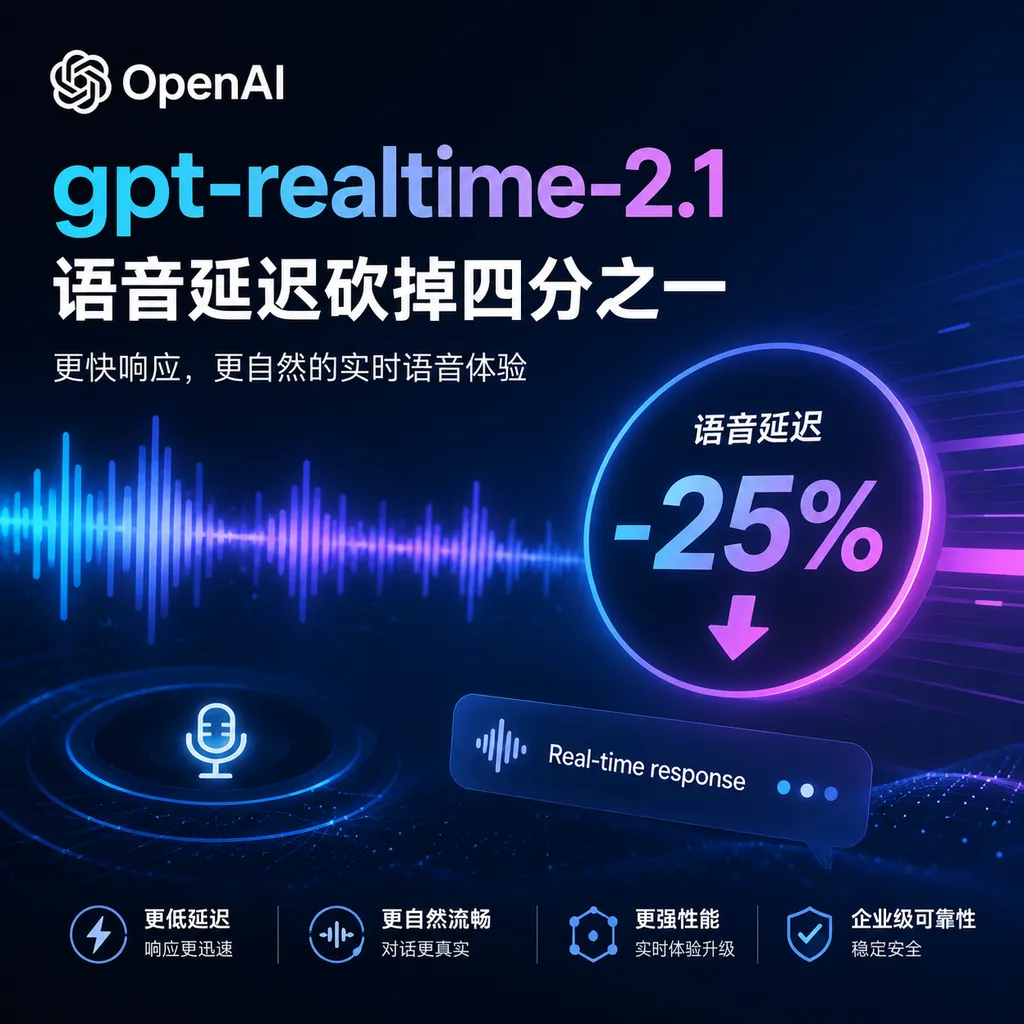
OpenAI quietly launched gpt-realtime-2.1 and a mini version yesterday. By optimizing caching, they reduced the Realtime API’s p95 latency by at least 25%. The mini version is also a small model capable of reasoning, with no price increase.
OpenAI Releases gpt-realtime-2.1: Realtime API p95 Latency Cut by 25%, Mini Version Now Includes Reasoning
On July 7, OpenAI posted an update announcement on its developer forum: two new models have been added to the Realtime API — gpt-realtime-2.1 and gpt-realtime-2.1-mini. At the same time, improvements to the caching mechanism have reduced p95 latency for Realtime voice models by at least 25%.
No developer conference, no CEO keynote — just a forum post and a documentation update. But for teams building voice agents, this is the most important move in the past two months, arguably more practical than the May release of GPT-Realtime-2, which brought GPT-5-level reasoning into voice. Because when it comes to voice interaction, latency is the line between life and death.
What Does a 25% Reduction in p95 Latency Actually Mean?
First, let’s clarify p95. This is not average latency — it’s the 95th percentile, meaning 95% of requests respond faster than this number. In voice agent scenarios, average latency is a misleading metric because users experience the long tail. Your average may look great at 300ms, but if one out of every ten conversations freezes for 1.5 seconds, users leave immediately.
Reducing p95 by 25% means long-tail requests become significantly more consistent overall. OpenAI describes this as happening “through improved caching,” which basically means cache hit rates have improved. This lines up with the blog post they published a few weeks ago about “rewriting the underlying connection stack in Go” — after replacing the network stack, session reuse and context caching paths became shorter, with the biggest gains appearing in persistent connection scenarios.
We still need real-world validation from the community. But judging from wording like “at least 25%,” the internal median improvements are probably higher, likely above 30%.
gpt-realtime-2.1: Fixes Focused Entirely on Production Problems
gpt-realtime-2.1 is an iterative upgrade of GPT-Realtime-2 released in May, and all the changes are aimed squarely at production environments:
- Improved alphanumeric recognition: Phone numbers, order IDs, VINs, verification codes — these are major failure points for voice customer service systems. Version 2.1 further improves alphanumeric sequence recognition in Spanish, Chinese, Japanese, and French.
- Silence and noise handling: Better robustness against office background noise, traffic sounds, TVs playing at home, and similar interference.
- Interrupt handling: No explanation needed here — whether a voice agent can naturally resume after being interrupted directly determines user experience.
- Instruction following: Hard constraints in system prompts such as “must read the disclaimer first” or “cannot answer unrelated questions” are enforced more strictly in 2.1.
- Configurable reasoning effort: Five levels — minimal / low / medium / high / xhigh.
This reasoning-effort tier system carries over from GPT-Realtime-2. The default is set to low, and OpenAI officially recommends starting production voice agents at the low level. That’s solid advice — most developers instinctively want to max everything out to xhigh for “maximum intelligence,” but while xhigh scores 96.6% on Big Bench Audio, the tradeoff is explosive latency and cost increases. Real-world conversational scenarios generally don’t need reasoning that heavy.
gpt-realtime-2.1-mini: A Small Model That Actually Thinks
The mini version is the more interesting part of this update.
It is a true mini reasoning model — and the key word here is reasoning. The old gpt-realtime-mini was basically just a cheaper conversational model. The new 2.1-mini adds reasoning capability, allowing the model to perform internal reasoning before taking actions, while maintaining conversational continuity through spoken filler phrases like “Let me think” or “Give me a second to check that.”
Pricing remains exactly the same as the previous mini version, but capabilities have significantly improved. This is classic OpenAI strategy: increase performance while keeping pricing fixed, pulling developers back from competitors.
For teams building voice customer support, voice ordering systems, or outbound call bots, 2.1-mini is likely the version that will actually see mass deployment. The full 2.1 model is better suited for complex agent scenarios — multiple tool calls, cross-session state management, handling ambiguous instructions, and so on. Everyday customer support can run perfectly well on mini.
Pricing: The Mini Version Is Shockingly Cheap
gpt-realtime-2.1 (per million tokens)
| Modality | Input | Cached Input | Output | |------|------|----------|------| | Text | $4 | $0.40 | $24 | | Audio | $32 | $0.40 | $64 | | Image | $5 | $0.50 | - |
gpt-realtime-2.1-mini (per million tokens)
| Modality | Input | Cached Input | Output | |------|------|----------|------| | Text | $0.6 | $0.06 | $2.4 | | Audio | $10 | $0.30 | $20 | | Image | $0.8 | $0.08 | - |
Two details are especially important:
First, cached input pricing has been cut to the bone. Cached audio input costs only $0.30–$0.40 for both models, making it 30–80 times cheaper than uncached input. That’s why OpenAI keeps emphasizing cache optimization — they want developers to use caching both to reduce latency and to encourage longer context sessions through massive cached-price discounts.
Second, mini’s audio output costs $20 per million tokens, more than three times cheaper than 2.1. By industry convention, one minute of voice consumes roughly 1000–1500 audio tokens, meaning a one-hour conversation on mini costs roughly $1.50. At that price point, it becomes viable inside real call-center financial models.
Usage Example
Both models connect through the Realtime API via WebSocket or WebRTC. OpenAI Hub already supports them, with API keys and request formats remaining OpenAI-compatible:
// Connect to the Realtime API via WebSocket
const ws = new WebSocket(
  "wss://api.openai-hub.net/v1/realtime?model=gpt-realtime-2.1",
  {
    headers: {
      "Authorization": `Bearer ${OPENAI_HUB_KEY}`,
      "OpenAI-Beta": "realtime=v1"
    }
  }
);

// Initialize session, with reasoning effort set to low
// (officially recommended starting point for production)
ws.on("open", () => {
  ws.send(JSON.stringify({
    type: "session.update",
    session: {
      modalities: ["audio", "text"],
      voice: "cedar",
      instructions: "You are a customer support assistant. Read phone numbers digit by digit.",
      reasoning: { effort: "low" },
      turn_detection: {
        type: "server_vad",
        threshold: 0.5,
        silence_duration_ms: 500
      },
      tools: [
        {
          type: "function",
          name: "query_order",
          description: "Query order status by order ID",
          parameters: {
            type: "object",
            properties: { order_id: { type: "string" } },
            required: ["order_id"]
          }
        }
      ]
    }
  }));
});
To use the mini version, simply change the model to gpt-realtime-2.1-mini; all other parameters remain fully compatible. For Chinese teams, one advantage of connecting directly through OpenAI Hub is avoiding overseas networking complications. WebSocket persistent connection stability is one of the most critical factors in Realtime API scenarios — latency is already pushed to the limit, and adding an unstable proxy chain can completely wipe out the 25% optimization gains.
One Hidden Detail: The Default Model Hasn’t Switched Yet
In the forum thread, an OpenAI engineer mentioned that the Playground still defaults to gpt-realtime-2. Version 2.1 is already available, but it is not the default yet. This is a very typical staged rollout strategy — release it first for developers to pressure-test, then switch the default after one or two weeks if the community doesn’t uncover major issues.
That means integrating 2.1 right now comes with a small bonus: early users get access to relatively idle inference clusters, so real-world latency is often even better than the official numbers. Once the default switches and traffic surges in, p95 will likely move back toward the published figures.
Also, both models share the same knowledge cutoff date: September 30, 2024, identical to GPT-2, with no update. This is unsurprising — the core strength of Realtime models lies in voice capabilities, not freshness of knowledge. New information can always be handled through tool calls.
Competitive Positioning: Anthropic and Google Need to Respond
Looking at the broader timeline:
- May: GPT-Realtime-2 brought GPT-5-level reasoning into voice and expanded context from 32K to 128K.
- July: The 2.1 series cuts latency by 25% and adds reasoning to the mini version.
OpenAI is iterating on voice agents at a quarterly cadence, and each release introduces measurable hard metrics. Anthropic’s Claude is still largely absent in voice, while Gemini Live benefits from Google’s ecosystem but continues to struggle with latency and instruction following.
The truly interesting comparison is the triangle of cost / latency / reasoning. gpt-realtime-2.1-mini pushes all three dimensions downward simultaneously — whereas previously you could only optimize two out of the three. Whoever ships a competitive alternative in Q3 stays in the game. Whoever doesn’t will effectively concede the voice-agent market.
Practical Recommendations for Developers
- Projects already using GPT-Realtime-2: Simply change the model parameter to
gpt-realtime-2.1. No other modifications are necessary. Improvements in alphanumeric recognition, noise handling, and interruption recovery are essentially free upgrades. - Starting new projects: Begin with mini + low reasoning effort by default. Measure p95 latency under real traffic, and only increase reasoning levels if instruction following or tool usage becomes problematic.
- Cost-sensitive scenarios: Put system prompts, common tool descriptions, and role settings into the session preamble to maximize cache hits. With an 80x price gap for cached audio input, there’s no reason not to exploit it.
- Don’t trust average latency: Before deployment, always measure p95 and p99 curves. Long-tail requests are the primary cause of user churn in voice agents.
Final takeaway: this update is not the kind of explosive release that demands immediate headlines, but it is a critical step in moving voice agents from “impressive demos that fail in production” to systems that can actually scale reliably. Teams working in this space should already have 2.1 evaluation tasks scheduled into this week’s sprint.
References
- ITHome: OpenAI Updates the 2.1 Series GPT Realtime AI Models, Reducing p95 Latency by at Least 25% - Comprehensive Chinese media coverage of this release, including pricing and capability details


