
MiniMax’s Next Shot: A 2.7 Trillion-Parameter MoE Model

MiniMax has reportedly been preparing a new-generation large model with 2.7 trillion parameters, six times larger than the 428 billion parameters of M3. At a time when DeepSeek is exerting pressure and the “Six Little Tigers” are collectively shifting direction, MiniMax still chooses to continue betting on the ultra-large-scale MoE route.
MiniMax’s Next Bullet: A 2.7-Trillion-Parameter MoE Model Is on the Way
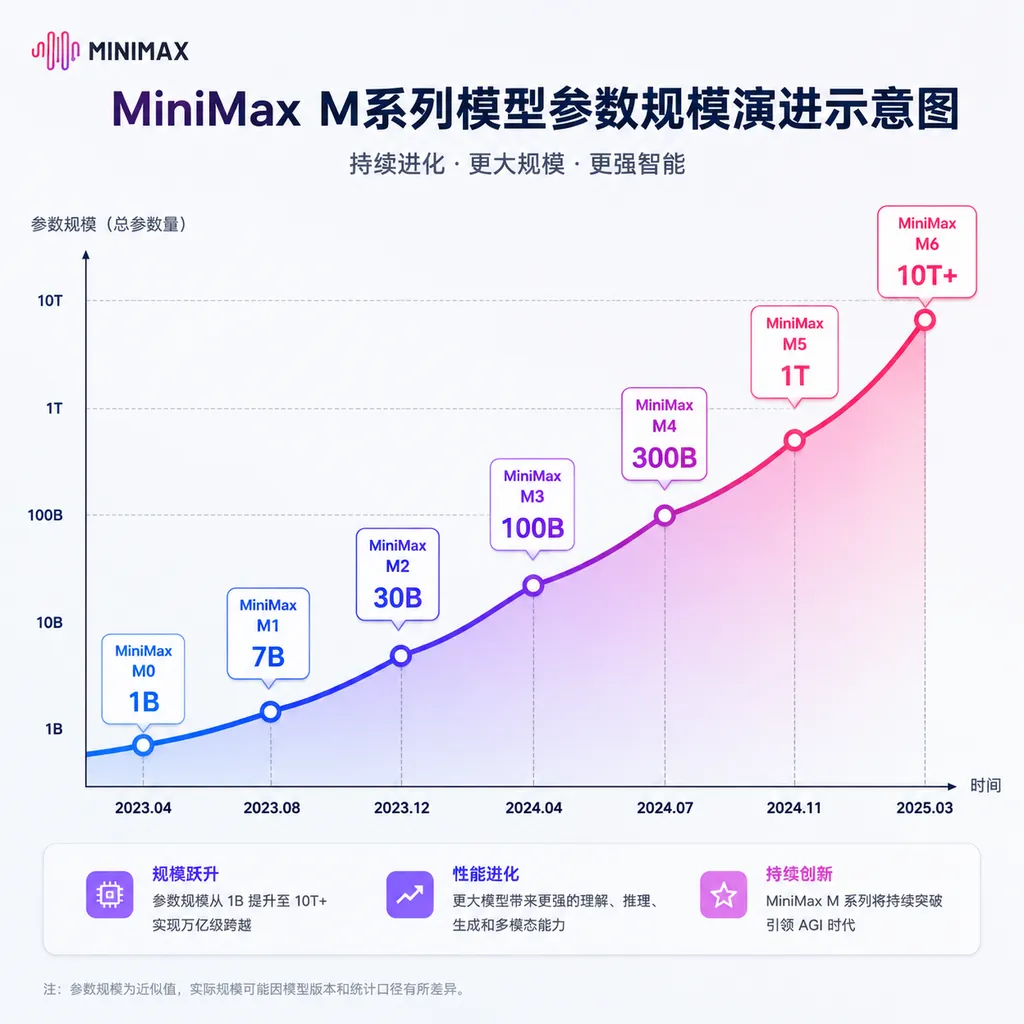
On July 8, according to a report from STAR Market Daily, MiniMax, operated by Xiyu Technology, is preparing a new-generation large model with a parameter scale of 2.7 trillion. This marks another major leap in model size following the open-sourcing of M3 last month. Compared with M3’s 428 billion total parameters, the new model would be roughly more than six times larger; compared with DeepSeek V3’s 671 billion, it would be close to quadrupling the scale.
At the moment, the news is still only at the “planning” stage. There is no confirmed timeline, nor any disclosure about the architecture or activated parameter count. But looking at Xiyu’s trajectory over the past year—from M1’s 456 billion, to M2/M2.5’s 230 billion, then M3’s 428 billion, and now the rumored 2.7 trillion—a clear pattern has emerged: MiniMax has no intention of following the industry trend toward “smaller and more refined” models. Instead, it continues pushing upward in total parameter count.
What Does 2.7 Trillion Actually Mean?
First, some context. Among publicly known models, only a handful reach this scale:
- GPT-4 (widely circulated industry estimate): around 1.8 trillion total parameters, MoE architecture
- Kimi K2: Moonshot AI’s open-source MoE released last July, trillion-parameter scale
- DeepSeek V3/R1: 671 billion total parameters, 37 billion activated
- Qwen3-Max: trillion-parameter scale
- MiniMax M3: 428 billion total parameters, 23 billion activated
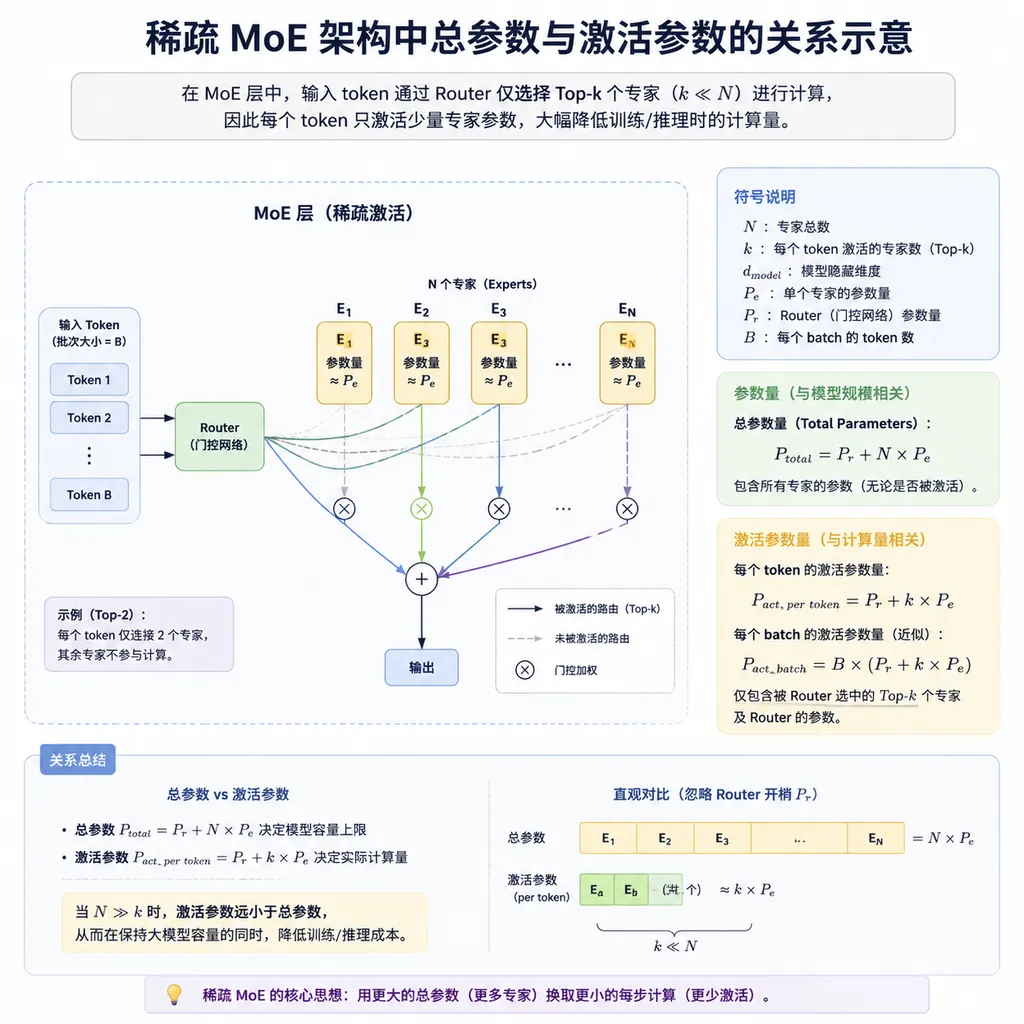
If the 2.7-trillion model launches, it would place Xiyu directly among the ranks of the largest publicly known models in the world by total parameter count. Of course, total parameters in MoE models are not directly equivalent to “intelligence level”—what truly determines cost and inference experience is the activated parameter count. Extrapolating from M3’s sparsity ratio (4280B / 23B ≈ 5.4%), if the 2.7-trillion model maintains a similar activation ratio, the activated parameters would land somewhere around 130–150 billion. Using DeepSeek’s 5.5% sparsity as a reference also yields a scale of roughly 140 billion activated parameters.
This would already be a “top-tier” model rather than a “cost-effective” one. To use an analogy: if M3 was still something “a high-performance consumer workstation could run,” the 2.7-trillion version is clearly targeting data-center-grade private deployments—scenarios such as finance, government, and large internet companies operating their own clusters.
Why Now, and Why Still “Big”?
There’s an ongoing debate in the industry here: after DeepSeek demonstrated what 671B can achieve, does continuing to scale parameter counts still matter?
Last month, Titanium Media’s article “The Six Little Dragons of Large Models Say Goodbye to Adolescence” put it bluntly: after DeepSeek’s open-source release, the valuation anchors of the “Six Tigers” were shaken, and the “scientist idealism” narrative was hit with cold reality. 01.AI and Baichuan have already explicitly abandoned general-purpose large models; Moonshot AI stopped large-scale traffic acquisition and pivoted toward foundational R&D; Zhipu and MiniMax chose the IPO route.
Against this industry backdrop, MiniMax choosing to continue scaling up sends a very clear signal. It aligns with Yan Junjie’s earlier strategic shift from “equal emphasis on models and products” to “models first.” Financial data also supports the decision—MiniMax’s total revenue in 2025 reached USD 79.038 million, up 158.9% year-over-year; gross margin increased from 12.2% to 25.4%; R&D investment reached USD 250 million. With cash on hand and B2B API consumption rising (daily token usage of the M2 series in February 2026 was more than six times that of December 2025), if not now, when would they invest heavily in models?
There are also more practical considerations:
- M2.5 already validated that the “large parameter count + high sparsity” route can be cost-effective. M2.5 achieved 80.2% on SWE-Bench Verified while keeping inference cost down to USD 1 per hour;
- Agent scenarios are rapidly increasing demands on model ceilings. Yan Junjie himself has said that programming is evolving from “tools” to “coworker-level” collaboration, and office scenarios will replicate programming’s adoption speed. To meet this wave of “L4–L5-level intelligence” demand, a model with only 20 billion activated parameters may indeed fall short;
- Breakthroughs in training efficiency have made the economics of scale-up viable again. MiniMax’s in-house Agent RL framework Forge reportedly delivers roughly 40x training acceleration for text models, directly changing the cost equation for training a 2.7-trillion-parameter model.
MoE Sparsification Has Always Been MiniMax’s Core Direction
If you trace MiniMax’s model roadmap from the abab era to today, one thing stands out: nearly all of the company’s key models have been aggressively pursuing sparse MoE architectures.
- M1 (June 2025): 4560B total / 45.9B activated, the world’s first open-source large-scale hybrid-architecture reasoning model, with 1 million context length
- M2/M2.1/M2.5 (Q4 2025 to February 2026): 2300B total / 10B activated, context compressed to 200K, focused on Agents
- M3 (June 2026): 4280B total / 23B activated, returns to million-token context + native multimodality
- Rumored next generation: 2.7 trillion total parameters
Several conclusions stand out from this roadmap:
First, MiniMax has become highly skilled at balancing “total parameters” versus “activated parameters.” The M2 series reduced activated parameters and shortened context length essentially to support high-frequency calls in Agent scenarios; M3 then restored long-context capabilities. This ability to tailor models according to scenario requirements is what gives them confidence to push toward 2.7 trillion.
Second, the hybrid attention architecture will likely continue evolving. M1 already used a “hybrid architecture,” mixing Lightning Attention with standard attention to reduce inference costs. At the 2.7-trillion scale, without engineering optimizations in the attention mechanism, KV Cache alone could overwhelm GPU memory.
Third, the open-source strategy will likely continue. M1, M2, and M3 were all open-sourced, and M2.5 even topped OpenRouter usage rankings for an extended period. For MiniMax, open source has become a commercial strategy of “trading ecosystem adoption for customers”—especially after going public, where the secondary market focuses on token consumption growth curves.
One Big Question: Will This One Be Open Source Too?
This is the question developers care about most. From M1 to M3, all models were open-sourced, earning MiniMax considerable goodwill in the community. But 2.7 trillion is a special scale—weight files could easily reach several terabytes, and even after downloading them, very few organizations would actually have the hardware capable of running the model.
Looking at Kimi K2 as a reference (a trillion-scale model that was open-sourced mainly for cloud vendors and research institutions), MiniMax will most likely also release the weights, but in practice, most users will still access it via API calls. That is also why Chinese teams like MiniMax and DeepSeek are willing to release weights—the real commercialization battlefield lies in token consumption, not private deployment.
For developers, it’s worth mentioning that the MiniMax M-series models have already been integrated into the OpenAI Hub aggregation gateway. With a single API key, users can access GPT, Claude, Gemini, DeepSeek, and MiniMax simultaneously, all compatible with the OpenAI format and directly accessible within China. Once the 2.7-trillion version launches, developers should theoretically be able to switch to it immediately under the same API key for comparative testing, avoiding the hassle of setting up separate integrations.
A Watershed Moment for the “Six Tigers”
Taking a broader view, this 2.7-trillion announcement is another sign of the “Six Tigers” diverging onto different paths.
- Moonshot AI: Kimi K2 already reached trillion scale, and today it released Kimi 2.5, continuing its model-centric strategy
- Zhipu: after going public, doubling down on government and enterprise markets, focusing on office Agents
- StepFun: all-in on multimodality + devices, partnering with hardware manufacturers like Geely and OPPO
- 01.AI and Baichuan: simply exiting the general-purpose large model race
- MiniMax: going public while continuing to scale up, while maintaining consumer-side cash flow from Talkie and Hailuo AI
Each company is searching for a path that allows it both to survive and continue growing. MiniMax’s path—using ultra-large-scale models to drive a growth flywheel in API consumption—is the one most similar to OpenAI and Anthropic among these strategies. Its risks are also obvious: the training and inference costs of a 2.7-trillion model are enormous, and if token consumption growth fails to keep pace, the patience of the secondary market may not last long.
That said, in the AI industry today, “playing it safe” has never been the defining trait of winners. If this 2.7-trillion model launches as planned in the second half of 2026, the ceiling for Chinese open-source large models will be raised yet again.
Now we wait for more details.
Sources
- Report: MiniMax Plans to Launch a New-Generation 2.7-Trillion-Parameter Large Model - IT Home: Original source of the news, including background information on M3’s 428 billion parameters
- The Six Little Dragons of Large Models Say Goodbye to Adolescence - Zhihu: Industry analysis on the strategic divergence among the “Six Tigers,” including architectural details of the 456-billion-parameter M1 model


