
Perplexity Secretly Built a Coding Agent, Codenamed Teammate
Perplexity’s internally developed AI programming tool, Teammate, which has been used in-house for two months, has been revealed. Positioned as an engineering agent that takes over the entire software project workflow, it directly targets Cursor, Claude Code, and Codex.
Perplexity Quietly Built a Coding Agent Codenamed Teammate
Another search company is coming after Cursor’s lunch.
On July 8, Business Insider obtained a batch of internal screenshots showing that Perplexity has been internally using a self-developed AI coding tool codenamed Teammate since May. IT Home later confirmed the news. The company, valued at $20 billion and originally focused on competing with Google Search, is quietly reaching into the fiercely competitive AI Coding space.
According to insiders, the company has not yet decided whether to turn it into a public product, but engineers have already been using it for two months. Translated: the internal dogfooding phase is over, and productization is only a matter of time.
Not a Copilot, but a “Teammate”
The name is straightforward. Teammate is not a code completion tool or a chat sidebar — it’s an engineering agent capable of independently handling long-running tasks.
According to the leaked internal announcement, Teammate is positioned as:
"This tool is built specifically for long-term engineering development: fully owning projects, triaging issues, and monitoring production services."
Three key phrases: own projects, triage issues, monitor production. That’s essentially packaging the daily responsibilities of a junior-to-mid-level SRE + engineer and handing them over to AI. The screenshots already show engineers using it to debug internal systems, with the full workflow from reproduction to diagnosis to repair suggestions handled end-to-end.
This positioning is interesting. Right now, coding agents on the market generally fall into three camps:
- IDE-embedded camp: Cursor, Windsurf, Copilot — emphasizing interaction and context, with humans staying in the loop
- CLI/terminal camp: Claude Code, Codex CLI, Aider — command-line driven, suited for traditional engineers
- Asynchronous agent camp: Devin, OpenAI’s Codex Cloud, Google Jules — you hand off tasks and let them run independently
Teammate clearly belongs to the third camp, and goes even further — it also wants to manage production monitoring. This is no longer “helping you write code”; it’s “helping you operate a project.”
Why Perplexity Is Building This
At first glance, it seems odd for a search company to branch into coding tools. But if you connect the dots across Perplexity’s moves over the past year, it becomes less surprising.
From the Comet browser to vertical agents for finance, shopping, and travel, Perplexity has consistently expanded toward becoming a “general information interaction layer.” Aravind Srinivas has long moved beyond simply wanting to build “a better Google.” And programming is the highest technical barrier among all agent scenarios, as well as the best proving ground for both model and product capability — if you can automate engineering work, then automating other white-collar jobs becomes largely a matter of reuse.
There’s also a more practical angle: Perplexity itself is a heavy consumer of AI models, burning enormous amounts of money on inference every month. Building an internal tool both improves engineering efficiency and helps the company deeply understand “how agents should actually be built.” Two birds with one stone.
The CTO’s Bold Claim: Engineers Won’t Need to Read Code by Year-End
The most viral quote from this leak came from Perplexity CTO Denis Yarats.
A few weeks before Teammate launched internally, he reportedly said in an internal message that, by the end of this year at the latest — possibly even sooner — software engineers should “stop looking through code” and rely directly on AI for development.
Some employees pushed back, arguing that AI-generated code has poor quality and too many bugs. Yarats responded in classic Silicon Valley style:
"As long as AI-generated code passes all quality checks, there is no such thing as ‘bad code.’"
You can call that aggressive, or you can call it evasive. Because “passing quality checks” is itself a sliding definition — unit test coverage, static analysis, integration tests, code review, every layer of filtering can be adjusted. The real issue has never been “whether AI code can pass tests,” but rather whether the tests themselves can cover the edge cases that actually cause business problems.
Still, setting aside the controversy in tone, this reflects an increasingly clear industry signal: CTOs at leading AI companies are beginning to treat “engineers no longer directly reading or writing code” as a concrete short-term goal, not a ten-year vision. Anthropic’s Claude Code, OpenAI’s internal Codex efforts, and Cognition’s Devin are all heading in the same direction.
An Easily Overlooked Detail: Multi-Model
Another detail buried in the leak is easy to miss: Teammate is model-agnostic and not tied to any single LLM.
This is actually consistent with Perplexity’s style — its search product has long switched between GPT, Claude, and its own Sonar models. But in the coding-agent context, the implications are different.
Because coding agents place extremely demanding requirements on models:
- Long context windows: a medium-sized repository can easily hit 200k tokens
- Tool-calling stability: a single task may require dozens or even hundreds of tool calls, and one hallucination can ruin everything
- Depth of code understanding: performance varies dramatically across languages and frameworks
It’s difficult for any single model to excel in all dimensions. Claude Sonnet is stable for coding, Gemini has massive context windows, and GPT has advantages in complex debugging reasoning. For a mature coding agent, routing and orchestration capability may matter more than simply stacking raw model power.
Perplexity has years of product experience orchestrating multiple models, and that may be the real foundation behind Teammate. Others are wrapping agents around their own models; Perplexity is building model-agnostic agent infrastructure.
Competitive Landscape: Is There Still Room in This Market?
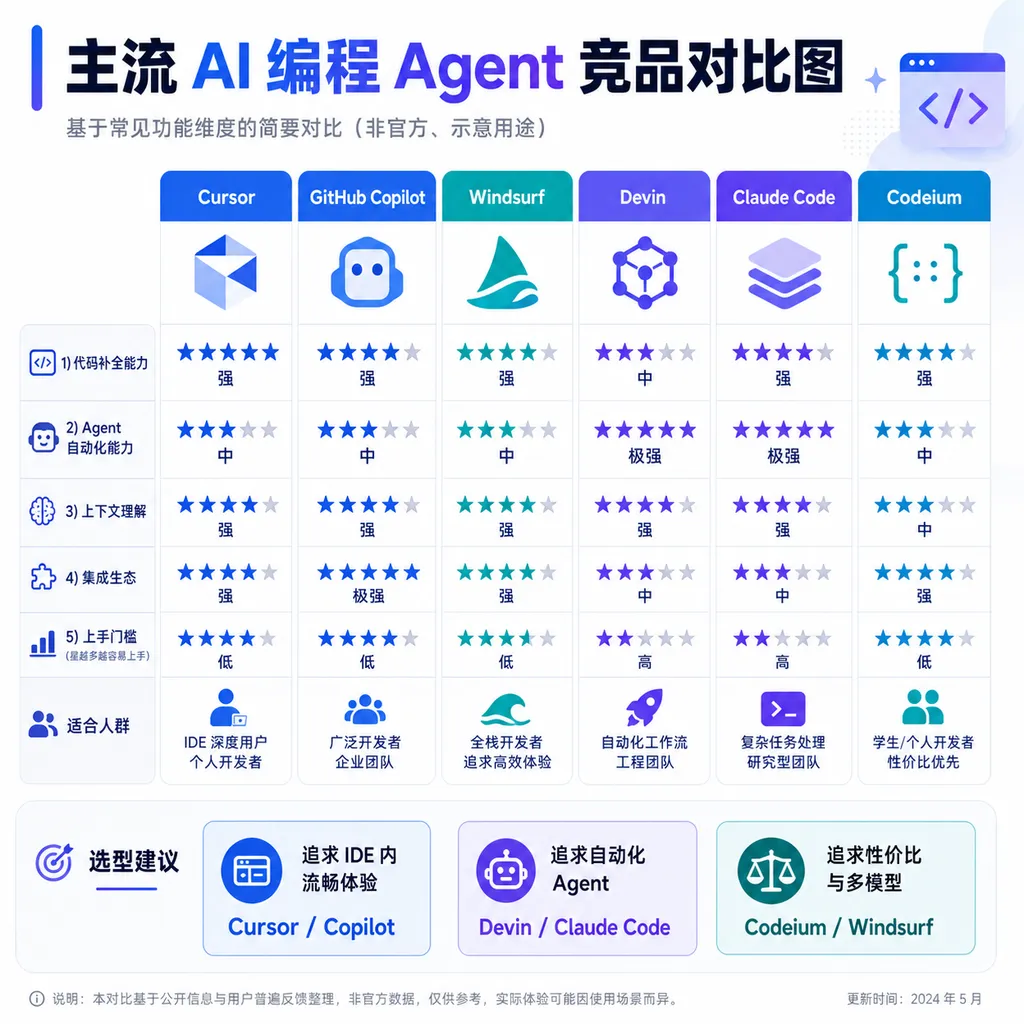
The AI Coding battlefield in the first half of 2026 is already extremely crowded:
| Product | Company | Positioning | |------|------|------| | Cursor | Anysphere | IDE, reportedly over $500M ARR | | Claude Code | Anthropic | CLI + Agent | | Codex | OpenAI | Cloud Agent + CLI | | Devin | Cognition | Fully autonomous agent | | Windsurf | Acquired by OpenAI | IDE | | Jules | Google | Asynchronous agent | | Teammate | Perplexity | Long-horizon engineering agent |
Cursor’s valuation has already entered the $10 billion club. Anthropic’s Claude Code is reportedly a major revenue driver. OpenAI spent heavily to acquire Windsurf. The leaders in this space are no longer easy targets for startups to disrupt.
So where is Perplexity’s opportunity window? My assessment comes down to two points:
First, the asynchronous agent segment still has no clear winner. Devin generated huge hype but mixed reviews, Codex Cloud is still relatively new, and Jules is more tightly integrated within Google. Whoever can build an agent that truly “takes over a backlog” rather than merely “completes an issue” will have a real chance. Teammate is clearly aiming at that goal.
Second, Perplexity has a unique distribution channel. Its search product already has substantial monthly active users. If it can integrate coding agents with search and browsing to create a “universal copilot for developers,” it may find differentiated positioning.
But the risks are also obvious: AI Coding products heavily depend on dogfooding and rapid iteration based on user feedback. The Cursor team lives in developer communities every day, and Anthropic has massive API customers using Claude Code. Perplexity’s internal engineering team is relatively limited, so whether it can sustain the iteration pace required for a complex agent product remains an open question.
When Will It Be Available?
Perplexity has not announced any official timeline, nor even confirmed whether it will become a commercial product. But judging from the timeline — internal launch in May, media exposure in July — it would not be an aggressive prediction to expect a preview release within the year.
For developers in China, the more practical question is: how can these new coding agents actually be used?
Tools like Cursor, Claude Code, and Codex fundamentally rely on API calls. As long as stable access to mainstream model APIs is available, most of their capabilities can be replicated. That’s also where aggregation platforms like OpenAI Hub provide value — one API key connecting GPT, Claude, Gemini, and DeepSeek, directly accessible in China and compatible with OpenAI formats. If Teammate eventually opens APIs, the integration path should also be relatively smooth.
A Final Take
Teammate itself is not especially earth-shattering — it’s 2026, and an AI company building an internal coding tool is completely normal. What’s truly worth paying attention to are two signals:
- The AI Coding battlefield is shifting from “assistance” to “takeover.” Copilot-style completion tools are no longer the center of the new battlefield; the future belongs to agents that handle long tasks, long cycles, and even operations management.
- The value of multi-model strategy is being repriced in the agent era. The “single model + application wrapper” approach is becoming increasingly difficult to sustain. Companies that can master multi-model orchestration will have structural advantages.
As for Yarats’ claim that engineers won’t need to look at code by year-end, I think it’s overly optimistic. But the direction is correct — engineers’ work is shifting from writing code toward defining problems, reviewing results, and maintaining systems. This transition is not future tense; it is already happening now.
References
- IT Home: Perplexity’s self-developed AI coding tool exposed, already in use by company programmers - First Chinese report containing key details from the Business Insider leak screenshots and internal CTO messages


