
Weng Li: The First Step of AI Self-Evolution Is Rewriting the Evaluation Layer
In her latest blog post, Weng Li proposed that “self-evolution starts with the harness,” arguing that the breakthrough point for the Agent training closed loop lies not in the model itself, but in the evaluation framework that has long been overlooked. DeepSeek’s Cui Tianyi reposted and endorsed the view, saying this direction is likely to produce results quickly.
Weng Li updated her blog yesterday with a very plain title — "Self-Evolution Starts with the Harness." The core idea can be summed up in one sentence: if you want Agents to truly self-evolve, don’t rush to modify model weights — improve the evaluation framework (Harness) first.
DeepSeek’s Cui Tianyi reposted it almost immediately, adding the comment: “This direction can produce results very easily.” It’s not common these days to see researchers from former OpenAI and DeepSeek independently converge on the same idea so quickly.
1. What Is a Harness, and Why Is Everyone Suddenly Talking About It?
First, let’s unpack the term. In the Agent context, a Harness refers to the “evaluation scaffolding” layer — it determines how tasks are fed to the model, how tools are exposed, how each step is judged as success or failure, and how rewards are fed back. You can think of it like a treadmill in a gym: the model is the runner, while the Harness is the treadmill itself, including the speed, incline, heart-rate monitoring, and the screen telling you, “You ran worse today than yesterday.”
Over the past two or three years, the industry’s attention has focused entirely on the runner — how many more tokens went into pretraining, what recipe was used for SFT, RLHF being replaced by GRPO, DPO giving way to KTO. But almost nobody touched the treadmill itself. People still use the same SWE-Bench, GAIA, and AgentBench setups, with evaluation sets hardcoded in YAML and a simple pass@1 score calculated at the end.
Weng Li’s argument is: if this layer doesn’t change, models cannot truly self-evolve.

2. Weng Li’s Specific Arguments
In the blog post, she discusses several layers of the problem. Here’s a translation into language developers can immediately align with:
1. The Harness Must Be Able to Iterate on Itself
Current evaluation frameworks are static — fixed tasks, fixed scoring, fixed environments. Once models “learn” the patterns of the Harness during training, scores become artificially inflated while actual capability stagnates. Weng Li’s idea is to turn the Harness itself into an evolvable object: tasks generated dynamically, scoring criteria revised through LLM reflection, and environments drifting over time.
This is somewhat analogous to AlphaGo’s transition from supervised learning to self-play — except this time, what self-evolves is not strategy, but the exam itself.
2. Reward Signals Should Be Decomposed at the Harness Layer
She emphasizes that many RL training failures are not algorithm problems but reward problems. In a SWE-Bench task, all you get at the end is pass or fail, while the dozen intermediate tool calls are compressed into a single binary label. That’s disastrous for credit assignment. If the Harness could provide fine-grained process rewards — which API call was wrong, which grep parameter was malformed — training efficiency could improve by orders of magnitude.
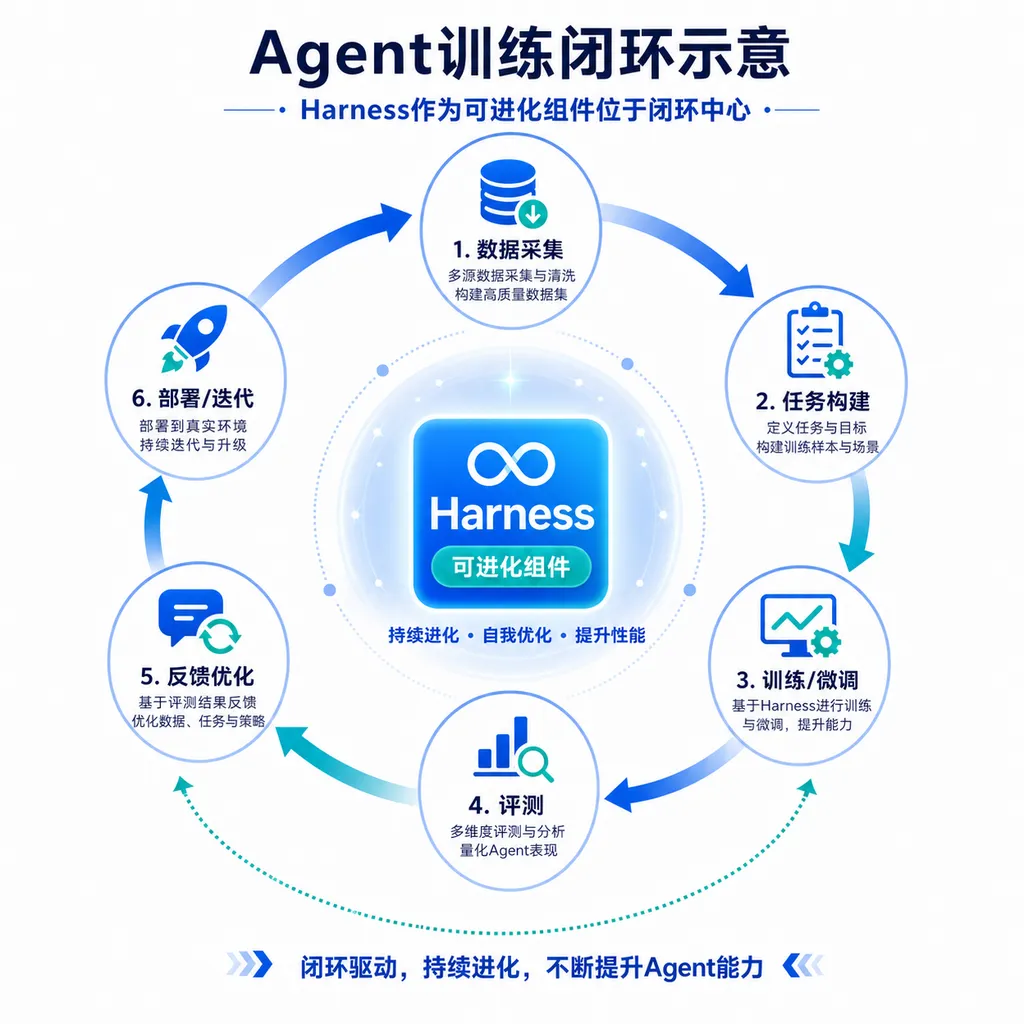
3. The Harness Is the First Piece of the Agent Training Feedback Loop
She diagrams a loop: Harness generates tasks → Agent executes → Harness evaluates and reflects → Harness updates itself → new round of tasks. The model is optimized within this loop, but what truly determines the ceiling is the evolution speed of the Harness itself.
3. Why Cui Tianyi Said “This Direction Can Produce Results Easily”
I thought about that statement for a while. DeepSeek has been heavily pushing the Agent capabilities of the R2 series over the past six months, so they probably understand the pain points of training pipelines better than most. “Easy to produce results” roughly translates into three things:
- The barrier is lower than retraining models. Improving the Harness doesn’t require an H100 cluster; a mid-sized team can do it.
- Gains are measurable. Using the same base model with a finer-grained Harness can immediately show different SWE-Bench results.
- Academically, it’s still a blue ocean. Most Agent papers accepted at NeurIPS and ICLR this year focus on prompts and workflows; very few specialize in Harness design.
In other words, this is a direction with an extremely high input-output ratio that most teams have overlooked.
4. Comparison with Current Mainstream Approaches
I looked through some of the more popular Agent training projects from recent months:
| Project | Focus | Is the Harness Layer Mutable? | |------|--------|------| | OpenAI o-series | Long-chain reasoning + RL | Mostly fixed | | Anthropic Fable 5 | Tool usage + safety alignment | Fixed | | DeepSeek R2-Agent | Code-generation feedback loop | Partially mutable | | Academic self-play agents | Strategy self-play | Rarely involved |
You can see that treating the Harness itself as an optimizable object has rarely been proposed systematically. Weng Li’s article is one of the first to state it explicitly.
5. Practical Implications for Developers
If you’re currently building Agent applications or doing internal fine-tuning, there are several things you can do immediately after reading this post:
- Treat your evaluation set as a living system. Don’t use the same fixed set of 100 questions for months. Build a task generator that creates new tasks every week.
- Label every tool invocation with fine-grained annotations. Even without RL, simply being able to pinpoint “where the Agent started going off track” is invaluable for debugging.
- Decouple the Harness from the model. Don’t hardcode scoring logic inside prompts. Abstract it into an independent service for easier replacement, A/B testing, and future RL integration.
6. One Personal Observation
Over the past year and a half, the industry has largely operated under one implicit assumption: as long as foundation models keep improving, Agent capabilities will naturally follow. After Claude Fable 5 achieved 80% on SWE-Bench Pro, that assumption seemed even more convincing.
But Weng Li’s post highlights something else entirely — the capabilities you can measure are the capabilities you can optimize. The reason Fable 5 can score 80% is fundamentally because Anthropic has been feeding it with a much more sophisticated private Harness than SWE-Bench over a long period of time. What the public sees is a strong model; what’s actually strong is the unpublished evaluation infrastructure behind it.
So over the next period, I expect two groups of players to emerge:
- One group will continue competing on model scale and RL algorithms;
- The other will quietly compete on Harnesses — writing task generators, process evaluators, and environment simulators.
The second group probably won’t generate headlines in the short term, but looking back a year or two from now, they are likely the ones who actually made Agents capable of real work.
The fact that both Weng Li and Cui Tianyi are focused on this direction is itself a signal.
References
(The primary blog posts and repost discussions related to this topic were mainly published on X and personal blogs. No in-depth discussions have yet accumulated in publicly accessible Chinese technical communities, so there are currently no whitelist-compliant domestic links to include. If high-quality analyses later appear on Zhihu or Juejin, they will be added in the comments section.)


