
Cloudflare Joins Hands with OpenAI: Feeding Network Traffic Signals to AI Search

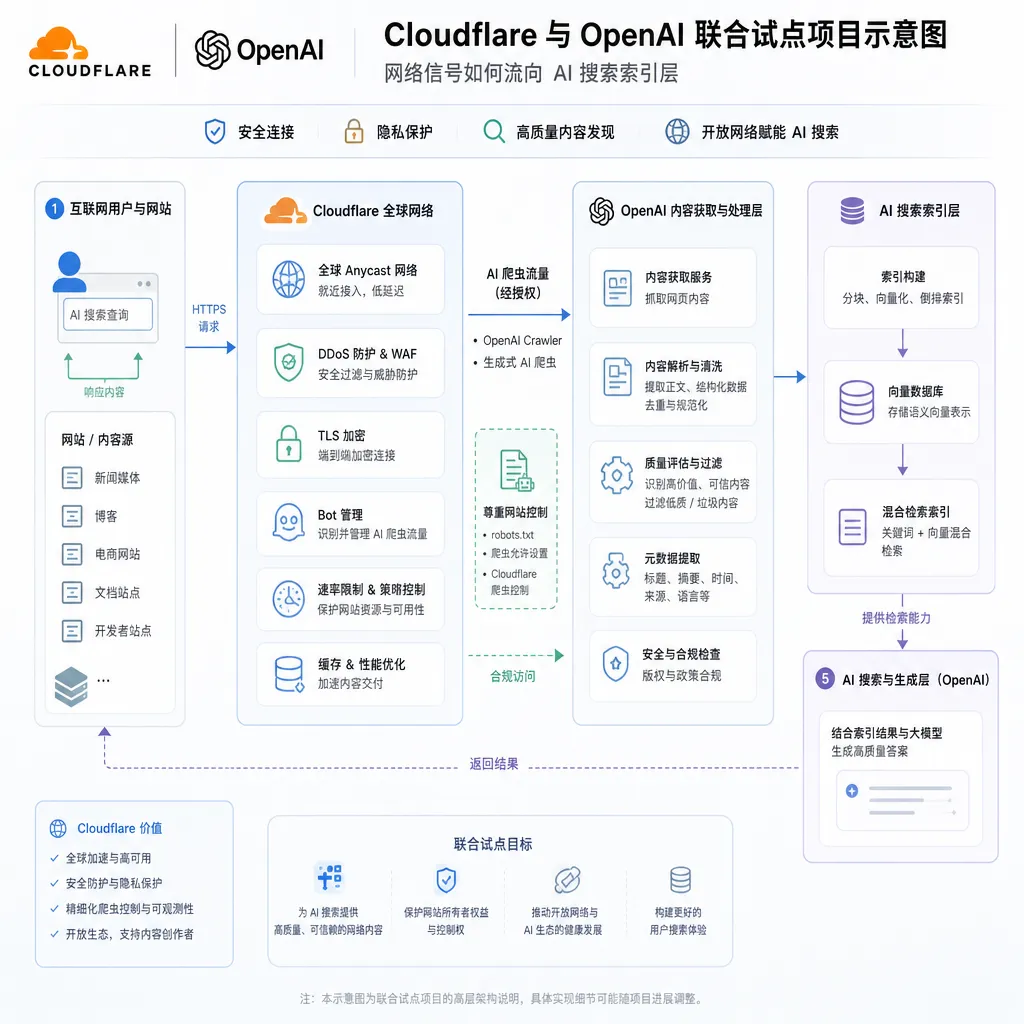
Cloudflare and OpenAI have launched a joint pilot program to connect real-time signals from the global network—content freshness, page changes, and traffic quality—directly to the crawling and indexing systems of AI search, with the goal of making answers more timely and preventing crawlers from doing unnecessary work.
A Collusion at the Infrastructure Layer
On July 8, Cloudflare and OpenAI officially announced a joint research pilot. The name sounds fairly conventional — “using global network insight data to optimize AI search” — but once you unpack it, the significance is much bigger than the headline suggests.
In simple terms: Cloudflare packages the real-time signals it sees across its network (which pages were just updated, which traffic comes from real humans, which content is worth crawling) and provides them to OpenAI. OpenAI then validates those signals using its own search-answering systems and real user queries. The goals are twofold: make ChatGPT-style products more timely and accurate, and eliminate wasteful crawling.
This is not a marketing-level “strategic partnership.” It is a direct integration at the crawling and indexing pipeline layer. Anyone who has worked on RAG or search should immediately recognize the implications here — the two biggest pain points in AI search, freshness and crawling cost, are being addressed simultaneously.
Why Cloudflare
The numbers speak for themselves: more than 20% of global internet traffic passes through Cloudflare’s network. At that scale, its awareness of “what’s happening on the internet right now” is effectively real-time. Which news site just published an article, which e-commerce page changed its price, which blog merely swapped out a favicon — Cloudflare can see all of it.
More importantly, it has visibility into traffic quality. In its own blog, Cloudflare stated that over 50% of online traffic now comes from non-human entities. Crawlers, bots, and AI agents are everywhere, creating an awkward situation: a page may be crawled hundreds of times by AI systems without ever being cited in an answer; meanwhile, a frequently cited page may not have been re-crawled for months.
Cloudflare CEO Matthew Prince put it this way: “By sharing our granular network signals, we can find better ways to improve AI search efficiency.” It sounds diplomatic, but the implication is obvious — current AI crawling strategies are crude, and Cloudflare is offering much finer-grained data.
This Is Exactly What OpenAI Lacks
Now look at it from OpenAI’s perspective. ChatGPT’s search capabilities have evolved rapidly over the past year, but “timeliness” remains one of the most common user complaints. Ask it about something that happened a few hours ago, and it either gives outdated information or admits that “the information I found may not be up to date.”
The root issue lies in the indexing layer. Traditional search engines have spent decades optimizing crawler and freshness systems. Google alone has published countless papers on something as specific as “when should a page be re-crawled.” As a late entrant to search, OpenAI faces enormous costs in building this scheduling infrastructure from scratch, and it lacks Google’s historical advantage of having already crawled the entire web.
Leveraging Cloudflare is a shortcut. Cloudflare can provide:
- Content freshness signals: which pages underwent meaningful changes rather than template refreshes
- Traffic quality signals: which pages are frequently visited by real users and therefore likely valuable
- Change granularity: distinguishing between “entire article rewritten” and “sidebar ad rotation”
OpenAI contributes the models, large-scale QA systems, and real query logs. It’s a balanced exchange: one side provides the “network,” the other the “brain,” jointly testing whether signal-driven crawling can significantly improve answer quality.
This Solves a Longstanding Industry Conflict
If you’ve followed the ongoing tension between AI crawlers and content publishers, you know this conflict has been building for a while.
A year ago, Cloudflare launched “Content Independence Day,” allowing site owners to block AI crawlers with one click. This year, it introduced “Pay Per Crawl,” enabling publishers to charge AI companies for crawling access. But Cloudflare itself acknowledged that this model is too crude: “A page may be crawled only once yet cited in thousands of answers; alternatively, it may be crawled repeatedly but never actually used.”
So they are evolving the model from “pay per crawl” to “pay per use.” Pilot programs are already underway with search companies like Ceramic.ai and You.com, experimenting with both per-query and per-result pricing.
Connect that thread to today’s OpenAI pilot, and the logic becomes clear:
- Cloudflare wants AI companies to reduce mindless crawling while giving publishers a fair value-distribution mechanism
- AI companies want to avoid wasting money and only crawl content that is genuinely valuable and updated
- Publishers want to receive compensation when their content is actually cited
All three parties’ interests converge around “fine-grained signals.” Today’s pilot essentially brings that logic to the industry’s top players.
Several Technical Details Worth Watching
From an engineering perspective, there are several interesting aspects here.
How freshness signals are defined. A page’s Last-Modified header has long been unreliable. Dynamic pages, CDN caching, and SSR all contaminate that field. What Cloudflare possesses is actual content diffs observed at edge nodes. In theory, this enables “content-level freshness” rather than merely “HTTP-level freshness.” For AI search, that difference is enormous.
Reallocation of crawl budget. OpenAI’s crawlers (GPTBot, OAI-SearchBot) undoubtedly already have their own scheduling algorithms, but they lack a web-wide perspective. With Cloudflare’s signals, they could theoretically make decisions like “this page hasn’t changed in three days, skip it” or “this page was just updated and traffic is surging, prioritize it,” focusing limited crawl budget where it matters most.
Separating bot traffic from real traffic. This is Cloudflare’s specialty. It can tell OpenAI: “Out of this page’s 100,000 daily page views, 80,000 are bots — don’t be misled by inflated traffic.” This becomes a subtle but critical input into answer-quality evaluation.
Index feedback loops. OpenAI has real query logs and can feed data back to Cloudflare: “Of the pages you recommended we prioritize, how often were they actually cited?” Once this loop is operational, the signal system should continuously improve.
My View: This Is a Milestone in the AI Search Infrastructure War
A subjective take.
The AI search space has been lively over the past year: Perplexity, You.com, ChatGPT Search, and Google AI Overviews are all competing aggressively. But most differentiation still exists at the model and product layers — fewer hallucinations, better citations, smoother interfaces.
The real foundational competition is actually about one question: “How do you know what currently exists on the web?” Google has twenty years of accumulated infrastructure here; everyone else is a newcomer. What Cloudflare and OpenAI are attempting today is a way to bypass that gap — not by crawling the entire web themselves, but by partnering with a company that already “sees” much of the web.
If this pilot succeeds, other AI search players will be under pressure. Anthropic, Google (despite having its own capabilities), and Perplexity will all need to consider whether they should also partner with Cloudflare. Will Cloudflare offer exclusivity? If not, will deeper partnerships give OpenAI access to better signals? These are very real questions.
Another hidden impact concerns the content ecosystem. As AI search crawling becomes more “precise,” the amount of long-tail content that gets crawled but never cited may decline, while citations become even more concentrated among top-tier content. For smaller publishers already struggling in the SEO era, this could be another major blow — though Cloudflare’s “pay per use” model at least leaves room for compensation.
What This Means for Developers
If you’re building products based on AI search or RAG, there are several signals worth paying attention to:
- ChatGPT Search’s timeliness may improve significantly soon. If your product relies on OpenAI search capabilities (such as the
web_searchtool in the Responses API), the performance ceiling may rise substantially. - Crawler friendliness matters again. If you operate a content site, exposing clear Last-Modified headers,
sitemap.xmllastmodfields, and using Cloudflare could make these signals much more important going forward. - Bot traffic detection will become more competitive. The tactic of disguising crawlers as browsers will become increasingly difficult, and Cloudflare’s detection accuracy will only improve.
For teams relying on multi-model capabilities, OpenAI Hub already supports unified access to mainstream models including GPT, Claude, Gemini, and DeepSeek. One API key, OpenAI-compatible format, direct connectivity from China. Once OpenAI’s search optimizations reach the API layer, clients won’t need to change anything.
Closing Thoughts
The next battle in AI search will not happen at the model layer, but in the pipeline layer that answers the question: “How do you know what’s happening on the web right now?” Cloudflare controls a significant portion of that pipeline, and that is exactly what OpenAI lacks. Today’s joint pilot is only the beginning. Over the next few months, what will really determine the importance of this partnership is whether they can produce measurable results — for example, improvements in answer freshness or reductions in crawl volume.
Another thing worth watching is whether other AI companies follow suit. Cloudflare clearly does not want to become an exclusive pipeline provider for OpenAI alone — its blog already states: “If you are building a question-answering engine and want to crawl more intelligently, we would also love to hear from you.” That is essentially an open invitation for bids.
References
- ITHome: Cloudflare and OpenAI launch pilot project using global network insight data to improve AI search efficiency — Initial report on the announcement, including Matthew Prince’s original comments


