
Mistral Enters Embodied AI: Robostral Navigate Climbs the Robot Navigation Rankings
Mistral today released its first robot navigation-specific model, Robostral Navigate, claiming state-of-the-art performance across multiple embodied AI benchmarks and pushing the French company from being purely a language model player into the physical world.
Mistral Has Reached Into Robotics
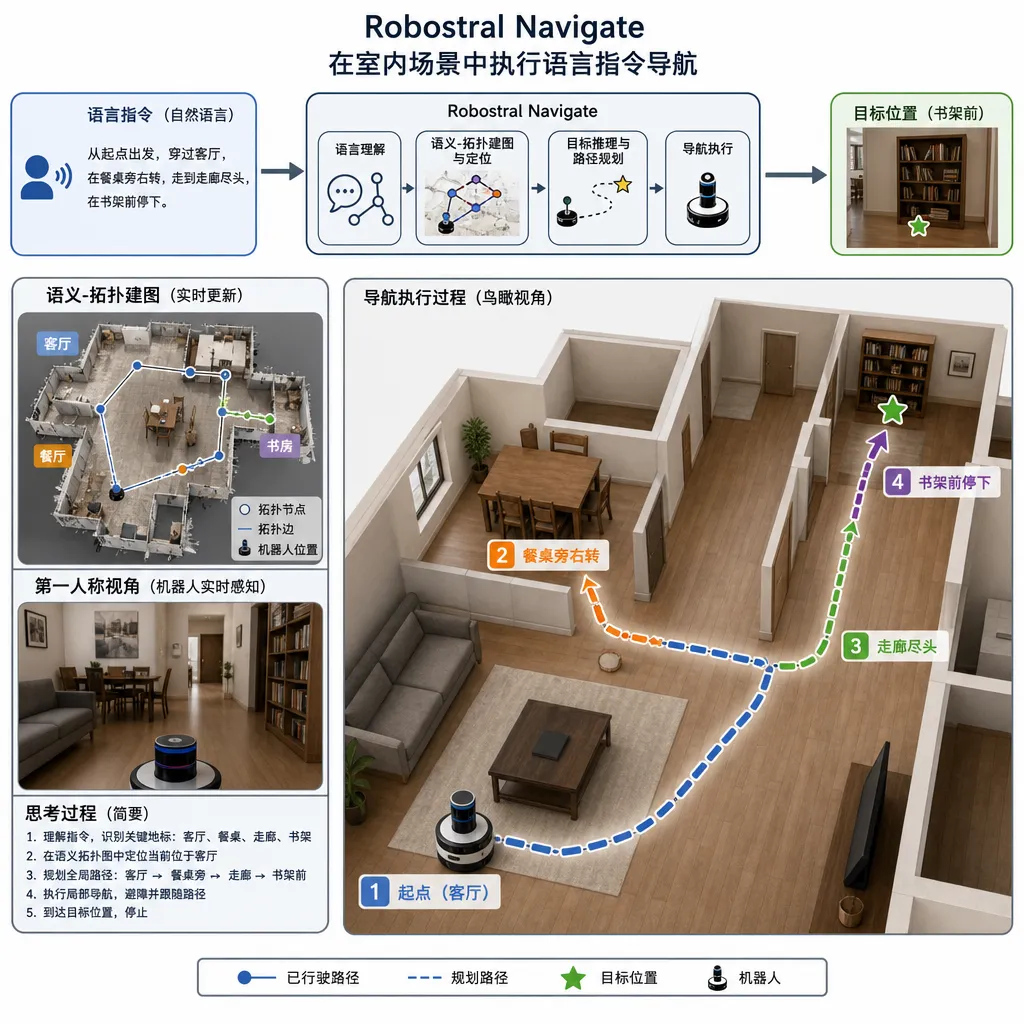
On July 8, Mistral released Robostral Navigate, a foundation model specifically trained for robot navigation. This is the French company's first public move beyond pure language models into embodied AI, and it is a significant leap in direction—from Le Chat, Codestral, Voxtral, and the whole family of "-stral" models to systems designed to operate in the physical world.
The official positioning is "state of the art," covering three major task categories: indoor navigation, open-world exploration, and language instruction following. It reportedly achieved top scores on mainstream benchmarks including Habitat, ObjectNav, and VLN-CE. In terms of release strategy, Mistral followed its usual pattern: release the model and paper first, with commercial licensing and enterprise deployment plans to follow later. The weights are also promised under a research license.
The move is not particularly surprising. Over the past six months, Robotics Foundation Models (RFMs) have become the new battleground for major AI companies—Google's Gemini Robotics, Figure's Helix, and Physical Intelligence's π series are all competing in this space. Mistral arrived late, but not absent, and its point of entry is interesting: instead of launching directly into a unified end-to-end VLA (Vision-Language-Action) model, it started with the relatively structured and mature domain of navigation, where benchmarking and comparative evaluation are easier.
What It Does Technically
Based on information disclosed in the official blog and technical report, Robostral Navigate includes several notable design choices.
1. Architecture: Bringing the Mistral Small Backbone into Embodied AI
The model uses the dense transformer backbone from Mistral Small 4 (not MoE, which is an important choice—robot inference is extremely latency-sensitive, and MoE routing overhead plus VRAM fluctuation is problematic on edge devices). The vision encoder was replaced with an in-house model called SpatialViT, specifically pre-trained to align depth maps, semantic segmentation, and occupancy grids.
Two parameter sizes were announced:
- Robostral Navigate 3B: intended for onboard deployment, capable of running above 15Hz on Jetson Orin-level hardware
- Robostral Navigate 12B: aimed at cloud and research scenarios, with a higher performance ceiling
The sizing is pragmatic. Compared with cloud-centric large-model approaches like Gemini Robotics, Mistral clearly prefers models that can run directly onboard robots. What robot manufacturers are actually willing to pay for are models that fit within a manageable BOM and hardware budget.
2. Training Data: The Usual Simulation + Real-World Recipe, but at Scale
The data strategy itself is not particularly surprising, but the scale is substantial. According to the release, the training set includes:
- More than 20 billion frames of simulated trajectories (based on Habitat 3.0, Isaac Sim, and an internal simulator)
- 120 million real-world robot rollout trajectories from partner fleets
- Large amounts of language-annotated path-planning data, including natural language instructions, path constraints, and failure feedback
One particularly interesting detail is the use of "Failure Replay" data construction: extracting real instances where robots crashed, got stuck, or became lost, and training the model to learn recovery strategies. The idea resembles DeepMind's earlier RT-Trajectory work, but Mistral emphasizes that this data accounts for as much as 18% of the dataset, which is considerably more aggressive than typical RFM ratios.
3. Training Strategy: A Three-Stage Pipeline
Training was divided into three phases:
- Spatial Pretraining: masked reconstruction using vision, depth, and point clouds to establish 3D spatial understanding
- Navigation Supervised Fine-Tuning: behavior cloning on simulated trajectories
- Online RL: PPO fine-tuning in simulation environments, combined with a VLM-based reward model to judge whether the target was reached and whether the path was reasonable
The reward model in the third stage uses a fine-tuned version of Mistral Medium 3.5. This is a classic example of internal model synergy within Mistral, and also one of its advantages over robotics-only startups: strong language model capabilities can be directly reused for reward modeling, instruction understanding, and chain-of-thought planning.
The Numbers: How Real Is the SOTA Claim?
The release blog provided results on several key benchmarks. Some representative examples:
| Benchmark | Previous SOTA | Robostral Navigate 12B | |---|---|---| | Habitat ObjectNav (val) | 68.2% SR | 74.5% SR | | VLN-CE R2R (val-unseen) | 62.1% SR | 69.8% SR | | HM3D-OVON (open-vocab) | 41.7% SR | 50.3% SR | | RxR-Habitat | 55.4% NDTW | 61.2% NDTW |
SR stands for Success Rate, while NDTW measures path similarity. If these numbers are reproducible, they are genuinely strong SOTA results—especially the nearly 9-point gain on HM3D-OVON, an open-vocabulary navigation task.
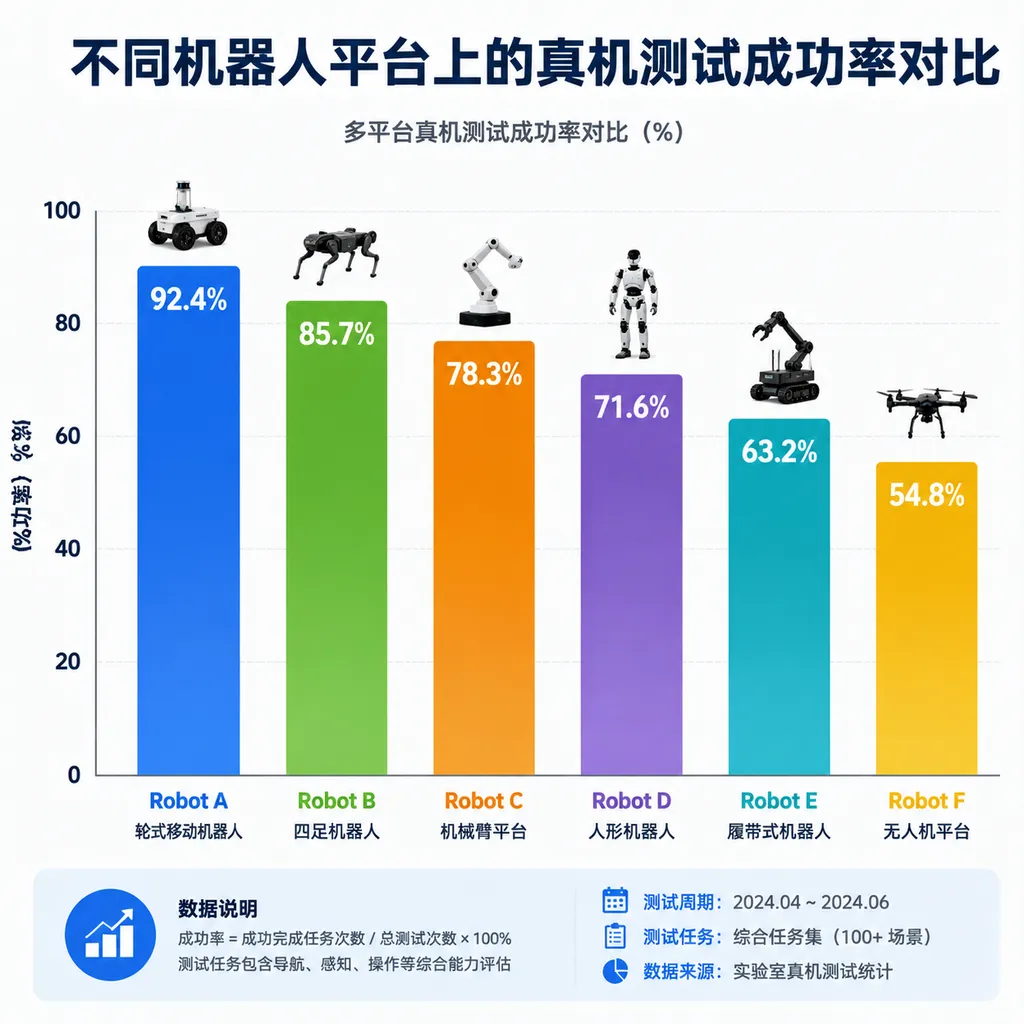
That said, robotics benchmarks always require caution. SOTA in simulation does not automatically translate to strong real-world robot performance, and SOTA on validation splits does not necessarily imply robust generalization. One smart move from Mistral was releasing results from real robot evaluations as well: cross-environment testing on four robot platforms (Boston Dynamics Spot, Unitree Go2, an AMR, and a humanoid robot). The success rates were significantly lower than in simulation, but the relative performance trends remained consistent.
Where It Sits Among Competitors
Positioning Robostral Navigate within the current RFM landscape:
- Compared with Gemini Robotics-ER: Google's system focuses on general embodied reasoning, covering grasping, navigation, and dual-arm coordination. Mistral focuses only on navigation, offering greater depth but narrower coverage
- Compared with Physical Intelligence π0.5: the π series uses an end-to-end VLA architecture with joint-angle outputs. Robostral Navigate outputs waypoints and motion primitives, making it closer to traditional planning stacks and easier to integrate into engineering systems
- Compared with NVIDIA GR00T N1: GR00T is more focused on humanoids and manipulation, with navigation as a secondary concern. Robostral Navigate is clearly more specialized in navigation
In short: Mistral chose a path centered on "deep specialization plus practical deployability." It is a very European approach—not chasing AGI-scale grand narratives, but going deep in areas where enterprise customers will actually pay. Looking at previous vertical models like OCR 4 and Voxtral TTS, Robostral Navigate fits perfectly into the same strategic direction.
Commercialization: Who Will Pay for It?
According to information from the blog, Mistral is already conducting joint deployments with several customers:
- A European logistics company working on warehouse AMR fleets
- A French cleaning robot manufacturer
- An industrial inspection robotics company
- And "a humanoid robotics company" (unnamed, though the wording strongly suggests a newer European player)
What these customers have in common is this: their environments are relatively structured, but traditional SLAM + planning stacks are reaching their limits. For example, the challenge for warehouse AMRs is no longer simply driving in straight lines, but understanding instructions such as "move this shelf to Zone 3 while avoiding the aisle currently being restocked." This is exactly the type of contextual instruction handling where models like Robostral Navigate can help.
The pricing strategy follows Mistral's usual pattern:
- Research-license weights available free for non-commercial use
- Commercial deployment requires separate licensing, priced by robot deployment count
- Cloud API access provided through La Plateforme
Some More Grounded Observations
Although the release generated a lot of attention, there are several points developers should keep in mind:
First, navigation is not the same as complete robot intelligence. Robostral Navigate solves "getting from A to B," but manipulation remains the truly difficult robotics problem. Mistral has not yet released a public manipulation model, and without one it is difficult to form a complete RFM stack.
Second, real-world data scale remains the moat. Mistral claims 120 million real rollouts, but compared with companies like Physical Intelligence and Figure that operate their own fleets, questions remain about data diversity and long-tail coverage. Partner-collected data often concentrates on a limited set of environments.
Third, the true openness depends on the weight release. Mistral says the 3B version will be available under a research license, while the 12B model is currently only offered through La Plateforme. This matches its previous strategy for the Large series—open smaller models to build ecosystem adoption, keep larger models closed for revenue. Whether developers consider this friendly depends on what the community eventually gets access to.
Fourth, real edge deployment power consumption. The claim of 15Hz on Jetson Orin sounds impressive, but Mistral did not specify whether this was achieved with INT8 quantization, nor did it disclose power usage. Robot manufacturers ultimately care about battery life and thermal management, and those questions will require third-party validation.
Final Thoughts
Robostral Navigate is not a revolutionary product, but it marks Mistral formally acknowledging something important: language models alone are not enough to tell the full AI story. While OpenAI is building Agents, Google is building Gemini Robotics, and Anthropic is building Computer Use, Mistral has chosen to enter embodied intelligence through a specific and practical slice of the problem.
That aligns with the company's consistent style—not trying to build the biggest thing, but the most deployable one. Whether this strategy succeeds will depend on the scale of real-world deployments and customer feedback over the next year. Based on today's release alone, Mistral has delivered a respectable first step.
Robostral Navigate is an open-source model, and the weights and inference code will be released gradually. Developers interested in the project will be able to deploy and test it locally.
References
- Hugging Face - Mistral Model Homepage: Mistral's official Hugging Face repository, where Robostral Navigate weights are expected to be released
- Reddit r/robotics Discussion: A central discussion hub for the robotics community around next-generation RFMs


