
Cognition Launches SWE-1.7: Coding Intelligence Goes Head-to-Head with GPT-5.5 and Opus

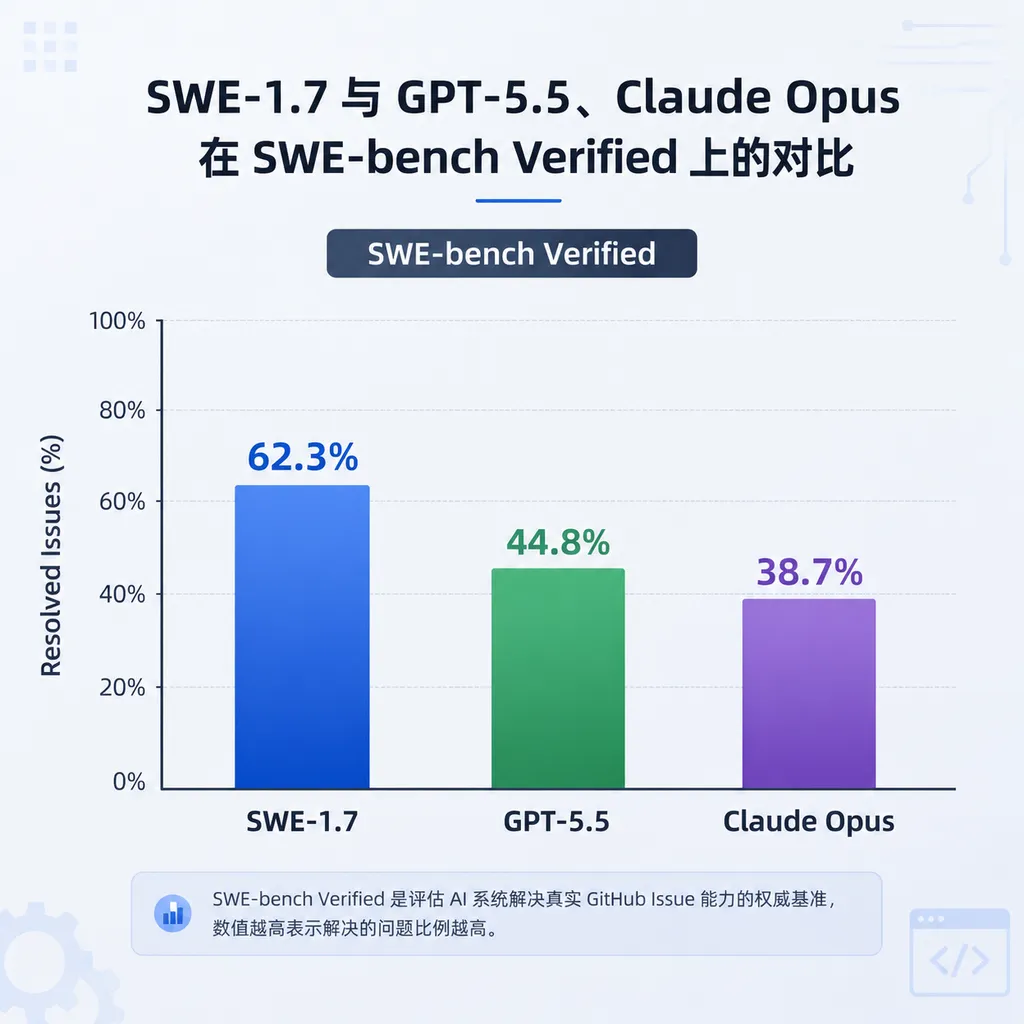
Cognition, the company behind Devin, has updated its in-house coding model SWE-1.7. On SWE-bench Verified, it is approaching GPT-5.5 and Claude Opus 4.8, as specialized models begin to catch up with general-purpose flagships.
Cognition released SWE-1.7 today, another iteration in the Devin team’s in-house programming model series. Looking at the numbers: on SWE-bench Verified, it’s now competing head-to-head with GPT-5.5 and Claude Opus 4.8 — both of which took turns topping the charts from April through June as general-purpose flagship models. A mid-sized model focused specifically on coding reaching this level means the “specialized vs. general-purpose” debate is about to be fought all over again.
One sentence summary of what happened
When the previous-generation SWE-1.5 launched, Cognition’s positioning was still “good enough, cheap, and fast” — an engine for its own agent products like Devin, avoiding Anthropic API calls in most scenarios. With SWE-1.7, the messaging changed: they’re now directly comparing their own model against GPT-5.5 and Opus 4.8. Cognition describes it as “near GPT-5.5 and Opus intelligence,” which basically translates to: we’re no longer the budget alternative — we’re competing head-on.
Judging from public third-party data, that claim is not much of an exaggeration. On vals.ai’s SWE-bench Verified leaderboard, Claude Fable 5 (Anthropic’s newly released reasoning-focused model) sits at the top with 95%, Opus 4.8 scores 88.6%, while GPT-5.5 and Opus 4.7 are both around 82%. The official SWE-1.7 number lands near the upper end of that range — meaning it has already pulled ahead of GPT-5.5 and Opus 4.7 by about half a step and is now closing in on Opus 4.8.
Why this matters
Over the past year, the “coding-specialized model” path has not gone particularly smoothly. Cursor Composer, the SWE-1 series released around the Windsurf acquisition, and customized Qwen-Coder variants from smaller companies all mostly occupied the niche of “cheap, fast, and good enough.” The models truly dominating benchmarks and becoming developers’ primary tools were still general-purpose flagships like Claude and GPT. The reason is simple: coding is not just about syntax — it requires reasoning, planning, tool usage, and long-context handling, areas where general-purpose frontier models have invested much more heavily.
What makes SWE-1.7 interesting is how it managed to close the gap. Cognition revealed several key signals in its blog post:
- The training data was extracted from Devin’s real execution traces. Devin has run massive numbers of production tasks over more than a year. What kinds of mistakes recur, which tool-call sequences actually fix bugs, what types of diffs pass human review — no other lab has access to this data. This is Cognition’s unique moat.
- The reinforcement learning environment was specifically designed for long-horizon coding tasks. SWE-bench Verified scores are relatively easy to optimize for, but the real differentiator is “multi-step agentic coding” — writing hundreds of lines, running tests, reading errors, rolling back, rewriting. SWE-1.7’s stability in these workflows has improved significantly over the previous generation.
- Distillation plus post-training. Industry consensus is that the SWE-1 series is likely built through extensive post-training on top of an open-source base model. This path’s ceiling has long been questioned, but SWE-1.7 demonstrates that with sufficiently authentic data and an RL environment closely aligned with real workflows, even mid-sized models can stay competitive with flagship systems.
Compared directly against GPT-5.5 and Opus 4.8, how far behind is it really?
One thing must be made clear: there’s quite a bit of ambiguity packed into the word “near.” Looking benchmark by benchmark:
| Task Type | SWE-1.7 Performance | Reference Models | |---------|-------------|---------| | SWE-bench Verified | Approaching the 82–85% range | GPT-5.5 (82.6%), Opus 4.7 (82.0%) | | Complex long-horizon agent tasks | Stability improved significantly, but still behind | Opus 4.8, Claude Fable 5 | | SWE-Bench Pro (real GitHub issues) | Not disclosed yet, caution advised | GPT-5.5 achieved 58.6% | | Terminal-Bench 2.0 | Not disclosed | GPT-5.5 leads with 82.7% |
In other words, SWE-1.7 has indeed caught up on “leaderboard-style” coding benchmarks, but for real-world scenarios like SWE-Bench Pro and Terminal-Bench — which require extremely strong planning and tool coordination — it still hasn’t produced sufficiently convincing data. Cognition is being strategic here as well, focusing heavily in its blog on SWE-bench Verified, the more mature benchmark track.
There’s another important detail that can’t be ignored: SWE-Bench Pro itself has recently become controversial. The DeepSWE report directly pointed out that roughly 32% of SWE-Bench Pro pass/fail judgments are “incorrect to a careful reader,” and there is also clear evidence of memorization contamination. This is why more frontier labs are increasingly turning to newer benchmarks like DeepSWE and Terminal-Bench for more realistic evaluation. If SWE-1.7 can eventually publish strong numbers on these newer benchmarks, its case will become far more convincing.
Devin’s real strategy
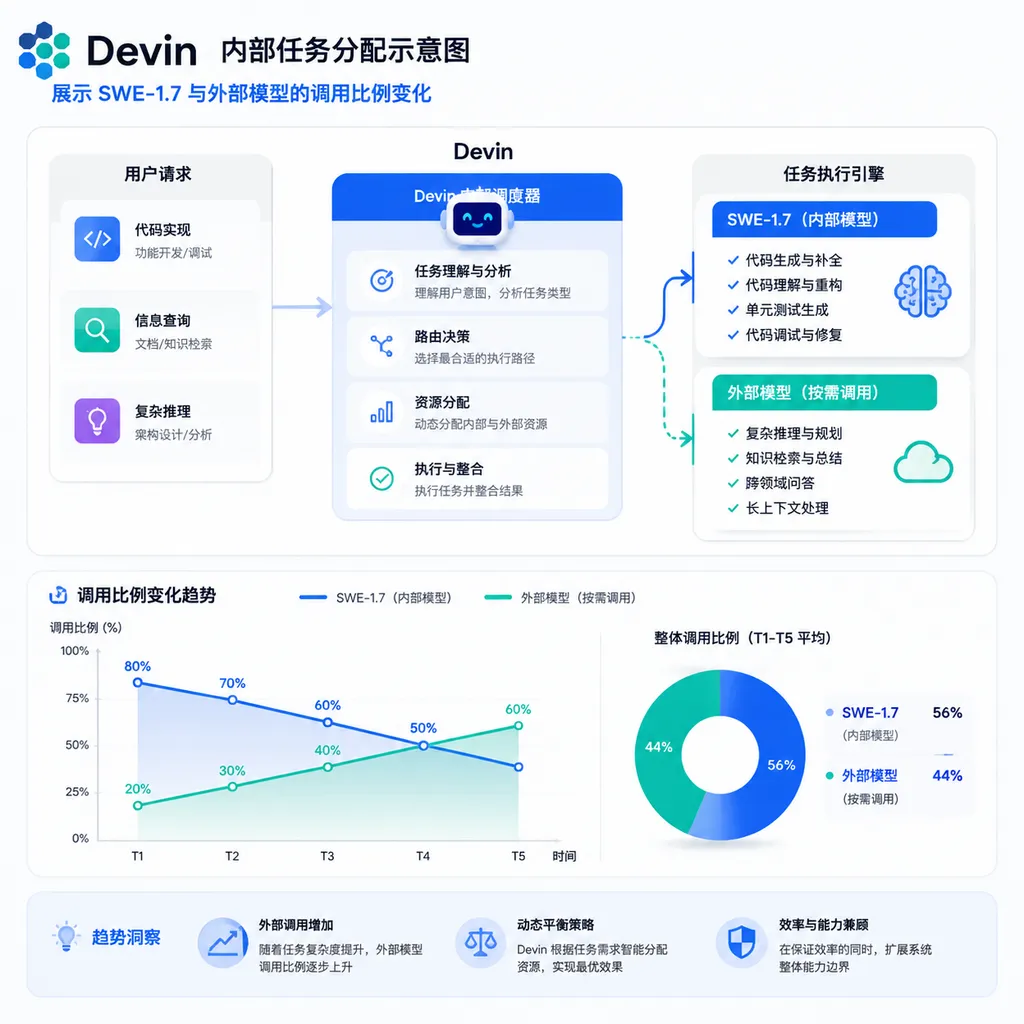
Zooming out, Cognition didn’t build SWE-1.7 to sell APIs — it built it to improve Devin’s economics. Devin’s business model charges by task or subscription, and the cost of the underlying models directly impacts margins. Previously, Devin used a hybrid approach: Claude handled the hardest work while the SWE series covered the middle layer. The significance of SWE-1.7 approaching general-purpose flagships is that Devin can now route more tasks to its own in-house model, reserving Claude/GPT only for the toughest problems.
This logic is exactly the same as Cursor’s. Cursor Composer also started out as “fast, rough, and aggressive,” then gradually absorbed Cursor’s internal tab completion, minor edits, and rapid refactoring workloads, reducing reliance on Claude/GPT calls. Any company building agent products that does not train its own models will eventually see long-term gross margins consumed by API providers. SWE-1.7 is another milestone along that path.
From a developer’s perspective: can you use it now, and how?
At the moment, SWE-1.7 is mainly accessed through the Devin product. Cognition has not publicly released a standalone API. This mirrors Cursor Composer’s strategy — the model is part of the product rather than something sold independently. Developers who want direct access either need a Devin subscription or must wait for Cognition to release it through partnership channels later on.
For developers writing code day-to-day, several practical questions matter:
- Should you switch to Devin? If your workflow is “throw an issue at AI and let it modify the repository and submit a PR,” Devin + SWE-1.7 is now genuinely compelling in terms of cost-performance. But if your workflow revolves around heavy in-IDE interaction (Cursor, Windsurf, Claude Code style), SWE-1.7 still doesn’t plug into that ecosystem in the short term.
- Will general-purpose flagships gradually get squeezed out? No — at least not anytime soon. Matching SWE-bench scores does not mean matching real-world engineering capability. In actual projects, areas like reasoning, cross-file understanding, and handling ambiguous requirements are still more reliable with general-purpose frontier models. But the boundary is clearly moving inward.
- Will the open-source community follow this path? Very likely. Open-source series like Qwen-Coder and DeepSeek-Coder have been pursuing this direction already, and SWE-1.7’s success will push more teams toward the “smaller model + real-data RL” approach.
A broader conclusion
In the first half of 2026, frontier flagship models (GPT-5.5, Opus 4.8, Fable 5, Gemini 3.5) have already started showing diminishing returns in coding capability. The jump from GPT-5.4 to 5.5 was roughly comparable to the jump from 5.3 to 5.4. The systems improving most rapidly right now are actually these vertically specialized models. The reason is straightforward: general-purpose flagships must optimize for everything, while specialized models only need to extract maximum value from every token within a single domain.
SWE-1.7 is not a revolutionary launch, but it is an important signal: for the first time, specialized coding models have genuinely dragged general-purpose flagships into direct competition. Over the next six months, we will probably see many more models following a similar path — training on real agent trajectories collected from actual products, targeting a single vertical domain with extreme focus, and delivering prices and speeds at less than half the cost of general-purpose flagships.
The practical impact for developers is this: in the future, the question may no longer be “which flagship model should I use,” but rather “which specialized model should this task be routed to.” Multi-model routing will become standard infrastructure. That’s also where aggregation platforms like OpenAI Hub become valuable — one API key connecting GPT, Claude, Gemini, DeepSeek, and other mainstream models, direct access within China, OpenAI-compatible formatting, and no need for developers to separately apply, integrate, and settle billing with multiple providers. Once we reach the point where a single task is distributed across three or four collaborating models, the aggregation layer itself may become the most indispensable infrastructure.
Conclusion
SWE-1.7 is not the kind of model launch that makes people scream during a keynote, but it adds another crucial piece of evidence supporting the “specialized programming model” technical path. GPT-5.5 and Opus 4.8 are still the ceiling, but the ceiling is no longer the only option. For people who work with code every day, that may matter more than yet another flagship upgrade.
References
- Opus 4.7 Barely Sat on the Throne Before GPT-5.5 Launched a Midnight Surprise Attack - Zhihu: In-depth first-day impressions and benchmark data roundup for GPT-5.5’s release


