
OpenAI Releases GPT-Live: Voice Models Are Starting to Truly "Understand Human Speech"
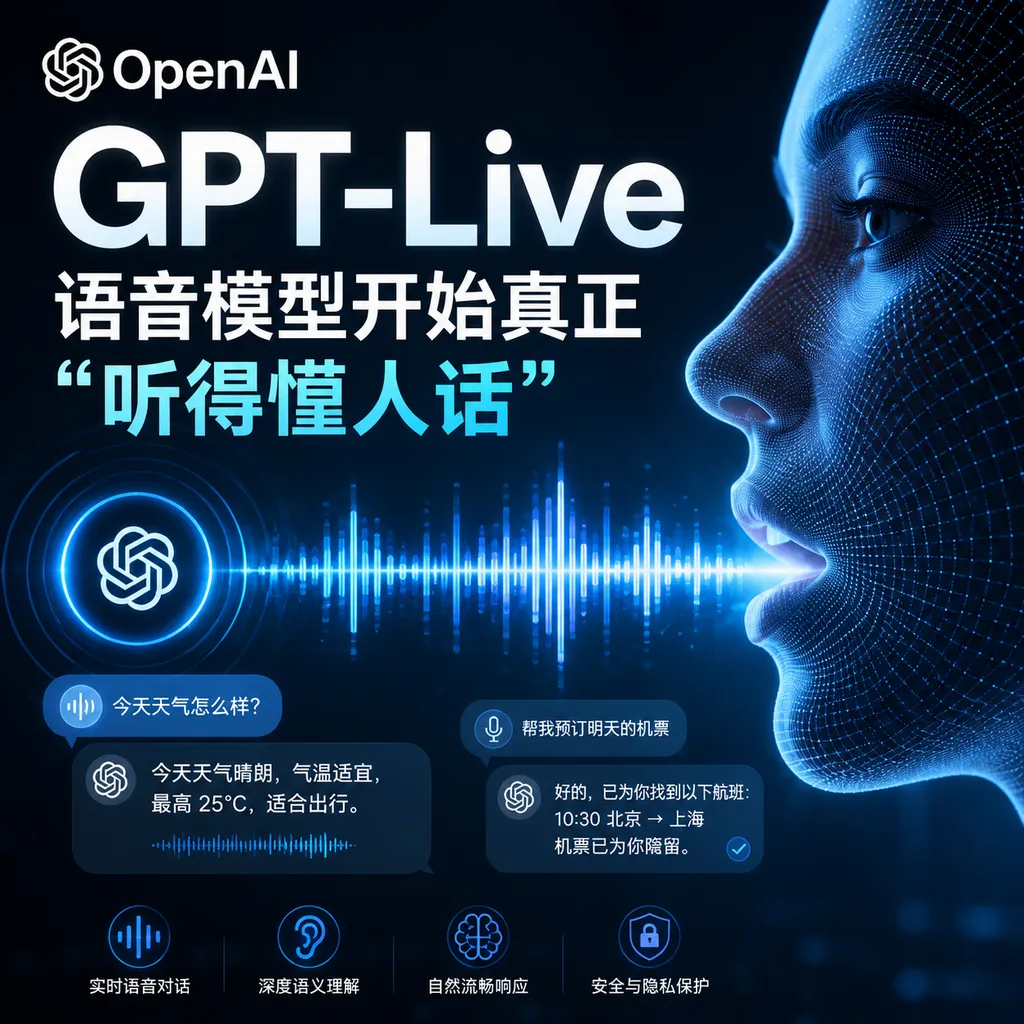
OpenAI today launched the full-duplex voice model GPT-Live-1, which supports simultaneous listening and speaking, automatically detects pause intent, and can seamlessly invoke GPT-5.5 for reasoning and retrieval. This marks the most significant leap in voice interaction experience since last year’s Advanced Voice.
OpenAI Launches GPT-Live: Voice Models Finally Start to “Actually Understand Human Speech”
On July 8, OpenAI launched a new voice model, GPT-Live-1, replacing the Advanced Voice Mode in ChatGPT that had been around for nearly two years and widely criticized by users for being “too talkative and constantly interrupting.” At the launch event, OpenAI research lead Kundan Kumar described it plainly: this is their “smartest voice model to date,” designed to make conversations feel “like talking to another person.”
That may sound like standard launch-event marketing, but this time the technical approach really is different.
Full Duplex Is the Real Keyword This Time
Over the past two years, voice assistants on the market — whether ChatGPT, Gemini Live, or Claude’s voice mode — have fundamentally remained “half-duplex.” You say something, then it replies, relying on VAD (voice activity detection) to determine whether you’ve finished speaking. The biggest problem with this mechanism is that it interrupts at the wrong moments: pause briefly to gather your thoughts, and it assumes you’re done and starts rambling; try to interrupt it, and it often won’t stop until it finishes a complete semantic unit.
GPT-Live-1 can listen and speak simultaneously. According to OpenAI, the model continuously processes incoming audio streams while generating audio output. This leads to two direct improvements:
- Interruptions feel more natural. The moment you start talking, it can stop speaking immediately instead of waiting to finish half a sentence.
- It stays quiet when it should. OpenAI specifically emphasized this point: the new model is “better at shutting up.” When users pause to think, it waits instead of jumping in.
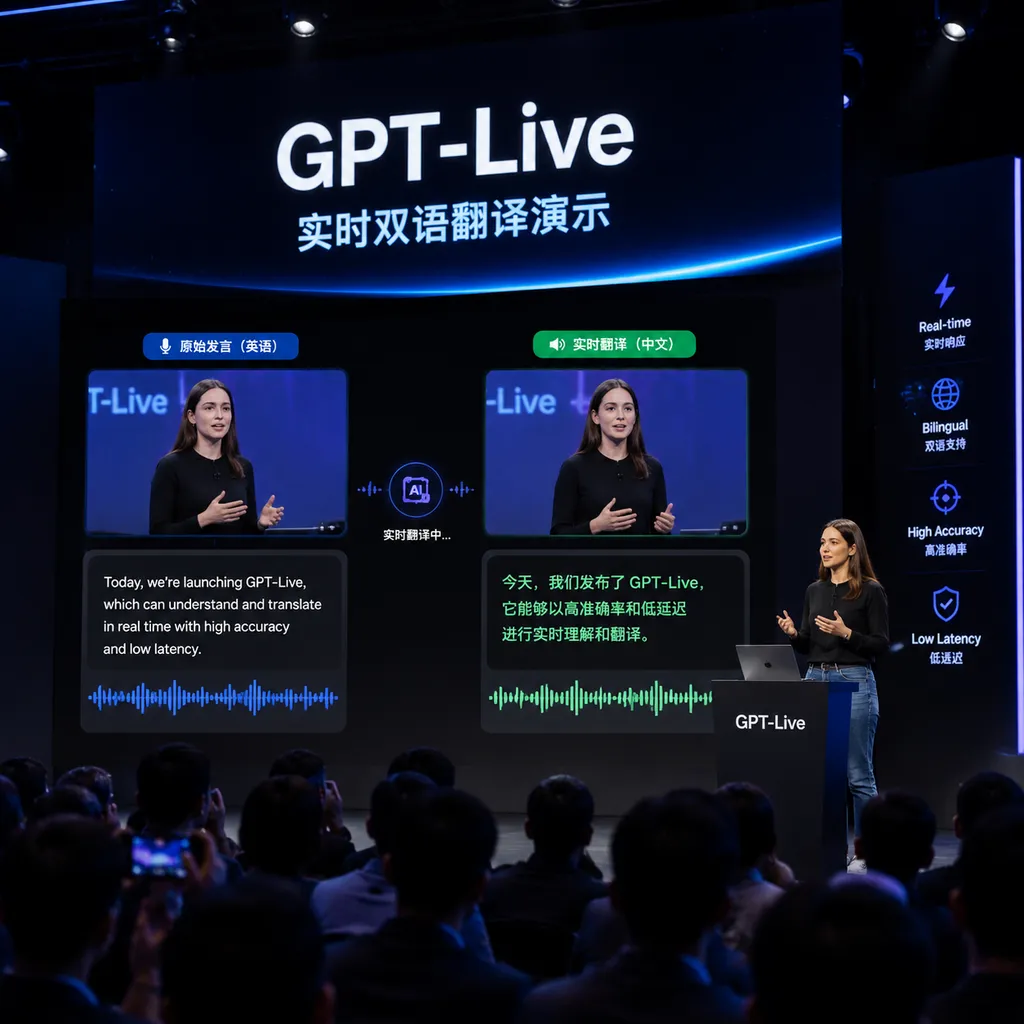
This capability is especially important for real-time translation scenarios. Traditional voice translation either works as “speak first, translate later” (high latency) or stitches together streaming ASR with streaming generation (causing mismatched timing and rhythm). Full-duplex models are naturally suited for simultaneous interpretation: listening to the source language while outputting the target language, without explicit segmentation in between. In its TechCrunch interview, OpenAI explicitly identified this as one of GPT-Live’s core use cases.
Routed to GPT-5.5, Solving the Longstanding “Voice Models Become Dumb” Problem
Personally, I think this matters even more than full duplex.
Until now, all end-to-end voice models shared the same weakness: to achieve low latency, the voice model itself couldn’t be too large, which meant significantly weaker reasoning ability compared to flagship text models from the same generation. Ask ChatGPT a moderately complex question via voice, and it often gives noticeably worse answers than text mode. That’s why many power users still prefer typing over speaking.
GPT-Live-1 solves this through automatic routing: when a query requires reasoning or web search, it hands the request off to GPT-5.5, then delivers the result back through streaming voice output. OpenAI says the process is seamless — the model knows when it should “search while speaking,” using filler phrases (“One moment, let me check that”) to mask backend reasoning latency.
This design is actually very pragmatic. Forcing strong reasoning capabilities directly into the voice model itself isn’t cost-effective. It makes more sense to let the voice model focus on the “perception-expression” layer while outsourcing the “thinking” to the strongest text model available. This approach is similar to Gemini Live’s recent Deep Think integration, but OpenAI’s implementation feels more unified — there’s no explicit mode switching, everything happens within a single conversational flow.
Key Upgrades at a Glance
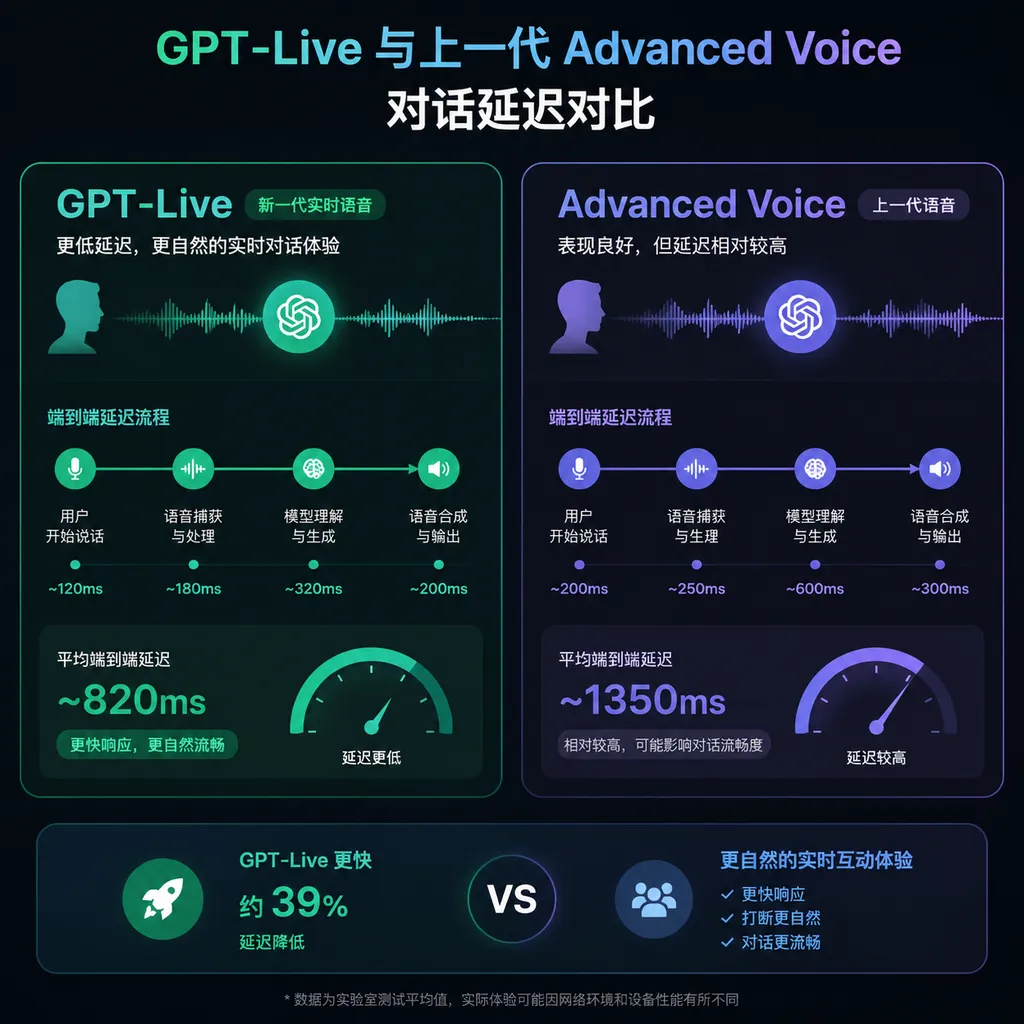
Based on OpenAI’s blog post and media briefings, GPT-Live-1 differs from the previous Advanced Voice generation in the following ways:
- Full-duplex audio processing: listening and speaking simultaneously, with interruption latency reportedly reduced to near-human reaction time levels (under 200ms).
- Pause awareness: user pauses no longer trigger interruptions; the model “waits.”
- Model routing: complex questions automatically invoke GPT-5.5, covering web search, code explanation, and multi-step reasoning.
- Enhanced dialogue behavior: during voice conversations, the model can proactively add relevant context (for example, offering analogies while explaining concepts) instead of passively answering.
- Real-time multilingual translation: one of OpenAI’s flagship scenarios, supporting major language pairs.
- Voice expressiveness: emotions, pacing, and intonation sound more human-like, including handling nonverbal vocal signals like laughter and sighs.
In hands-on use, the most immediate feeling is that it’s “less annoying.” Previously, the biggest frustration with voice mode was how overly enthusiastic it was — long-winded answers that often required interrupting it twice just to stop talking. This new model clearly has a better sense of brevity, and its responsiveness is noticeably faster.
Competitor Comparison: Gemini Live, Sesame, Doubao Real-Time Calls
The voice AI space has become fiercely competitive over the past year.
- Google Gemini Live introduced native audio output last year and also supports full-duplex interaction, though its interruption handling has often been criticized as unnatural.
- Sesame went viral for a while last year with its Maya/Miles demos, emphasizing “voices with soul,” but commercialization has progressed slowly.
- ByteDance’s Doubao real-time calling actually delivers a solid experience in China, with good latency and naturalness, but its reasoning depth clearly falls short of GPT-Live integrated with GPT-5.5.
- Kyutai Moshi achieved full-duplex end-to-end voice interaction academically, but its general capabilities and product maturity lag behind commercial offerings.
Viewed together, GPT-Live-1’s differentiation becomes clear: its duplex capabilities have caught up with the top tier, while intelligent routing gives it a reasoning advantage. This is OpenAI’s counterattack after previously trailing Gemini in voice interaction.
What This Means for Developers
OpenAI simultaneously released the GPT-Live-1 API, continuing the Realtime API naming convention and using the WebSocket protocol. Existing Realtime API users can migrate almost seamlessly — mostly by changing the model name.
If you’ve previously integrated voice models using OpenAI-compatible APIs, the call pattern looks roughly like this:
from openai import OpenAI

client = OpenAI(
    base_url="https://api.openai-hub.net/v1",
    api_key="your-api-key"
)

# GPT-Live uses the Realtime API over WebSocket
# Below is a non-streaming conversation trigger example
response = client.chat.completions.create(
    model="gpt-live-1",
    modalities=["text", "audio"],
    audio={"voice": "cove", "format": "pcm16"},
    messages=[
        {"role": "user", "content": "Help me greet this client in Japanese, then translate his replies for me in real time"}
    ]
)

print(response.choices[0].message.audio)
For true real-time conversations, WebSocket is recommended directly:
const ws = new WebSocket(
  "wss://api.openai-hub.net/v1/realtime?model=gpt-live-1"
);

ws.on("open", () => {
  ws.send(JSON.stringify({
    type: "session.update",
    session: {
      modalities: ["audio", "text"],
      voice: "cove",
      turn_detection: { type: "server_vad_duplex" },
      instructions: "You are a real-time Chinese-Japanese translation assistant"
    }
  }));
});

// Continuously push audio frames
ws.send(JSON.stringify({
  type: "input_audio_buffer.append",
  audio: base64AudioChunk
}));
Pay attention to the turn_detection field — GPT-Live introduces a new server_vad_duplex mode, which is the key switch for enabling full-duplex behavior. The older server_vad mode is still supported, but it falls back to a half-duplex experience.
OpenAI Hub already supports GPT-Live-1, including Realtime WebSocket channels. Users in China can connect directly, and the same API key can switch between GPT, Claude, Gemini, and other mainstream models for comparison testing — useful for teams still evaluating options.
Pricing and Availability
OpenAI hasn’t made major pricing changes this time: audio input costs $40 per million tokens, audio output $80 per million tokens, slightly cheaper than the previous generation. Text pricing remains aligned with the GPT-5.5 lineup. It’s not exactly cheap, but considering that “one connection handles STT + LLM + TTS + translation,” the total cost may actually be lower than building a three-stage pipeline yourself.
As for availability: ChatGPT Plus/Pro/Team users began receiving access the same day via gradual rollout, while Enterprise and Education versions will follow next week. At the API level, rollout is global with no distinction between preview and GA.
Final Thoughts
Voice interaction has repeatedly gone through cycles of hype and disappointment over the past two years. Every time someone declared “this is the real Her moment,” people would use it for two days and realize it still fell short. I wouldn’t call GPT-Live the endpoint, but the combination of “full duplex + intelligent routing” genuinely addresses the two most obvious weaknesses in previous voice assistants: interrupting users and becoming less intelligent.
What really matters is whether this can reignite the idea of voice as the primary AI interaction interface. Text conversation is already a killer app, but voice has remained stuck in the awkward middle ground of “usable but not great.” If GPT-Live’s real-world experience reaches even 80% of the launch demo quality, we’ll likely see a wave of new products across customer service, education, translation, and companionship — because the infrastructure is finally in place.
Now the focus shifts to Anthropic and Google. Claude Voice has already been delayed for quite some time, and the next version of Gemini Live is reportedly testing true duplex interaction as well. This new round of voice AI competition is only just beginning again.
References
- Global AI Model Release Timeline (Zhihu Column) — Continuously updated tracking of model releases, useful for comparing GPT-Live’s position in the 2026 voice AI landscape
- AI-Compass Weekly Highlights (GitHub) — Weekly roundup of major AI developments, including recent multimodal and voice model technical insights


