
Open-Source Agents Strike Back: Nemotron 3 Ultra Goes Head-to-Head with Closed-Source Frontiers
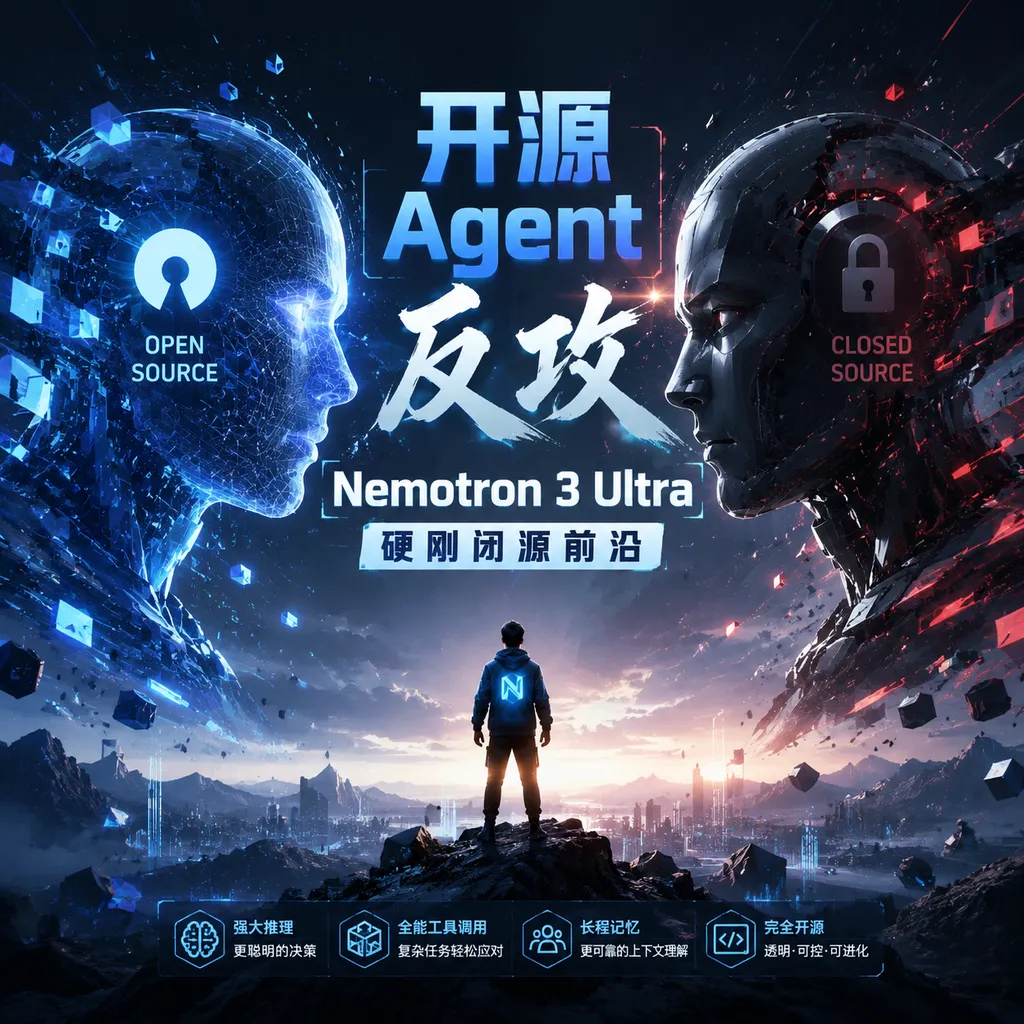
After deep optimization with LangChain Deep Agents, NVIDIA Nemotron 3 Ultra achieved the highest accuracy in open-source model Agent evaluations, while operating at only one-tenth the cost of top closed-source models. This marks the first time the open-source ecosystem has truly approached the frontier of closed-source models in long-horizon Agent scenarios.
Open-Source Models Have Truly Started to Bite Into Closed-Source Dominance in Agent Scenarios
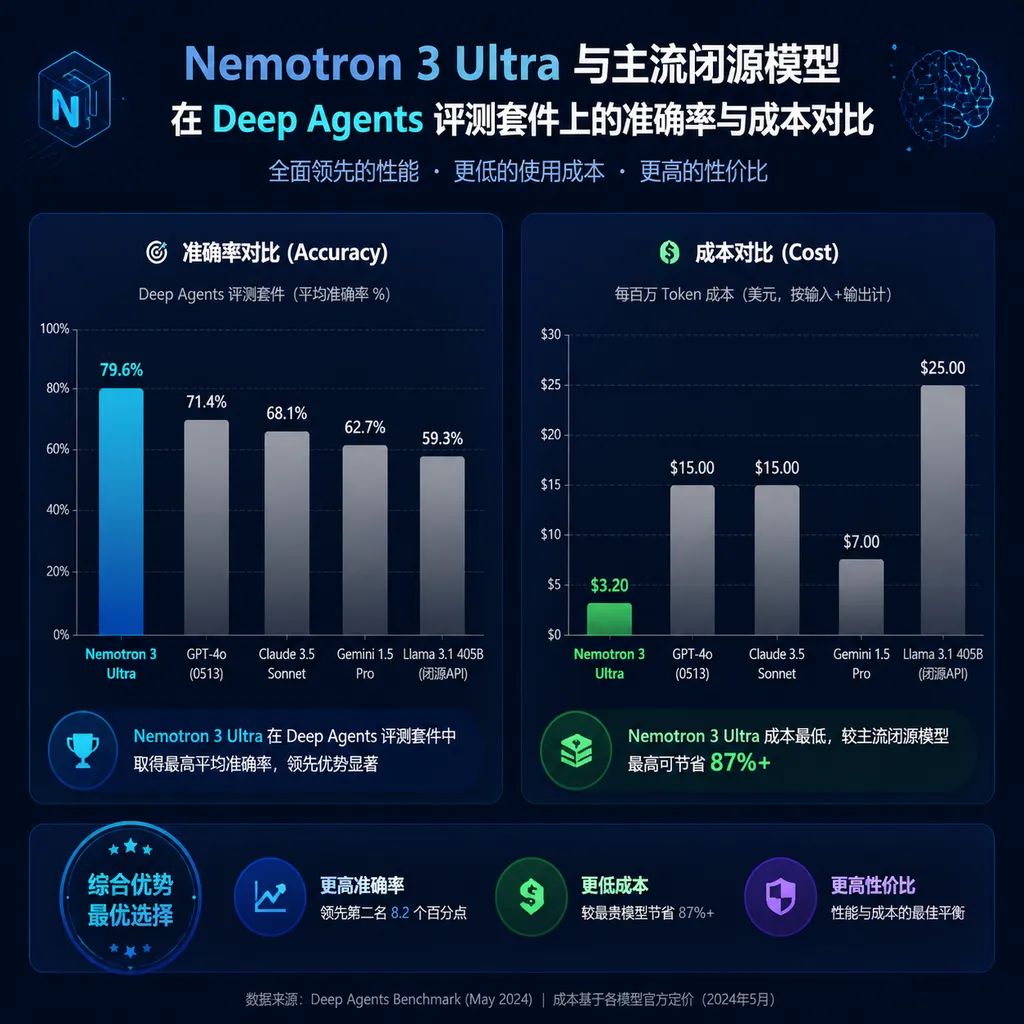
On July 8, NVIDIA and LangChain jointly released a rather provocative report card: Nemotron 3 Ultra achieved the highest Agent task accuracy among open-source models on the LangChain Deep Agents evaluation suite, while costing roughly one-tenth per run compared to mainstream closed-source models. DeepInfra and Baseten simultaneously launched hosted endpoints, meaning developers can point their Agent code at it and start running today.
What makes this worth discussing separately is that over the past year, open-source models have already narrowed the gap significantly in pure conversation and single-turn coding tasks. But when it comes to real production scenarios like multi-step Agents, long-horizon planning, and tool use, closed-source models have still maintained a substantial lead. The data released for Nemotron 3 Ultra marks the first time the open-source camp has compressed that gap to a negotiable level in a more real-world-oriented benchmark like Deep Agents.
The Key Is Not the Model, but the Harness
Interestingly, both NVIDIA and LangChain repeatedly emphasized one sentence in their blogs: the model itself was not retrained at all this time.
All the performance gains came from LangChain re-tuning the Deep Agents harness for Nemotron 3 Ultra — in other words, the layer around the model’s main loop involving prompts, tool interfaces, middleware, and orchestration strategies. In their own words, the harness is what determines Agent performance. The model is just the engine; the chassis, transmission, and suspension determine whether the car can actually handle long-distance driving.
This idea has actually been controversial within the industry. A few years ago, people preferred to believe that “model capability determines everything,” and the harness was merely a thin layer of glue. But practical experience since GPT-4 has shown that the same model can differ by dozens of percentage points across different Agent frameworks, especially on long-horizon tasks. LangChain has essentially turned this into reproducible evidence: the exact same Nemotron 3 Ultra, using the default harness versus the tuned harness on the same evaluation suite, produced differences significant enough to warrant a dedicated blog announcement.
LangChain did not fully disclose what was changed, but the documentation suggests several major areas:
- Reconstruction of system prompts, rewriting planner and sub-agent instruction templates around the reasoning style of the Nemotron series
- Standardization of tool descriptions, reducing hesitation during tool selection and lowering erroneous tool invocation rates
- Middleware fault tolerance, including automatic repair for formatting deviations and retry strategies for failed tool calls
- Adjustment of sub-agent division of labor, making information transfer between planner and executor better aligned with Nemotron’s context usage patterns
Put simply, this transformed a general-purpose harness into one specifically optimized for the quirks of a particular model. The engineering effort was not massive, but the gains were surprisingly high.
Nemotron 3 Ultra Itself: Built for Long-Running Agents
Looking back at Nemotron 3 Ultra itself, NVIDIA’s positioning has actually been very clear all along — not aimed at topping general chatbot leaderboards, but explicitly targeting “long-running agents.”
Several of its design choices point in this direction:
First, optimization of reasoning pipeline efficiency. In Agent scenarios, the model is not answering a single question; it is continuously making decisions across dozens or even hundreds of steps. The latency and token consumption of each step are amplified. Nemotron 3 Ultra includes substantial inference optimizations for this purpose. According to official figures, it delivers better throughput and end-to-end latency than similarly sized open-source models at equivalent accuracy.
Second, stability in tool use. This is the Achilles’ heel of long-running Agents. In a 30-step task, if each tool invocation has a 3% chance of formatting failure, the final success rate becomes discouragingly low. Nemotron 3 Ultra was clearly trained with a large number of tool-use examples, and in practice it exhibits fewer formatting deviations and hallucinated calls than open-source models of similar scale.
Third, attention retention under long context windows. Architectures like Deep Agents pack large amounts of intermediate state into the context, requiring the model to accurately identify key information within 100K+ tokens. The Nemotron series has consistently performed well in this area, and the Ultra version further tightened retrieval accuracy under long contexts.
Combined with LangChain’s harness optimization, this forms the technical foundation behind the reported results.
Where the 10x Cost Difference Comes From
The phrase “roughly 10x lower cost per run than closed alternatives” in the blog deserves closer examination.
The 10x cost difference does not come entirely from the model’s token pricing. Open-source models hosted on inference services like DeepInfra and Baseten are already cheaper than closed-source APIs like GPT-4, but not by a factor of ten. The real gap comes from several compounding factors:
- Base pricing is already 3–4x lower — open-source models have inherent pricing advantages on self-hosted or third-party inference platforms
- Lower token consumption — the optimized harness reduces unnecessary tool calls and reasoning loops, directly lowering token usage for the same task
- Lower retry costs — improved tool-call stability means fewer failed retries
- Higher parallelism — Nemotron 3 Ultra’s throughput characteristics allow more aggressive parallel sub-agent scheduling
The combination of these layers creates the 10x difference. For teams running large-scale Agent workflows, the implications are straightforward: a monthly inference bill of hundreds of thousands of dollars could theoretically be reduced to tens of thousands.
A Signal of a Complete Open-Source Stack
Stepping back, the real highlight of this release is not the victory of a particular model or harness, but the emergence of a complete open-source Agent stack.
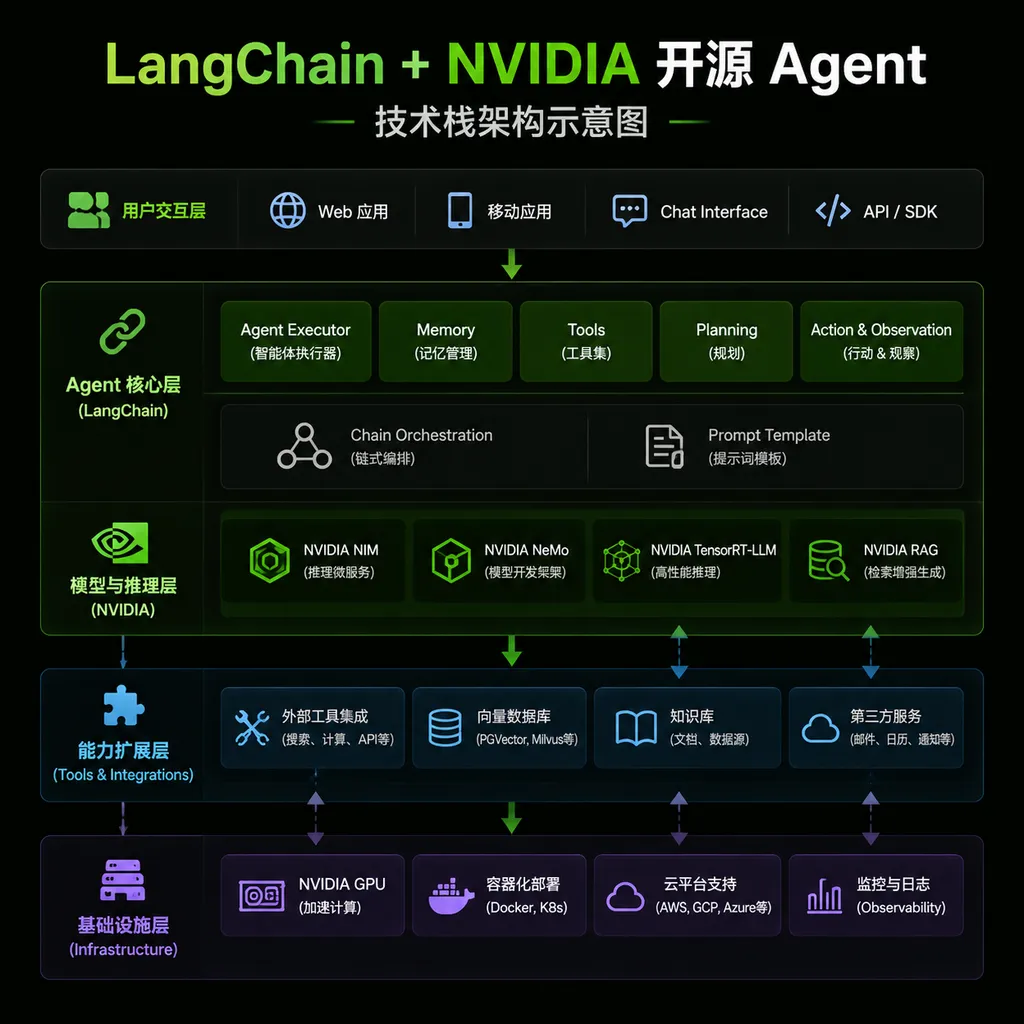
LangChain joined the NVIDIA-led Nemotron Coalition in March, then launched an enterprise-grade Agentic AI platform connecting LangSmith, LangGraph, and Deep Agents with NVIDIA Agent Toolkit, NIM microservices, and Dynamo. The harness optimization for Nemotron 3 Ultra is simply one concrete outcome of this collaboration.
For developers, this means there is now a relatively complete and fully open-source production path for Agents:
- Model layer: Nemotron 3 Ultra (or other open-source models)
- Inference layer: NIM microservices / DeepInfra / Baseten
- Orchestration layer: LangGraph + Deep Agents
- Observability layer: LangSmith
- Optimization layer: NeMo Agent Toolkit
The significance of this stack is that, for the first time, “running production-grade Agents without relying on closed-source big-tech APIs” has become a concrete and executable solution rather than just a slogan.
Practical Implications for Chinese Developers
From the perspective of teams in China, there are several noteworthy points here:
First is model accessibility. Nemotron 3 Ultra has fully open weights. You can download and run it yourself or access it through various API aggregation services. Platforms such as OpenAI Hub are already integrating frontier open-source models, allowing a single API key to access Nemotron, GPT, Claude, Gemini, DeepSeek, and more through an OpenAI-compatible format, making multi-model comparison and fallback strategies much more convenient.
Second is the transferability of the harness approach. Even if you do not use Deep Agents, LangChain has demonstrated that “tuning the harness for a specific model” is a broadly applicable methodology. When Chinese teams use Qwen, DeepSeek, or GLM for Agent systems, instead of complaining that the model is insufficiently capable, it may be more worthwhile to carefully refine prompt templates, tool descriptions, and error handling around the specific model you are using. The returns are often greater than switching models.
Third is reevaluating the cost model. If your current Agent system runs on GPT-4 or Claude and the bill is painful, then the “open-source model + optimized harness” route deserves serious consideration. Even if you only realize 3–5x savings instead of the full 10x, the budget impact is still substantial. Of course, it depends on the specific workload. Closed-source models still maintain advantages in scenarios requiring dense general intelligence, but in long-running workflow-style tasks — the natural home turf of Agents — open source has reached a stage where serious comparison is warranted.
A Slightly Cautious Conclusion
One final cold note. This release is fundamentally a marketing moment for both NVIDIA and LangChain. The evaluation results come from their own Deep Agents benchmark suite, not an independent third-party benchmark. Claims that open-source models have “caught up to closed source” in Agent scenarios will require more independent reproduction before they can be fully accepted.
Even with that caveat, however, the direction is already clear: in the Agent era, the technological gap increasingly comes from the harness rather than the model itself. Once the harness becomes the main battleground, the moat around closed-source models becomes harder to defend, because harnesses are naturally an area where open-source ecosystems excel.
The industry is shifting from the GPT-era idea of “the model is the product” to the Agent-era idea of “the stack is the product.” Nemotron 3 Ultra + Deep Agents is just one signal of that transition, but it is a sufficiently clear one.
References
- LangChain NVIDIA Integration Documentation - Official LangChain documentation for NVIDIA integration components, including ChatNVIDIA, NeMo Agent Toolkit optimization, Sandboxed Agents, and more
- Nemotron Models on Hugging Face - NVIDIA’s official Hugging Face page, providing Nemotron 3 Ultra and related open-source model weights and usage documentation


