
Ant Lingbo Open-Sources LingBot-World 2.0: Embedding Agents into World Models
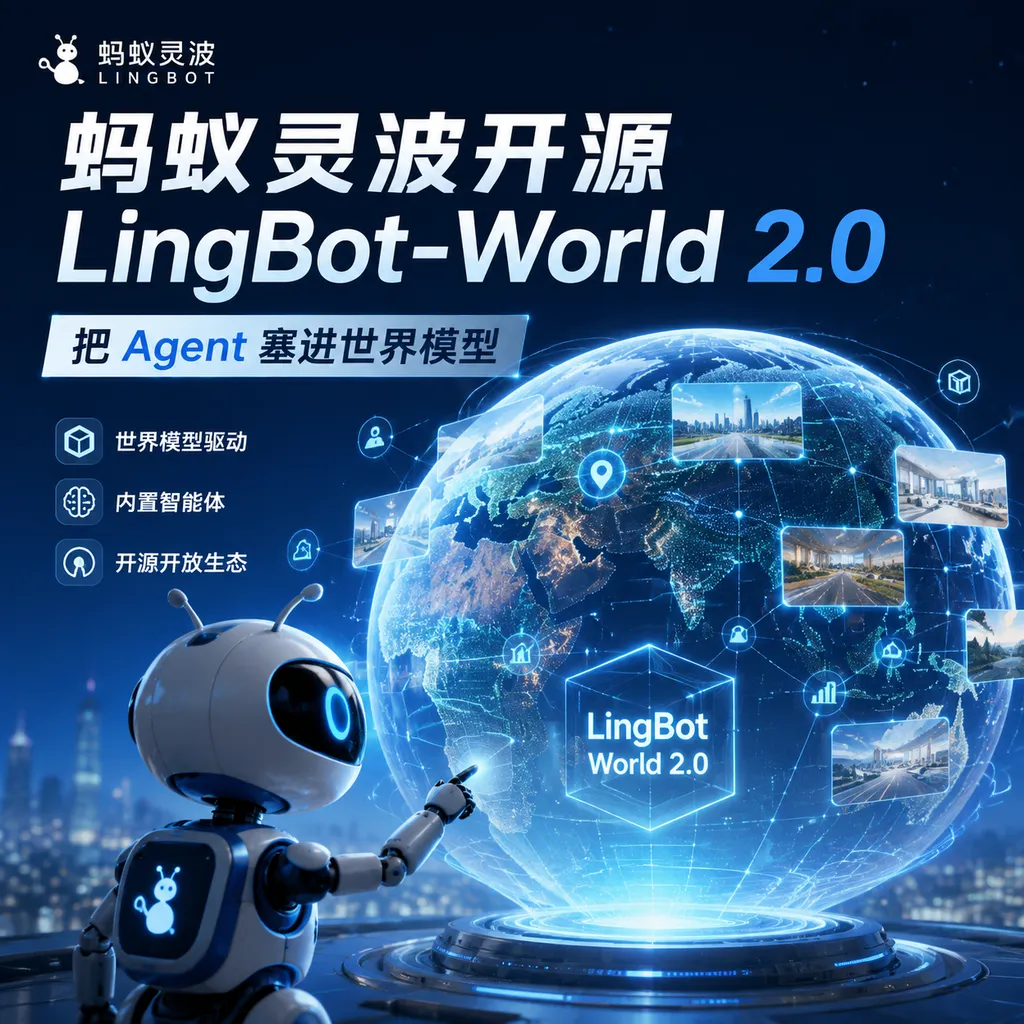
Ant Lingbo today open-sourced the next-generation real-time interactive world model LingBot-World 2.0, supporting 720p/60fps high-definition real-time output and hour-long generation. It is also the first in the industry to introduce an Agent mechanism into a world model, targeting scenarios such as gaming, embodied intelligence, and digital twins.
Ant Lingbo today updated LingBot-World to 2.0 and, as usual, open-sourced it. This is a major upgrade: resolution has been pushed to 720p/60fps, generation duration has leaped from “10 minutes” to “hour-scale,” and most importantly — the Agent mechanism has been inserted into a real-time interactive world model for the first time.
If the version of LingBot-World from six months ago was still competing with Genie 3 over “who can generate longer, more stable worlds,” then 2.0 has clearly switched tracks. The problem it wants to solve is no longer “Can AI create a world you can explore?” but rather “Can this world grow characters that can act on their own?”
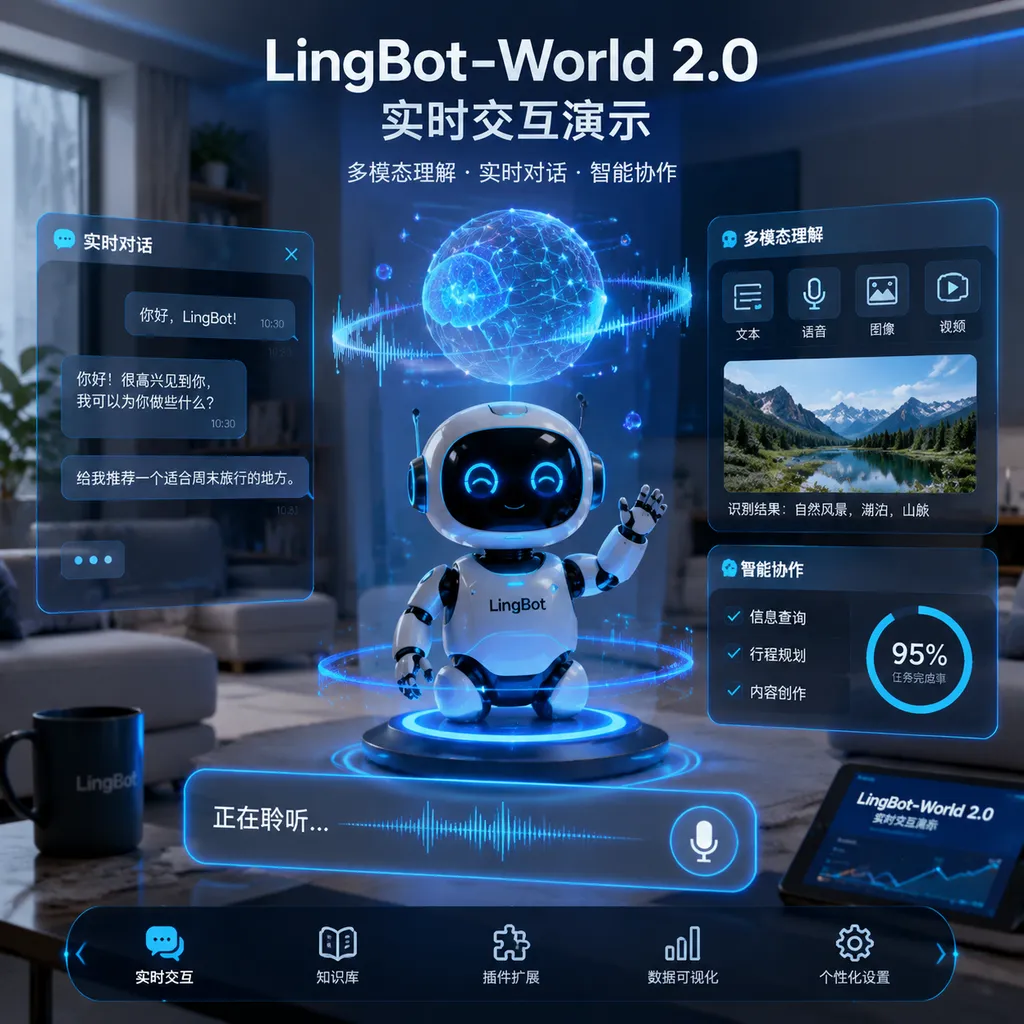
From “Explorable” to “Populated”
To understand the significance of 2.0, it helps to first review the timeline.
Ant Lingbo’s trajectory over the past year has actually been very clear:
- January 2026: LingBot-World Base debuted, featuring 720p and coherent 10-minute single-session generation. Using a scalable data engine to learn physical laws from game environments, it briefly held the record for generation duration among open-source world models.
- Late January: A rapid “triple release” followed — LingBot-Depth (spatial perception), LingBot-VLA (vision-language-action), and LingBot-VA (autoregressive video-action) — tightly coupling world models with embodied control.
- April: LingBot-World-Fast was open-sourced, offering 480P/16fps and reducing end-to-end interactive latency to under one second. At the same time, the Lingguang App launched its “experience world models” feature, bringing the technology to mobile devices for the first time.
- July 9: LingBot-World 2.0 arrived.
The positioning of 2.0 is very clear: it is no longer just a “generator,” but a “real-time stage” capable of hosting intelligent agents. The official description is “the industry’s first introduction of Agent mechanisms into world models.” That may sound like marketing language, but it’s actually meaningful when unpacked.
Previously, all mainstream world models — whether DeepMind’s Genie 3, NVIDIA Cosmos, or Fei-Fei Li’s Marble — fundamentally operated as a one-way loop of “human control → world response”: you press keys or input prompts, and the world renders the next frame. To integrate Agents, external systems were required — treating the world model as an environment and the Agent as a client.
What LingBot-World 2.0 does is make “the existence of intelligent agents” a first-class citizen inside the world model itself. Using concepts previously validated in Lingbo’s VLA line: Agent actions reshape the environment state in real time, while the evolution of the environment in turn determines the Agent’s next decisions. If this feedback loop truly works, the significance goes beyond entertainment — it effectively provides embodied intelligence with an “unlimited, replayable, and intervenable” training ground.
How It Achieves 720p/60fps and Hour-Scale Generation
First, the hard metrics.
From the Fast version in April to 2.0 in July, resolution increased from 480P to 720p, frame rate jumped from 16fps to 60fps, and generation duration expanded from minutes to hours. Achieving all three simultaneously would be nearly impossible under the compute scaling laws of traditional diffusion video models — each doubling would normally require several times more VRAM and computation.
The system likely continues and strengthens the approach used in the Fast version: during generation, it focuses only on newly added visual content, without recomputing stable regions. This is somewhat analogous to keyframe + P-frame mechanisms in video encoding, except implemented along the neural inference pipeline. Combined with the asynchronous inference pipelines and persistent memory caching previously used in LingBot-VA, it manages to keep “consistency” and “real-time responsiveness” — two long-standing rivals — under control.
60fps is a threshold. Below that number, users can clearly feel they are in an “AI-generated world.” At 60fps, visually it becomes difficult to distinguish from a game engine render. This fundamentally changes the possibilities for downstream applications — you cannot build a viable game prototype at 16fps, but you can at 60fps.
Hour-scale generation is equally significant. For comparison: Veo 3 tops out at 8 seconds, Sora 2 at 25 seconds, Runway Gen-3 Alpha at 40 seconds, and Kling at 2 minutes. The previous LingBot-World already stretched to 10 minutes; now it jumps directly to “hour-scale.” Once generation exceeds an hour, the boundary between “video generation” and “world simulation” becomes blurred — it can no longer be treated as a video, only as a continuously running virtual environment.
How the Agent Mechanism Was Integrated
This is the most intriguing part of 2.0. The official announcement only mentioned “the industry’s first introduction of Agent mechanisms into world models,” without going into technical detail, but the path can be inferred from Lingbo’s technology stack over the past year.
LingBot-VA earlier this year already provided half the answer: an autoregressive video-action world modeling framework — while generating the “next world state,” the model simultaneously predicts and outputs the corresponding action sequence. At the time, this framework was designed for a single robot, essentially “one Agent reasoning and acting within the world.”
What 2.0 likely does is extend this “Agent-World co-evolution” mechanism from single-agent systems to multi-agent systems, and from offline simulation to real-time interaction. In other words, the world can simultaneously contain:
- A first-person perspective directly controlled by users in real time (continuing the keyboard/mouse interaction from the Fast version)
- Environment events triggered by text prompts (weather, style, local narratives)
- NPCs/Agents driven internally by the model itself (the newly introduced Agent mechanism)
These three layers of input are fed together into the world model, which outputs coherent visuals at 60fps. The challenge is not generation itself, but how “intentions from different sources can all be satisfied simultaneously while preserving physical plausibility.” For example: if you knock over a crate in the scene while an AI-driven character is chasing another target, the character must recognize the crate as a new obstacle and route around it — that is the complete form of “Agents entering the world model.”
If this approach works, world models evolve from “AI-generated movies” into “AI-generated open-world games” — and entirely unscripted ones at that.
Who Will Actually Use It
Ant Lingbo lists a long range of application scenarios: game content generation, film previs, virtual simulation, digital twins, and robotics/embodied intelligence training. It sounds like PR copy, but each category has a concrete use case.
Embodied intelligence training is the most immediate need. Everyone working on robotics knows that real-world data is too expensive and simulation environments are too unrealistic; what’s needed is something “realistic enough and cheap enough.” LingBot-World 2.0 combined with LingBot-VLA/VA forms exactly such a closed loop — VLA outputs candidate actions, the World model simulates the physical consequences, and the safest option is executed on real hardware. Lingbo itself is already using this pipeline internally, and open-sourcing it means other domestic robotics companies can adopt it as well.
Game prototyping is the most imaginative use case. Traditional game development requires modeling, scripting, and physics tuning — even a simple demo can take weeks. If world models can generate playable scenes in real time, a solo indie developer could rapidly test different gameplay ideas. 60fps/720p has already crossed the threshold of “playable.”
Digital twins and film previs belong to established markets where demand has always existed; previous bottlenecks were cost and interactivity.
Offline experiences are another direction Lingbo has repeatedly emphasized in interviews — cultural tourism, exhibitions, education, and companionship scenarios. Imagine entering a museum exhibit where AI generates historical scenes in real time based on your actions and speech; when you leave, the scene persists; when your friends arrive, the environment continues evolving. If packaged as an engine, this could support a substantial B2B business.
The World Model Race Is Getting Crowded
In the first half of 2026, world models suddenly shifted from “academic frontier” to “product arms race.”
DeepMind’s Hassabis stated early this year that by 2026 world models would advance to the stage of supporting “planning,” integrated into Gemini. Fei-Fei Li’s World Labs spent months in stealth before unveiling Marble, focused on spatial relationships. NVIDIA divided world models into three product lines: prediction, style transfer, and reasoning. In China, Ant Lingbo has moved the fastest, open-sourcing six models in a single year: Depth, VLA, VA, World, World-Fast, and World 2.0, with at least four directly related to world models.
On open source, Lingbo has taken the most aggressive stance. Genie 3 is closed-source, Cosmos is partially open-source, Marble has not yet clarified its direction — only the LingBot series has released both weights and code from the very beginning, without hardware lock-in. This strategy is very characteristic of Ant: rapidly occupy the ecosystem through open source, making the InclusionAI community a default option for embodied intelligence in China.
One noteworthy point is that LingBot-World 2.0 is no longer positioned solely for Ant’s own robotics business — it is moving toward becoming general-purpose infrastructure. The introduction of Agent mechanisms makes this especially obvious: robots do not need NPCs, but games and interactive scenarios do. Lingbo clearly wants to capture both embodied intelligence and content generation simultaneously.
A Final Assessment
LingBot-World 2.0 is not an easy model to evaluate. Its technical highlights are extremely impressive (Agent mechanisms, hour-scale generation, 60fps), but many details remain unclear — for example, how complex Agent behavior logic can become, how long consistency can be maintained in multi-agent interactions, and what the actual inference cost is. Those questions will only be answered after the model weights are released on Hugging Face and developers begin testing it in practice.
But even with some discounting, it has already raised the bar again for open-source world models. Teams in China working on embodied intelligence, AI gaming, or simulation environments will likely find it difficult to ignore this model going forward.
The world model space has not yet reached the point of truly killer applications, but the infrastructure arms race has clearly begun.
References
- LingBot-World Officially Open-Sourced! - Zhihu: Introduction to the first-generation LingBot-World technical architecture and data engine


