
Tencent Cloud Agent Bucket Officially Released: A Dedicated Cloud Space for Every AI Agent
Tencent Cloud officially launched Agent Bucket today, using the Space abstraction layer to provide natively isolated independent cloud spaces for hundreds of millions of agents, compatible with the S3 interface. This is not simply a renaming of storage buckets, but a transformation of traditional storage designed for “people” into a native foundation designed for Agents.
Tencent Cloud Officially Launches Agent Bucket: A Dedicated Cloud Space for Every AI Agent
On July 9, Tencent Cloud officially launched Agent Bucket, a native storage product purpose-built for AI Agents. The name sounds fairly ordinary—just another “bucket.” But when you break it down, it is actually the most critical missing piece in Tencent Cloud’s Agent Storage strategy, which it has been heavily promoting over the past six months, finally moving from preview to GA.
If you are building Agent applications—especially scenarios where you need to provision dedicated agents for hundreds of thousands or even millions of users—the problem this product aims to solve is probably very familiar:
Where exactly should each Agent’s files be stored?
Traditional Approaches No Longer Scale
First, let’s look at the two conventional approaches and why neither works in Agent scenarios.
The first approach: one Bucket per Agent. It sounds clean and provides the best isolation. But Tencent Cloud COS Buckets have a default limit of only 200 buckets. Even large customers who apply for expanded quotas can only reach a few thousand. That is nowhere near the scale required for businesses deploying millions or tens of millions of intelligent agent instances.
The second approach: all Agents share one Bucket and are separated by file path prefixes. This has been the classic object storage pattern for the past two decades—low cost and simple to manage. But the problems are obvious:
- Isolation relies entirely on application code, and a single bug in prefix concatenation could leak User A’s reports to User B.
- Quota and rate limiting cannot be enforced at the Agent level, so a suddenly popular Agent can degrade the entire Bucket.
- Permissions and lifecycle policies only apply at the Bucket level, making fine-grained management for individual Agents impossible.
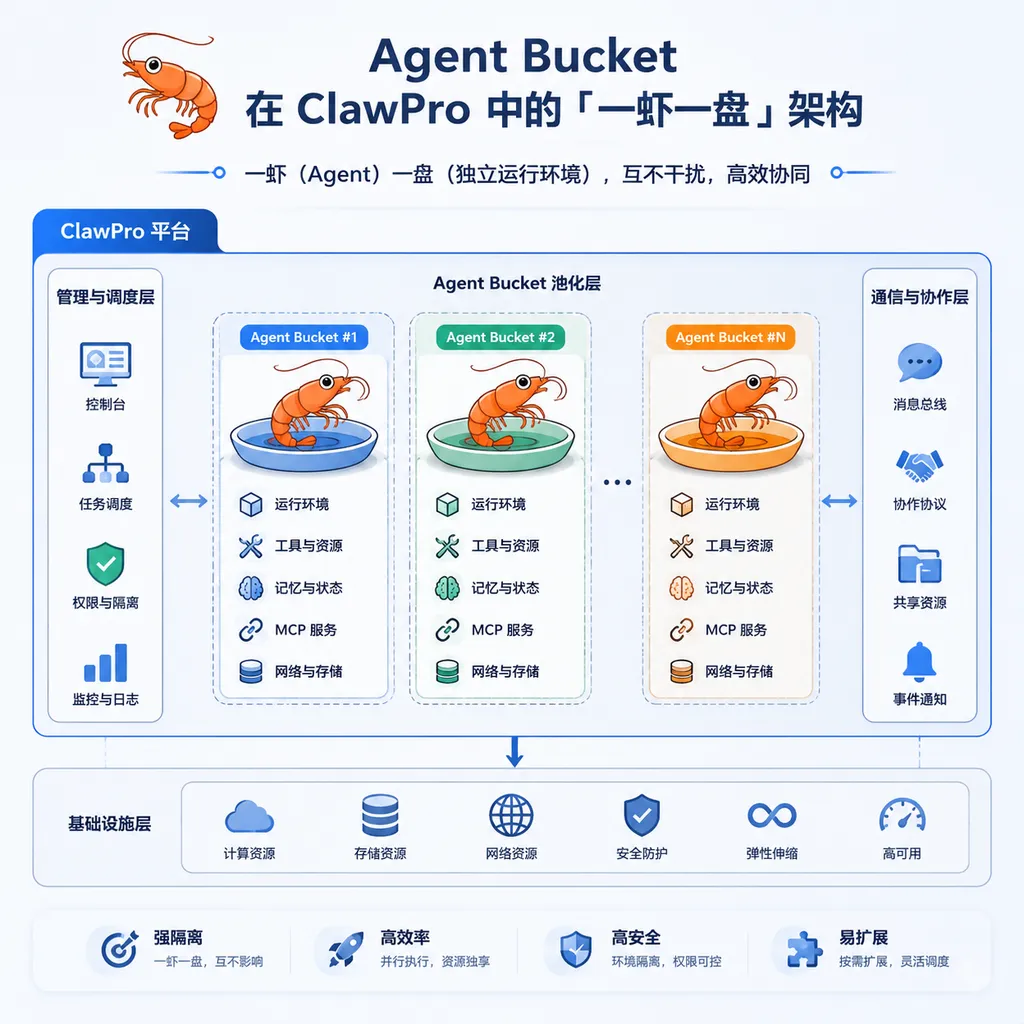
This is not just a theoretical concern. Tencent itself ran into this issue internally. Products like ClawPro, which aim to provide “one AI agent per employee,” simply could not implement the “one shrimp, one plate” model using traditional COS architectures.
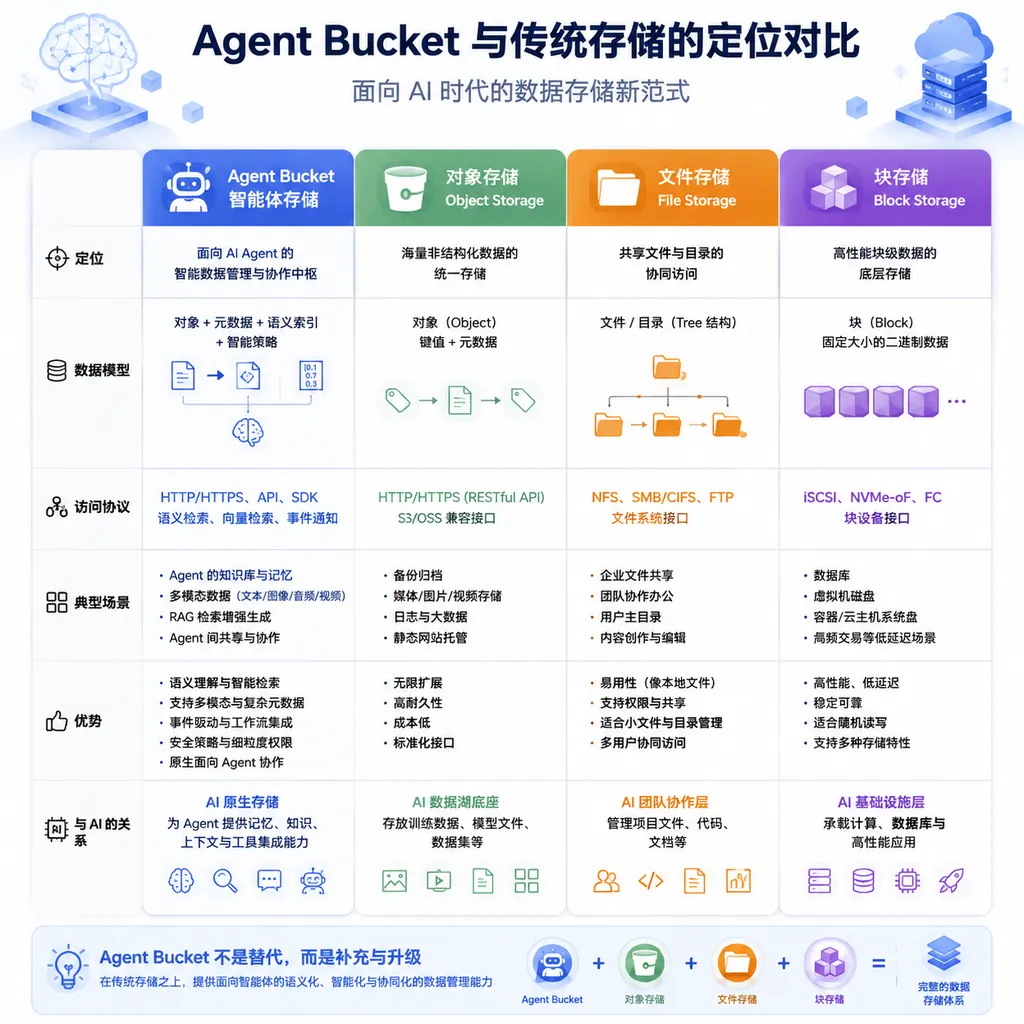
Space: Turning Isolation from Application Logic into a System Capability
At the core of Agent Bucket is a single concept: Space.
Within a single Agent Bucket, developers can create a massive number of Spaces. Each Space corresponds to an Agent or a user and includes:
- Independent access credentials (a dedicated AK/SK pair per Space with physical isolation)
- Independent storage quotas
- Independent read/write rate limits
- Independent lifecycle policies
The key point is that these isolation capabilities no longer depend on application-layer implementation—they are built directly into the storage system itself. Developers no longer need to write large amounts of glue code for prefix concatenation, permission validation, and quota accounting, nor worry that a mistaken line of code could cause cross-user data leakage.
Architecturally, this resembles the evolution of multi-tenant databases from “multiple schemas in one database separated by prefixes” to “native multi-tenant isolation.” The difference is that this time the tenant scale is in the hundreds of millions.
Hotspot issues are also addressed along the way. The underlying architecture automatically load-balances traffic, so one suddenly popular Space will not overload the entire Bucket. In Agent scenarios, this is practically a necessity, since traffic distribution across popular Agents is inherently uneven.
S3 Compatible, Integration Is Nearly Frictionless
At the API layer, Agent Bucket is compatible with standard S3 interfaces, which has effectively become the default expectation for object storage products. For developers, this means:
- Existing S3 SDKs, boto3, and aws-cli work out of the box
- Migration costs are roughly equivalent to changing the endpoint and credentials
- Familiar semantics such as PutObject/GetObject/ListObjects remain unchanged
On top of that, Agent Bucket introduces advanced Agent-oriented semantics such as directory trees, move, rename, and search.
Traditional object storage is fundamentally a flat KV structure. Renaming a “directory” actually requires copying all underlying objects and then deleting them. But in Agent scenarios, enabling agents to manage cloud files as if they were operating on a local file system is essential, making these “cloud-drive-level” file semantics a baseline requirement.
Not a Standalone Product, but Part of the Five-Piece Agent Infra Stack
The positioning of Agent Bucket becomes clearer when viewed within Tencent Cloud’s broader Agent Runtime ecosystem.
At the AI Industry Application Conference in June this year, Tencent Cloud divided Agent infrastructure into five core components:
| Component | Capability | |---|---| | Agent Sandbox | 60 ms ultra-fast cold start, millions of concurrent instances per cluster | | CBS Cloud Disk | Block-storage-level high-throughput read/write | | Agent Bucket | Hundreds of millions of isolated Spaces, user-level dedicated data spaces | | Agent Memory | 76.1% long-term memory accuracy, nearly 60% reduction in token consumption | | Agent Security Gateway | Zero-trust access control |
At a higher level, the Agent Storage layer itself is also divided into three components:
- Agent Bucket handles unified access and user isolation
- Vector Bucket handles vector memory (with over 90% lower total cost than traditional vector databases)
- MetaInsight handles multimodal retrieval
In other words, Agent Bucket is the foundation of the Agent data ingress layer. Above it sits vector retrieval; below it connect sandbox environments and GPU training clusters, forming a complete chain from “store data” to “retrieve data” to “use data.”
Real-World Example: ClawPro’s “One Shrimp, One Plate”
The ClawPro case mentioned in the reference materials deserves special attention because it illustrates the practical value of Agent Bucket most clearly.
ClawPro is an enterprise AI agent management platform that requires every employee to have their own intelligent agent. Files and materials generated by each agent must be managed independently, while also supporting shared enterprise collaboration spaces.
Using traditional approaches, the development team would have needed to implement:
- Multi-tenant isolation logic
- Per-user quota and rate limiting
- Directory tree and file operation semantics
- External link sharing and permission management
- Lifecycle policies
According to the team itself, building this infrastructure alone would have required development cycles measured in months. After integrating Agent Bucket, that timeline was reduced to days. The storage-layer capabilities worked out of the box, allowing the development team to focus on business logic instead.
Similar examples include WorkBuddy (Tencent’s own persistent office Agent), ASUS AI PCs, and Dongfeng Nissan’s in-vehicle cloud space. These scenarios share several common characteristics:
Large user bases, long-term cloud data ownership for each user, and cross-session, cross-device access requirements.
Traditional object storage either cannot scale, lacks sufficient isolation, or becomes prohibitively expensive to manage in these environments.
Why This Is Happening Now
The timing is worth examining. In the first half of 2026, nearly every major cloud provider has been aggressively launching Agent infrastructure offerings. This is not a coincidence.
Over the past two years, AI competition focused on “compute narratives” such as model parameters, context length, and inference speed. But as Agents began entering real production environments, the bottleneck started shifting. Once compute became widely accessible, storage and data management emerged as the new constraints.
Tencent Cloud Storage’s view is that the industry has been overly obsessed with raw compute while underestimating the importance of a “unified data foundation.”
An Agent task may run for tens of minutes or even hours, involving downloading, installation, coding, cleaning, and generating artifacts across many stages. If every step relies on temporary storage with no persistent data accumulation or reuse across tasks, Agents remain limited to disposable one-off jobs instead of becoming true “persistent productivity.”
That is the problem Agent Bucket aims to solve:
Giving every Agent a long-term, independently managed data home that can always be accessed by itself or by other Agents.
Things That Still Haven’t Been Fully Explained
Of course, beyond the official announcements, there are still some important points worth watching.
First is pricing. Public information currently does not include detailed Space-level billing rules. If hundreds of millions of Spaces are billed using traditional Bucket pricing logic, the resulting costs could become enormous. But if Spaces are not billed independently, then how the business model closes the loop becomes another question.
Second is cross-cloud portability. Although Agent Bucket is S3-compatible, the Space abstraction itself is unique to Tencent Cloud. If a business heavily depends on Space-level isolation and quota management, migrating to AWS or Alibaba Cloud would require rewriting this entire layer. That creates vendor lock-in costs.
Third is competitive differentiation. Alibaba Cloud, Volcano Engine, and AWS are all building similar capabilities. Which abstraction model is better and which platform delivers stronger performance will require more real-world customer testing to determine. At least based on current public information, Tencent Cloud appears to have taken an early lead in “user-level isolation.”
So is it worth trying for developers building Agent applications?
My assessment is this: if you are building a multi-tenant consumer-facing Agent product, or enterprise scenarios where every employee needs an independent agent, Agent Bucket deserves serious evaluation. If you are only building a small-scale Agent demo or internal tool, standard COS plus prefix isolation is still workable for now, and there is no urgent need to migrate.
The dividing line in storage has changed. The competition is no longer about who can store data more cheaply or more reliably. Now it is about who can make storage work more naturally for massive numbers of AI Agents.
That is the position Agent Bucket is really trying to capture.
References
- Tencent Cloud launches Agent Bucket, providing native independent cloud spaces for hundreds of millions of intelligent agents - IT之家 - First-hand coverage of the Agent Bucket launch


