
ForceMind DM0.5 Debuts with Impact: Trained on 150,000 Hours of Data, Zero-Shot Performance Surges by 31%

On July 9, Force Intelligent officially released the embodied foundation model DM0.5, trained on 150,000 hours of real robot data. Its Zero-Shot capability has improved by 31% over the previous generation, with emerging generalization abilities becoming prominent, enabling deployment across multiple robot types including bipedal humanoids, wheeled robots, and dual-arm systems.
Yuanli Lingji DM0.5 Makes a Stunning Debut: Trained on 150,000 Hours of Data, Zero-Shot Performance Jumps 31%
Following the debut of the first embodied-native foundation model DM0 in February this year and dual recognition from NVIDIA and Physical Intelligence (Pi) in March, embodied AI rising star Yuanli Lingji has made another major move. Recently, the company officially released its new-generation embodied-native foundation model, DM0.5. Refined through 150,000 hours of mixed real-world and simulation data, the model delivers a 31% improvement in Zero-Shot capability compared to its predecessor DM0, and has already demonstrated clear signs of "generalization emergence" across multiple robot platforms and task scenarios.
Only five months after DM0’s initial release, the iteration speed and performance leap of DM0.5 are reshaping industry expectations regarding the evolution pace of embodied foundation models.
1. 150,000 Hours of Data: More "Fuel" for Embodied-Native Intelligence
In the embodied AI field, data has always been the scarcest, most expensive, and hardest-to-standardize resource. A widely held industry belief is that a general-purpose embodied model requires at least over 100,000 hours of robot interaction data to take shape. In previous public discussions, Yuanli Lingji CEO Tang Wenbin explicitly stated that "a data scale below 10,000 hours is insufficient to support the emergence of general capabilities."
The 150,000-hour data milestone unveiled by DM0.5 is a direct response to that judgment.
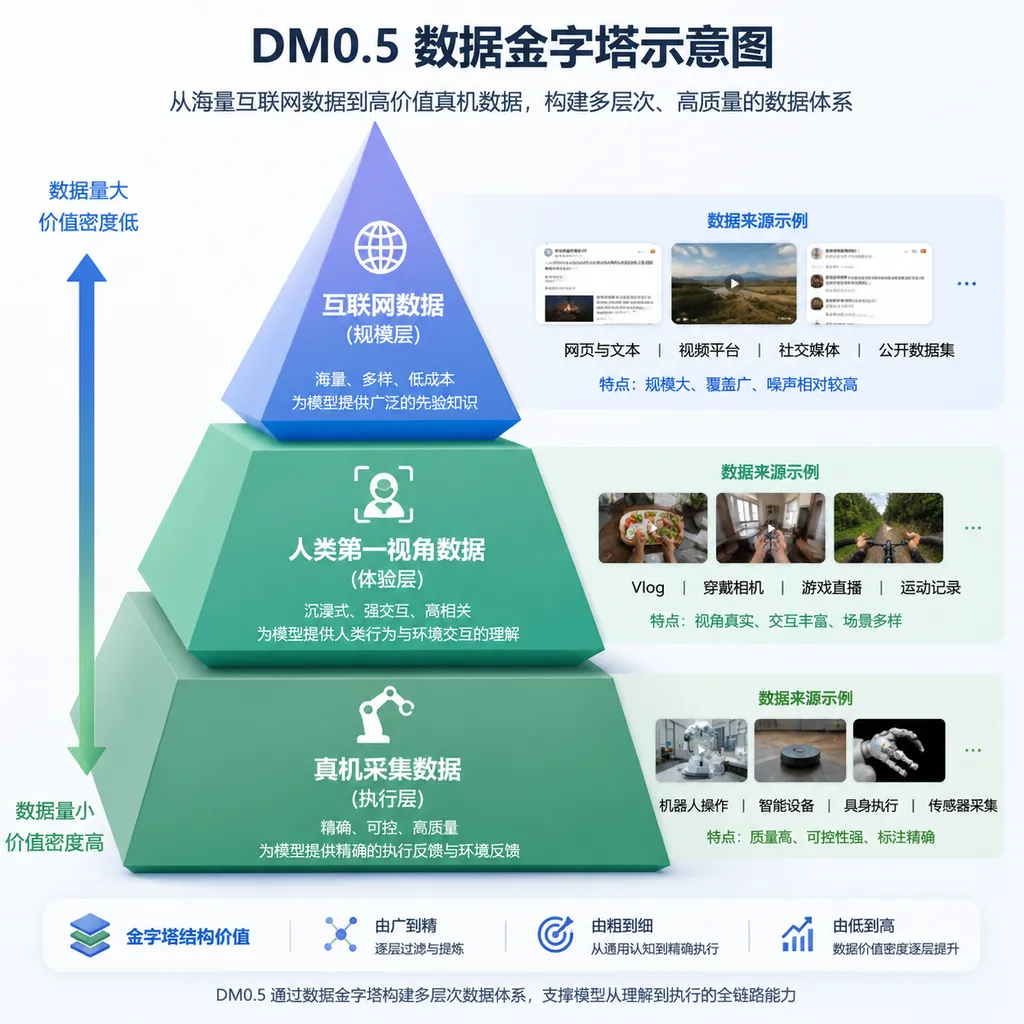
Three Layers of Data Composition
According to official disclosures, DM0.5’s training data mainly consists of three parts:
- Embodied sensor data: Multi-dimensional perception signals including vision, touch, and force sensing, collected from real robots interacting in physical environments;
- Human first-person data (human data / ego data): Human daily operation behaviors captured through head-mounted devices, enriching the semantic space of fine-grained actions;
- Multimodal internet data + simulation data: Including videos, text-image content, driving behavior, navigation data, and other heterogeneous signals used to expand world knowledge boundaries.
Notably, Yuanli Lingji did not simply pursue a "bigger is always better" strategy for data scaling. The team explicitly pointed out that although simulation data is abundant, its value is limited in delicate operation scenarios such as pouring water or handling liquids — because fluid movement continuously changes an object’s center of mass, making precise simulation extremely difficult. As a result, DM0.5 heavily leverages simulation data for indoor navigation and rigid-object grasping, while strongly prioritizing real-world collection for fine manipulation tasks.
Data Distribution Determines Model Robustness
The Yuanli Lingji team has repeatedly emphasized a key idea in technical presentations: data scale largely reflects confidence in distribution coverage. The more data available, the more confidently the model can cover scenario distributions, leading to greater robustness. Beyond sheer volume, DM0.5’s 150,000 hours cover diverse real-world operating conditions ranging from industrial assembly and food preparation to household organization and outdoor inspection.
2. 31% Zero-Shot Improvement: The "Critical Point" of Generalization Emergence
The most striking upgrade in DM0.5 is its 31% improvement in Zero-Shot capability over DM0. The phenomenon behind this figure is described by the team using a more noteworthy phrase: "generalization emergence has already appeared."
What Is Generalization Emergence in Embodied Models?
In the era of language models, emergence usually refers to models suddenly acquiring previously absent capabilities after crossing a certain scale threshold. In embodied scenarios, generalization emergence means:
- Object generalization: The model can reliably grasp unseen shapes, materials, and sizes;
- Scene generalization: The model can transfer from industrial workshops to household kitchens without recollecting primary task data;
- Platform generalization: New hardware platforms unseen during training can be adapted with minimal adjustments;
- Task generalization: Tasks can extend from "pouring water" to "pouring oil," or from "tightening screws" to "twisting bottle caps" without retraining.
According to official information, DM0.5 demonstrates significant Zero-Shot improvements in the following task categories:
| Capability Dimension | DM0 Baseline | DM0.5 Improvement | | --- | --- | --- | | Overall Zero-Shot Capability | 100% | +31% | | Bridge-style Tasks | — | Significant improvement (continuing DM0’s +14.6% trend) | | Cross-Platform Transfer Success Rate | Limited | Greatly improved | | Fine Manipulation Stability | Good | Significantly enhanced |
From "Remembering" to "Reasoning"
Yuanli Lingji partner Zhou Erjin previously mentioned a counterintuitive conclusion in public discussions: "The model is small, yet extremely generalizable." DM0 has only 2.4B parameters, but thanks to its embodied-native training route, it achieved performance far beyond expectations for its parameter scale. DM0.5 pushes generalization capabilities significantly further while maintaining a lightweight design.
Two key technical choices underpin this progress:
- Train-from-Scratch: Rather than attaching an Action Head onto a VLM backbone, the model allows the abilities to "understand the world," "operate within the world," and "predict the world" to grow and shape one another within a unified architecture;
- Integrated multi-platform multi-task training: During training, bipedal humanoids, wheeled robots, dual-arm and single-arm systems are all trained together, giving the model native cross-platform transfer capability.
3. One-Click Deployment Across Multiple Robot Platforms: From Single Hardware to a Universal Brain
Another major upgrade direction for DM0.5 is its cross-platform deployment capability.
Yuanli Lingji explicitly stated that DM0.5 can "easily adapt" to robot platforms including:
- Bipedal humanoid robots
- Wheeled mobile platforms
- Dual-arm/single-arm manipulation robots
- Hybrid platforms (mobility + manipulation)
For developers, this means the previous challenge where "one model serves only one hardware platform" is significantly alleviated. Instead of retraining a complete control strategy for every new robot type, users can deploy based on DM0.5 as a universal brain, requiring only limited fine-tuning for adaptation.
Why Is Cross-Platform Capability So Important?
In the past two years of embodied AI lab demos, achieving a 99% success rate has not been uncommon. But moving toward real-world business deployment reveals a cost gap thousands of times larger between demos and scalable delivery. "Every new robot requires complete retuning" has been one of the heaviest cost burdens.
DM0.5’s integrated multi-platform training mechanism essentially embeds "platform differences" as a learnable dimension inside the model itself, enabling it to understand concepts such as "how many degrees this robotic arm can rotate" or "how steep a slope this chassis can climb." Once hardware constraints become prompts interpretable by the model, cross-platform deployment shifts from "retrain again" to simply "reason again."
4. Dexbotic + RLinf: The Prototype of an Embodied AI "PyTorch"
DM0.5 is not an isolated model release, but a core component in Yuanli Lingji’s evolving "embodied-native technology stack."
Built on the previously released Dexbotic 2.0 development framework, DM0.5 continues the following technical foundations:
- Full closed-loop integration across data — training — evaluation — hardware;
- Support for multi-source mixed-data training;
- Unified embodied manipulation and navigation, and unified imitation learning with reinforcement learning;
- Deep integration with RLinf, a reinforcement learning framework jointly launched with Tsinghua University and Wuwen Xinqiong.
This entire infrastructure stack is widely viewed within the industry as the prototype of an embodied AI "PyTorch." Just as PyTorch freed deep learning researchers from low-level engineering burdens, the combination of Dexbotic + DM0.5 + RLinf is lowering the barrier of embodied AI development to the point where "consumer-grade GPUs are sufficient for fine-tuning and secondary development."
Open-Source Commitment for Developers
Continuing the open-source strategy established during the DM0 era, Yuanli Lingji will release key DM0.5 components to the community. Developers will be able to:
- Fine-tune on consumer-grade GPUs;
- Rapidly adapt based on their own hardware platforms;
- Combine RLinf for hybrid imitation learning + reinforcement learning training;
- Build their own embodied applications through Dexbotic’s "LEGO-style" interfaces.
5. DFOL: From "99% in the Lab" to "24-Hour Factory Operation"
It is also worth noting that alongside DM0.5’s deployment roadmap, the company’s previously announced DFOL (Distributed Field Online Learning) mass-production workflow is being upgraded in parallel.
The core innovation of DFOL is its "data feedback loop" mechanism, forming a continuously evolving closed loop of:
cloud training — on-site execution — data feedback — model updating
- Generic capabilities are trained in the cloud using DM0.5;
- The model is deployed onto specific robots for task execution;
- Real-world operational data flows back to the cloud;
- The model continuously improves itself in real-world environments.
The significance of this mechanism lies in its ability to explicitly bridge the gap between "99% success rates in the lab" and "stable 24/7 factory operation" through an engineering pipeline. The Yuanli Lingji team stated: "No matter how good a demo is, one-time success is far from enough — continuous success is what matters."
6. Industry Signals: Has the GPT-3 Moment for Embodied AI Truly Arrived?
From DM0’s debut in February igniting the "embodied-native" technical narrative, to recognition from NVIDIA and Physical Intelligence in March, and the release of GEN-1 by the Generalist team in April marking the arrival of the "Embodied GPT-3 Moment," the first half of 2026 has seen both technological density and deployment speed in embodied AI accelerate dramatically.
The release of DM0.5 sends at least three clear industry signals:
- The minimum data threshold has risen above the 100,000-hour level, and teams below this threshold will struggle to achieve true generalization capability;
- The embodied-native route is being jointly validated by mainstream players, with train-from-scratch approaches, multimodal fusion, and integrated multi-platform training becoming technical consensus;
- Open ecosystems are becoming competitive accelerators — whoever first builds the "PyTorch for embodied AI" ecosystem is more likely to secure strategic leadership in the next phase.
Conclusion: The "One Generation Every Six Months" Pace of Embodied AI
From DM0 to DM0.5, in just five months, parameter scale remained lightweight while data scale doubled, Zero-Shot capability improved by 31%, and signs of generalization emergence began to appear. This iteration speed is pushing embodied AI into a rapid evolution cycle resembling the "one generation every six months" pace seen in language models.
For developers, robot manufacturers, and industrial integrators, the significance of DM0.5 is not merely the arrival of another SOTA model, but rather a clear milestone indicating that embodied-native technology stacks have entered a stage of usability, reproducibility, and scalable deployment. Will the next version be DM1.0, or leap directly toward a general embodied foundation model with billions or even tens of billions of parameters? It is a development that everyone following embodied AI should continue watching closely.
References
- Zhihu Topic: Embodied AI and Embodied-Native Foundation Models — Collection of technical discussions on embodied AI and embodied-native approaches
- GitHub - Open-Source Embodied AI Projects — Open-source frameworks and model repositories related to embodied AI
- Hugging Face Model Community — Follow open-source release updates for embodied models such as DM0/DM0.5


