
Meta Launches Model Invocation Sales: Muse Spark 1.1 API Officially Goes Live
On July 9, Meta officially opened the Muse Spark 1.1 API to developers, focusing on Coding and Agent task capabilities. With an input price of $1.25 per million tokens, this marks Meta’s official entry into the commercialization competition for AI models.
Meta Officially Launches the Muse Spark 1.1 API: Focused on Coding and Agent Tasks, Meta Begins Directly Selling Model Access
July 9, 2026 — After major players like Anthropic, OpenAI, and Google have spent years battling in the API commercialization arena, Meta has finally let go of its obsession with keeping models exclusive to its own apps. Today, Meta Platforms officially opened the Muse Spark AI model API to developers while also releasing the upgraded Muse Spark 1.1. This marks the first time Meta has directly monetized its flagship model capabilities through token-based pricing. It also signals that under Zuckerberg’s leadership, the social media giant is extending its “Personal Superintelligence” strategy from the product layer into the infrastructure layer.
1. Quick Overview: Meta Is Finally “Selling Models”
For developers familiar with the AI industry landscape, Meta’s move is not particularly early. Looking back at the timeline from 2025 to 2026:
- 2025: Meta formed its “Superintelligence” team, formally diverging from FAIR and targeting frontier models.
- April 2026: Muse Spark debuted as the inaugural product of Meta Superintelligence Labs. It launched only in the Meta AI app and the meta.ai web version, while API access remained limited to a small group of partners in private testing.
- July 9, 2026 (today): Muse Spark 1.1 is publicly released alongside the public preview launch of the Meta Model API, available for direct signup by U.S. developers.
In other words, Meta’s models have officially transitioned from “exclusive to its own storefront” to “wholesale for the entire industry.” The core signal behind this shift is Meta’s recognition that: Facebook, Instagram, and WhatsApp traffic alone are insufficient to build a broad enough developer ecosystem around its models. To truly compete with Anthropic and OpenAI, Meta must enter developers’ direct workflows.
2. Muse Spark 1.1: From “Initial Release” to a “Step-Change”
According to Meta, Muse Spark 1.1 represents a “step-change” upgrade over the original version launched in April, rather than the usual incremental refinement. The improvements directly target developer pain points identified over the past three months.
1. Coding Capabilities
The new model not only generates code, but specifically strengthens its ability to detect and fix complex bugs. Meta explicitly describes it as “the strongest model to date for Real-World Coding tasks.” The wording is notably careful — it does not claim to be “the world’s best,” instead narrowing the claim to “real-world” scenarios. This suggests its benchmark results may still trail Anthropic and OpenAI flagships, while already being highly competitive in actual projects.
Specific supported scenarios include:
- Writing and debugging code;
- End-to-end external tool invocation and software operation;
- Understanding context across multi-file and multi-module projects;
- Fixing subtle logical bugs (not just syntax errors).
2. Agent and Multi-Agent Systems
Version 1.1 introduces native support for end-to-end agentic workflows, including cross-application multi-agent collaboration. Meta repeatedly emphasizes this point, making its target extremely clear: competing for the Coding Agent and automation agent market — currently the strongest domain for Anthropic Claude Sonnet/Opus.
3. Native Multimodality
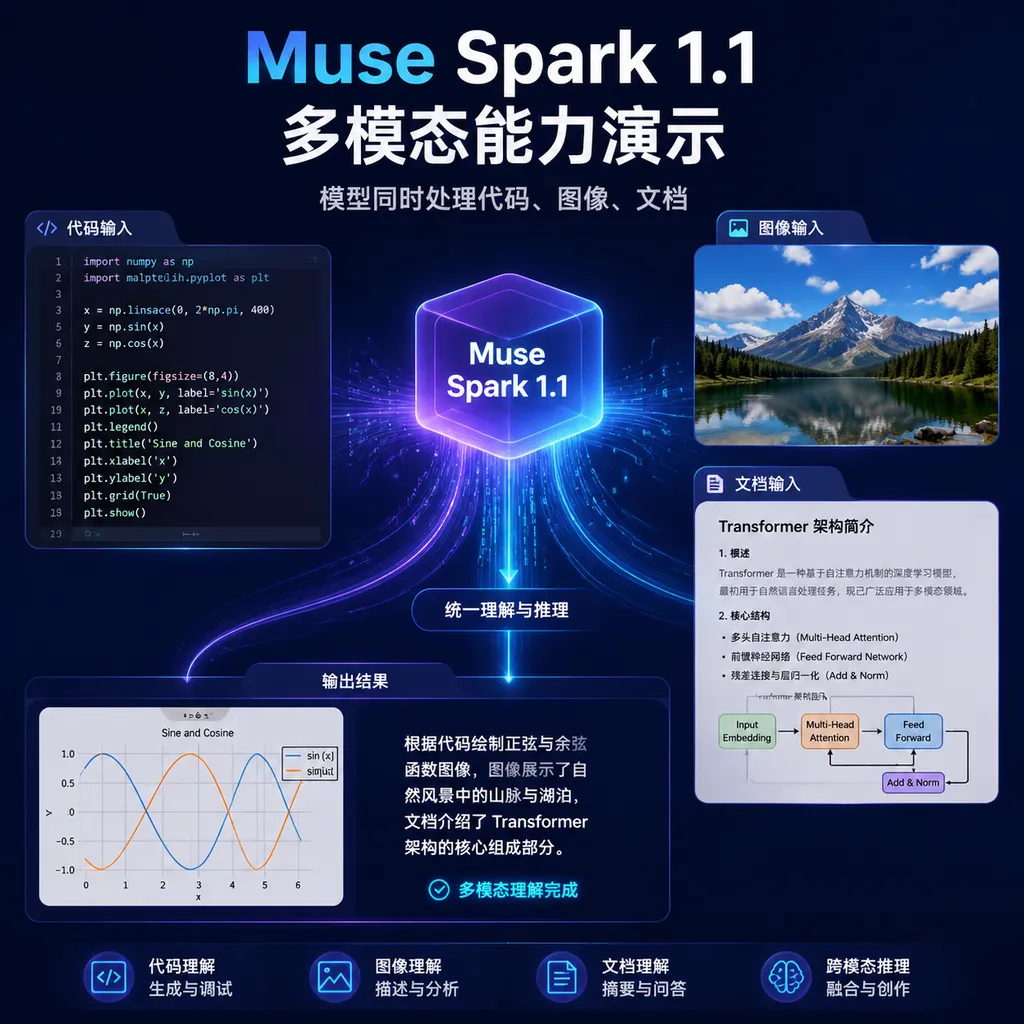
The new model natively supports image, video, and document understanding without requiring external vision encoders. Developers can directly feed screenshots, screen recordings, and PDFs into the model, allowing it to “understand” and execute further actions. This is highly aligned with Meta Ray-Ban AI glasses use cases — after all, whatever the glasses see, the model must understand.
4. Reduced Human Intervention
Meta describes it as being able to “complete complex multi-step tasks with less human intervention.” In the context of agents, the meaning is clear: reducing interruption rates and the need for human fallback handling, enabling the model to autonomously progress tasks for longer periods.
3. Pricing Strategy: Positioned Between GPT-5 mini and Claude Sonnet 4.6
For developers, no matter how powerful a model is, pricing ultimately matters most. Meta announced the following pricing:
| Item | Price | | --- | --- | | Input Tokens | $1.25 / million tokens | | Output Tokens | $4.25 / million tokens | | Free Credits for New Registrations | $20 |
Compared to the current market pricing spectrum:
- Higher than OpenAI’s entry-level GPT-5 mini;
- Higher than Anthropic’s low-cost Claude Haiku 4.5;
- Lower than Anthropic’s premium flagship Claude Sonnet 4.6.
This is a very “smart” pricing strategy. Meta did not pursue ultra-low pricing (which would raise profitability concerns and remind people of the disruptive tactics used during the Llama era), nor did it directly challenge Claude Opus/GPT-5 premium pricing (its benchmark positioning is not there yet). Instead, it precisely positions itself as a “mid-to-high-end option with Sonnet-level capabilities at a lower price,” targeting the market gap as a “cost-performance killer.”
For small and medium SaaS companies and developer tool vendors consuming tens of millions of tokens daily, this pricing means costs can be reduced by 20% to 40% without sacrificing too much quality — enough to justify serious A/B testing.
4. API Quick Start: OpenAI-Compatible Format
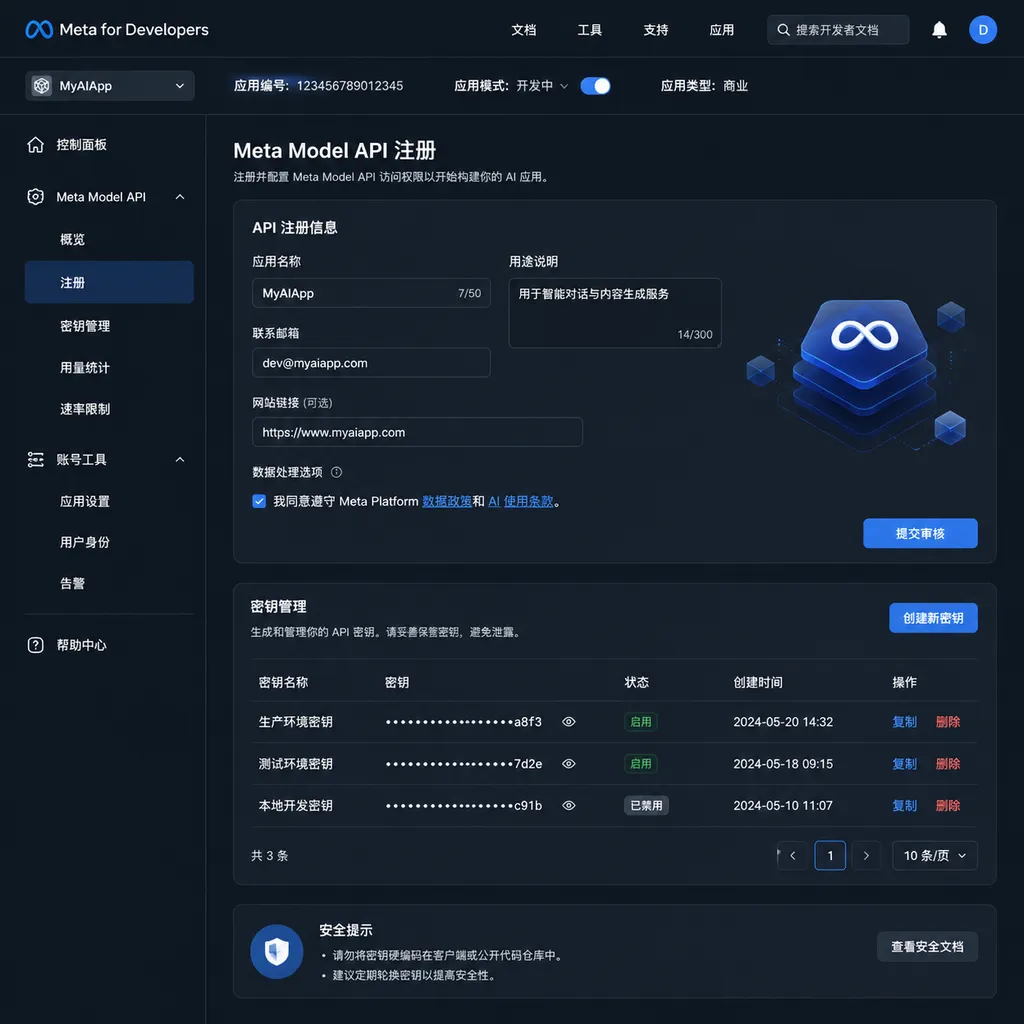
The public preview of the Meta Model API is currently available only to U.S. developers. After registration, developers receive $20 in free credits for prompt testing, output comparison, and application prototype development. The interface follows OpenAI-compatible protocols, making migration costs extremely low — an intentional strategy by Meta so developers can test it by changing only the base_url and model name.
Here is a typical Python example:
from openai import OpenAI

client = OpenAI(
    api_key="YOUR_META_API_KEY",
    base_url="https://api.meta.ai/v1"
)

response = client.chat.completions.create(
    model="muse-spark-1.1",
    messages=[
        {"role": "system", "content": "You are an expert Python engineer."},
        {"role": "user", "content": "Help me implement a thread-safe LRU cache and provide unit tests."}
    ],
    temperature=0.2,
    max_tokens=4096
)

print(response.choices[0].message.content)
To use Muse Spark 1.1’s Agent and tool-calling capabilities, tools can be declared like this:
tools = [
    {
        "type": "function",
        "function": {
            "name": "run_shell",
            "description": "Execute a shell command in the sandbox",
            "parameters": {
                "type": "object",
                "properties": {
                    "command": {"type": "string", "description": "Shell command"}
                },
                "required": ["command"]
            }
        }
    }
]

resp = client.chat.completions.create(
    model="muse-spark-1.1",
    messages=[
        {"role": "user", "content": "Scan all .py files in the current directory and find unused imports."}
    ],
    tools=tools,
    tool_choice="auto"
)

for tool_call in resp.choices[0].message.tool_calls or []:
    print(tool_call.function.name, tool_call.function.arguments)
For native multimodal calls (image + text), the format is similarly close to OpenAI Vision:
resp = client.chat.completions.create(
    model="muse-spark-1.1",
    messages=[
        {
            "role": "user",
            "content": [
                {"type": "text", "text": "What potential single points of failure exist in this architecture diagram?"},
                {
                    "type": "image_url",
                    "image_url": {"url": "https://example.com/arch.png"}
                }
            ]
        }
    ]
)
print(resp.choices[0].message.content)
From the code examples, it’s clear that Meta almost completely follows established industry API interaction patterns instead of trying to be different for the sake of differentiation. This is extremely developer-friendly — existing OpenAI/Claude integrations can adopt it with almost zero modification.
5. Strategic Analysis: Why Is Meta Acting Now?
Viewed within Meta’s broader AI roadmap, the Muse Spark 1.1 API launch is not an isolated product move.
1. The Llama Series Is About to Move to the Background
Meta explicitly stated that Muse Spark will gradually replace the Llama series currently powering chatbots across WhatsApp, Instagram, Facebook, and Meta smart glasses. This is an extremely significant statement — it means the “open-source, general-purpose, ecosystem-first” strategy of the Llama era is being replaced by a “closed-source, verticalized, commercial-first” approach. Meta is reserving its best model capabilities for the closed Muse family, while Llama’s strategic priority is clearly declining.
2. Commercialization Pressure Is Real
Since the second half of 2025, Meta’s capital expenditures on Reality Labs and AI infrastructure (including the Hyperion data center) have continued rising. Wall Street concerns over “massive investment vs. monetization path” have intensified. API billing is the most direct and measurable revenue model: selling tokens to enterprises is the AI revenue structure Wall Street understands best and values most easily.
3. Positioning for the Agent Era
The emphasis on Coding and Agents in version 1.1 is no coincidence. Anthropic Claude has already established itself as the “default choice for agents” across ecosystems such as Cursor, Windsurf, Cline, Claude Code, and GitHub Copilot; OpenAI is counterattacking with Codex and the GPT-5 Codex family. If Meta remains absent, it risks losing the Coding Agent entry point over the coming years. Launching Muse Spark 1.1 directly into this space is an attempt to seize both “model capability” and “developer access” simultaneously.
4. Synergy With Meta AI Consumer Products
Muse Spark 1.1 has already launched in the Meta AI app and web version with a “Thinking” mode, allowing users to explicitly choose longer-chain reasoning. This mirrors Anthropic’s extended thinking and OpenAI’s GPT-5 reasoning mode, indicating that “explicit thinking modes” have become standard UX for flagship models.
6. Developer Perspective: Is Migration Worth It?
Muse Spark 1.1’s appeal varies significantly depending on the type of team.
Teams Worth Evaluating Immediately
- Teams currently using Claude Sonnet 4.6 for Coding Agents: Run benchmark tests to see whether similar performance can be achieved at lower cost.
- Products heavily dependent on multimodal input: Such as document parsing, UI automation, and CV+LLM hybrid applications — Muse Spark 1.1’s native multimodality is worth comparing.
- Teams building multi-agent systems: Meta explicitly claims “support for multi-agent systems,” making real-world evaluation worthwhile.
Teams That Don’t Need to Rush
- Teams focused primarily on Chinese-language scenarios: Official announcements and documentation are mainly in English, and comparative Chinese-language capability data is not yet available.
- Developers outside the United States: The public API preview is currently U.S.-only.
- Production environments highly sensitive to stability: As a public preview product, SLA and rate-limiting policies are not yet fully transparent. Waiting may be prudent.
7. Industry Landscape: Three Challengers Competing for Two Dominant Positions, With Meta Fighting for Third Place
With the launch of the Muse Spark 1.1 API, the competitive landscape for top-tier closed-source model APIs has become even more complex:
- OpenAI: The GPT-5 family spans low-, mid-, and high-end tiers with the most complete ecosystem;
- Anthropic: Claude Opus/Sonnet/Haiku dominate mindshare in Coding Agent scenarios;
- Google: Gemini 3.1 Pro is strong in multimodality and Deep Think;
- Meta: Muse Spark 1.1 enters with a “cost-performance + multimodality + agents” strategy, attempting to force its way into the top tier.
The ultimate deciding factor in this competition may no longer be “whose benchmark score is highest,” but rather “whose model survives inside developers’ real workflows.” Meta opening its API today is only the beginning of a long-term battle. For developers, this means more choices, more price wars, and — undoubtedly — better models.
8. Conclusion
The launch of the Muse Spark 1.1 API marks a clear turning point in Meta’s AI strategy history. It signifies Meta’s transition from “models serving internal applications” to “models as commercial products.” The combination of $20 free credits, $1.25 / $4.25 token pricing, OpenAI-compatible protocols, native multimodality, and agent capabilities is both pragmatic and restrained.
If Meta can deliver on its “step-change” claims — especially in real-world coding and multi-agent collaboration scenarios — developers will gain another genuinely viable option. And this option may redefine the cost-performance standard for mid-tier flagship models over the coming months.
References
- Meta Officially Opens Muse Spark AI Model API to Developers, Joining the AI Commercialization Race - IT Home: IT Home’s July 9 Chinese launch report containing complete pricing and capability details.


