
OpenAI Shelves the Atlas Browser, Bringing Agent Capabilities Back to the Desktop
ChatGPT Atlas, which has been online for less than a year, will shut down on August 9. OpenAI is splitting and migrating its Agent browsing capabilities to the ChatGPT desktop app and Chrome extension. This is the second “side project” cut since Fidji Simo took office; Sora was previously discontinued as well.
OpenAI product manager James Sun confirmed on X today (July 10): ChatGPT Atlas is shutting down, with a planned termination date of August 9. It’s been less than a year since the browser launched with major fanfare last October.
The official wording was the usual polite corporate phrasing — “Atlas features will be migrated into new products,” with existing users to be notified via email and push notifications in the coming days. Put more plainly: the product failed, the team was dissolved, and whatever useful capabilities remain are being folded back into the main product line.
Why an “All-in ChatGPT” browser couldn’t survive a year
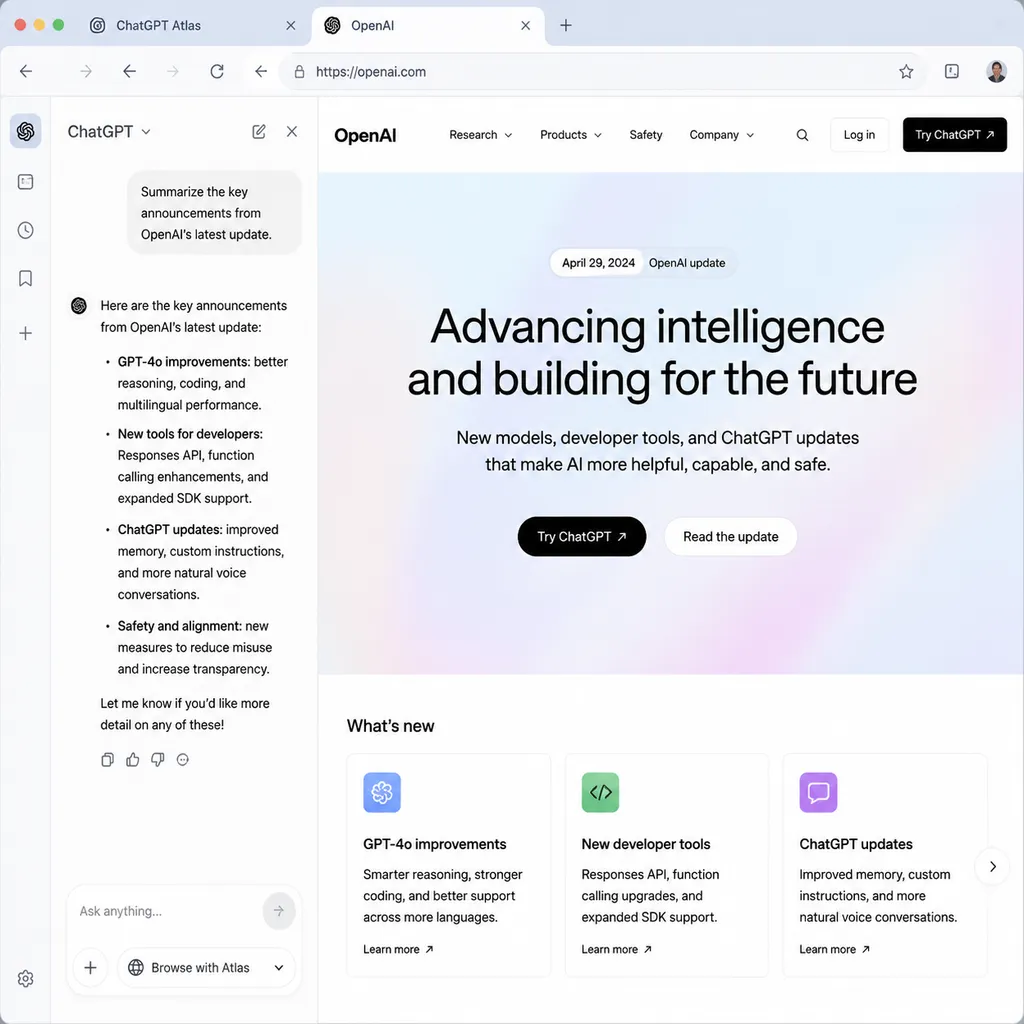
First, a quick recap of what Atlas actually was. When it launched last October, OpenAI positioned it as “a new browser built around ChatGPT,” centered on three key features:
- Sidebar ChatGPT: Invoke ChatGPT on any webpage for Q&A and summaries based directly on the current page content
- Browser Memories: Optional browsing memory that lets ChatGPT remember what you’ve visited, enabling cross-session requests like “Summarize the industry trends from the job listings I looked at last week”
- Agent Mode: Let ChatGPT operate the browser on your behalf — research, food ordering, meeting scheduling, etc., available to Plus/Pro/Business users
At launch it only supported macOS, with Windows, iOS, and Android supposedly “in development.” That “Mac-first” decision was heavily criticized on Reddit at the time — a product trying to challenge Chrome’s entry point while ignoring over 70% of desktop users didn’t exactly look serious.
In hindsight, that signal may have mattered more than expected. From the very beginning, Atlas never really looked like a strategic product. It looked more like a technology validation demo wearing the skin of a product.
The real reason: Fidji Simo’s “side quest cleanup”
TechCrunch’s report highlighted an important background detail: OpenAI applications chief Fidji Simo (former Instacart CEO, who joined OpenAI last year) had already instructed teams months ago to cut “side quests.”
The first casualty was the Sora video-generation app. ChatGPT’s “adult mode” plans were also paused. Now it’s Atlas’s turn. The Verge put it even more bluntly: OpenAI is busy chasing Anthropic in productivity features and no longer has the bandwidth to maintain resource-draining edge projects.
Looking at the timeline together, the logic becomes clear:
- OpenAI realized it was under heavy pressure from Anthropic in enterprise/productivity scenarios (Claude + Claude Code + the MCP ecosystem)
- The ChatGPT Work product announced today is the real priority
- Resources need to be concentrated, and projects like Atlas — with a separate client, separate brand, and separate distribution channel — simply have poor ROI
The browser space is now extremely crowded: Perplexity’s Comet, The Browser Company’s Dia, Google stuffing Gemini into Chrome, Microsoft embedding Copilot into Edge. Everyone wants to become “the internet entry point for the AI era.” But entry points have network effects. Chrome sits at over 65% market share, and convincing users to migrate to a new browser from scratch is absurdly expensive.
After a few months, OpenAI seems to have realized something: browsers are tools, not destinations. Users won’t switch browsers just for AI, but they are willing to let AI into the browser they already use.
That conclusion is actually quite pragmatic.
Where the capabilities went: desktop app + Chrome extension + cloud browser
Atlas is dead, but OpenAI’s browser-based Agent capabilities are not. Instead, they’ve been split into three forms that are much closer to users:
1. Chrome extension
OpenAI is developing a ChatGPT Chrome extension. It can read the context of the current webpage, allowing users to ask questions and generate summaries without leaving the browser.
This move came late, but it was the right move. Convincing users to install an extension has an order-of-magnitude lower mental cost than convincing them to switch browsers. And a Chrome extension instantly covers Windows, Mac, Linux, and ChromeOS — far more practical than Atlas’s macOS-only approach.
2. Browser built into the ChatGPT desktop app
The latest version of the ChatGPT desktop app includes a more complete built-in browser component capable of opening webpages, logging into accounts, and downloading files. In essence, this moves Atlas’s core engine into the desktop app, where it exists as an “Agent workspace” rather than a standalone browser.
The positioning difference is critical: Atlas was “a browser with AI,” while the desktop app browser is “an AI with a browser.” The former competes with Chrome; the latter complements Chrome.
3. Cloud browser
This already existed as the server-side runtime environment for ChatGPT Agent. When you ask ChatGPT to book flights or conduct research, it operates a remote browser running on OpenAI’s servers, independent of your local machine.
Taken together, these three components effectively split browser capabilities into three layers: “local context acquisition (extension) + local task execution (desktop app) + cloud asynchronous tasks (cloud browser).” This architecture is more rational than Atlas trying to do everything in a single client, and it makes much better use of ChatGPT’s existing user base and data assets.
One observation: strategic retreat or tactical adjustment?
A lot of people saw Atlas getting cut and immediately thought, “Is OpenAI struggling?” I think the opposite is true.
The genuinely concerning signal would have been an OpenAI under Sam Altman trying to do everything at once — hardware, browsers, video, adult mode, social networking. Fidji Simo coming in and starting to cut projects is actually healthier. An AI company valued in the hundreds of billions fighting ten fronts simultaneously suggests it doesn’t know what it actually needs to win at.
Cutting Atlas sends a clear message: OpenAI recognizes that it is not a consumer operating system company. It is a provider of models and Agent capabilities. Users stay where they already are, and OpenAI should deliver capabilities there rather than expecting users to relocate for its convenience.
For developers, the more practical implication is this: future Agent capabilities are unlikely to remain locked inside exclusive clients. Instead, they’ll spread more broadly through extensions, SDKs, and APIs. OpenAI is already pushing its Apps SDK, and once the Chrome extension route matures, the barrier to integrating Agent capabilities will only get lower.
For developers in China, OpenAI Hub currently supports unified access to mainstream models including GPT-5, Claude, Gemini, and DeepSeek, with direct domestic connectivity and OpenAI-compatible APIs. For Agent-related testing and integration, developers can switch models using a single key to compare results without having to build their own proxy infrastructure.
Closing thoughts
Atlas lasted less than 10 months from launch to shutdown. What people may ultimately remember is not what it accomplished, but what it proved: in the face of an entry point as dominant as Chrome, “AI-first” alone is not enough reason for users to migrate.
The next question is how long Perplexity’s Comet and The Browser Company’s Dia can keep going.
References
- ITHome: OpenAI’s desktop browser ChatGPT Atlas is about to be discontinued — Chinese report summarizing the shutdown timeline and feature migration path
- Reddit r/ChatGPT: Discussion about OpenAI’s new browser Atlas lacking Windows support at launch — Developer community criticism of Atlas’s platform strategy at launch


