
Fitting a 27B Large Model into an iPhone: PrismML Has Caught Apple’s Attention

PrismML used native 1-bit compression to run Alibaba’s Qwen 3.6 27B model on the iPhone 17 Pro, and Apple is already in talks. This is not conventional quantization, but a new end-to-end approach that represents weights using only {-1, +1}, shrinking the model to 1/14 of its original size.
Fitting a 27B Model into an iPhone: PrismML’s 1-bit Compression Has Apple Paying Attention
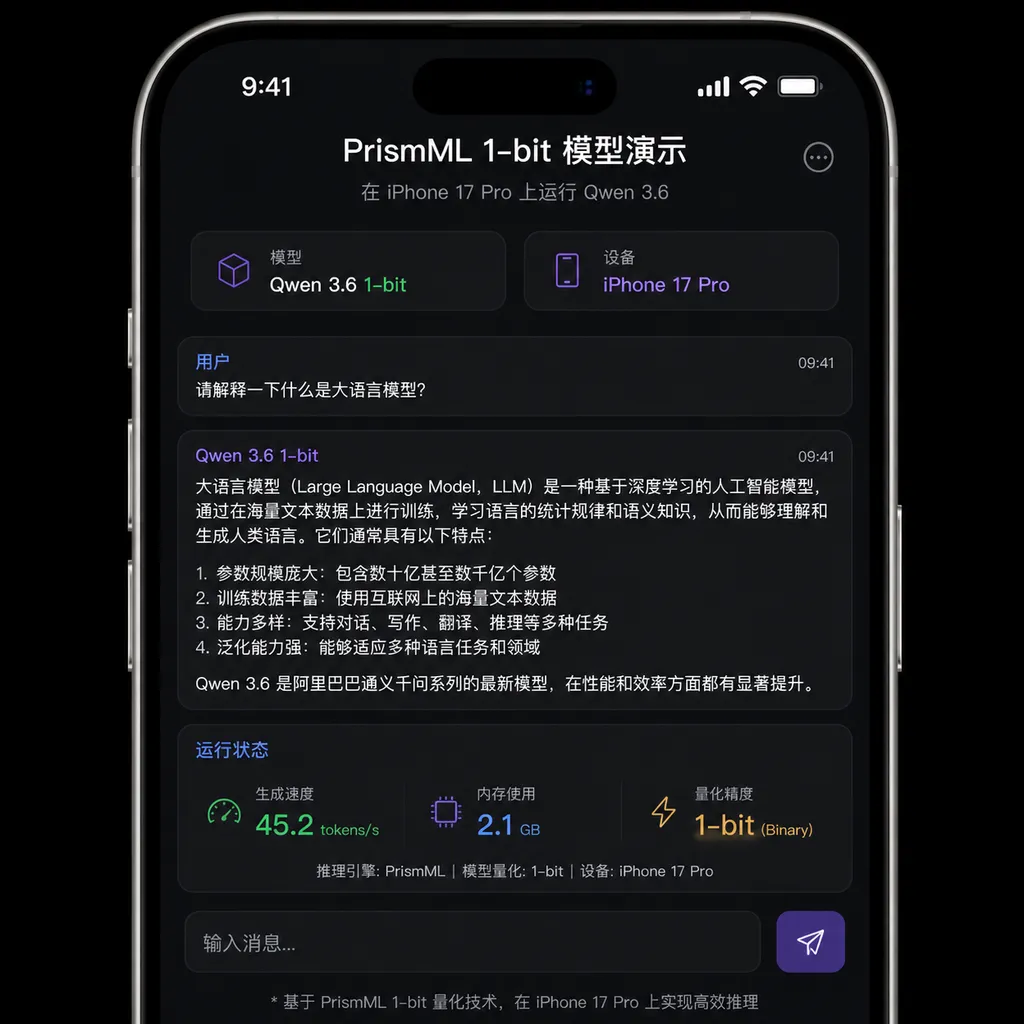
On July 9, The Information dropped a report: Apple is in talks with a startup called PrismML, evaluating the feasibility of running larger AI models directly on the iPhone. The company’s headline achievement is that PrismML has successfully compressed and run Alibaba’s open-source Qwen 3.6 (27B parameters) in full on an iPhone 17 Pro.
This is the largest model publicly reported to have run on-device so far. For comparison, when PrismML first appeared three months ago, its flagship demo was the 8B-parameter Bonsai model. In just three months, the ceiling for edge-device models has more than tripled.
How Did They Get 27B Running on a Phone?
First, the short answer: this is not another round of INT8 or INT4 quantization.
Traditional quantization methods—whether GPTQ, AWQ, or SmoothQuant—essentially take FP16 weights after training and compress them into 8-bit or 4-bit formats using various strategies. The issue is that, to preserve accuracy in critical layers, these approaches usually keep part of the weights running in FP16 or higher precision. These “high-precision escape hatches” mean that even so-called 4-bit models still rely heavily on floating-point computation in sensitive layers, significantly reducing the actual compression ratio.
PrismML took a different route: a native 1-bit architecture. Weights are represented using only two values, {-1, +1}, combined with shared group scaling factors to preserve the model’s expressive power. The key word here is “native”: embedding layers, attention layers, MLPs, and the LM head all operate entirely in 1-bit end-to-end, with no precision backdoors.
This is not post-training compression. The model is trained for a 1-bit target from the pretraining stage onward. The models are trained from scratch on Google TPU v4 hardware, with weights inherently binarized from the beginning.
Here’s what the results look like:
- Model size: The full-precision version of Qwen 3.6 27B requires around 54GB of VRAM. After compression, it shrinks to roughly 4GB—a compression ratio close to 14:1.
- Memory usage: Reduced by over 90%.
- Inference speed: Up to 8× faster.
- Power consumption: Reduced by 75%–80%.
Compare this to the Bonsai 8B model PrismML released in March: 8.2 billion parameters packed into 1.15GB, running at around 40 tokens per second on an iPhone 17 Pro, with energy usage of just 0.068 milliwatt-hours per second on the iPhone 17 Pro Max. On an M4 Pro Mac it reached 131 tokens/s, while an RTX 4090 pushed 368 tokens/s.
If similar efficiency ratios hold for Qwen 3.6 27B, the significance goes beyond “it can run.” It means it’s actually practical to use.
Why Apple Is Interested
Apple’s strategy around on-device AI has been conflicted for years.
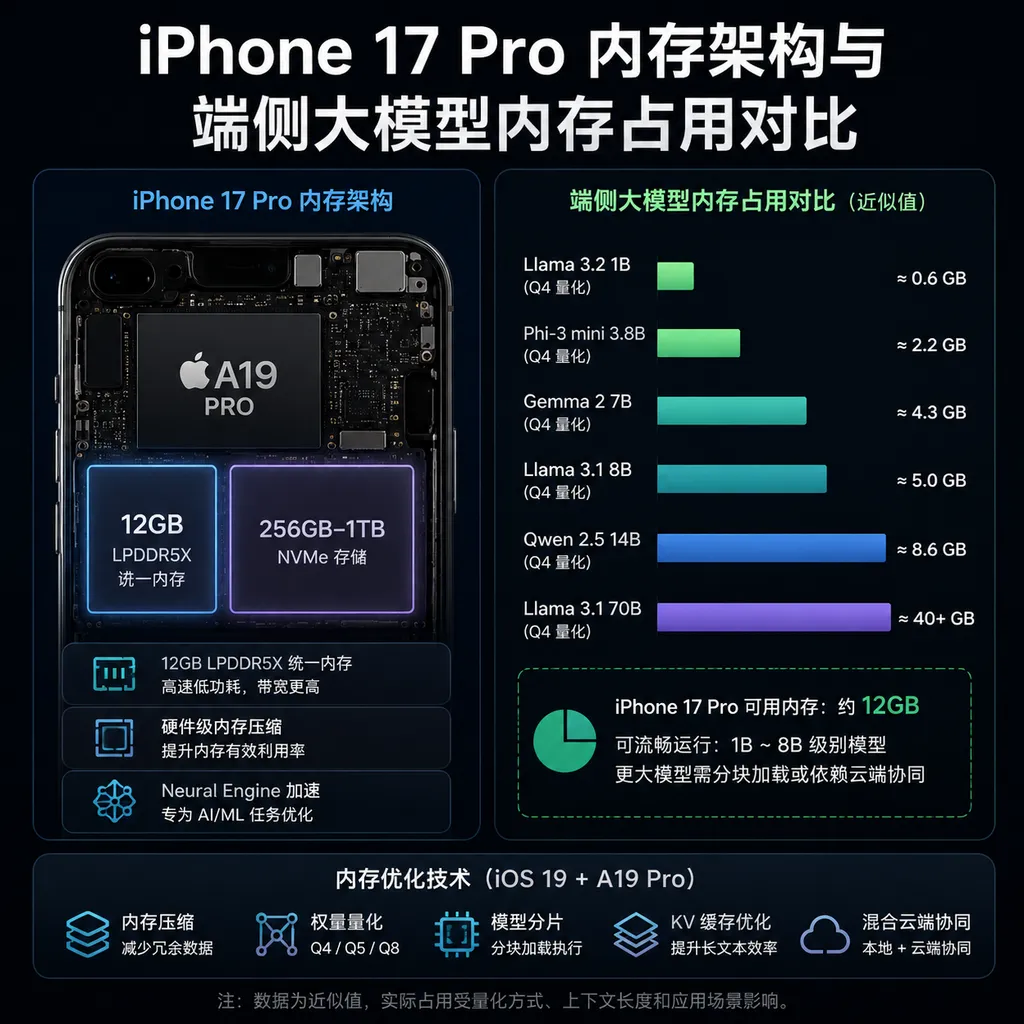
Apple Intelligence emphasizes on-device processing, but due to memory limitations, iPhones have only been running relatively small models around 3B parameters. More demanding tasks are offloaded either to Private Cloud Compute or to ChatGPT. Truly capable “on-device large models” have remained a missing piece.
The bottleneck isn’t compute power. The NPUs in Apple’s M-series chips have been powerful enough for a while. The real constraint is memory. Even the iPhone 17 Pro tops out at 12GB of RAM, and much of that must remain available for iOS and apps. An FP16 8B model alone requires about 16GB just for weights, making it impossible to fit. INT4 quantization can compress it down to around 4GB, but the accuracy degradation is noticeable.
PrismML’s 1-bit solution hits this pain point directly: it compresses 27B-scale models into a memory footprint acceptable for consumer smartphones while maintaining accuracy close to FP16. If Apple validates the approach, the capability ceiling for the next generation of Apple Intelligence could rise dramatically. Running advanced agents, long-document understanding, and code generation locally—tasks that currently require cloud infrastructure—would become realistic.
This also explains why Apple is the first major company making moves here. Google has Gemini Nano, Microsoft has Phi, both following the “train a smaller model” strategy. Apple needs the ability to “compress large models into small ones”—a differentiated requirement driven by hardware constraints.
Who Is PrismML?
PrismML is a Caltech spinout startup that officially emerged from stealth mode in March 2026, backed by Khosla Ventures. Vinod Khosla personally endorsed the company with a quote that attracted attention:
“The future of AI will not be defined by who can build the largest data centers.”
The statement itself isn’t particularly novel—people were saying similar things after DeepSeek emerged last year. But PrismML’s technical direction really is different from the mainstream. Instead of pursuing “bigger and stronger,” it focuses relentlessly on intelligence density—how much intelligence can be delivered per gigabyte of memory.
As for products, PrismML currently has three models available on Hugging Face under the Apache 2.0 license, supporting both Apple MLX format and llama.cpp CUDA. Developers can download and run them directly on edge devices. That matters because if the technology remained locked inside closed-source models, it would be difficult to convince the industry that the approach truly works. Open source itself becomes a credibility signal.
Choosing Qwen 3.6 27B as the demonstration target was also deliberate. The Qwen family is currently one of the strongest Chinese open-source model series overall, and 27B is considered a sweet spot: powerful enough for serious work without being absurdly massive. By validating its compression technology on someone else’s model, PrismML’s claims carry far more weight than if it only demonstrated self-trained, self-compressed models.
How Significant Is This Really?
First, some caution: PrismML’s claim of “near-FP16 accuracy” currently relies only on its own benchmarks. Native 1-bit training is not a new academic concept—Microsoft’s BitNet series has explored it for several years—but PrismML is the first company to publicly demonstrate a 27B-scale implementation running on consumer hardware.
There are still several key questions:
- How much accuracy degradation is there really? Moving from 8B to 27B, can a 1-bit architecture maintain comparable fidelity? Independent evaluations are still needed, especially for tasks sensitive to weight precision like complex reasoning and code generation.
- Training cost: Training a 1-bit model from scratch may not actually be cheaper than FP16 training. Upfront investment remains substantial. Whether this scales commercially depends on how many companies adopt the approach.
- Generality: Qwen 3.6 is a dense model. What about MoE architectures? Multimodal models? Whether 1-bit methods can generalize across mainstream architectures remains uncertain.
Still, the direction makes sense. From DeepSeek cutting training costs by an order of magnitude through engineering optimization, to PrismML compressing model size by a factor of fourteen, the AI industry narrative is shifting from “more parameters, more compute” toward “higher efficiency, higher density.” This isn’t a paradigm revolution—it’s straightforward engineering evolution. But for developers and edge applications, that’s exactly what can unlock the next ceiling.
If Apple adopts PrismML’s approach, there’s a strong chance Apple Intelligence in late 2026 or early 2027 will use this compression technology. At that point, running 20B+ models locally on an iPhone would move from demo territory into everyday reality.
What This Means for Developers
In the short term, the immediate beneficiaries are developers building edge applications. The 1-bit Bonsai series is already available for download on Hugging Face. MLX format works well with Apple hardware, while llama.cpp support covers mainstream GPU environments. To try it yourself:
# Download the Bonsai 8B 1-bit model
git lfs install
git clone https://huggingface.co/prismml/Bonsai-8B-1bit

# MLX format (Apple Silicon)
pip install mlx-lm
mlx_lm.generate --model prismml/Bonsai-8B-1bit \
  --prompt \"Explain 1-bit quantization\"

# llama.cpp with GGUF
./llama-cli -m Bonsai-8B-1bit.gguf -p \"Hello\"
In the medium term, once a 1-bit version of Qwen 3.6 27B is released—if PrismML chooses to publish it—it could become an important benchmark for edge AI development. Right now, calling Qwen 3.6 through cloud APIs is already standard practice for many developers. Aggregation platforms like OpenAI Hub allow developers to access Qwen, Claude, GPT, Gemini, DeepSeek, and others through a single API key with OpenAI-compatible formatting, making testing and comparison convenient. Once capable 1-bit edge versions mature, hybrid cloud-plus-edge deployment will likely become mainstream: simple tasks run locally to save costs, while complex tasks run in the cloud for better performance.
Long term, if 1-bit architectures truly become an industry standard, the entire cost structure of AI hardware could be rewritten. Data centers would no longer need to stack endless H100s and B200s, and edge devices wouldn’t need ever-increasing memory just to support AI workloads. That would be beneficial for industry-wide energy consumption, costs, and accessibility.
The next thing worth watching is whether Apple unveils an “epic update” for Apple Intelligence at WWDC 2027. If it does, that may become the strongest validation yet for this technology.
Sources
- Qwen 3.6 Fully Running on iPhone 17 Pro; Reports Say Apple Is Interested in PrismML’s AI Compression Technology - IT Home: Original IT Home report summarizing Apple’s discussions with PrismML and the key points of its 1-bit compression technology.
- Stuffing an 8B Model into an iPhone: This Company Makes AI Faster While Cutting Power Usage by 80% - Zhihu: Zhihu technical article with a detailed breakdown of PrismML Bonsai 8B’s 1-bit architecture and training methods.
- PrismML Bonsai Model Series - Hugging Face: PrismML’s official model repository, providing MLX and GGUF downloads for the 1-bit Bonsai series.


