
GPT-5.6 Trio Debuts: Codex Integrated into ChatGPT
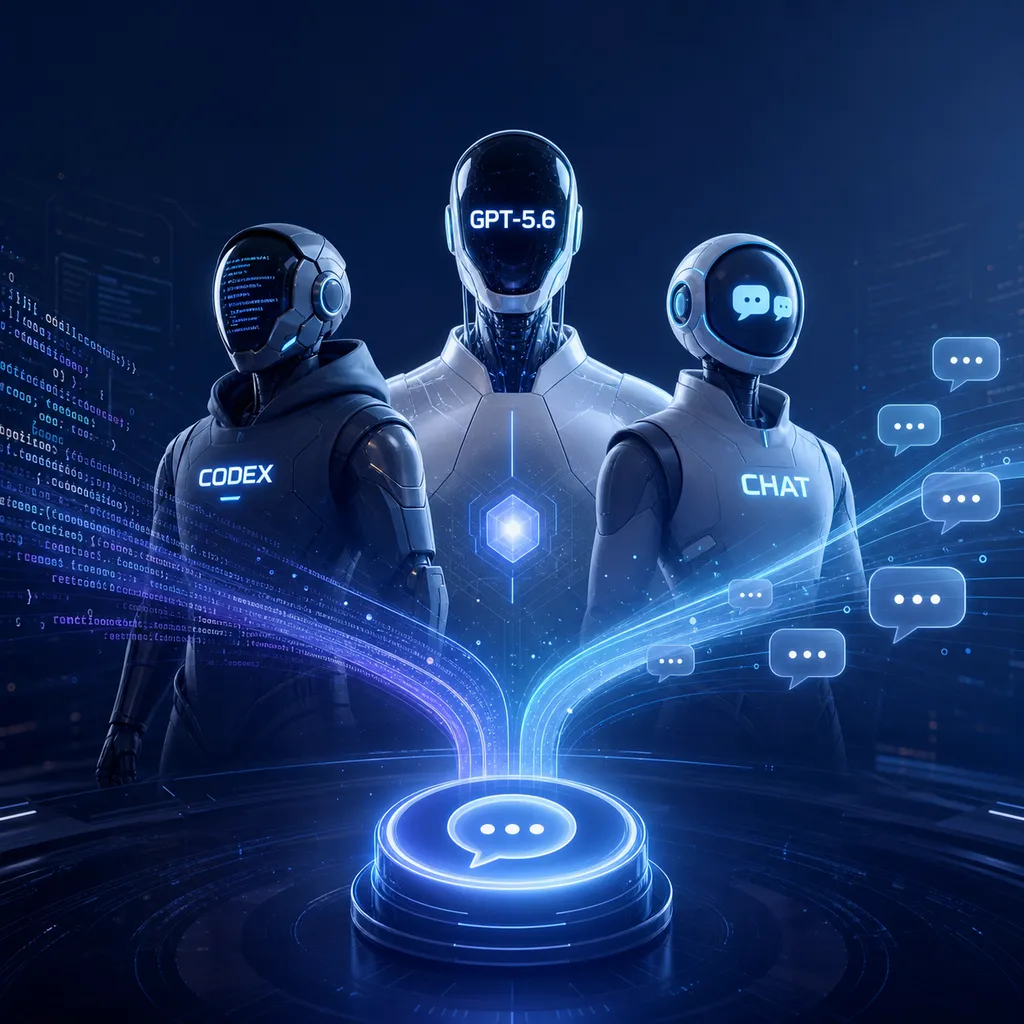
OpenAI officially releases the full GPT-5.6 lineup — Sol, Terra, and Luna tiers are now available simultaneously, emphasizing cost-effectiveness rather than being "smarter," while Codex is integrated into ChatGPT. The flagship Sol sets new SOTA records on coding and agent benchmarks, directly challenging Claude Fable 5.
OpenAI unveiled the entire GPT-5.6 lineup in one go last night: the flagship Sol, the balanced Terra, and the lightweight Luna, all released together with full availability. At the same time, Codex disappeared as a standalone product—it has been folded into ChatGPT, finally completing OpenAI’s long-promised “super app.”
The core narrative of this launch is not “smarter,” but “cheaper.” Altman himself made it explicit on X: OpenAI heard enterprise customers complaining about AI costs, and GPT-5.6 is designed around one question—how much each task costs to run.
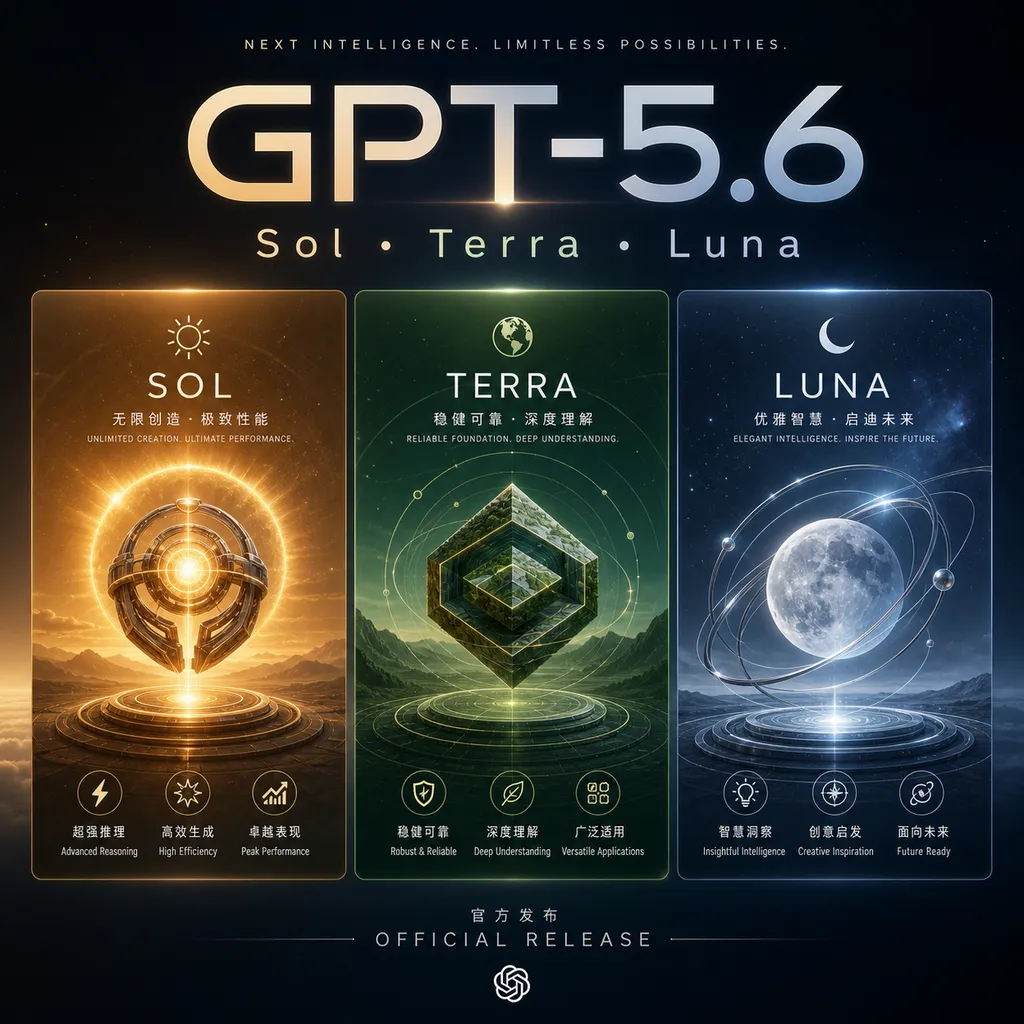
Three-tier lineup: celestial naming, independent iteration
GPT-5.6 introduces a new naming system—numbers represent generations, while celestial names represent tiers. Going forward, each tier can evolve on its own schedule instead of requiring the entire product line to update together.
- Sol (Sun): The flagship model, aimed at hardcore coding, scientific research, cybersecurity, and long-chain agent workflows. This release also introduces Ultra mode, which by default coordinates four AI agents working in parallel.
- Terra (Earth): The main productivity model, balancing capability, stability, and cost for enterprise office work, content generation, and data analysis.
- Luna (Moon): The cheapest and fastest model, suited for lightweight high-frequency tasks such as customer support Q&A, information extraction, and large-scale classification.
Pricing is the centerpiece of this launch. Per million tokens:
| Model | Input | Output | |------|------|------| | Sol | $5 | $30 | | Terra | $2.5 | $15 | | Luna | $1 | $6 |
Compared to Claude Fable 5’s $10 / $50 pricing, Sol cuts the cost in half, Terra halves it again, and Luna costs only a fraction of the competitor’s price.
Benchmarks: Sol outperforms Fable 5 across the board
Beyond price-performance, Sol’s raw capability also holds up.
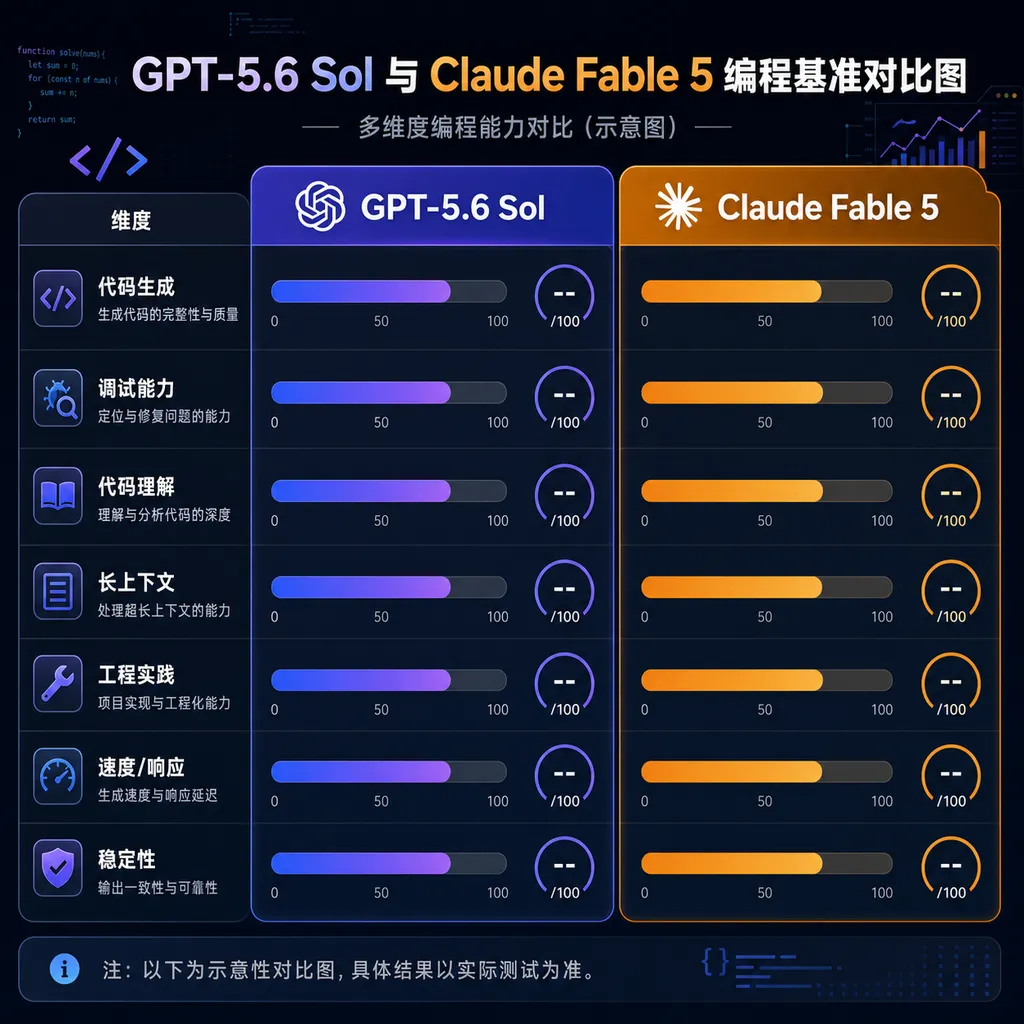
On the Artificial Analysis Coding Agent Index, Sol scored 80 points with max reasoning enabled, setting a new SOTA and outperforming Fable 5 by 2.8 points. More importantly, it used less than half the output tokens, took less than half the time, and cost roughly one-third as much.
On Agents’ Last Exam, Sol achieved a new high score of 53.6, beating Fable 5 by 13.1 points. OpenAI added that even with only mid-level reasoning enabled, Sol still outperformed Fable 5 by 11.4 points at roughly one-quarter of the cost. The smaller Terra and Luna models also surpassed Fable 5 while costing around one-sixteenth as much.
On Terminal-Bench 2.1, Sol Ultra led with 91.9%, standard Sol scored 88.8%, and Fable 5 reached 88.0%. The top tier consists of the Sol family, while Fable 5 and Terra fall into the second tier. Gemini 3.1 Pro Preview came last at 70.7%.
Billing changes also reinforce the “cost-saving” narrative
To strengthen the value-for-money story, OpenAI also adjusted billing rules: writing to the prompt cache is billed at 1.25× the standard input rate, while cache reads cost only 10% of the normal rate. Developers can manually define cache breakpoints, and caches are retained for at least 30 minutes. For workloads involving long contexts and repeated calls, billing predictability improves significantly.
The messaging sounds good, but actual deployment costs will still depend on workload patterns—especially since Ultra mode launches four agents in parallel by default, which may make bills less attractive than expected. Still, the overall direction is clearly downward: better performance at the same tier for lower prices, or stronger models for the same money.
Codex disappears, ChatGPT becomes “one entry point”
Another major shift is product-line consolidation. Codex as a standalone product has been discontinued, with its capabilities integrated into ChatGPT. The story OpenAI wants to tell is clear: from now on, there is only one application—ChatGPT—with coding, productivity, and agents all bundled together.
For developers, this means capabilities previously scattered across multiple products are now unified, but it also means heavy Codex users may need to adapt their workflows.
OpenAI Hub now supports the full lineup
OpenAI Hub has already integrated the entire GPT-5.6 family—Sol, Terra, and Luna can all be accessed with a single API key, fully compatible with the OpenAI format, with direct domestic connectivity and no proxy setup required. Developers who want to compare Sol with Fable 5 side by side, or use Luna for batch workloads, can avoid the hassle of switching accounts and network configurations.
curl -X POST https://api.openai-hub.net/v1/chat/completions \
  -H "Authorization: Bearer YOUR_API_KEY" \
  -H "Content-Type: application/json" \
  -d '{
      "messages": [
        {
          "content": "Hello!",
          "role": "user"
        }
      ],
      "model": "gpt-5.6-luna"
    }'
Whether GPT-5.6 can truly dethrone Claude as the leading coding agent will depend on real developer feedback over the coming months. But at least from a pricing perspective, OpenAI clearly intends to push industry pricing downward in this round.


