
Microsoft Aurora 1.5 Open-Sourced: Bringing Weather Forecasting Down to the Hourly Level
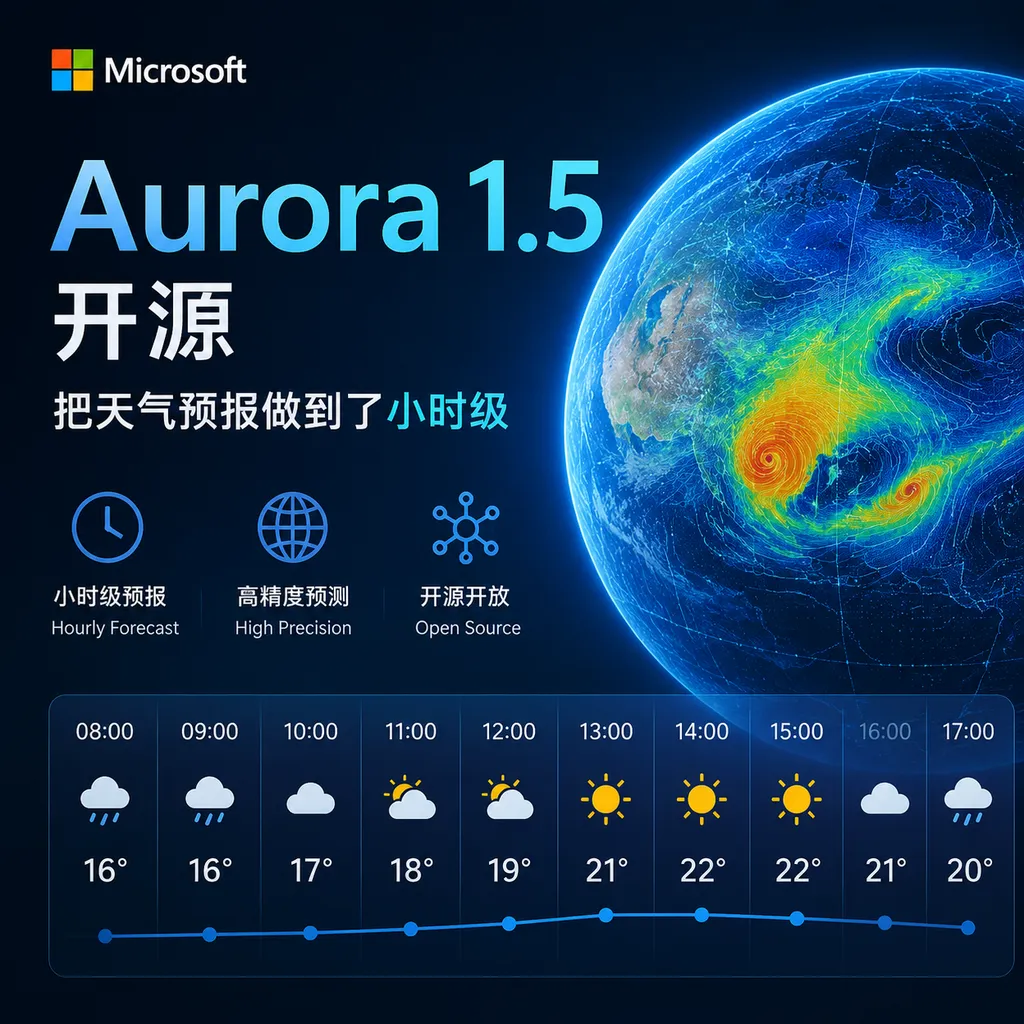
Microsoft released Aurora 1.5 on July 9. The weather foundation model adds 22 new variables, supports hourly forecasting and ensemble prediction, and reduces hurricane track error by one-third compared to the previous generation. The code has been open-sourced on GitHub.
Microsoft Pushes Aurora Forward Again — This Time to Hour-Level Forecasting
On July 9, Microsoft Research officially released Aurora 1.5 — a major update to its Earth system foundation model. Compared with the original Aurora that impressed the meteorology community more than a year ago, this version expands the number of variables to 22, compresses temporal resolution from 6 hours down to 1 hour, and adds built-in probabilistic ensemble forecasting capabilities. The code is available on GitHub, the weights are hosted on Hugging Face, and academic institutions, governments, and research organizations can download and run it directly.
When the news broke, the industry’s first reaction was not “wow, AI wins again,” but rather: finally, a version that can actually be deployed into production systems.
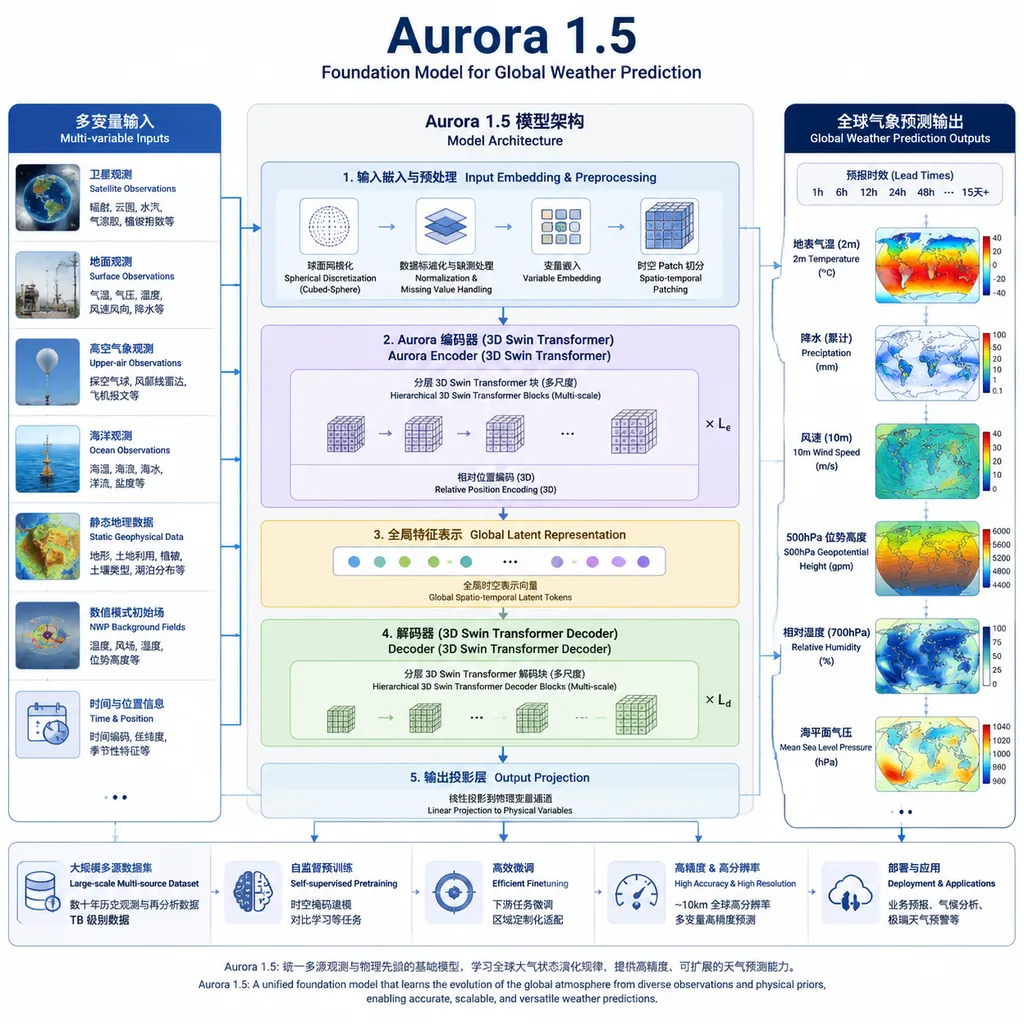
What 22 Variables Actually Means
First, the variables. The original Aurora mainly focused on global forecasting using core atmospheric quantities — temperature, humidity, wind fields, pressure, and the usual set. Its coverage was already broad, but for downstream industries it still felt “one layer removed.” The 22 variables added in version 1.5 are highly targeted:
- Energy-related: surface shortwave/longwave radiation fluxes, 10-meter wind components, boundary layer height — exactly the data used for solar and wind power scheduling
- Agriculture-related: layered soil moisture, evapotranspiration, surface temperature — essential for planting decisions and irrigation management
- Transportation-related: visibility, low-altitude turbulence, runway crosswind components — long-standing pain points for aviation and shipping
- Climate risk: derived metrics such as extreme precipitation probability and compound heatwave indices — exactly what insurance and reinsurance companies have been lacking in recent years
This is not simply about attaching a few extra heads to the output layer. It means Aurora has taken a step from being a “basic research achievement” toward becoming an “industry-consumable forecasting product.” Anyone who has worked on meteorological data integration knows the real headache in production systems is not the lack of a global temperature map, but that every downstream application has to assemble its own derived variables. Aurora 1.5 effectively handles that layer directly.
Hour-Level Forecasting and Ensemble Prediction — These Are the Hard Problems
If adding variables is “widening,” then hour-level forecasting and ensemble prediction are “deepening.”
Traditional numerical weather prediction models such as ECMWF’s IFS operate production-grade high-resolution forecasts at 6-hour or 3-hour intervals. AI weather models in academia over the past few years have also mostly stopped at 6 hours. Dropping to 1 hour introduces difficulties not mainly in compute power, but in the training data itself — ERA5 reanalysis temporal density, spatiotemporal alignment of observational data, autoregressive error accumulation — every piece has to be retuned.
According to Microsoft’s technical report, Aurora 1.5 modifies the original Swin Transformer 3D backbone in two ways: first, replacing temporal embeddings with finer-grained positional encoding; second, introducing a short-term forecasting fine-tuning stage using high-frequency observational data for conditional generation. This combination allows the model to match production-grade nowcasting systems in the 1–24 hour window while retaining medium-range forecasting capability (3–10 days).
Ensemble forecasting is the other feature that immediately caught the attention of operational users. Weather forecasting is fundamentally probabilistic — “70% chance of rain tomorrow” is much more useful than simply “it will rain tomorrow.” Traditional ensemble forecasting requires running dozens of numerical simulations with different initial conditions, making it extremely expensive. ECMWF’s 51-member ensemble system consumes millions of core-hours per day. Aurora 1.5 generates ensemble members in one pass using perturbed initial conditions plus diffusion sampling, reducing costs to roughly one-hundredth of the original level. This is not just an academic breakthrough; it genuinely changes who can afford to run ensemble forecasting.
Real-World Hurricane Helene Test: Aurora Beats ECMWF
Metrics alone are not enough — here’s a concrete example.
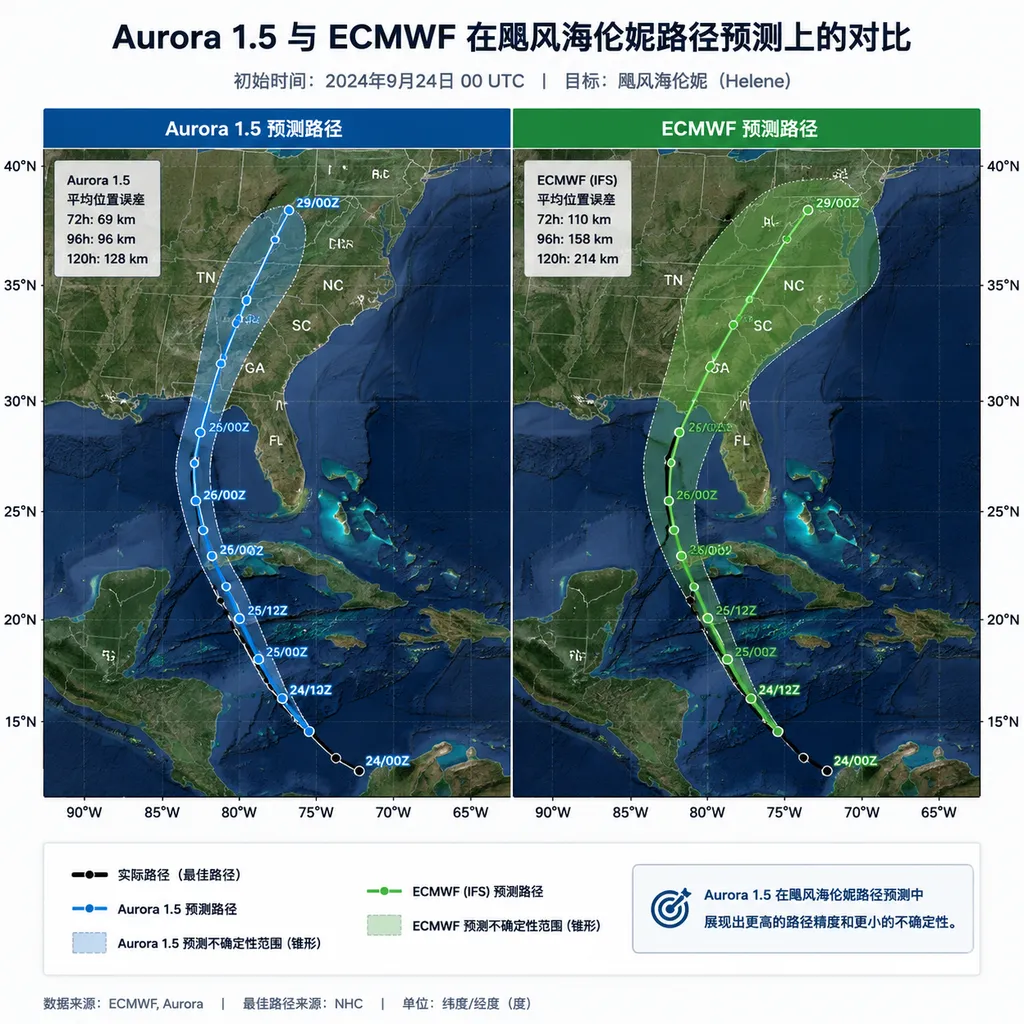
Microsoft used Hurricane Helene from 2024 as a retrospective test case. Helene was a major disaster that struck the southeastern United States last September, where forecast track accuracy directly determined how many people in Florida and Georgia needed to evacuate in advance. Aurora 1.5 reduced median track error by about one-third compared with the previous generation, and against ECMWF’s operational model it achieved an overall win rate of 88.9% across combined metrics.
To understand the significance of that number, you have to understand the caliber of the opponent. ECMWF — the European Centre for Medium-Range Weather Forecasts — represents decades of accumulated physical modeling and data assimilation expertise, and has long been considered the global gold standard in hurricane track prediction. DeepMind’s GraphCast and Huawei’s Pangu-Weather were both trained on ECMWF data before claiming to “match or surpass” its performance. Aurora 1.5 did not merely catch up — it outperformed ECMWF in one of the hardest forecasting scenarios: hurricanes.
Of course, that 88.9% win rate was calculated under a specific set of metrics. Whether the model can maintain similar performance across typhoons, polar cyclones, and inland severe convection still requires independent validation. But the direction is already clear: AI weather models are no longer merely “fast but less accurate” alternatives — they are beginning to become the primary solution in critical scenarios.
Open Source + Commercialization: Microsoft’s Strategy Is Smarter Than Google’s
Aurora 1.5 follows a fully open-source approach — model weights on Hugging Face, code on GitHub, under the Apache 2.0 license. This is completely different from DeepMind’s GraphCast approach, where only papers and inference code are released while training details and weights remain undisclosed.
But Microsoft is not doing charity work. On the same day, the company also announced that Aurora 1.5 would be integrated into Microsoft Weather, Bing Weather, and Azure’s meteorological data services. What is open-sourced is the model itself; what Microsoft intends to sell is the infrastructure and data pipeline required to run the model — real-time observational assimilation, cloud-based elastic inference, industry-specific fine-tuning. Building that stack independently would cost any research institution millions of dollars at minimum.
This strategy is smarter than Google’s more closed-off approach. Open source builds the ecosystem, the ecosystem drives cloud consumption, and the meteorology market is vertical enough and enterprise-oriented enough that Microsoft clearly understands the model itself is not the moat — service capability is. For developers and researchers, gaining access to a truly state-of-the-art weather foundation model is already one of the biggest gifts of the first half of 2026.
Who Should Be Worried
The most nervous players should probably be startups building “AI weather SaaS” products — companies like Atmo and Tomorrow.io. Their technological moat previously depended on “we have our own proprietary model.” Aurora 1.5 effectively gives away a state-of-the-art model for free, dramatically weakening that moat overnight. Going forward, differentiation will have to come from data integration, industry know-how, and fine-tuning for vertical scenarios. Pure model companies no longer have much of a path forward.
For meteorological agencies and research institutions, however, this is good news. National weather centers previously had to negotiate licensing and pricing with commercial vendors. Now they can simply download the weights and run the model on their own supercomputers, reducing both costs and dependence. Meteorological service capabilities in developing countries could also become significantly more accessible — arguably the most socially valuable aspect of Aurora 1.5.
A Brief Take
Aurora moved from 1.0 to 1.5 in just over a year. That pace of iteration shows Microsoft genuinely treats it as a foundation model platform, not a one-off experiment meant to produce a Nature paper. From a technical trajectory perspective, the “GPT moment” for meteorology has already passed — the debate is no longer whether AI can do weather forecasting, but which industry scenarios it can handle and at what cost.
The next milestone worth watching is whether Aurora 2.0 will more deeply couple subsystems such as oceans, glaciers, and atmospheric chemistry into a true-fledged Earth system foundation model. Microsoft’s ambitions are clearly heading in that direction, and the newly added variables already hint at it.
For developers, there is a lot that can be done right now: pull down the code and test it, fine-tune and validate it on regions you care about, or build a vertical-industry API service on top of it. The open-source opportunity window is usually richest in the first six months.
References
- ITHome: More Accurate Hurricane Prediction — Microsoft Releases Aurora 1.5 Weather Forecasting Model — Initial domestic media coverage including Hurricane Helene benchmark data
- GitHub - microsoft/aurora — Official Aurora open-source repository containing model code, fine-tuning scripts, and documentation
- Hugging Face - microsoft/aurora — Hosting location for model weights and checkpoints


