
ByteDance develops Chinese-language AI music: 1 billion parameters trained from scratch, specifically to eliminate the “machine” feel
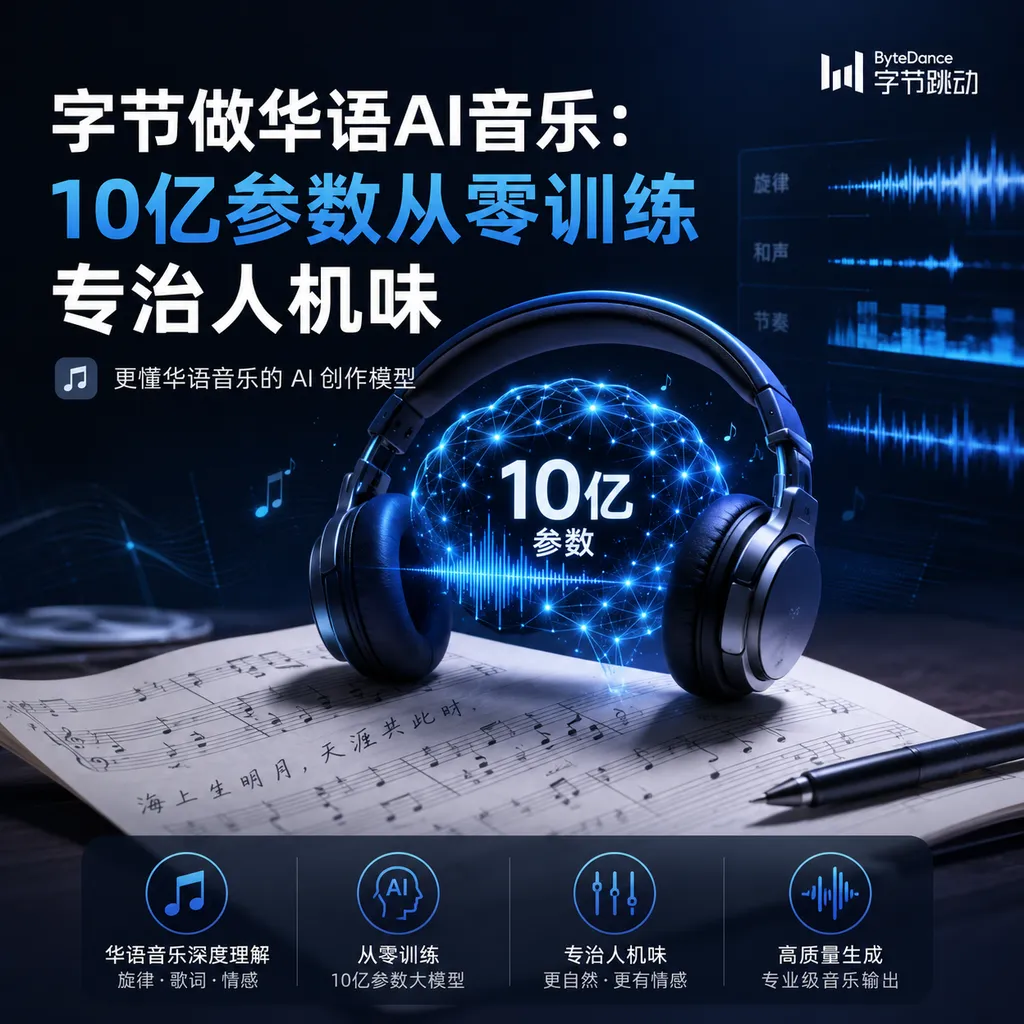
ByteDance has launched a 1-billion-parameter Mandarin song generation model trained from scratch, aiming to address the "machine-like" issue in AI music. This is the first truly native large model in the field of Mandarin music generation, following Suno and Udio.
Byte Also Enters the Game
In July 2026, ByteDance was reported to be betting on the AI music track—pretraining from scratch a 1-billion-parameter generative model specifically for Mandarin songs. This isn’t another “wrapper” job of fine-tuning on an open-source foundation, but a full-stack self-developed pipeline from Tokenizer to vocoder, with only one goal: making AI‑sung Chinese songs sound not like AI.
Developers who’ve listened to Chinese songs generated by Suno or Udio know the feeling—the melody isn’t bad, the arrangement is fine, but the moment the voice comes in, it breaks the illusion. The pronunciation drifts, breath control feels off, transitions are stiff, and unique Mandarin tones and plosive consonants get flattened by training data dominated by English. It ends up sounding like “a foreigner singing karaoke.” That’s what the industry calls the “machine-like” flavor.
That’s exactly the problem Byte wants to solve this time.
Why “Pretraining from Scratch”
Let’s start with a counterintuitive fact: almost none of the AI products currently capable of generating Mandarin songs are truly “native Mandarin” models.
Suno’s V3 and V4 versions mainly use English pop music as training data, with Chinese as a minor tail-end language; Udio’s similar; domestic products either add melody control to open-source TTS models or wrap around Suno. That leads to an awkward situation—Chinese AI music’s ceiling is actually determined by the architecture and data distribution of English models.
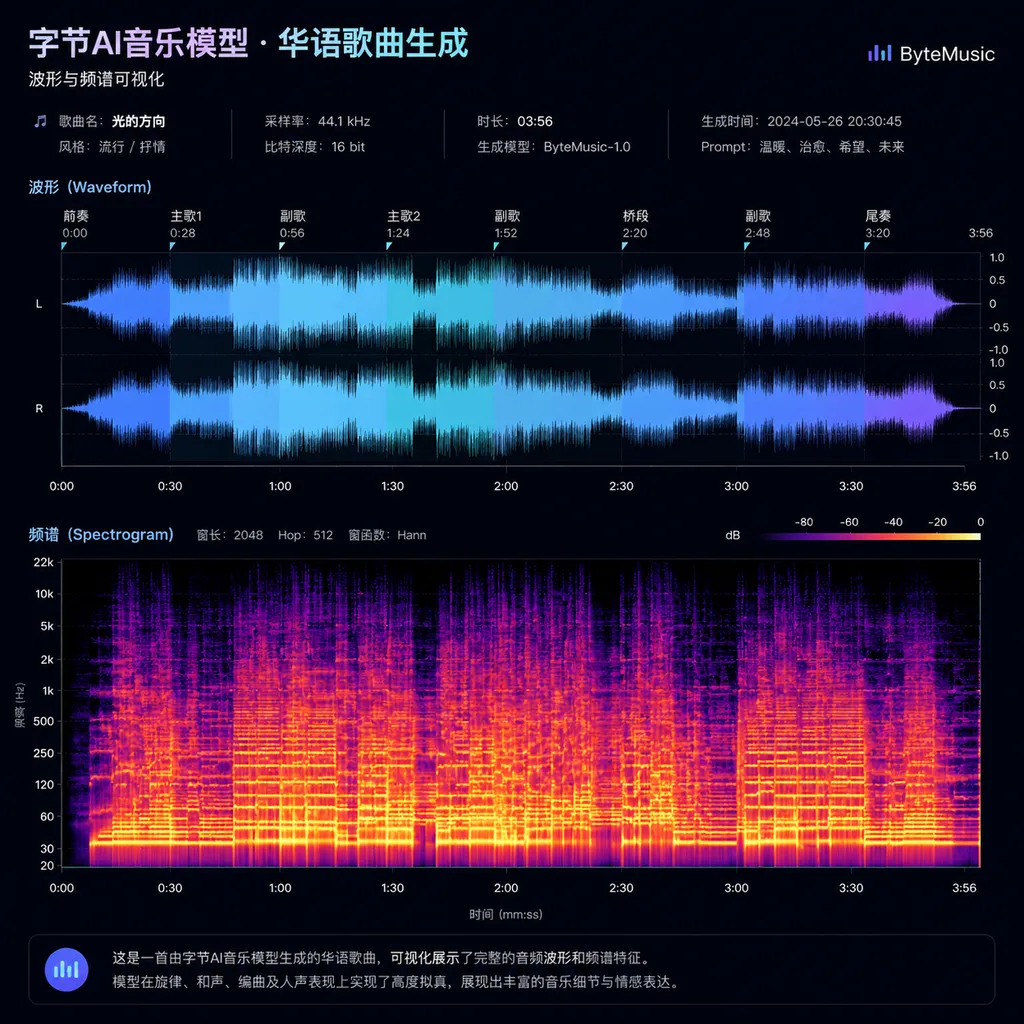
Byte’s approach this time is brute force: not reusing any existing music foundation models, but redesigning from the Tokenizer stage for Mandarin phonemes, tones, and resonance features, pretraining 1 billion parameters from scratch with terabytes of Chinese song data. The price is steep—according to current training costs, running a 1B-param music model from scratch means computing expenses in the tens of millions of RMB.
But the cost buys architectural freedom. For example, in Mandarin songs, “crisp articulation” versus “relaxed enunciation” are two distinct singing styles—the former aligns with traditional or operatic singing, the latter with pop. This distinction barely exists in English, where pop singing is naturally relaxed. If your base model was trained on English data, trying to make it stably produce “crisp” Mandarin singing is essentially fighting the model’s prior distribution. Starting from scratch means these Mandarin-specific expressive dimensions can be directly encoded into the training objectives.
Technical Approach: More Than “Replace Training Data with Chinese”
If it were as simple as swapping training data from English to Chinese, someone in China would’ve done it already. The technical depth in Byte’s plan lies in several aspects:
First, tonal modeling is independent from melodic modeling. Mandarin is a tonal language: a syllable’s pitch curve (its tone) is different from the melody’s pitch contour. Songwriters know about the “tone conflict” problem—if a melody’s note progression clashes with the word’s tone, the meaning changes (classic case: singing “I love you” as “I obstruct you”). Byte’s model reportedly decouples tonal and melodic tracks, modeling them separately and fusing later, allowing the AI to adjust tones while keeping melody intact.
Second, breath and airflow modeling. Much of the “machine flavor” doesn’t come from pitch but from a lack of breathiness. Human singers take small breaths mid‑phrase, add sighs or airy textures for emotion; if this micro‑timing isn’t explicitly modeled, the result is an unnaturally steady stream—a “one-breath” robotic sound. Byte’s system reportedly includes a dedicated breathing event prediction module.
Third, the “sufficiency philosophy” behind 1 billion parameters. While 1B sounds small in the era of LLMs, it’s a carefully chosen sweet spot for music generation. Music doesn’t require world knowledge or deep reasoning—it needs high-fidelity modeling of audio detail, singing habits, and arrangement structure. Scaling to tens of billions might cause overfitting or unbearably slow inference—if users have to wait three minutes for a song, the product’s dead.
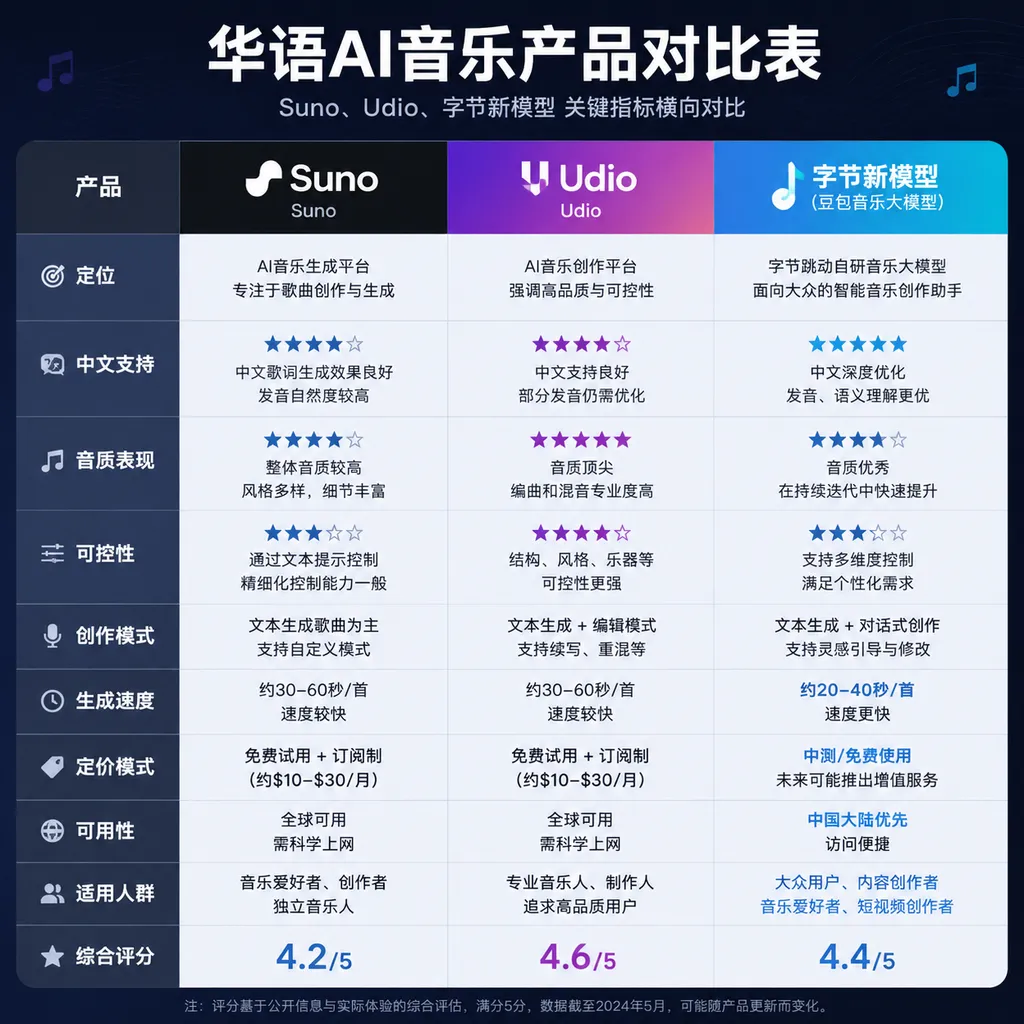
Compared with Suno: Where’s the Edge
That’s the unavoidable question. Suno has raised multiple rounds, surpassing 100 million users; Udio is backed by former DeepMind members. Is Byte late to the game?
My take: in the Mandarin market, “late” or “not” depends on what you compare.
If we compare English song quality, global user count, or ecosystem completeness, Byte’s catch-up will be hard. But a hidden truth about AI music is that its market is segmented by language. Chinese users want Chinese songs, Japanese users want Japanese songs, and there’s almost no overlap with the English market. The reason Suno hasn’t dominated China is that its Chinese song experience is on par with—or even worse than—a product built for Chinese from the start.
Byte’s other advantage is distribution. TikTok and Douyin are already the world’s biggest short‑video music platforms, and the most direct application for AI-generated music is BGM, remixing, and indie demos. This chain is already integrated for Byte—Suno doesn’t have that.
More realistically, Byte’s move isn’t about beating Suno; it’s about securing an irreplaceable position in the Mandarin segment where Suno falls short.
What It Means for Developers
For indie developers and content creators, if this model eventually opens an API or product, several practical opportunities are worth watching:
- Automated short‑video scoring: teams now either use licensed tracks (expensive), royalty‑free ones (homogenized), or hire composers (slow). A stable AI tool outputting music that fits Mandarin aesthetics could cut this cost entirely.
- Indie demo production: songwriters know the gap between a demo and a mastered track; if AI can raise demos to near‑release quality, production barriers drop by an order of magnitude.
- Dynamic music for games/podcasts: this area’s nearly empty in China due to high custom composition costs.
- Education scenes: children’s songs and story music—huge demand, strong copyright sensitivity.
Technically, if Byte follows its previous open pattern with the Doubao LLM, the music model will likely be offered via Volcano Engine API. Integration should resemble mainstream multimodal APIs—input lyrics, style prompts, reference audio, and receive a generated audio URL.
A Less Optimistic Observation
That said, all players in AI music face one structural problem: copyright and training data legality.
In 2025, several lawsuits from major record labels against Suno and Udio were already in progress in the U.S., centering on whether the training data used copyrighted music legally. Domestic regulation remains loose for now, but as a major company, where will Byte source its Mandarin dataset? If it relies on existing pop recordings, rights holders (the “big three,” Taihe, Modern Sky, etc.) will eventually react.
This isn’t a technical issue—it’s a business‑model issue. For Byte’s bet to go far, label cooperation or a clear data‑compliance path might matter more than the model itself.
My Take
Overall, Byte’s entry into AI music is a textbook case of “brute force drives miracles”—not incremental tuning atop open foundations but a massive, multimillion‑RMB pretraining of a Mandarin‑native model from scratch. The upside: higher ceiling, clearer differentiation; the downside: high trial cost and long cycles.
For the Mandarin AI music market, I see Byte’s entry as a net positive. The field has long “made do” with English‑based models—a truly Mandarin‑native one will raise the industry baseline. Even if Byte doesn’t fully succeed, the technical path and architectural ideas it pioneers will accelerate followers.
One last detail: this leaked 1B‑parameter model is likely just the first generation. Following the trajectory of LLMs, expect music models to jump from 1B to tens of billions within 12–18 months. By then, the “machine flavor” in Mandarin AI music might truly be history.
By the way, OpenAI Hub can orchestrate all major models (GPT, Claude, Gemini, DeepSeek, etc.) with a single key. If Byte’s music model opens up later, integration will be smoother for developers—the platform is already preparing for multimodal and audio‑generation model support.
References
- Hugging Face Audio Generation Model Hub – Repository of mainstream open-source audio generation models; useful for architecture reference.
- Zhihu: AI Music Generation Technical Discussion – In‑depth discussions from China’s tech community on AI music generation.
- Xitu Juejin: Multimodal LLM Development Practices – Developer‑oriented insights on integrating multimodal models.


