
MoleculeOS Officially Launched: AI Protein Design Enters the "Operating System" Era

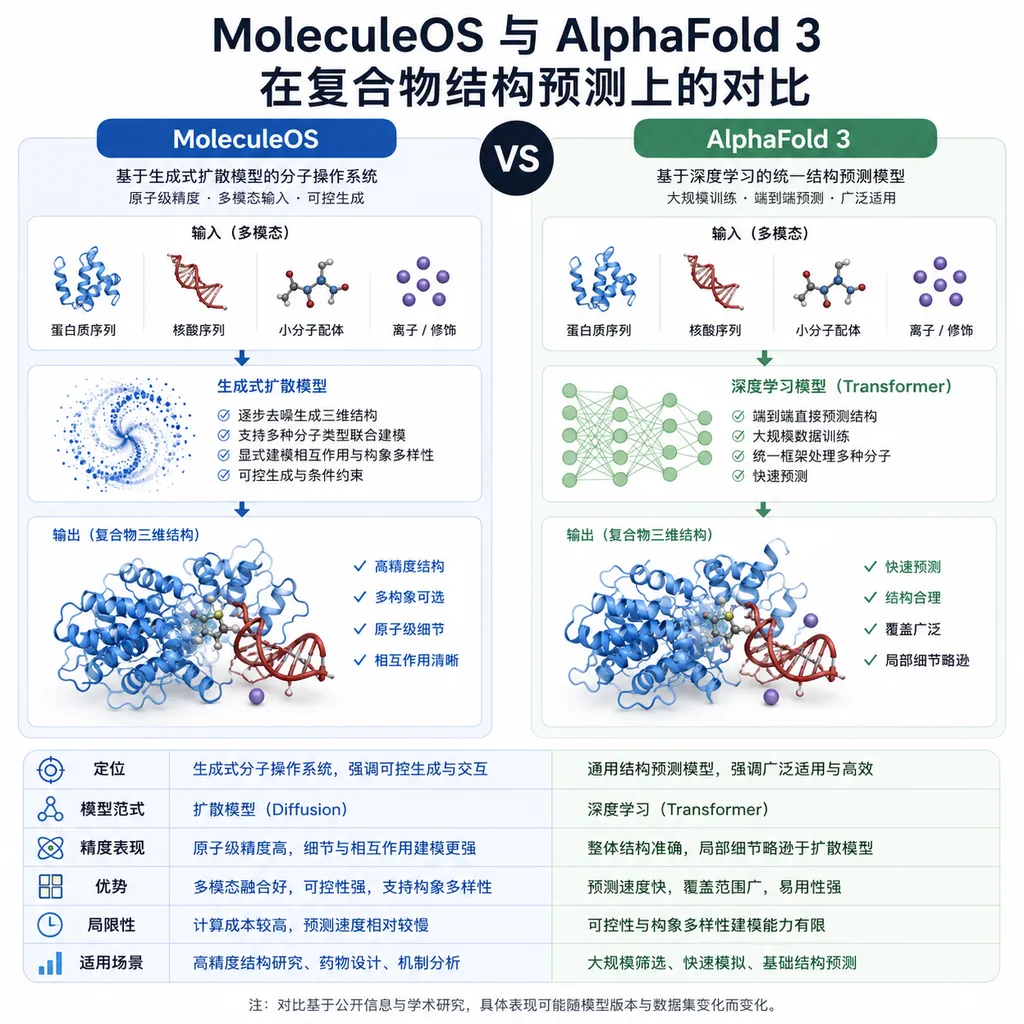
Xu Jinbo’s team at Molecular Heart has officially opened their AI protein R&D platform **MoleculeOS** for testing by the industry and academia. Built upon their self-developed multimodal foundation model **NewOrigin**, it matches or even surpasses **AlphaFold 3** in predicting antibody–antigen and protein–small molecule complex structures, and for the first time achieves industrial-grade precision in protein dynamic design.
MoleculeOS Officially Opens: AI Biotech Enters the “Model Operating System” Era
MoleculeMind has moved MoleculeOS from an internal industry project onto a public testing stage. The company, founded by “AI protein folding pioneer” Jinbo Xu, has officially opened registration for beta testing of its AI-powered protein optimization and design platform to both industry and academia. Its official positioning is straightforward—an “AI operating system” for biological R&D.
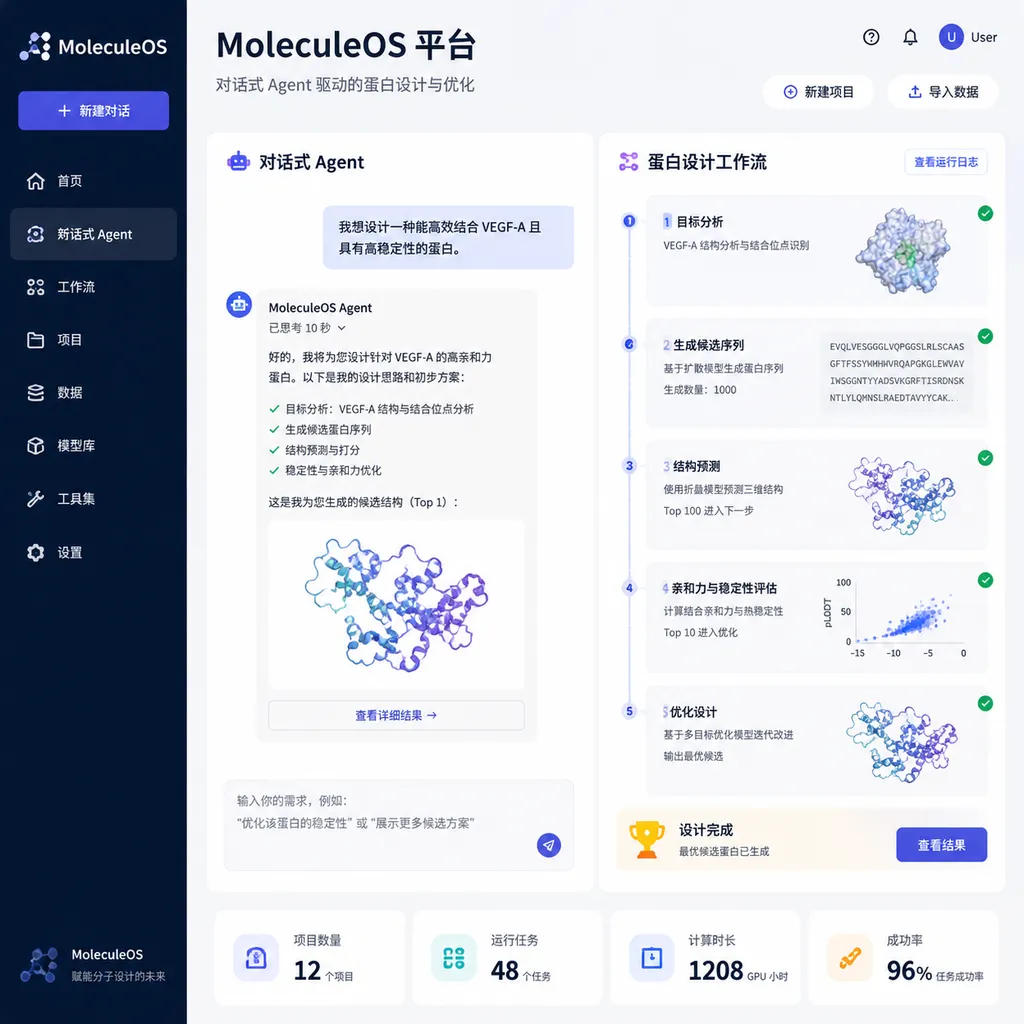
This is not another “AI + Biology” marketing package. If you dissect MoleculeOS, it’s more like unifying the fragmented capabilities scattered across various labs over the past two years—structure prediction, complex modeling, dynamic simulation, generative design, and wet-lab closed loops—into an engineered pipeline, then letting an Agent that understands biological intent schedule the process. If this step works, protein R&D will truly have its own “IDE.”
From “Gold Mining” to “Minting”: A Paradigm Shift
Let’s clarify one thing first: MoleculeOS is not a replica of AlphaFold. The AlphaFold series answers the question “Give me a sequence, tell me what it looks like”—essentially an act of interpretation. MoleculeOS aims to solve the reverse problem: “I need an antibody that releases at pH 6.0 and stays dormant at pH 7.4—please design it.”
As Xu puts it, classical biotech R&D is “I see what nature offers and what I can use”; now it’s shifting to “I want something, so I design it.” It sounds like a slogan, but industrially it’s a hard-nosed point. The “10-10 rule” of drug development (10 years, 1 billion dollars, less than 10% success rate) is hard to break because screening-based R&D is fundamentally high-stakes gambling. When “design” replaces “screening” as the main pipeline, the economics of R&D are rewritten.
The most noteworthy aspect of this public release isn’t that it’s become low-barrier to use, but that it’s pushed “generative protein design” to truly deliverable industrial precision.
NewOrigin: A Four-in-One Foundational Model
The platform’s foundation is MoleculeMind’s self-developed multimodal protein foundation model, NewOrigin (Chinese name “Darwin”). Unlike most protein models that only model one-dimensional sequences, NewOrigin places four modalities—sequence, 3D structure, function, and evolutionary constraints—into a unified representation space.
As an analogy: traditional protein models are like LLMs that can only “read text,” while NewOrigin can “read text, view images, understand video sequences, and perceive physical laws” simultaneously. This difference becomes critical in low-data and zero-shot design tasks—many industrial enzymes lack crystal structures or sufficient activity data; sequence-only models are blind, but multimodal representations can fill those gaps using structural and evolutionary information.
On top of NewOrigin, MoleculeOS breaks typical industrial needs into five categories:
- Prediction: structure, affinity, stability, and other property predictions
- Discovery: mining candidates from the existing protein space
- Optimization: directed evolution toward goals like expression yield, thermal stability, or catalytic efficiency
- Design: de novo construction of new molecules with specific functions
- Validation: integrated wet-lab loops for feedback and iteration
This five-part categorization seems simple but provides the platform with a clear “system call” boundary—once the upper-layer Agent understands user intent, it can route tasks to the right module. This is what makes the “operating system” analogy appropriate—not because it looks like Windows, but because it abstracts fragmented capabilities into composable primitives.
The Accuracy Battle: Head-on with AlphaFold 3
In the two industry-critical scenarios—antibody-antigen and protein-small molecule complex structure prediction—the official data from MoleculeMind claims MoleculeOS is “on par with or superior to AlphaFold 3.” This is almost standard industry phrasing now, but MoleculeMind emphasizes a more practical dimension: predictive structures with better physical realism.
This matters hugely in downstream design. AlphaFold-like models have long been criticized for producing structures that visually look correct, but whose side chains, hydrogen networks, and binding pockets often fail physical validation during energy calculations and molecular dynamics. For drug discovery, this means a model might “look dockable,” yet yield unstable scoring under different functions. MoleculeOS’s focus on physical consistency ensures that the “prediction → design → validation” pipeline doesn’t break midway.
A harder technical advancement lies in dynamic protein structure prediction and dynamic design. Proteins move in vivo—enzyme catalysis itself is a conformational cycle. Classical AI models provide only “static snapshots,” a disadvantage in enzyme design. MoleculeMind integrates AI, molecular dynamics, and first-principles methods into a unified framework, achieving 10¹¹× efficiency improvements over traditional quantum chemistry methods while maintaining the same precision—reaching “industrial usability.”
Translated, “industrial usability” means that simulations that used to take weeks or months now run in minutes or hours—a fundamental shift for drug and biomanufacturing companies.
Three Real Cases: What Has AI Actually Delivered
Metrics can sound impressive, but industry clients only value delivery. MoleculeMind provided three completed project results worth examining:
pH-sensitive antibody design. This is a scenario almost unreachable by traditional high-throughput screening—requiring an antibody that binds stably at blood pH 7.4 yet rapidly releases at pH 6.0 in tumor microenvironments or endosomes. Using two months and two wet-dry iterations, MoleculeOS delivered fewer than 10 candidate molecules, achieving a 60× affinity ratio between pH 7.4 and 6.0. Traditional methods typically screen hundreds of thousands to millions of mutants.
Rescuing a moribund fusion protein. A fusion protein nearly abandoned due to low expression and aggregation saw its expression increased over 400× and monomer content above 95% within three months through generative AI. For biologics developers, that’s the difference between “project canceled” and “ready for CMC.”
5× catalytic efficiency improvement in an industrial enzyme. In collaboration with Cathay Biotech, MoleculeOS optimized an enzyme with no crystal structure and complex catalytic mechanisms, under minimal industrial data. Within six months, catalytic efficiency improved fivefold. In the synthetic biology world, getting even 2× through years of manual mutation screening is often celebration-worthy.
The common factor: not “how smart the AI is,” but that each project closed the loop within months—the true dividing line between industrial AI and paper AI.
Agent Layer: Hiding the AI
Another major change in this open beta is the interaction layer. The platform now features a conversational AI Agent, allowing biologists to request in natural language, for example:
“Design a lipase that retains 80% activity at 80°C, with substrate C12 straight-chain fatty acid.”
The Agent autonomously parses the intent, routes to proper modules, and outputs candidate molecules and experimental recommendations. Xu’s design philosophy is clear: not to turn biologists into AI experts, but to make AI disappear behind them.
This mirrors the broader trajectory of Agent systems—moving from exposed APIs, to workflow orchestration, to natural language-driven intent. The difference here is that protein design toolchains are far more complex than in typical SaaS; these Agents must choose among dozens of specialized models and physics engines while respecting biological constraints—a difficult engineering feat. So far, MoleculeOS is ahead of its peers.
A Judgement: Is This the “CUDA Moment” for Biology?
Positioning itself as an “operating system” is highly ambitious. To truly merit the term, a platform must nurture an ecosystem and define standards.
Based on current public information, MoleculeOS resembles a deeply integrated proprietary platform—its foundational model, algorithm modules, workflows, and wet-lab capabilities are all in-house. That ensures quality initially, but to evolve into an industry OS, it must next open a developer layer—allowing third parties to train proprietary models, release domain workflows, and integrate their own experimental data. Whether this happens will determine if it becomes the “CUDA of biology” or remains a “superpowered SaaS.”
From another angle, such platforms are also rewriting the cost structure for biotech startups. Previously, even a small protein engineering team had to build compute clusters, hire AI engineers, and spend years accumulating data assets. Now, a five-person biotech startup can theoretically run design tasks directly on the platform, shifting most capital expenditure from “infrastructure” to “clinical validation.” If this leverage proves effective, biotech financing logic itself will relax.
On the broader bioeconomy front, both China and the U.S. are clearly accelerating—America’s Bioeconomy Blueprint, David Baker’s billion-dollar Xaira Therapeutics, and China’s “AI+” initiative all converge on this trend. The window that AlphaFold opened is rapidly being occupied by engineering-focused platforms. MoleculeOS is currently the frontrunner in China.
The next 6–12 months will be telling: (1) whether any native MoleculeOS drug or enzyme products reach clinical or production stages after the platform opens; and (2) whether it undertakes the next essential step in every OS narrative—building a developer ecosystem. These two factors will determine whether the “AI Bio Operating System” is a concept or a real emerging track.
References
- Zhihu: How to View the Public Beta of MoleculeMind MoleculeOS — A collection of discussions on the AI protein design platform, including practitioner perspectives
- Zhihu: Comparison Between AlphaFold 3 and Domestic AI Protein Models — Technical discussions on complex structure prediction accuracy
- GitHub: Awesome Protein Design — A curated list of open-source protein design models and tools, useful for mapping the generative protein design landscape
- Hugging Face: Protein Language Models — An entry point to the open-source ecosystem of protein language models, comparable to the multimodal foundation approach of NewOrigin


