
Hugging Face CEO: Companies No Longer Rent Models, Open Source Welcomes a Second Growth Curve

In a recent interview, Clem Delangue stated bluntly that half of the Fortune 500 companies are already running open-source models on Hugging Face, and enterprises are shifting from renting APIs to building and managing their own. Open-source AI is no longer a game for idealists—it’s now a line item in the CIO’s next budget.
In one sentence: The era of renting models is coming to an end
On July 10th, TechCrunch’s podcast released the latest interview with Clem Delangue. The Hugging Face CEO’s assessment was clear—companies are growing tired of the “pay-per-token” logic. More and more firms are choosing to pull open-source models in-house to fine-tune, deploy, and take control. In his own words: roughly half of the Fortune 500 companies are now Hugging Face users, and they are all completing one mission—saying goodbye to the API rental era.
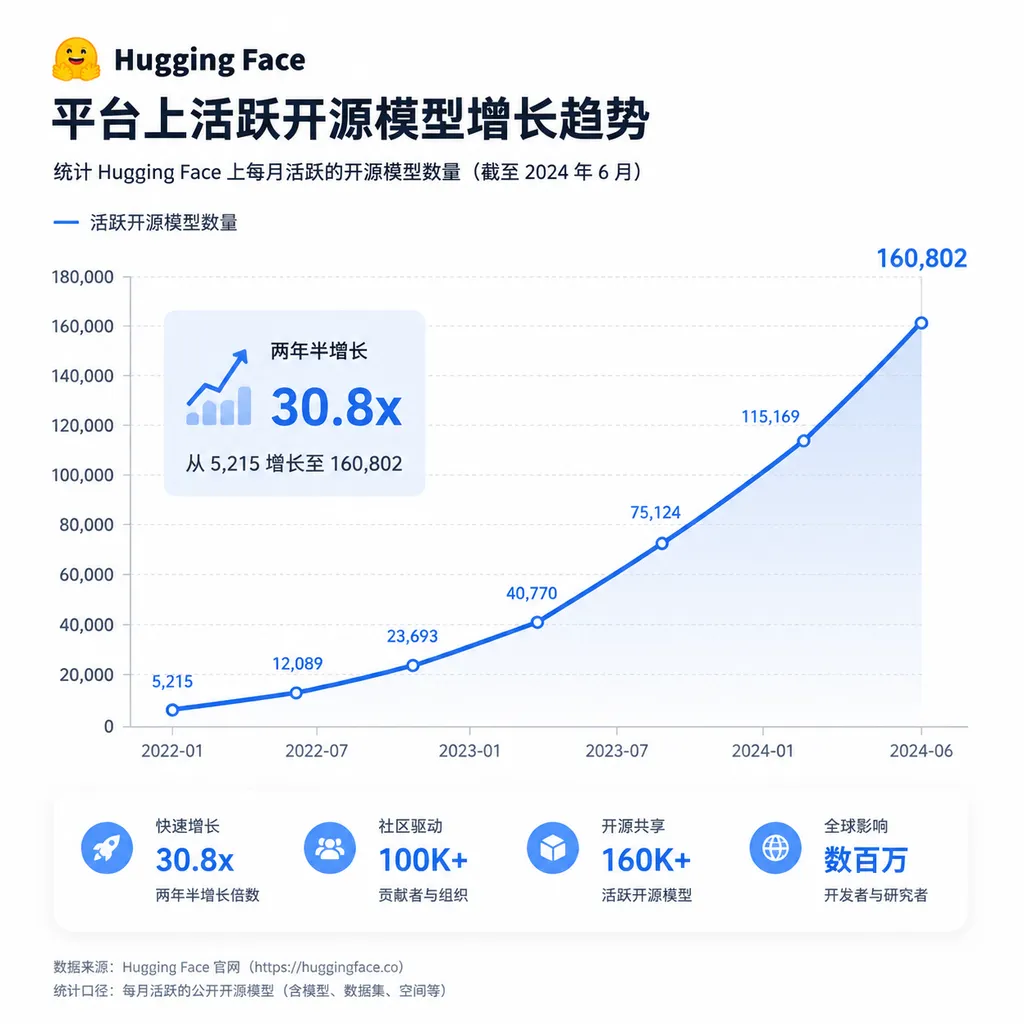
This isn’t just a slogan. In Hugging Face’s Spring State of Open Source report, a clear curve emerges: traditional U.S. tech companies like Airbnb have sharply increased their participation in the open-source ecosystem over the past 12 months. Many “traditional enterprises” upgraded to Enterprise Hub subscriptions in 2025. In other words, it’s no longer just AI-native startups paying for access—it’s the old money that was still on the sidelines three years ago.
The script repeats: from “using APIs first” to “must build our own”
Delangue described a cycle he’s seen repeatedly—a cycle developers can easily relate to:
- Initial stage: The company builds demos or runs PoCs, directly calling OpenAI/Anthropic APIs because it’s fast, convenient, and brainless.
- Scaling stage: Traffic rises, bills become terrifying, and legal teams start worrying about data exports and compliance.
- Migration stage: The team evaluates open-source alternatives, performs fine-tuning, and migrates critical paths to models it controls.
- Maturity stage: Hybrid deployment of multiple models, with closed APIs only handling long-tail scenarios.
In 2023–2024, only a few big Silicon Valley firms were following this path. By 2026, it has become the default roadmap for the Fortune 500. The reason is simple—when inference costs eat up more than half of your GPU budget, you start rethinking every cent you spend on “renting.”
Delangue also made a sharp point: the hidden cost of renting APIs isn’t the bill—it’s failing to grow internal AI capabilities. After three years, a company might have no team capable of deep model customization, but a strong dependency on an external API instead. For CTOs, that’s chronic technical debt.
Chinese open-source models are visibly gaining strength
One detail in the spring report deserves special attention: Hugging Face explicitly pointed out the explosive growth in downloads of Chinese open-source models, closely tied to one factor—these models now officially support domestic chips.
Over the past two years, models like DeepSeek, Qwen, and the GLM series have transformed from “budget-friendly options” to “top-tier performers.” In the first half of this year, if you check the Hugging Face leaderboards, an interesting trend appears: models and datasets are used most in the regions where they are developed. Developers naturally choose models closer to their native language, local use cases, and domestic compute stacks.
This shift has major implications for the industry. It suggests that AI won’t consolidate into 3–5 global giants like cloud computing did, but instead evolve into a multi-region, multi-language, multi-hardware distributed ecosystem. Delangue’s long-standing view—“models are like code libraries; there won’t be one that rules them all”—now has solid data to back it up.
By the way, OpenAI Hub has already integrated mainstream open-source models like DeepSeek, Qwen, and GLM—one single key can switch between them with OpenAI-compatible formatting. This saves developers from having to create multiple accounts and manage quotas just to compare models—a major convenience.
Kernel Hub: Hugging Face’s quietly huge move
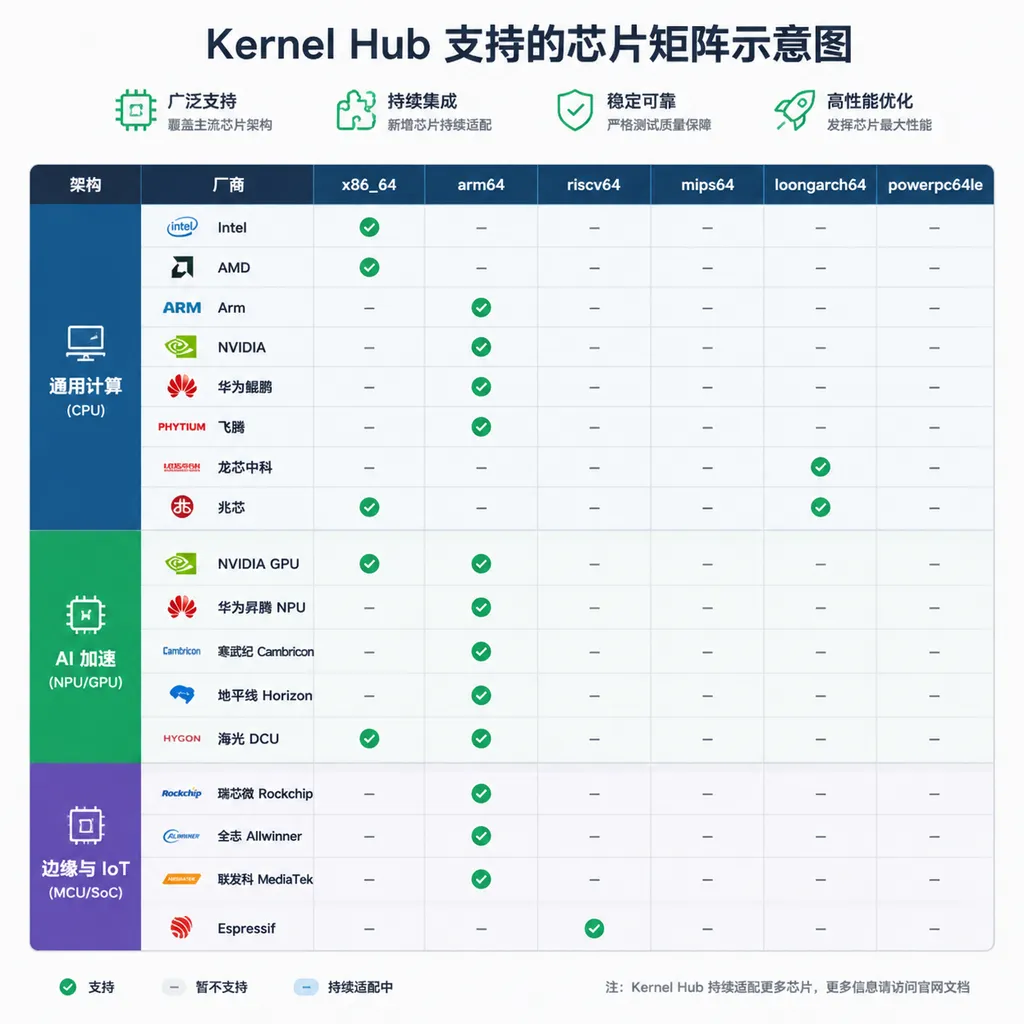
In 2025, Hugging Face launched Kernel Hub—a dedicated hub for operator kernels optimized for NVIDIA and AMD GPUs. The media barely covered it, but from an ecosystem standpoint, it’s a major signal: Hugging Face is no longer just a “model repository” but also intends to manage the model runtime.
Why is this important? Because for open-source models to truly replace APIs, runtime optimization must keep up—not just model weights. Complaints about self-hosted deployment speed have often stemmed from poor kernel-level optimization—the same H100 could yield throughput 3–5× lower than a manually tuned vLLM setup. Kernel Hub’s mission is to turn that manual tuning knowledge into shared infrastructure.
With AMD’s ecosystem gaining traction and Chinese NPU vendors joining in, Hugging Face is effectively becoming the “runtime-neutral layer” of the open-source AI era—not siding with any one chip, but ensuring open models run efficiently across all.
Robotics datasets are rising fast
Another detail, and perhaps the most surprising one: robotics datasets had the fastest download growth over the past year.
This is no coincidence. VLA (Vision-Language-Action) models are becoming feasible, and leaders like Physical Intelligence, Figure, and several domestic embodied intelligence teams are pushing data sharing aggressively. The number of robotics operation datasets, teleoperation trajectories, and multimodal perception datasets on Hugging Face has multiplied several times compared to last year.
Looking back at NLP’s history reveals a strikingly similar pattern:
- 2018: BERT is released; NLP datasets begin to centralize on Hugging Face.
- 2020: The Transformers library becomes the de facto standard.
- 2023: Everyone’s default baselines are run on open models.
Robotics is now between 2018 and 2020. Whoever claims the data infrastructure now may define the next five years of development paradigms. Hugging Face clearly aims to be that foundation.
Developer perspective: how to think about tech choices now
Taken separately, the above look like different developments. But together, they tell one story—the open-source AI ecosystem is entering its second growth curve.
The first curve proved that open-source can catch up with closed-source (largely confirmed after DeepSeek-R1).
The second curve is proving that enterprises are willing to pay to self-deploy open solutions. According to Delangue, “the data is already there.”
From a developer’s standpoint, a few key takeaways are worth noting:
- Architectures purely reliant on APIs will become increasingly rare in the next two years. APIs won’t die, but local models will take over core paths, leaving APIs as supplements for edge and long-tail cases.
- Model choice will shift focus from “which is strongest” to “which fits my deployment stack.” Chip compatibility, kernel support, inference frameworks, and quantization schemes—all once peripheral—are moving to the center of the table.
- Fine-tuning engineering will become AI teams’ core competency. In the API era, teams competed on prompts; in the self-hosting era, they’ll compete on data pipelines and post-training.
- Multi-model hybrid deployment will become the default architecture. Using model A as the backbone, B for specific domains, and C as fallback—this combo approach will be common.
On this last point, aggregators like OpenAI Hub will play an increasingly useful role—you can call GPT, Claude, Gemini, DeepSeek, and Qwen under one key, with A/B testing or traffic routing done without changing SDKs. By 2026, domestic direct access is no longer rare, but for enterprise purchasing, the difference between one invoice versus five still saves the CFO considerable patience.
Delangue’s stance: not radical, but resolute
Interestingly, Delangue isn’t an “open wins, closed loses” extremist. He repeatedly emphasizes that “both models will coexist,” but the industry’s center of gravity is clearly shifting. He doesn’t even position Hugging Face as OpenAI’s rival—the platform hosts model weights and checkpoints from OpenAI, Meta, Google, Mistral, and DeepSeek. Hugging Face is infrastructure, not a faction.
This “infrastructure neutrality” may in fact be Hugging Face’s strongest moat. GitHub became the default for code hosting not because it took sides, but because everyone needed it. Hugging Face is walking the same path—and now, more steadily than ever.
At the end of the interview, the host asked Delangue what Hugging Face might look like ten years from now. His answer was characteristically French: “I don’t care how big it gets; I care whether it’s useful to everyone.”
It may sound polite, but given his behavior—avoiding investors when not fundraising, building a globally distributed team, and sticking to the freemium model—it’s clear this isn’t PR. He genuinely lives by that logic.
For developers, the most tangible benefit of Hugging Face’s chosen path is this—you now have more models and tools than ever that you can use, deploy, and modify freely.
That alone is the most authentic note of the open-source AI ecosystem’s second growth curve.
References
- State of Open Source on Hugging Face: Spring 2026: Hugging Face’s official spring open-source ecosystem report, including Fortune 500 usage data, robotics dataset growth, and Kernel Hub details.
- Shifting Compute Landscape: Hugging Face’s industry observations on Chinese open-source models and domestic chip adaptation.
- Kernel Hub community page: Official Kernel Hub homepage, showing the current list of GPU-optimized kernels.
- Introduction to the Hugging Face Chinese Community: A Zhihu article detailing Hugging Face’s early development history in Chinese context—great for background reading.


