
One Cut and It Fails: Meta AI Image Detection Tool Backfires

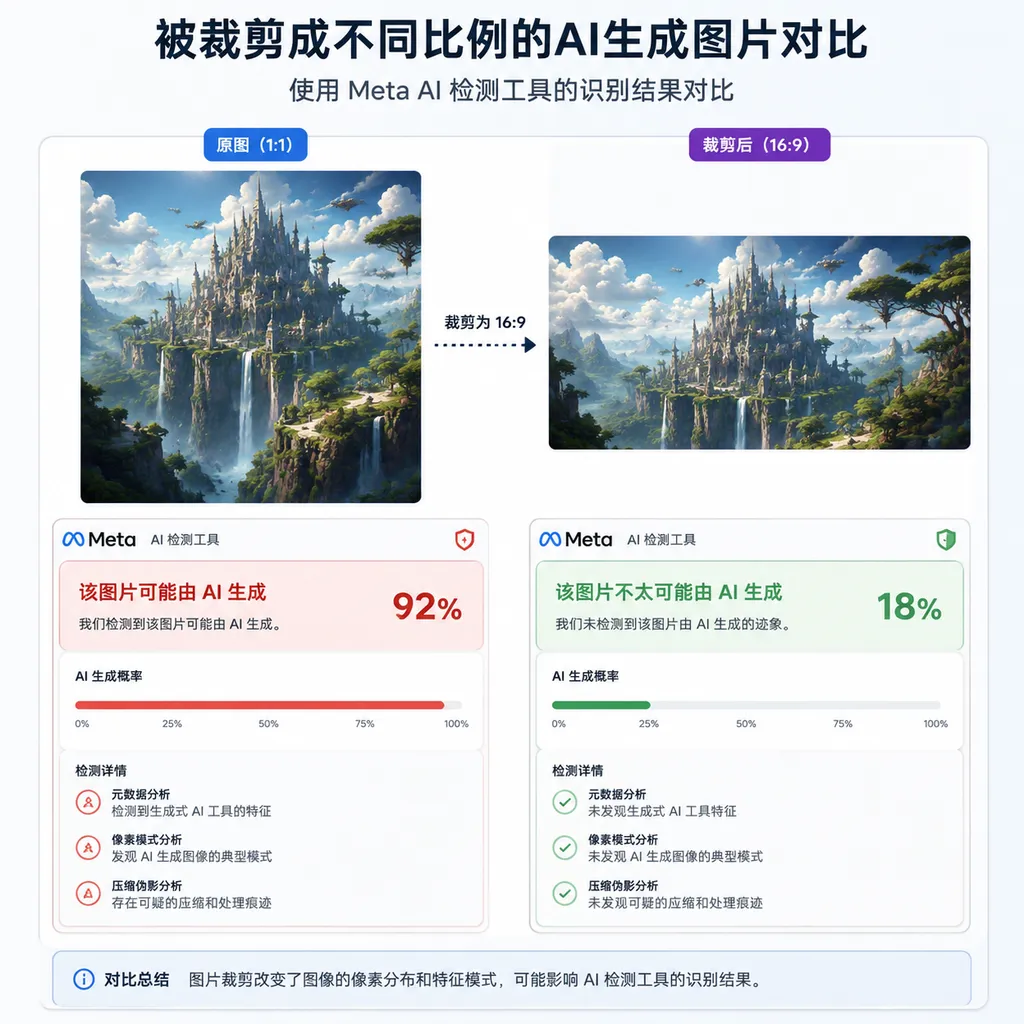
Reuters tested Meta’s newly released AI image detection tool and found that simply cropping images generated by Muse Image to one-third to one-half of their original size made 55% of the images unrecognizable as AI-generated. Meta responded that the tool is still in preview.
Meta just dug a hole for its own AI detection tool — with Reuters helping expose it.
On July 10, Reuters published a set of real-world test results: using Meta’s newly released AI image detection tool to identify images generated by Meta’s own Muse Image model, all 40 original images were successfully detected. But once those images were cropped down to one-third to one-half of their original size, 55% of them could no longer be identified as AI-generated. One pair of scissors effectively cut Meta’s provenance promise in half.
The most awkward part is that when Meta launched Muse Image, it specifically emphasized that the detection tool could “still recognize images even after cropping.” Now, after being disproven by its own generated images, the company’s messaging has shifted overnight from “it can detect them” to “it’s still a preview version.”
What Exactly Is Content Seal?
To understand why a simple crop breaks it, you first need to look at the approach Meta is using.
Every image generated by Muse Image contains an invisible watermark layer called Content Seal. The idea behind this kind of watermark follows the same logic as traditional digital watermarking: tiny perturbations are embedded at the pixel level, invisible to the human eye but readable by algorithms. Meta’s design goal is for the watermark signal to survive even if the image is compressed, screenshotted, or re-saved.
Sounds great — but the devil is hidden in the word “survive.”
Invisible watermarks fundamentally work by distributing information across the pixel structure of the entire image. Imagine writing a password across every corner of an A4 sheet of paper. To reconstruct the password, you need enough of the page intact. Compression, filters, and brightness adjustments only blur the writing in each corner, but the whole page still exists — so the watermark survives.
Cropping is different. Cropping literally tears away part of the paper. Once half the page is gone, the password itself becomes incomplete. If you crop an image down to one-third of its original size, you’re effectively throwing away 66% of the watermark signal. Whether the remaining fragments are enough for the detection algorithm to reconstruct the watermark becomes a probability problem — so a 55% failure rate is not surprising.
This Isn’t Just Meta’s Problem
Looking at the broader landscape, nearly everyone working on AI content provenance is stuck in the same trap.
- Google’s SynthID has been shown in public testing to be sensitive to cropping, rotation, and major color adjustments
- Adobe-led C2PA standards rely on metadata signatures, which are easily broken by screenshots or re-saving files
- OpenAI’s early DALL·E watermarking tool was acknowledged by OpenAI itself as “easy to remove,” and has since largely disappeared from discussion
Technically speaking, current mainstream AI image provenance approaches fall into just three categories:
- Invisible pixel watermarks (used by Meta Content Seal and Google SynthID) — resistant to ordinary edits, but weak against structural destruction
- Metadata signatures (C2PA) — extremely easy to strip away, essentially a “gentleman’s agreement”
- Model fingerprint detection — no watermark required; instead, classifiers are trained to identify statistical patterns in AI-generated images, but they generalize poorly to unseen models
All three approaches have major weaknesses. Meta’s failure doesn’t just expose flaws in its own watermarking system — it reveals the fundamental ceiling of invisible watermarking when faced with “physical-level destruction” like cropping.
What Does the 55% Number Actually Mean?
You might think 55% isn’t that bad — after all, 45% were still detected. But for provenance tools, that logic doesn’t work.
The entire value proposition of provenance tools depends on high confidence. When a tool tells users “this image is not AI-generated,” people tend to believe it. But if that conclusion itself has a 50% chance of being wrong, the tool becomes unusable in real-world scenarios. Media organizations can’t rely on it for fact-checking, platforms can’t use it as moderation evidence, and courts certainly won’t accept it.
Look at it another way: anyone trying to spread fake AI-generated images only needs to crop the image before posting it, and they already have better than a 50% chance of bypassing Meta’s detector. The cost of the attack is effectively zero — any phone app can do it. When the attacker’s payoff vastly outweighs the cost, the defense has already failed.
Even more problematic is the spread effect of false negatives. If the detection tool says “this is not an AI image,” it effectively endorses the image, allowing misinformation to spread further. That’s worse than having no detection tool at all.
Meta’s Response Is Telling
In response to Reuters’ testing results, Meta said:
“The detection tool is still a preview version. Content Seal is designed to preserve watermark signals after common edits, but signals may still be lost once images are heavily cropped.”
Translated into plain language:
- It’s a preview version, so problems are expected
- Heavy cropping was never part of the promise
But the issue is that Meta originally promoted the tool as being able to detect images “even after cropping,” without specifying “light cropping.” Reuters tested crops down to one-third to one-half of the original image size — which is entirely normal on social media. Cropping images for Instagram grids or Weibo cover photos can easily reach that level.
Blaming the gap between marketing claims and actual capabilities on “preview version” status and “heavy cropping” doesn’t hold up with developers. The real issue is this: Meta clearly understood the physical limitations of watermarking systems, yet deliberately blurred those boundary conditions in its marketing.
A Deeper Issue: AI Provenance May Be a False Premise
Stepping beyond Meta’s latest stumble, the entire technical direction of AI content provenance may need rethinking.
Over the past two years, the industry consensus has been that “AI-generated content should be identifiable.” Regulations from the EU AI Act to China’s deep synthesis rules are writing this requirement into law. But whether technology can actually fulfill regulatory expectations is a completely different question.
The dilemma of invisible watermarking is straightforward: the stronger the embedded signal, the more obvious the degradation in image quality; the weaker the signal, the easier it is to attack. This is an information-theory tradeoff, not something solvable by training a better model. And watermarking has a fatal prerequisite: the generator must cooperate voluntarily. Once open-source models spread, who’s going to add watermarks? Community fine-tuned versions of Stable Diffusion are everywhere, and none of them are voluntarily watermarking outputs.
The truly promising direction may actually be the opposite: instead of making AI images “detectable,” make real images “verifiable.” Camera manufacturers could cryptographically sign images at the moment they’re captured, with the signature distributed alongside the image. That’s the direction camera companies like Sony and Canon are pursuing within the C2PA alliance. This approach is more like “issuing birth certificates for authentic content” rather than “branding AI content.”
After all, expecting every dishonest actor to voluntarily label their own deception was never a logically sound idea.
What This Means for Developers
If you’re building content platforms, moderation systems, or any product that depends on image authenticity, Meta’s failure offers at least three lessons:
- Don’t over-rely on a single watermarking solution. Any moderation system built around a single technical checkpoint will collapse under adversarial conditions
- Combine metadata, watermarks, and model fingerprinting. Each approach has limitations, but together they cover more attack surfaces
- Moderation outputs should express confidence levels instead of binary judgments. “This image has a 30% probability of being AI-generated” is more responsible than “this image is not AI-generated”
As for ordinary users, the takeaway for now is simple: don’t treat the output of any AI detection tool as a definitive conclusion. It’s closer to a hint than to evidence.
Whether it’s Meta’s Content Seal or Google’s SynthID, these technologies are still in their infancy. The arms race between detection and abuse has only just begun.
By the way, for developers working on AI-related projects: if you need to call mainstream multimodal models like GPT, Claude, Gemini, and DeepSeek under a single API key for experiments (for example, building your own multi-model cross-validation image recognition workflow), you can try OpenAI Hub (openai-hub.com). It supports direct access from mainland China and is compatible with the OpenAI API format, which saves a lot of environment setup hassle.
References
- Reuters testing finds Meta’s detection tool “fails” on cropped AI-generated images from its own models - IT Home — Original report on the incident, including Reuters’ detailed test data and Meta’s official response


