
Google SensorFM Makes a Move: Feeding Smartwatch Data from 5 Million People into a Model
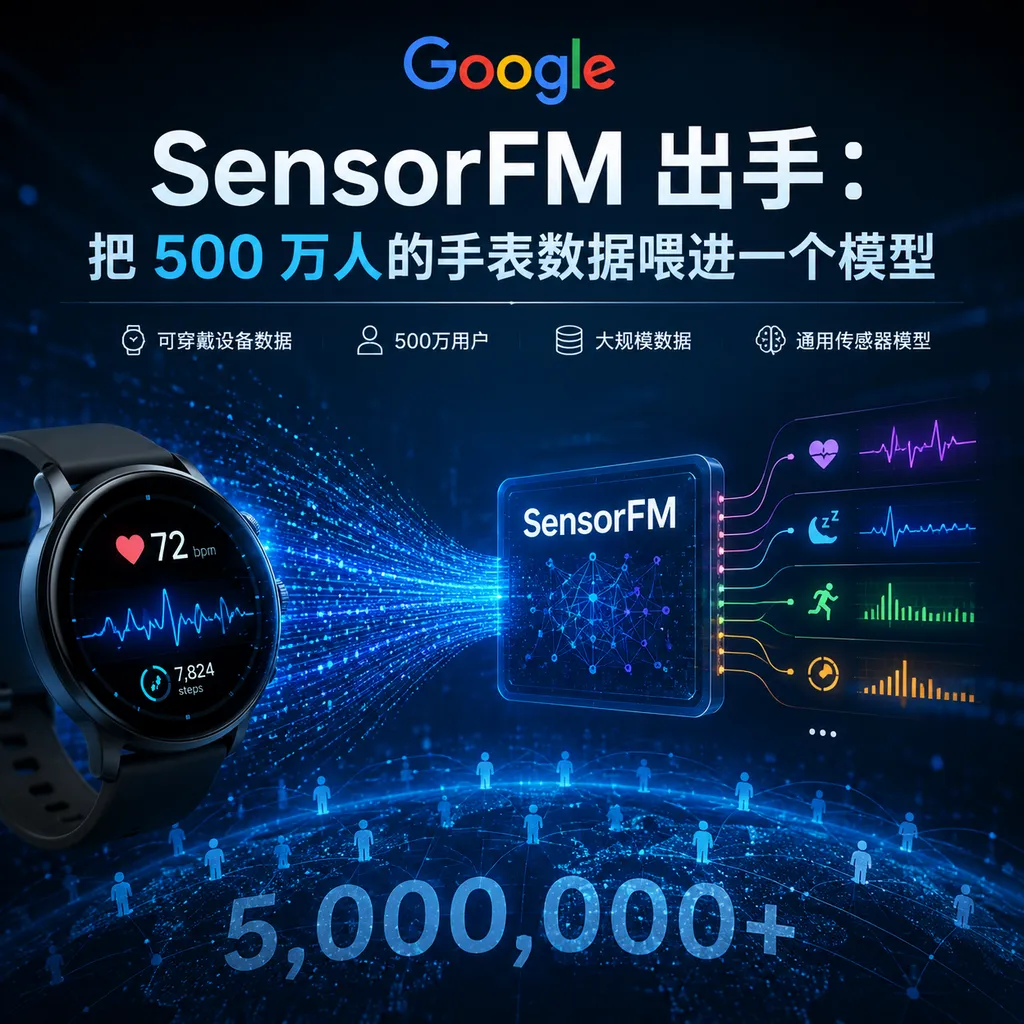
On July 9, Google Research released SensorFM, a foundation model for wearable health applications. It was pretrained on sensor data from 5 million people totaling more than 1 trillion minutes, outperforming traditional supervised baselines on 34 of 35 health tasks. The release also included an LLM agent system that automatically generates inference code.
Google Research dropped SensorFM on July 9 — a health foundation model built specifically to ingest raw signals from wearable devices. The numbers speak for themselves: data from 5 million consented users, 2 billion hours, and more than 1 trillion minutes of sensor recordings, spanning over 100 countries and more than 20 Fitbit and Pixel Watch device models. This is likely the largest publicly disclosed wearable dataset to date.
The takeaway is equally straightforward: across 35 health prediction tasks, SensorFM-B won on 33 of them; meanwhile, a linear probe outperformed the traditional “feature engineering + supervised learning” baseline on 34 tasks. For digital health teams, that points to one thing — the old workflow of building a separate pipeline for every metric may genuinely be on the way out.
One Model, Six Major Health Domains
First, it’s important to clarify what problem SensorFM is actually solving.
Over the past few years, most wearable-health AI teams have followed a “one disease, one model” approach: one model for sleep quality prediction, another for cardiovascular risk, another for stress estimation. Each required a fresh round of feature engineering — extracting heart rate variability from PPG, gait metrics from accelerometers, circadian signals from skin temperature — followed by supervised training on task-specific labels. The weaknesses of this approach are obvious: extremely poor data utilization, no knowledge sharing across models, and every new task essentially starting from scratch.
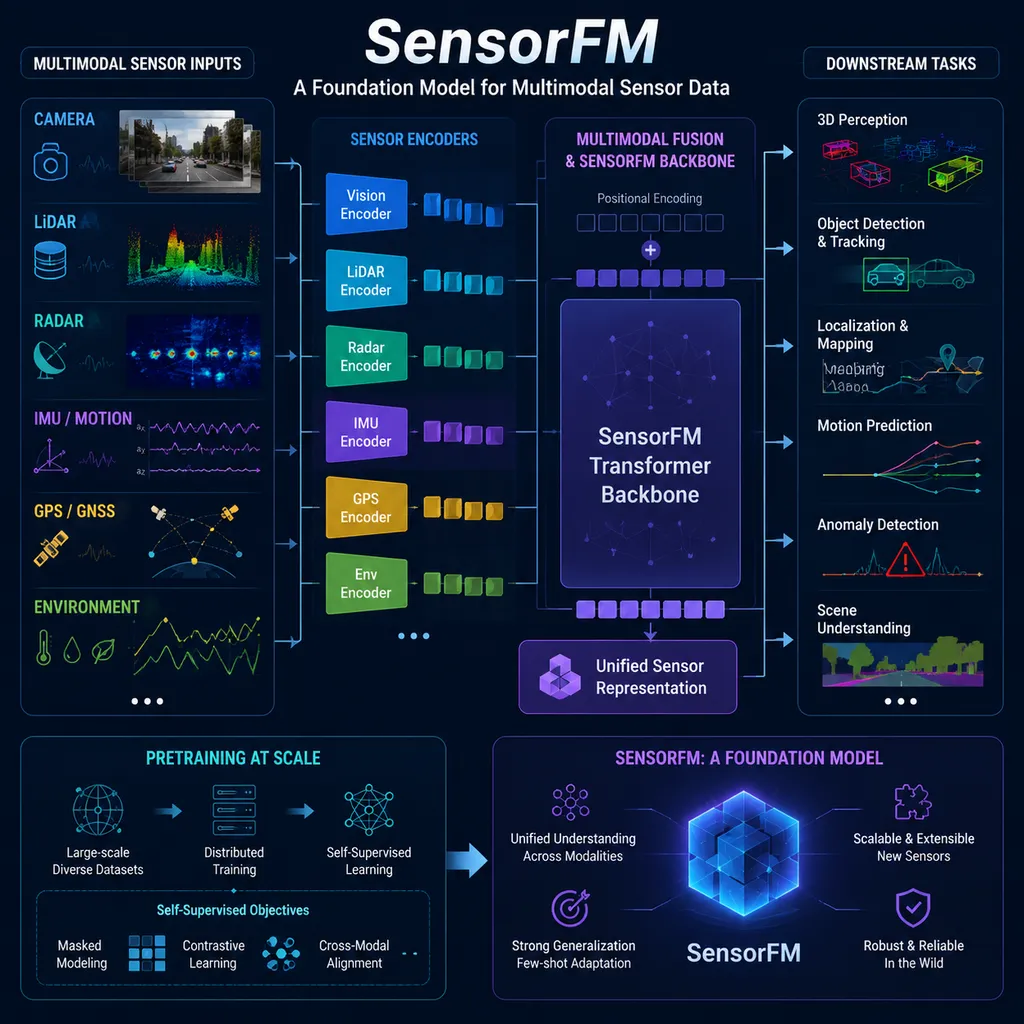
SensorFM adopts the NLP-style pretraining paradigm, except applied to sensor signals. The model input consists of 34 one-minute aggregated features derived from five sensor types:
- PPG (photoplethysmography): captures heart rate, heart rate variability, blood oxygen saturation
- Accelerometry: captures movement, step count, sleep stages
- EDA (electrodermal activity): captures skin conductance as an indirect measure of sympathetic nervous system activity
- Skin temperature: captures circadian rhythm, fever, and female cycle-related signals
- Altimeter: captures stair climbing and elevation changes
The pretraining objective is “missing-aware masked reconstruction” — masking portions of the signal and asking the model to reconstruct them, similar in spirit to BERT, but adapted for the inherent missingness and asynchrony of sensor data. This detail matters: in the real world, nobody wears a smartwatch 24/7, so the model has to learn not to collapse when faced with gaps in the data.
The pretraining corpus was collected over a full year, from September 2024 to September 2025. Several weeks of data were sampled per user to assemble the trillion-minute dataset.
Scaling Effects: Bigger Models Deliver Bigger Gains
Google trained four model sizes: XXS, XS, S, and B. Compared with the smallest version, the largest model, SensorFM-B, achieved:
- 31% lower reconstruction loss
- 9% higher average AUC on classification tasks
- 21% higher average Pearson correlation on regression tasks
This scaling curve is arguably the most convincing part of the paper. It shows that wearable signals are not, as some have worried, “too low-density for scale to matter.” With enough data and diversity, scaling the model continues to pay off. The 21% improvement in Pearson correlation on regression tasks is especially notable, since regression typically depends more heavily on data quality than classification.
The 35 downstream tasks span six categories: cardiovascular health, metabolic risk, mental health, sleep, demographics, and lifestyle. SensorFM-B performed best on 33 of them and remained competitive on the other two. That kind of cross-domain generalization is exactly what gives the term “foundation model” its meaning — pretrain once, reuse everywhere.
The Most Interesting Part: The Agentic “Classroom”
If the pretraining section represents an expected victory through scale, the truly eye-catching part of the SensorFM paper is the agentic “classroom.”
Google built an LLM-agent system where multiple agents collaboratively and competitively iterated on inference code generation. In simple terms, the LLMs wrote their own prediction heads for downstream tasks — proposing solutions, reviewing one another’s work, keeping the best versions, and repeating the cycle over and over.
The numbers are striking:
- The system explored more than 30,000 candidate solutions
- Across 20 classification tasks, agent-generated prediction heads beat the linear probe on 16 tasks
- Across 15 regression tasks, they outperformed the linear probe on 12 tasks
Why does this matter? Traditionally, the “foundation model + downstream fine-tuning” workflow required researchers to manually tune architectures, hyperparameters, and training strategies during fine-tuning. Now the LLM handles that work directly, and for Google, the cost of 30,000 rounds of trial and error is manageable. In essence, this combines the AutoML paradigm with LLM coding capability — and demonstrates it on a genuinely valuable real-world task suite.
If this “classroom” approach proves transferable beyond healthcare, it raises an obvious question: could downstream adaptation for other foundation models be handled the same way? It’s worth watching.
What It Still Hasn’t Told Us
That said, several important questions remain unanswered.
First, privacy and data provenance. A dataset built from 5 million consented users is still a substantial ethical issue even if every participant explicitly opted in. Fitbit data has remained sensitive ever since Google acquired the company in 2021, and EU regulators imposed strict commitments that the data would not be used for advertising. Does training medical-health models exceed what users reasonably expected? Google’s blog post does not provide much detail on the consent process.
Second, what exactly are those 35 “wins” measured against? The baseline is “feature engineering + supervised learning,” but that baseline itself may already lag behind more recent self-supervised learning approaches. Has SensorFM been directly compared against Apple health research systems or academic wearable SSL models like STEP or sensor-oriented SimCLR variants? So far, no such comparison has appeared.
Third, when will the model become available? Google’s blog refers to SensorFM as a “grounding tool for a Personal Health Agent,” suggesting integration into some future personal health agent product. But it says nothing about whether the weights will be open-sourced, when APIs might launch, or when Fitbit and Pixel Watch users could actually access it. For the developer community, those are the most important questions.
What This Means for Developers
If SensorFM eventually becomes available in some form — even just as an inference endpoint exposed through the Fitbit API or Google Health Connect — it could be a major boost for developers building health applications. Previously, training something like an abnormal heart rate detection model required collecting labeled data from scratch. In the future, it may be enough to add a lightweight probe on top of SensorFM representations.
Longer term, calling this the “GPT moment for sensor data” may not be an exaggeration. Vision has CLIP, language has GPT, but wearable signals have lacked a truly strong general-purpose representation model. SensorFM at least demonstrates that the approach works — and that it scales. The next question is who can turn it into a product developers can actually use: Google itself, Fitbit, or perhaps an open-source community alternative.
References
- Google releases the SensorFM AI model: pretrained on wearable data from 5 million people and 1 trillion minutes — Original IT Home report covering model scale, task performance, the agentic classroom system, and other core details.


