
VultronRetriever Open-Sourced: 8B Retrieval Model Tops MTEB Rankings, Flash Version Fits on iPhone for Offline Inference
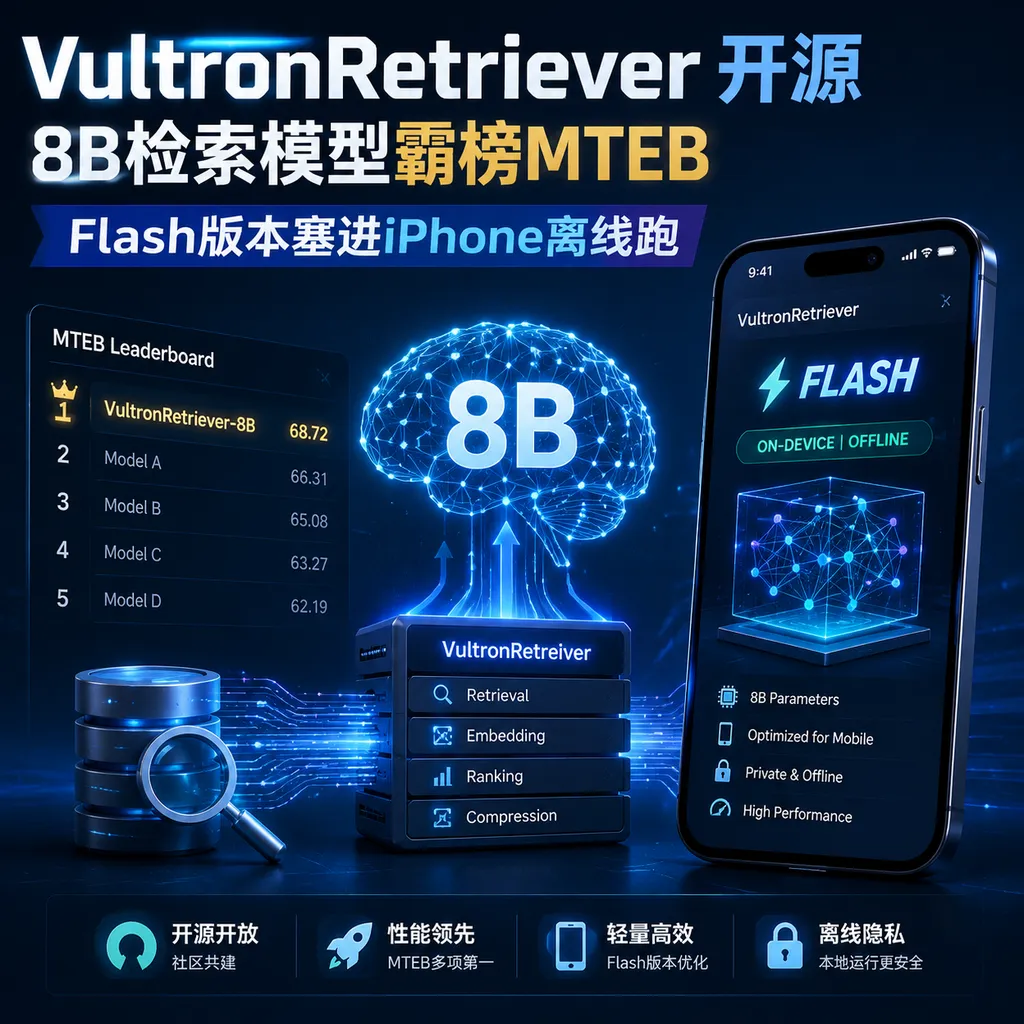
At the Raise Summit in Paris, Vultr unveiled the VultronRetriever trilogy. Prime-8B topped the global MTEB leaderboard, while the smallest model, Flash-0.8B, can perform fully offline document embedding and Q&A on an iPhone, indexing 60 images per minute. In the field of visual document retrieval, the hardware barrier has been lowered to consumer-grade smartphones.
Visual Document Retrieval Has Reached Smartphones
At last night’s developer demo session at the Raise Summit in Paris, an iPhone went offline, switched to airplane mode, scanned a stack of PDFs into a local index on the spot, and answered natural-language questions about them — without making a single network request the entire time. This was the debut of Vultr’s new VultronRetriever family. Three sizes: Prime-8B, Core-4.5B, and Flash-0.8B. The weights were released on HuggingFace the same day under an MIT license, available for commercial use.
Over the past two years, the Visual Document Retrieval (VDR) space has been propelled by models like ColPali and ColQwen. The core idea is to skip OCR entirely and feed PDF pages directly as images into a multimodal encoder, then perform matching at the patch-token level using late interaction. The technical path works, but two engineering bottlenecks have remained: indexes are too large (a single PDF page can generate thousands of vectors) and inference is too heavy (difficult to run on phones or CPUs). VultronRetriever is targeting exactly these two pain points.
Three Sizes, Three Intentions
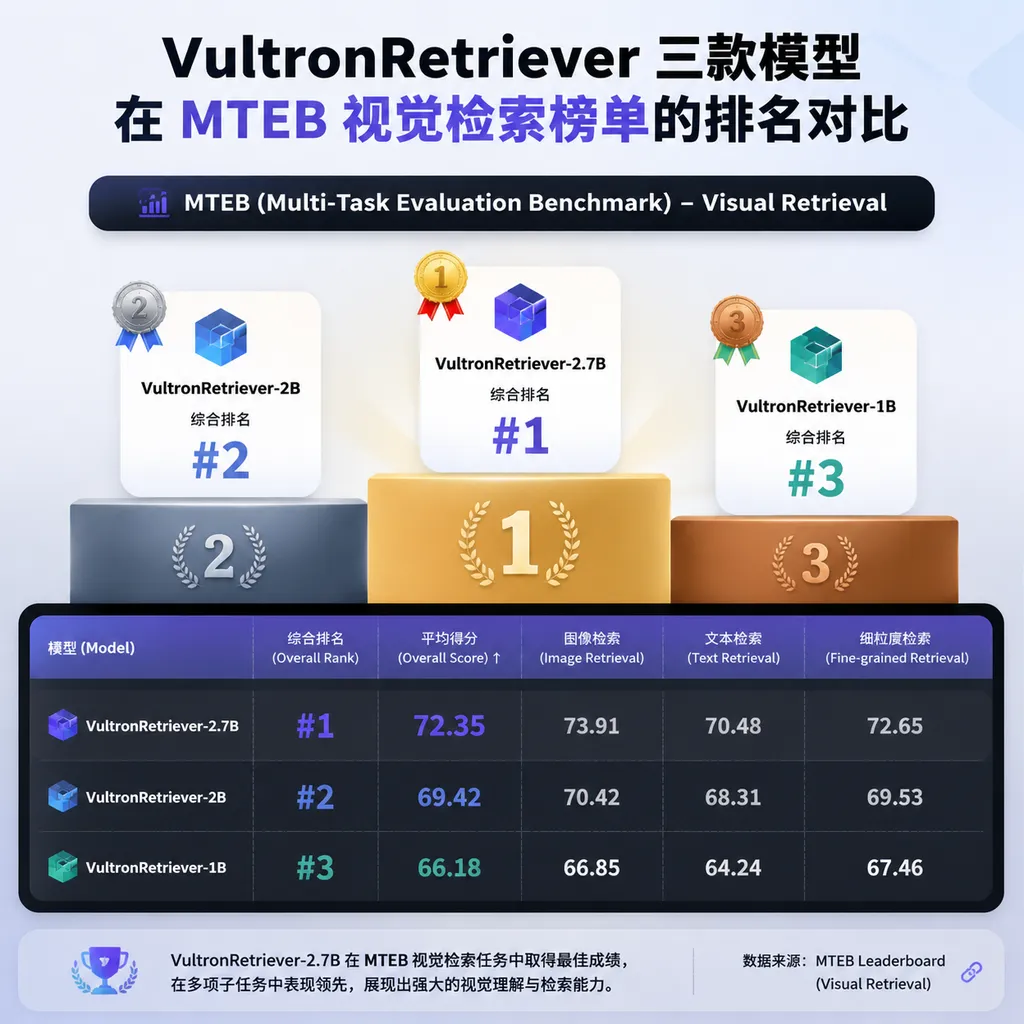
Starting with the official numbers: Prime-8B claimed the top global spot on the MTEB visual retrieval track, with Core-4.5B close behind, while Flash-0.8B reportedly leads by a large margin among sub-1B models. The absolute rankings will need independent community verification, but the fact that Vultr is willing to publish comparison data at this stage suggests confidence in the results.
The positioning of the three models is very clearly defined:
- VultronRetrieverPrime-8B: Designed for server-side deployment and focused on maximum accuracy. Compared with previous leading 9B-class models, index storage is reduced by up to 16× while throughput improves by 12×. If these numbers hold, a knowledge base that previously required 1.6TB for embeddings could now fit into 100GB — fundamentally changing the cost structure of vector databases.
- VultronRetrieverCore-4.5B: The value-oriented option. Performance trails only its own Prime sibling while outperforming many open-source 9B and 12B competitors. Suitable for mid-sized enterprises building RAG systems without investing in H100 GPUs.
- VultronRetrieverFlash-0.8B: Built for edge devices. Vultr describes it as “running cool on phones,” capable of indexing 60 images per minute. This was the model demonstrated running fully offline on an iPhone at the Raise Summit.
One detail worth noting is that the family does not use an MoE architecture. Over the past six months, almost every open-source retriever has adopted MoE, but all three VultronRetriever models are dense architectures. The reason is fairly obvious — MoE is a nightmare for edge deployment. Uneven activated parameter distribution quickly exhausts the iPhone’s unified memory. Vultr clearly treated “can this run on an A18 chip?” as a core architectural constraint from the beginning.
The Hydra Architecture: Merging Retrieval and Generation
The most interesting part of the technical whitepaper is something called the Hydra Architecture. The name is flashy, but the underlying idea is practical: support both late-interaction retrieval and text generation within a single shared set of weights, while cutting generation-time VRAM usage roughly in half compared to similar models.
Under the hood, this is a shared-backbone, dual-head design. The retrieval head outputs patch-level multi-vector representations following the ColBERT-style late-interaction approach, while the generation head reuses deep encoder features for decoder-only text generation. The key detail is that both heads share the same KV cache — once a PDF is encoded into memory using the retrieval head, the system can switch directly to the generation head for question answering without re-running the visual encoder.
That’s why Flash-0.8B can run the entire “read document → answer questions” loop end-to-end on an iPhone. Traditional mobile RAG pipelines hit two major barriers: embedding models and generation models use separate weights that cannot fit together in memory, and every question requires recomputing image features. Hydra solves both problems at once.
From an engineering perspective, the idea itself is not entirely new. Multimodal Qwen models and IBM’s Granite Vision from last year both experimented with similar weight-sharing approaches. But compressing this into a 0.8B model while remaining competitive on the MTEB leaderboard suggests significant work in training data and routing strategy. Unfortunately, Vultr has only released model cards and benchmark numbers so far; the detailed training paper is still pending, so the community will likely need several weeks before fully dissecting the internals.
What Offline iPhone Execution Actually Means
For developers, the iPhone demo is still the main attraction. To make visual document retrieval work on a phone, three conditions must all be satisfied:
- The model must fit within roughly 4–6GB of available memory (the iPhone 15 Pro and newer models have 8GB total, with the system consuming the rest)
- Image encoding must be fast enough to avoid user drop-off (60 images per minute is about one image per second)
- Battery consumption and heat generation must remain manageable
Flash-0.8B reportedly clears all three. Behind this is a combination of quantization (Vultr directly provides int4 weights), Metal acceleration, and shared KV cache design. Once this threshold is crossed, an entire category of applications becomes viable: lawyers searching case files locally without uploading them to the cloud, doctors querying medical records without leaving private networks, enterprise sales teams searching bid documents on-site with zero latency. Previously, these use cases either sacrificed privacy by relying on cloud systems or sacrificed usability by falling back to keyword search.

Compared with Apple’s recently updated Apple Intelligence private cloud compute strategy announced in June, the philosophy is almost the opposite. Apple’s approach is “small models on-device, large models in private cloud,” while Vultr’s approach is “small, medium, and large tiers, with on-device models already sufficient.” The former is a compromise between privacy and capability; the latter bets that edge-side model quality has already crossed the practical threshold. Judging from Flash-0.8B’s MTEB ranking, that bet does not appear reckless.
How the 16× Index Compression Works
Prime-8B’s claimed 16× index compression initially sounds like marketing language, but the principle is actually straightforward. The storage bottleneck in late-interaction retrieval is that every token requires its own vector. A PDF page divided into 1024 patches becomes 1024 vectors at 128 dimensions each. Traditionally these are stored in fp16 format, resulting in roughly 256KB per page.
This time, Vultr combines three techniques:
- Patch pooling: Adjacent patches contain heavy semantic redundancy, so a learnable pooler compresses 1024 patches down to 128–256
- Vector dimension reduction: Reducing vectors from 128 dimensions to 64 while compensating for accuracy loss using contrastive learning
- Binary quantization + residual encoding: Store coarse 1-bit signatures first, then rerank top-k candidates more precisely
Together, these steps reduce per-page index size from 256KB to roughly 16KB. For enterprise knowledge bases, this translates directly into lower costs — vector database storage on AWS is billed per GB, so reducing index size to 1/16 roughly reduces the storage bill to 1/16 as well.
Compared with ColPali and ColQwen
The unavoidable comparisons are with the ColPali and ColQwen families, which have effectively defined the VDR standard over the past year. But both have weaknesses: ColPali, based on PaliGemma, delivers strong accuracy but produces very large indexes; ColQwen 2.5, based on Qwen2.5-VL 3B, is still relatively heavy for edge deployment and requires extra fine-tuning for Chinese-language use cases.
VultronRetriever’s differentiation lies in simultaneously targeting both ends of the spectrum — maximizing server-side accuracy and throughput while also pushing practical edge deployment. Core-4.5B is particularly well positioned, filling the gap between ColQwen 3B and larger flagship models.
That said, the community still needs answers to several questions before drawing conclusions:
- Real-world testing beyond MTEB, especially with noisy data such as Chinese PDFs and scanned historical texts
- Fine-tuning difficulty and whether Vultr will release low-cost domain adaptation methods
- Long-document performance and cross-page information aggregation
- Whether Hydra’s generation quality can genuinely replace standalone LLMs or merely produce summary-level output
Ecosystem Positioning and Deployment Strategy
Commercial embedding models in the open-source ecosystem have always faced an awkward question: once the weights are public, how do you make money? Vultr’s answer is “free models, paid cloud inference and enterprise support.” The VultronRetriever branding itself makes the strategy obvious — download the models freely, but if users want turnkey APIs or deployment on Vultr GPUs, the ecosystem naturally funnels them toward Vultr’s cloud platform. Cohere has followed this route before, and so has Mistral; the model is already proven.
For Chinese developers, the HuggingFace weights can be downloaded directly, making local deployment straightforward. For complete RAG pipelines — using VultronRetriever locally for retrieval while relying on cloud LLMs for generation — aggregator platforms like OpenAI Hub can route requests across Claude, Gemini, and DeepSeek with a single API key, avoiding separate billing setups for each provider. Running the retriever locally preserves data sovereignty, while using APIs for generation preserves top-end model quality. At the moment, this is one of the more practical combinations available.
Is It Worth Trying?
The short answer: if you are building RAG systems or working on visual document understanding, you should probably test Flash this week. At 0.8B scale, local testing is almost free. If the model performs as described, it represents a significant upgrade in the engineering stack; if not, the validation cost is basically just one evening. Core and Prime are better suited for teams with server-side budgets and scheduled evaluations, but the temptation to replace existing ColPali production pipelines is already substantial.
Last year, visual document retrieval was still focused on proving “whether it could be done.” This year, the competition is about “whether it can be done cheaply and on phones.” Vultr’s release pushes the barrier even lower. The next step is seeing how well the community reproduces the results and how the models perform in real-world deployments.
References
- VultronRetriever family of models released on HuggingFace - Reddit: Initial release thread for the model family, including official benchmark data and details of the offline iPhone demo
- Practical Document QA Applications Based on RAG and LLMs: Reference architecture for RAG document QA systems, useful for understanding the retriever’s role in the pipeline
- vLLM Supported Models List: Deployment reference list for mainstream open-source models, useful for comparing future possibilities of integrating VultronRetriever with vLLM


