
Reame Open Source: A CPU Inference Server That Gets Faster the More It Runs Debuts

The open-source project Reame made its debut on Hacker News, featuring a CPU inference server architecture centered on the idea that “the longer it runs, the faster inference becomes.” By using runtime adaptive optimization to break through CPU inference performance bottlenecks, it offers small and medium-sized teams that do not rely on GPUs a new low-cost approach to deploying large models.
Reame Open-Source CPU Inference Server Debuts: Model Inference Automatically Speeds Up Over Time
On July 11, 2026, an open-source CPU inference server project called Reame made its public debut on Hacker News as a “Show HN” post and quickly climbed the discussion charts. Led by developer swellweb, the project’s biggest selling point is simple yet highly disruptive: it is “a CPU inference server that gets faster as it runs.” Unlike today’s mainstream static optimization approaches represented by llama.cpp, Ollama, and vLLM CPU backends, Reame emphasizes runtime adaptive acceleration. The service delivers usable throughput immediately after launch, and as request samples accumulate over time, inference latency automatically decreases while throughput steadily rises.
At a time when GPU supply remains constrained and enterprise AI deployment costs stay high, Reame offers a noteworthy new option for the “running large models on CPUs” path.
1. Project Overview: From Show HN to Community Buzz
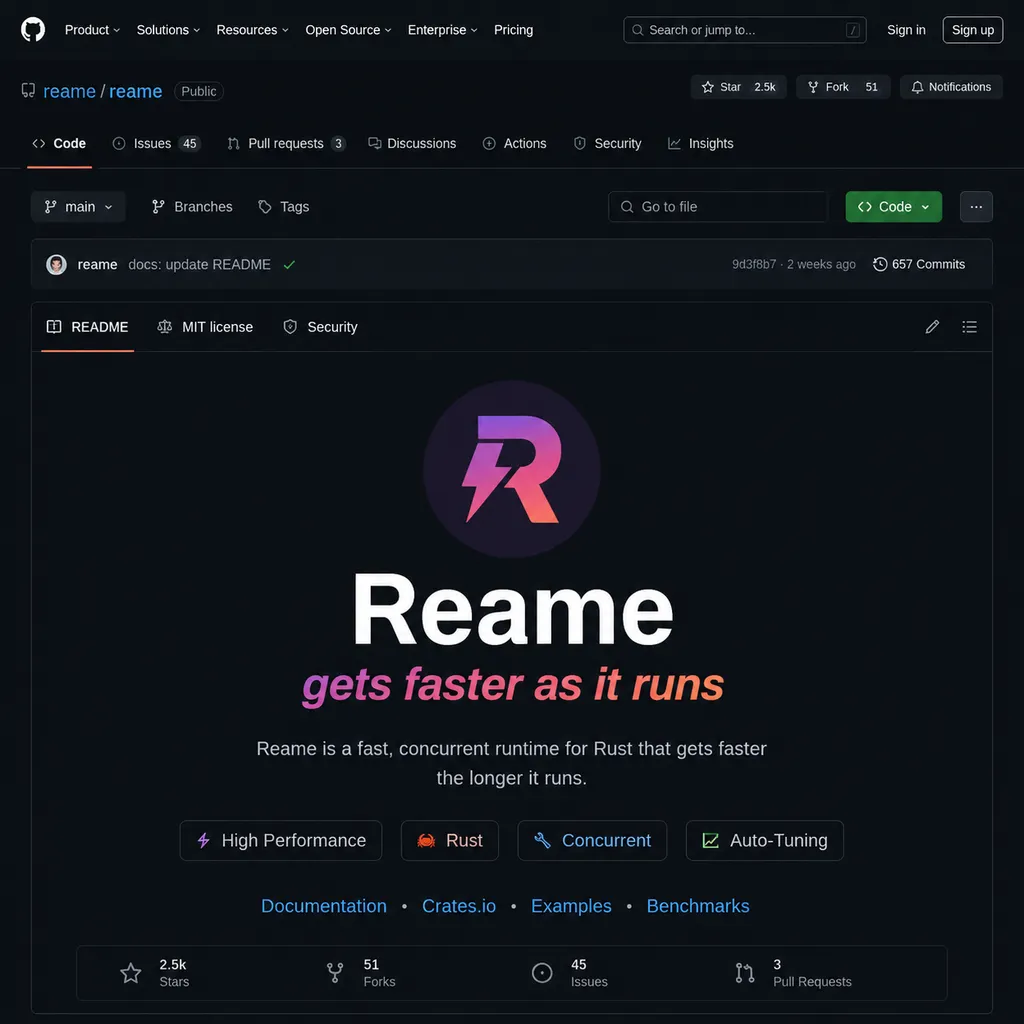
The Reame project is hosted in the GitHub repository swellweb/reame, where the author introduced the inference server through a “Show HN” post. According to the release information, Reame’s core positioning can be summarized in three points:
- Pure CPU inference: No dependence on GPU ecosystems such as CUDA or ROCm. All operators run on general-purpose x86_64 and ARM64 CPUs, supporting mainstream Intel, AMD, and cloud ARM instances such as Graviton and Ampere.
- Runtime adaptive optimization: During operation, the system dynamically adjusts scheduling strategies, operator selection, and cache layouts based on real request workloads, prompt distributions, generation lengths, and other metrics.
- HTTP + OpenAI-compatible interface: Hides underlying complexity from applications, allowing nearly seamless migration from existing inference services with minimal business-code changes.
On Hacker News, discussion quickly focused on several themes: whether “gets faster over time” is merely a marketing spin on “warm-up + caching”; the impact of adaptive strategies on production stability and SLA guarantees; and how Reame differs in design philosophy from active CPU inference projects of recent years such as llama.cpp, DashInfer, Intel xFasterTransformer, and WasmEdge. In the comments, the author responded that Reame is not simply JIT warm-up, but rather a system-level redesign centered around online profiling + strategy search, aiming to move the tuning process from offline benchmarking into automatic runtime optimization.
2. Why Is There a Need for a “Self-Accelerating” CPU Inference Server Now?
Over the past two years, industry interest in CPU inference has resurged significantly, driven by several factors:
- GPU resources remain scarce and expensive. Even common mid-sized 7B–14B models often require GPUs to be reserved long-term for peak demand, leading to poor utilization rates.
- The rise of Arm-based CPUs. According to Arm, roughly half of the compute delivered to hyperscale cloud providers is now Arm-based, while instruction sets such as SVE and SME2 continue improving matrix multiplication efficiency.
- Maturation of quantization and sparsity techniques. Formats such as GGUF, AWQ, GPTQ, and INT4/INT8 allow 7B and even 14B-scale models to run on ordinary servers with only tens of gigabytes of memory.
- The growth of agentic workloads. These workloads are characterized by persistent online operation, high request frequency, and moderate per-request compute requirements, making them particularly CPU-friendly in terms of energy efficiency.
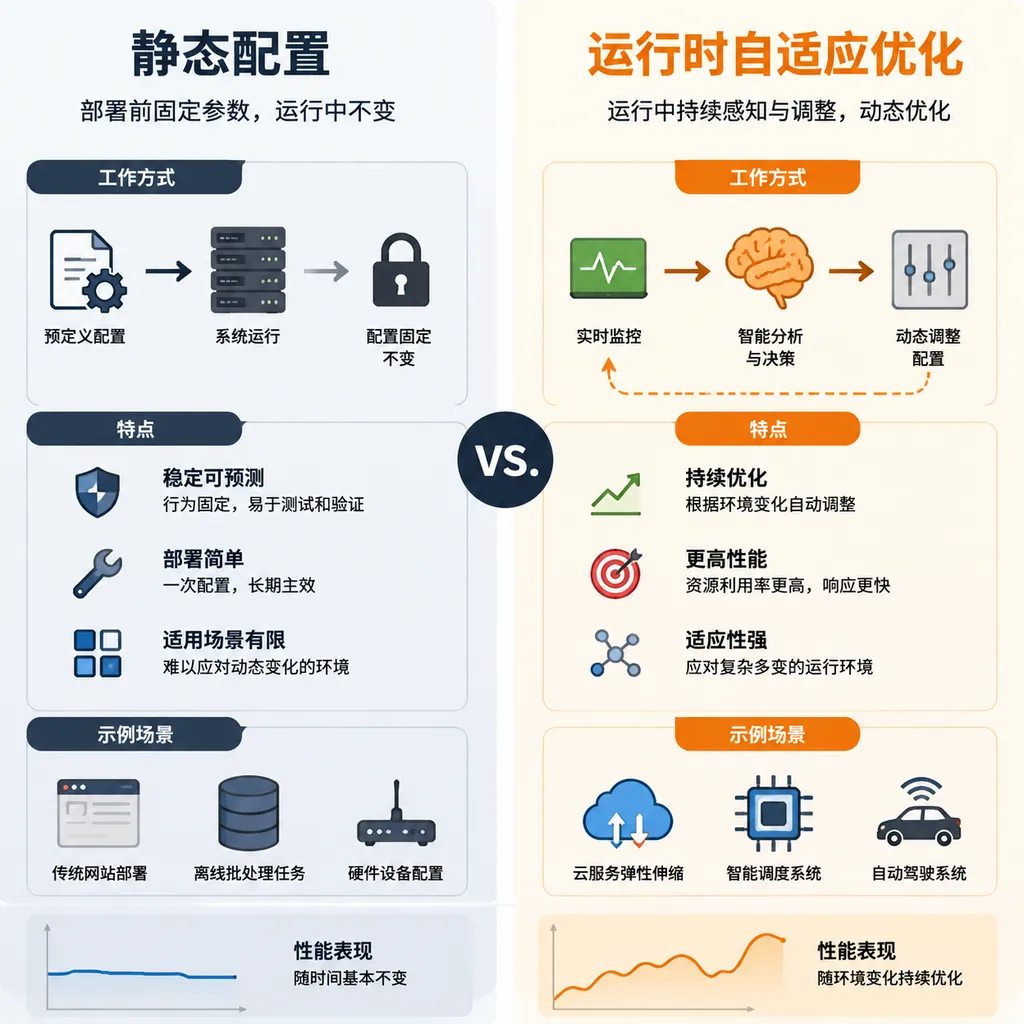
However, most existing CPU inference stacks share a common problem: static configuration. Before deployment, developers must manually choose thread counts, KV cache sharding strategies, batching policies, quantization formats, NUMA bindings, and many other parameters. Once deployed, these settings typically remain fixed throughout the service lifecycle. In reality, the combinatorial search space across CPU core counts, KV cache sizes, batch sizes, and quantization precision can easily explode into hundreds or thousands of possibilities. Based on real production cluster testing, evaluating a single parameter set—from service startup to stress-test data collection—can take several minutes, making exhaustive manual tuning nearly impossible.
Reame’s answer is: stop manually tuning parameters—let the server discover the optimal configuration while running.
3. Reame’s Core Design: A Three-Layer Adaptive Architecture
Based on the public repository structure and the author’s explanations, Reame can roughly be broken down into three layers of adaptive mechanisms, each operating at increasing depth.
3.1 Runtime Operator Selection (Kernel Auto-Tuning)
For time-consuming operators such as GEMM, Attention, and RMSNorm, Reame includes multiple implementation variants optimized for different CPU microarchitectures, covering instruction sets such as AVX2, AVX-512, AMX, Arm Neon, SVE, and SME2. During startup, Reame runs a quick benchmark to select a “safe default.” Then, under real traffic, it continuously scores candidate implementations through online A/B sampling and gradually converges toward the optimal combination for the current workload while respecting jitter constraints.
The key here is that “runtime switching does not affect in-flight requests.” Reame uses a double-buffered operator table, performs switching at request boundaries, and includes rollback thresholds to avoid collapsing throughput due to a single incorrect decision.
3.2 Online Profiling for KV Cache and Scheduler
In CPU inference, the bottleneck is usually not computation but rather memory bandwidth and KV cache movement. Reame maintains a lightweight request profile for each model replica, including:
- Prompt length distribution and generation length distribution;
- Arrival rates and burst factors of concurrent requests;
- KV cache hit rates and eviction rates;
- NUMA access latency across threads.
Based on these profiles, the scheduler dynamically adjusts the following strategies:
- Maximum batch size and batching window for Continuous Batching: Increase batch size when many short requests arrive; reduce it during long-generation scenarios to lower tail latency.
- KV sharding strategy: Switch to chunked Attention under long-context scenarios to reduce one-time memory usage.
- Thread pool binding: Rebind threads according to NUMA topology to reduce cross-socket memory access.
As a result, Reame’s claim of “getting faster over time” is not mysterious: once the service has run long enough and observed enough real traffic diversity, it develops an accurate model of the workload characteristics and can naturally tune operators and scheduling into the workload’s performance sweet spot.
3.3 Prefix Caching and Hotspot Reuse
In Agent, RAG, and multi-turn dialogue scenarios, many requests share the same System Prompt or tool-description prefixes. Reame includes cross-request KV cache prefix sharing: when identical prefixes are detected, it directly reuses previously computed K/V values and skips the redundant prefill phase.
As runtime increases, the hit rate of this cache layer continues rising until it reaches a steady state. This is also the most directly user-visible aspect of “getting faster over time”: the more frequently the same System Prompt is reused, the lower the end-to-end latency becomes.
4. Positioning Compared with Existing Solutions
To understand Reame’s place in the ecosystem, it helps to compare it with existing CPU inference projects:
| Project | Positioning | Optimization Direction | | --- | --- | --- | | llama.cpp / Ollama | Single-machine / local inference, cross-platform friendly | Compile-time and startup-time static optimization, GGUF quantization | | DashInfer (ModelScope) | High-performance inference engine for CPU servers | Manual tuning + request queue + result queue architecture | | Intel xFasterTransformer | Extreme operator-level optimization for Xeon | Deep integration with Intel instruction sets | | WasmEdge + llama.cpp | Lightweight edge inference runtime | Focus on portability and secure sandboxing | | Reame | General-purpose CPU server inference, OpenAI-compatible | Runtime adaptivity: operators, scheduling, and caching are all tuned online |
Clearly, Reame is not directly competing with projects like llama.cpp or DashInfer over “whose single operator is faster.” Instead, it follows a path of system-level adaptive optimization. As the author stated in the comments: “Others are competing on whose static benchmarks look better. We care more about what real production workloads look like after running for a week.”
5. Quick Start: From Launch to API Calls
According to the repository README, Reame’s startup process is intentionally minimal and requires almost no additional configuration files:
# Clone the repository
git clone https://github.com/swellweb/reame.git
cd reame

# Build (requires CMake and a modern C++ compiler)
cmake -B build -DCMAKE_BUILD_TYPE=Release
cmake --build build -j

# Start the service and load a GGUF quantized model
./build/reame serve \
  --model /models/qwen2.5-7b-instruct-q4_k_m.gguf \
  --host 0.0.0.0 \
  --port 8080 \
  --adaptive on
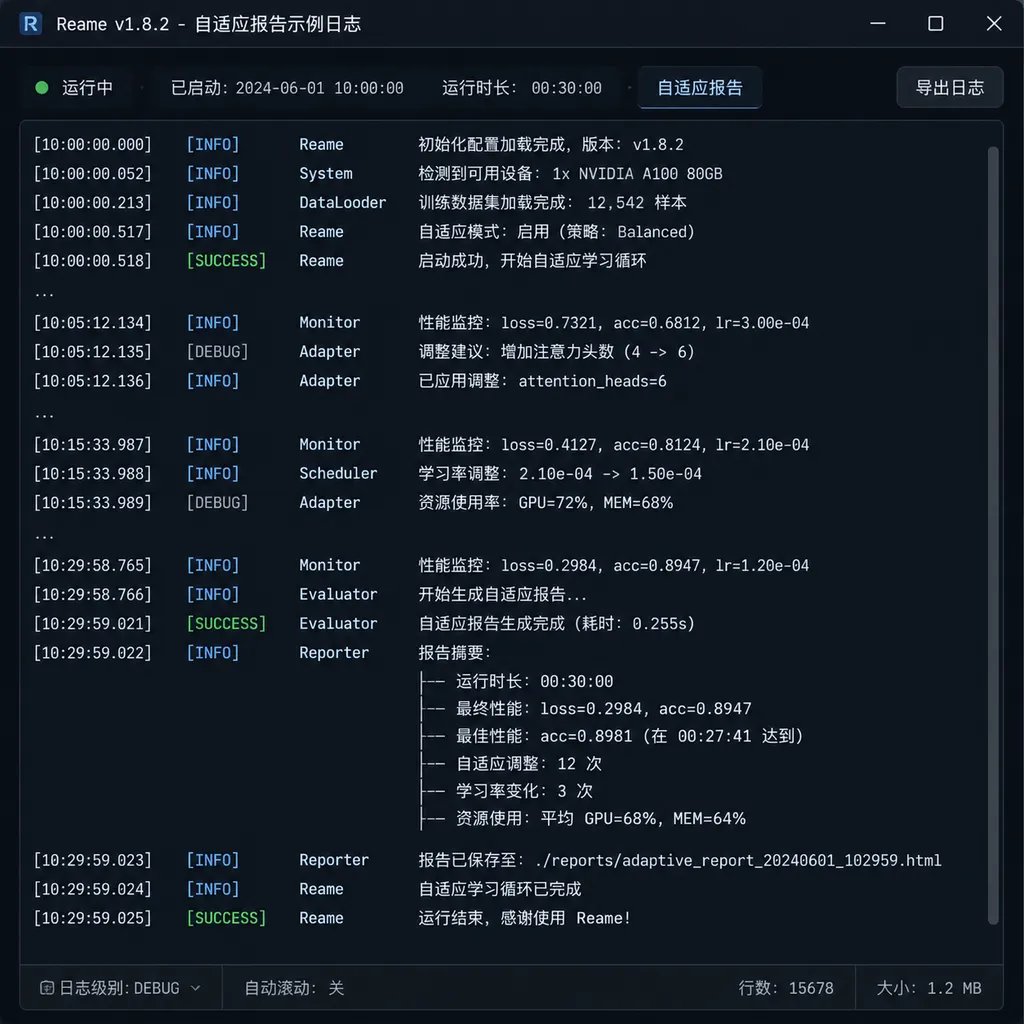
After startup, Reame exposes an HTTP interface compatible with OpenAI Chat Completions, meaning existing client SDKs require no changes. The logs periodically output runtime profiling reports such as:
[reame] adaptive report @ 30m
  prefix cache hit-rate: 0.62 (+0.18 vs boot)
  chosen gemm kernel:   avx512-bf16-v2
  effective throughput: 118.4 tok/s (+41% vs boot)
  p95 latency:          312 ms (-27% vs boot)
The author also emphasized in the Issues section that “gets faster over time” is not unlimited: once profiling converges, performance stabilizes at a plateau rather than rising indefinitely. This is also an important indicator for judging whether Reame is delivering “real optimization” instead of “marketing language.”
6. Community Feedback and Key Questions
Current discussions on Hacker News and GitHub Issues mainly focus on the following topics:
- Predictability vs. adaptivity: Production environments typically require stable, predictable SLAs, whereas runtime adaptive strategies inherently introduce some variability. Reame addresses this with an
--adaptive offswitch and a “strategy freeze” feature that allows locking the current strategy once a steady state is reached. - Compatibility with existing gateways: Since it adopts the OpenAI-compatible protocol, Reame can integrate directly with common API gateways, authentication layers, and observability stacks, which is a major advantage over some custom-protocol approaches.
- Multi-model / multi-tenant support: Current support for multiple concurrent models is still relatively preliminary. The roadmap mentions introducing mechanisms similar to model repositories + dynamic loading, drawing inspiration from systems such as Seldon and KubeDL.
- Adaptation to agentic workloads: Many commenters are interested in whether Reame can effectively support high-frequency short requests combined with long System Prompts, as seen in Agent scenarios. So far, its combination of prefix caching and adaptive batching appears naturally advantageous for these workloads.
7. The Next Step for CPU Inference: From “Can Run” to “Runs Better Over Time”
From llama.cpp enabling large models to run on laptops, to DashInfer and xFasterTransformer pushing CPU inference performance close to entry-level GPUs, and now Reame attempting to make CPU servers “get faster as they run” through runtime adaptivity, CPU inference is clearly progressing through three stages:
- Stage 1: Can run — Quantization + compiler optimization enable large models to run on CPUs;
- Stage 2: Runs fast — Deep operator optimization targeting specific CPU microarchitectures;
- Stage 3: Runs better over time — Runtime adaptation based on real production traffic.
For scenarios such as small and medium-sized teams, private deployments, edge inference, and agent service architectures, Reame’s approach offers a new point of reference. It may not immediately replace existing stacks, but it clearly shifts “parameter search” from humans to machines.
For developers, two practical approaches stand out at this stage: first, try deploying a Reame instance on non-critical workloads and observe profiling and performance curves after 24–72 hours of runtime; second, pay attention to its future evolution around multi-model support, multi-tenancy, and Kubernetes deployment. After all, in 2026—when GPUs are still scarce—any open-source project capable of squeezing an extra 30%–40% throughput out of CPU servers deserves serious attention from engineers.
References
- Show HN: Reame – a CPU inference server that gets faster as it runs (github.com/swellweb/reame): The official GitHub repository for the Reame project, including source code, README, and the latest Issues discussions.


