
Mesh LLM Debuts: iroh Brings Large Model Inference into P2P Networks
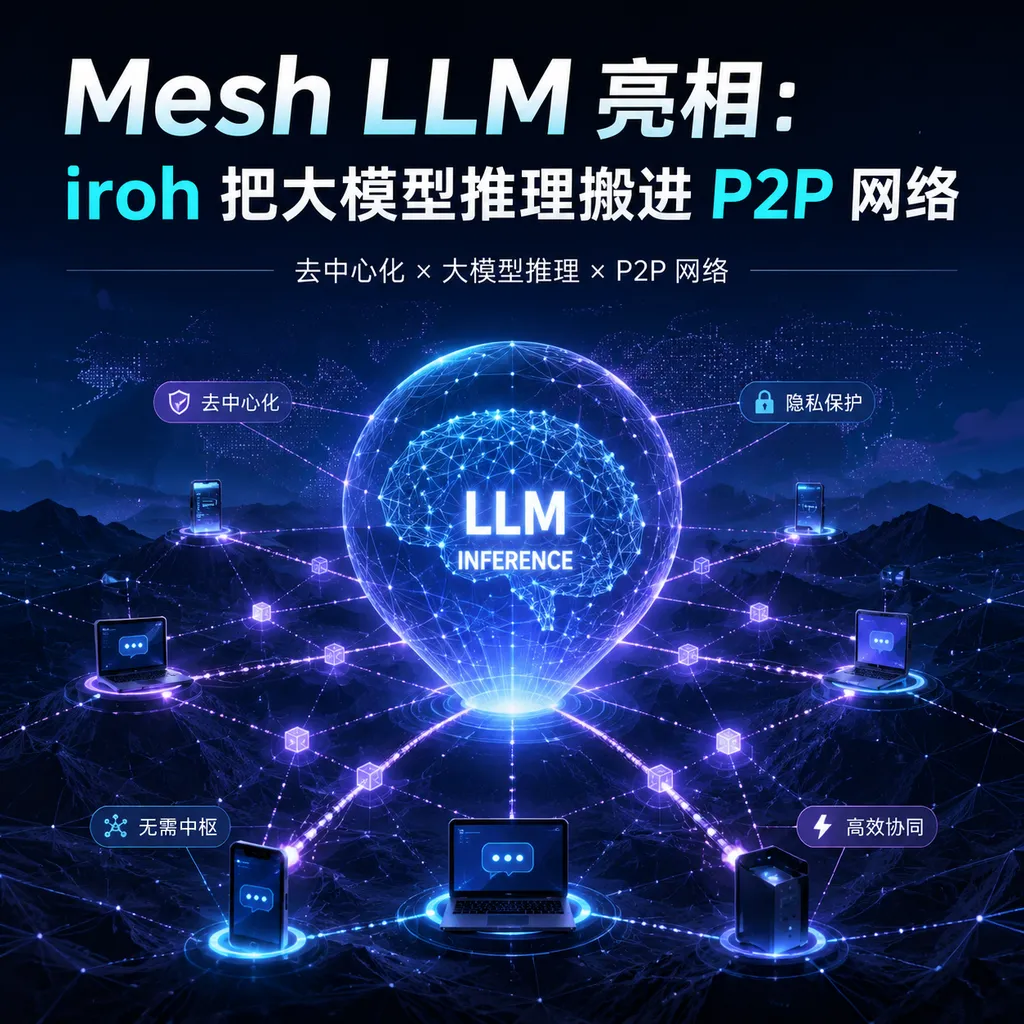
The iroh team recently released the Mesh LLM project, a distributed LLM inference framework built on its P2P network protocol. It enables consumer-grade devices to collaboratively handle model inference tasks, offering a new alternative to centralized AI computing power.
Mesh LLM Debuts: iroh Brings Large-Model Inference into the P2P Network
As centralized GPU clusters become the electricity, water, and fuel of the AI era, a team from iroh is attempting to break apart and distribute large-model inference across every idle device in the world. In July 2026, the Mesh LLM project officially made its public debut, moving distributed inference out of the data center and into the P2P network.
1. Quick Overview: A Different Kind of “Distributed Inference”
The iroh team recently announced the Mesh LLM project on its official blog, formally positioning it as a “distributed LLM computing framework built on iroh.” Unlike llm-d and vLLM cluster solutions that have frequently dominated headlines over the past two years, Mesh LLM does not follow the “Kubernetes + data center GPU” path. Instead, it pushes inference tasks down to ordinary nodes in a P2P network — your laptop, your home workstation, or even an old unused Mac mini can become a node in the inference network.
In summary, the key points of this release are:
- Underlying protocol: Node-to-node communication is built on iroh’s QUIC + hole punching capabilities, naturally traversing NATs and firewalls;
- Scheduling model: Combines tensor parallelism and pipeline parallelism to split a single LLM across heterogeneous devices;
- Trust model: Does not assume nodes are trustworthy, instead ensuring reliable output through verification, redundancy, and content addressing;
- Target scenarios: From “a small local cluster sharing one large model” to “cross-region collaborative inference,” reducing the dependence of individuals and small teams on cloud GPUs.
For developers familiar with iroh, this is almost a natural next step. iroh itself is already a modern P2P toolkit centered around content addressing and direct-connect-first networking, and it has been running in the Rust ecosystem for several years. Mesh LLM essentially adds a layer of compute and scheduling protocols specifically designed for large-model inference on top of this connection layer.
2. Why iroh: Getting the “Connection” Layer Right
Before discussing Mesh LLM, it is necessary to understand what problem iroh is solving.
Over the past decade, the dominant narrative in distributed systems has revolved around “cloud native + Kubernetes,” with everything centered on “controllable data centers.” But as soon as cross-datacenter, cross-cloud, or cross-home-network scenarios are involved, NAT traversal, public IPs, and connection stability immediately become major obstacles. iroh’s core value lies in:
- Using QUIC as the transport layer, making it naturally resilient to packet loss and network switching;
- Combining hole punching with relay fallback so that most nodes can establish direct connections;
- Using BLAKE3 content addressing to decouple “where the data is” from “what the data is”;
- Being entirely written in Rust, treating embedded systems, desktops, and servers equally.
Previously, this connection layer was mainly used for scenarios such as file synchronization, collaborative editing, and edge data distribution. Mesh LLM’s idea is that large-model inference is fundamentally repeated cross-node data movement and computation, which aligns almost perfectly with iroh’s existing abstractions at the lower layers.
A concrete example: in traditional clusters, nodes often rely on InfiniBand or high-performance Ethernet for collective communications such as all-reduce and all-gather. In a P2P network, however, nodes are scattered across the internet, making the traditional MPI approach impractical. Mesh LLM instead redefines communication primitives so that tensors flow over QUIC streams in a more “asynchronous, fault-tolerant, resumable” way. The tradeoff is lower bandwidth efficiency, but the benefit is that any internet-connected device can participate in inference.
3. Mesh LLM Architecture: Turning a Model into a Network
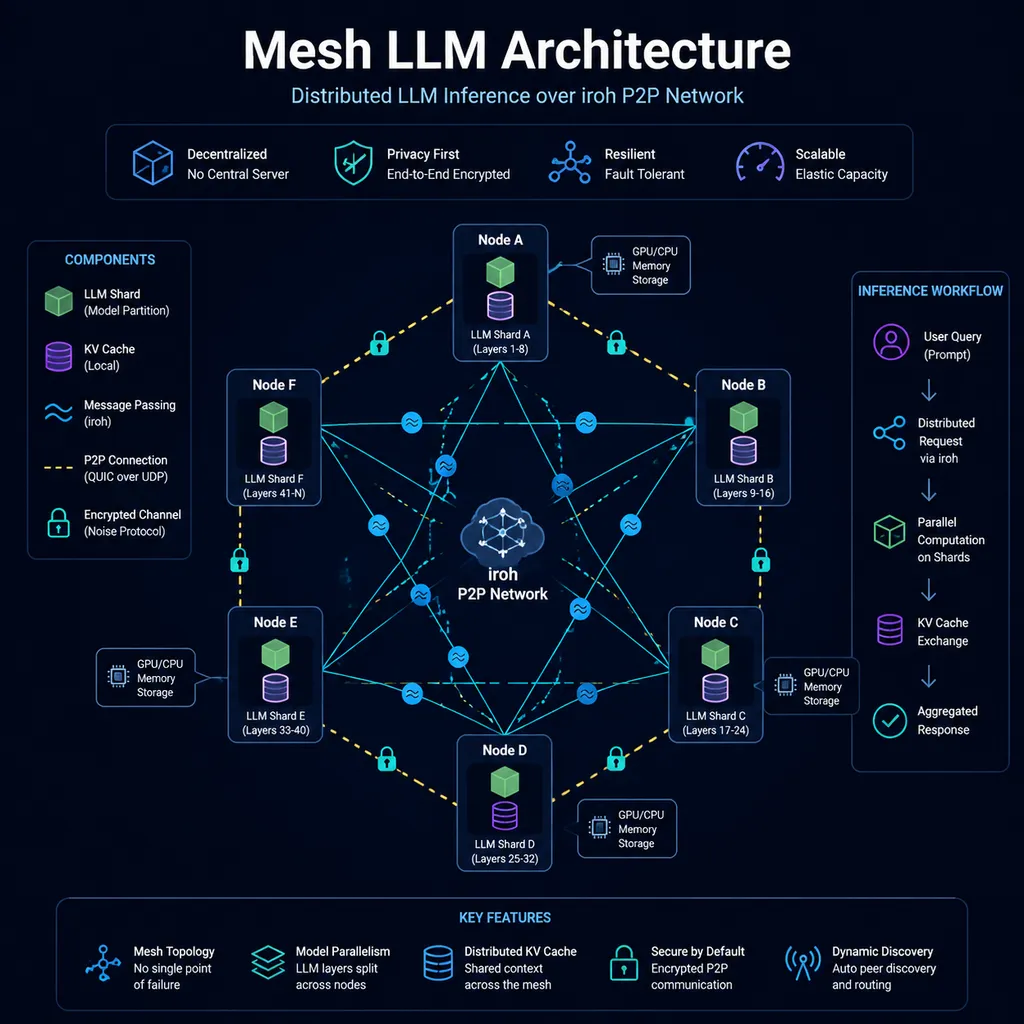
Based on public materials, Mesh LLM’s overall architecture can be divided into four layers:
1. Node Layer: Abstracting Heterogeneous Hardware
Nodes can be:
- A development machine with a dedicated GPU (NVIDIA, AMD, or Apple Silicon);
- A CPU-only server;
- Potentially mobile phones, edge boxes, and other low-compute devices in the future.
When starting Mesh LLM, each node reports its capabilities: available VRAM, system memory, supported precision modes, and current load. This metadata is periodically broadcast to the network and used by the scheduler to assign tasks.
2. Communication Layer: Direct Connectivity Provided by iroh
All nodes establish peer-to-peer connections through iroh, with tensors transmitted over QUIC streams in chunks. iroh’s relay network acts as a fallback when both peers are behind restrictive NATs. This design means:
- Nodes no longer need to be on the same subnet;
- Network jitter and reconnections do not cause an entire inference round to fail;
- Content addressing allows “the same set of weights” to be transmitted only once and then reused after verification.
3. Scheduling Layer: Model Partitioning and Task Distribution
This is the most technically sophisticated layer of Mesh LLM. It must answer the following question:
Given an LLM and a set of unevenly matched nodes in the network, how should the model be partitioned and requests routed to minimize end-to-end latency while avoiding bottlenecks?
The currently disclosed approach includes:
- Layer partitioning (pipeline parallelism): Splitting Transformer layers into segments deployed across different nodes, with requests flowing through them like a pipeline;
- Tensor partitioning (tensor parallelism): For memory-constrained nodes, further splitting layer weights by dimension so multiple nodes jointly handle a single layer;
- Dynamic migration: When a node disconnects or becomes overloaded, the scheduler reassigns its shards to other nodes.
4. Application Layer: Developer-Facing Interfaces
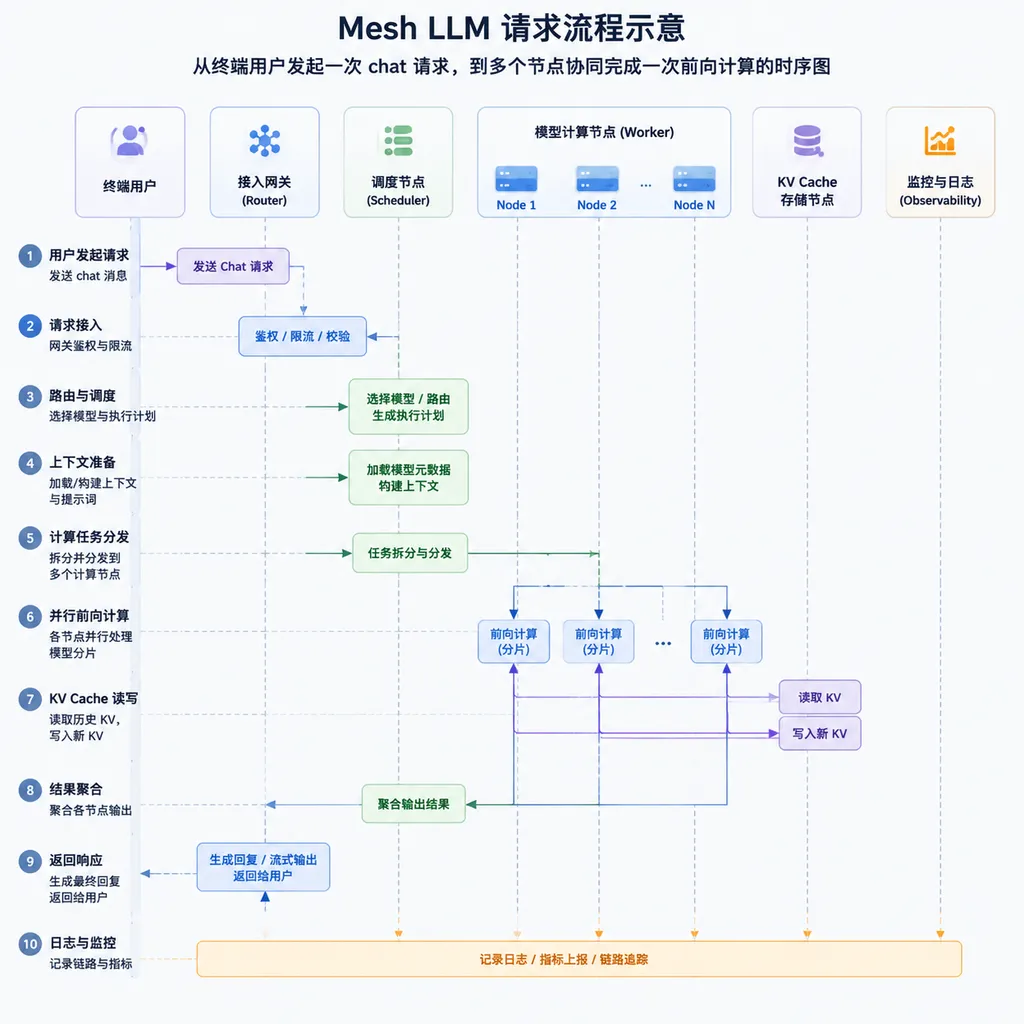
For upper-layer applications, Mesh LLM exposes an interface that “looks like a local LLM.” You simply connect to the local Mesh LLM daemon and can send chat requests just as you would with Ollama or llama.cpp, while the framework handles all distributed details internally.
4. Compared with llm-d and Jalapeño, What Makes Mesh LLM Different?
The year 2026 is shaping up to be a pivotal moment where large-model infrastructure is shifting “from training to inference.” Several major industry directions are worth comparing:
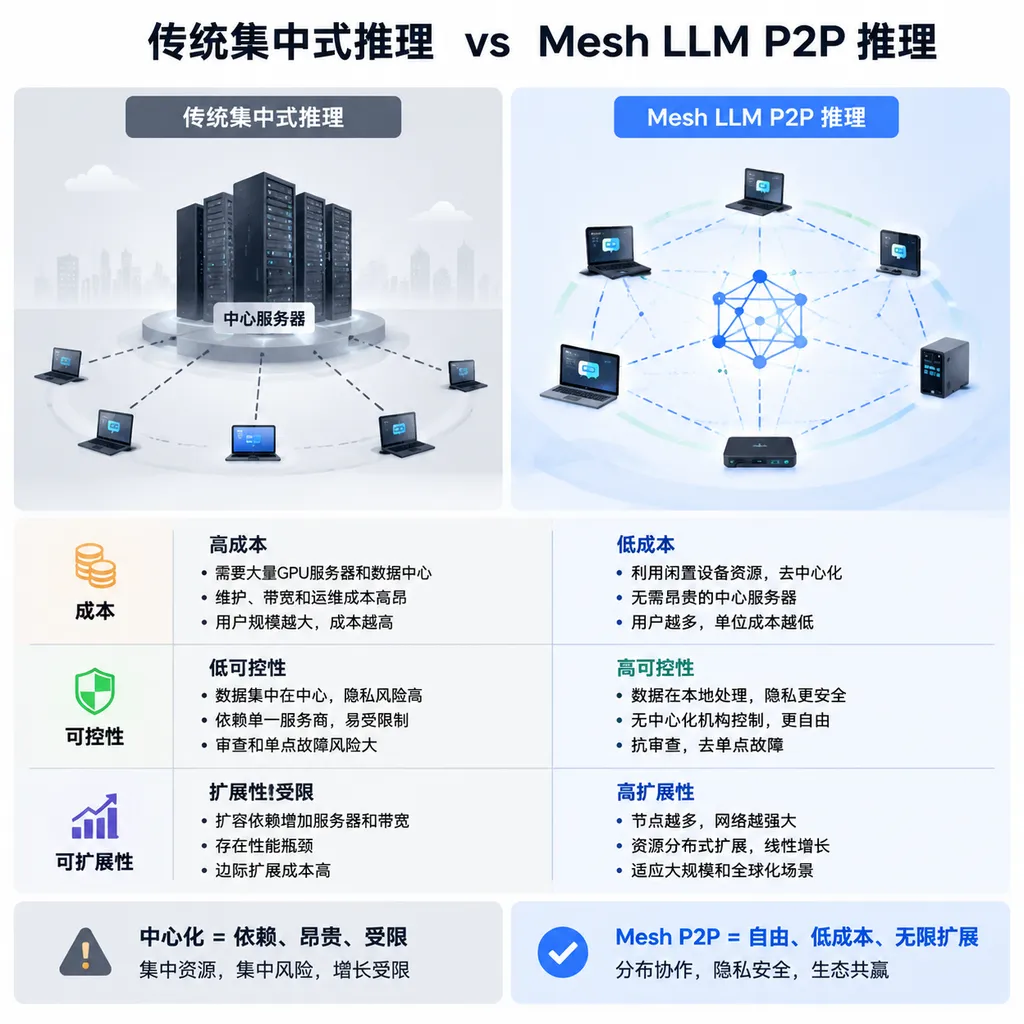
- The Red Hat-led llm-d community: Kubernetes-native and based on vLLM, focused on “enterprise hybrid cloud + large-scale inference,” with emphasis on bringing maximum inference efficiency to data centers;
- The Jalapeño inference chip jointly launched by OpenAI and Broadcom: Custom silicon built specifically for LLM inference, entering gigawatt-scale data center deployment by late 2026, representing “extreme concentration of compute power”;
- Mesh LLM: Taking the opposite approach by distributing inference tasks across countless ordinary devices and compensating for weaker single-node performance through scale.
These three paths are not mutually exclusive. Together, they form a broader industry map: Jalapeño enables top cloud providers to run larger and more expensive models; llm-d enables enterprises to afford customized private inference; while Mesh LLM aims to give individual developers, research groups, and open-source communities their own “inference cloud.”
At the core is a critical question:
As models grow more capable and inference costs continue rising, do we continue accepting pricing power concentrated in the hands of a few AI giants, or do we attempt to rebuild an open, participatory, auditable inference network through P2P methods?
Mesh LLM’s answer carries echoes of early BitTorrent, Tor, and even Ethereum.
5. Technical Challenges Worth Watching
Running LLM inference over a P2P network sounds exciting, but practical deployment faces several hard problems:
- The reality of latency and bandwidth constraints
- Even when partitioned by layer, a 70B-scale model requires moving hundreds of megabytes to gigabytes of intermediate tensors across nodes during each forward pass;
- On home broadband, this directly impacts token/s performance. Mesh LLM must aggressively optimize through quantization, pruning, hierarchical KV cache strategies, and more.
- Node reliability
- Consumer devices are far less reliable than data-center infrastructure and can power off, sleep, or disconnect at any time;
- The framework must include built-in checkpointing, request replay, multi-replica redundancy, and similar mechanisms.
- Trust and security
- How can you ensure a node in the network is not secretly returning incorrect logits?
- One feasible approach is redundant computation with cross-validation by critical nodes, though this wastes compute resources. iroh’s content addressing can help prevent weight tampering, but output correctness still requires additional mechanisms.
- Model licensing and compliance
- Most open-source models (such as Llama, Qwen, and GLM) have their own licensing terms. How to distribute weights compliantly in a P2P network, and how to prevent nodes from being abused for high-risk content generation, are unavoidable issues.
6. Developer Perspective: What It Can and Cannot Do — for Now
For ordinary developers, Mesh LLM is currently more of a technology direction worth watching than something ready for production deployment. Potential use cases include:
- Small-team model sharing: A few office machines forming a mesh to share a somewhat larger open-source model;
- Home inference clusters: Linking together a main workstation, old GPU machines, and a Mac Studio to run a model too large for a single machine;
- Research projects: Using Mesh LLM as an experimental platform for distributed inference scheduling, communication protocols, and partitioning strategies.
In the short term, it is not recommended for:
- Highly latency-sensitive interactive applications;
- Commercial inference services requiring strict SLA guarantees;
- Scenarios involving sensitive data that must never leave the local machine.
7. The Bigger Picture: What Does “Decentralized” AI Compute Really Mean?
It is worth noting that Mesh LLM is not an isolated experiment. Academia has recently explored elastic shared scheduling approaches such as LLM-Mesh, while industry is exploring “LLM Mesh” as a general-purpose backbone for enterprise AI platforms. Although these names are similar, their focuses differ:
- Academia focuses more on scheduling theory and resource utilization;
- Enterprise LLM Mesh focuses more on multi-model, multi-vendor governance;
- iroh’s Mesh LLM focuses more on network-layer protocols and node autonomy.
Taken together, these directions point to one thing: large models will not remain exclusively centralized services controlled by major companies forever. In the future, there will inevitably be an “edge + P2P + open source” branch existing alongside the mainstream centralized path.
For developers, now is an excellent time to start understanding these underlying protocols. Whether you ultimately choose cluster-based solutions like llm-d or P2P solutions like Mesh LLM, understanding the fundamentals of “distributed inference” will become one of the core skills for AI engineers in the coming years.
8. Conclusion
The emergence of Mesh LLM turns the idea of “liberating AI from the data center” from a slogan into code that can actually be cloned and explored. It is still very early-stage, and performance, stability, and ecosystem maturity all need time to develop. But viewed over a longer horizon, it represents an important possibility:
AI computing does not have to remain a game only for giants.
As iroh continues strengthening the connectivity layer, as more open-source models become small enough to fit into consumer GPUs, and as edge-device compute power keeps advancing, an “inference internet” woven together by countless ordinary nodes may not be as far away as it seems.
The second half of 2026 will be worth watching closely for Mesh LLM’s progress, as well as the similar projects it inspires. Distributed inference as a field is only beginning to heat up.
References
- Hugging Face Open-Source Model Community — The primary source of distributable open-source models for the Mesh LLM network, including mainstream weights such as Llama, Qwen, and GLM.
- Stack Overflow discussions on QUIC and P2P hole punching — A practical reference for understanding iroh’s underlying communication mechanisms and common NAT traversal issues.
- Reddit r/LocalLLaMA community — A hub for discussions around local and distributed LLM inference practices, including community feedback and benchmarks related to Mesh LLM.


