
StepFun Releases the Step Edge End-Side Full Stack: Agent-Native AI Runs Directly on Phones and Cars
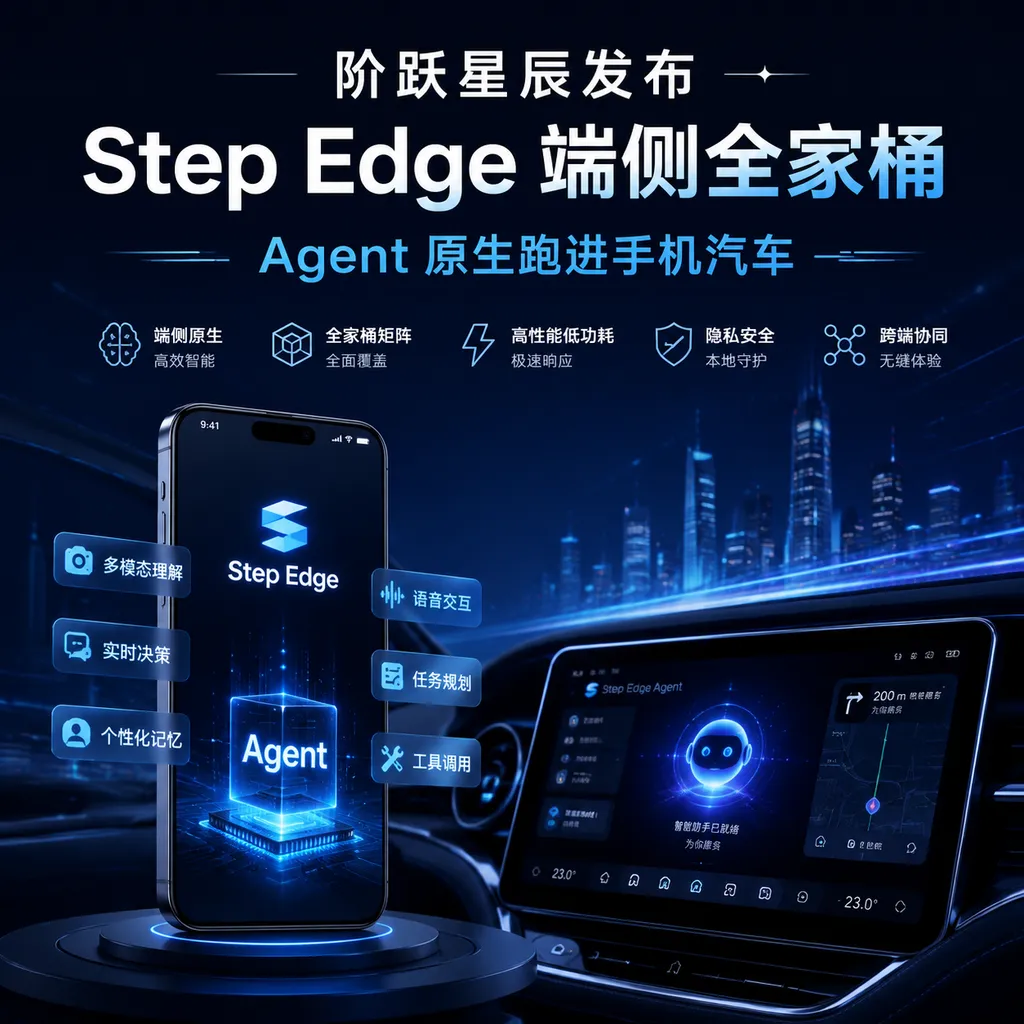
StepFun officially launched the Step Edge on-device model suite on July 12, including four products: the base model, Audio, GUI, and Gen. Designed for terminal scenarios such as smartphones and automobiles, it supports local toolcall responses within 0.1 seconds, enabling Agents to truly move beyond the cloud and run natively on end devices.
StepFun Releases the Step Edge On-Device Model Suite: Agents Begin Running Natively on Phones and Cars
On July 12, StepFun — one of China’s “Six Little Tigers” of large models and widely known as a “multimodal powerhouse” — dropped another major bombshell in the on-device AI arena. Today, StepFun officially announced the launch of the Step Edge on-device model suite, introducing four model products designed for real-world terminal scenarios in one go: Step Edge Base Model, Step Edge Audio, Step Edge GUI, and Step Edge Gen.
This is not another routine release centered on “cloud parameter leaderboard rankings.” Instead, it represents a systematic move in StepFun’s 2026 edge AI strategy — turning Agents from abstract concepts living in cloud APIs into systems that truly run natively inside phones, cars, IoT devices, and other hardware endpoints, enabling “instant local response with privacy staying on-device.”
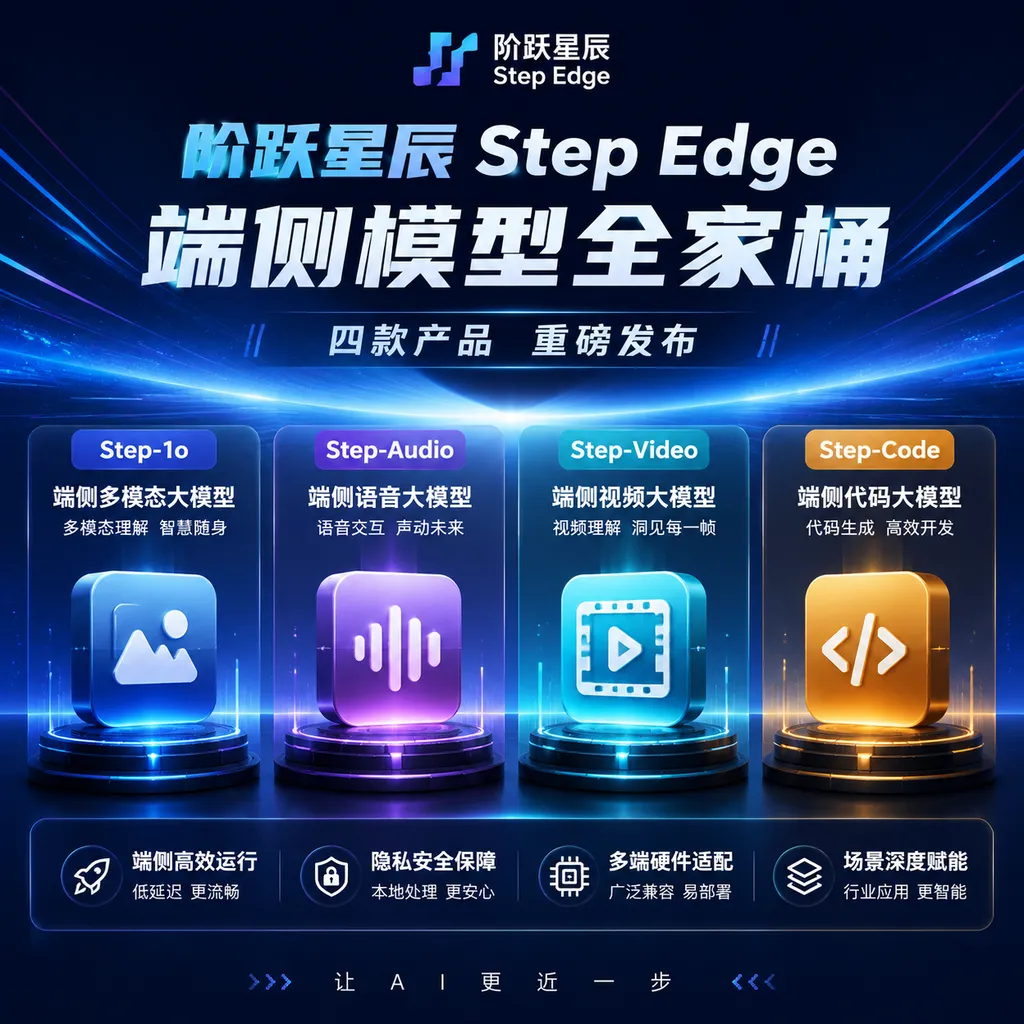
Four Models Debut Together: Full Coverage from Core Intelligence to GUI Agents
The naming alone makes one thing clear: StepFun is not trying to conquer edge AI with a single universal model. Instead, it has split capabilities according to real-world terminal Agent scenarios:
- Step Edge Base Model: The foundation of the entire suite, responsible for general language understanding, instruction following, and local tool-call decision-making — effectively the “brain” of on-device Agents;
- Step Edge Audio: Designed for voice interaction scenarios, integrating speech recognition, semantic understanding, and speech synthesis into a unified multimodal on-device model for real-time local responses in car systems, earbuds, and mobile voice assistants;
- Step Edge GUI: Built for GUI Agent scenarios, capable of understanding interface elements on phone and in-car displays and directly performing operations inside apps based on natural-language instructions. It is the evolved successor to the open-source Step-GUI Edge released late last year;
- Step Edge Gen: Focused on on-device generation tasks, covering multimodal generation capabilities such as images and content creation, enabling terminals to generate locally rather than merely recognize.
StepFun’s positioning for this “full suite” is extremely clear — targeting phones, cars, and other terminal scenarios to bring Agents out of the cloud and into actual devices. This directly aligns with the company’s long-standing “car + smartphone + IoT + embodied intelligence” four-front edge strategy first outlined during the Step UP ecosystem open day in early 2025.
Three Core Highlights: What Problems Do On-Device Agents Actually Solve?
Looking only at the model lineup, many may ask: haven’t on-device models existed for a long time already? What makes the Step Edge suite different? StepFun summarized three core highlights that clearly explain both “why edge AI matters” and “how edge AI should be done.”
1. Ultra-Low Local Latency: 0.1-Second Local Tool Calls
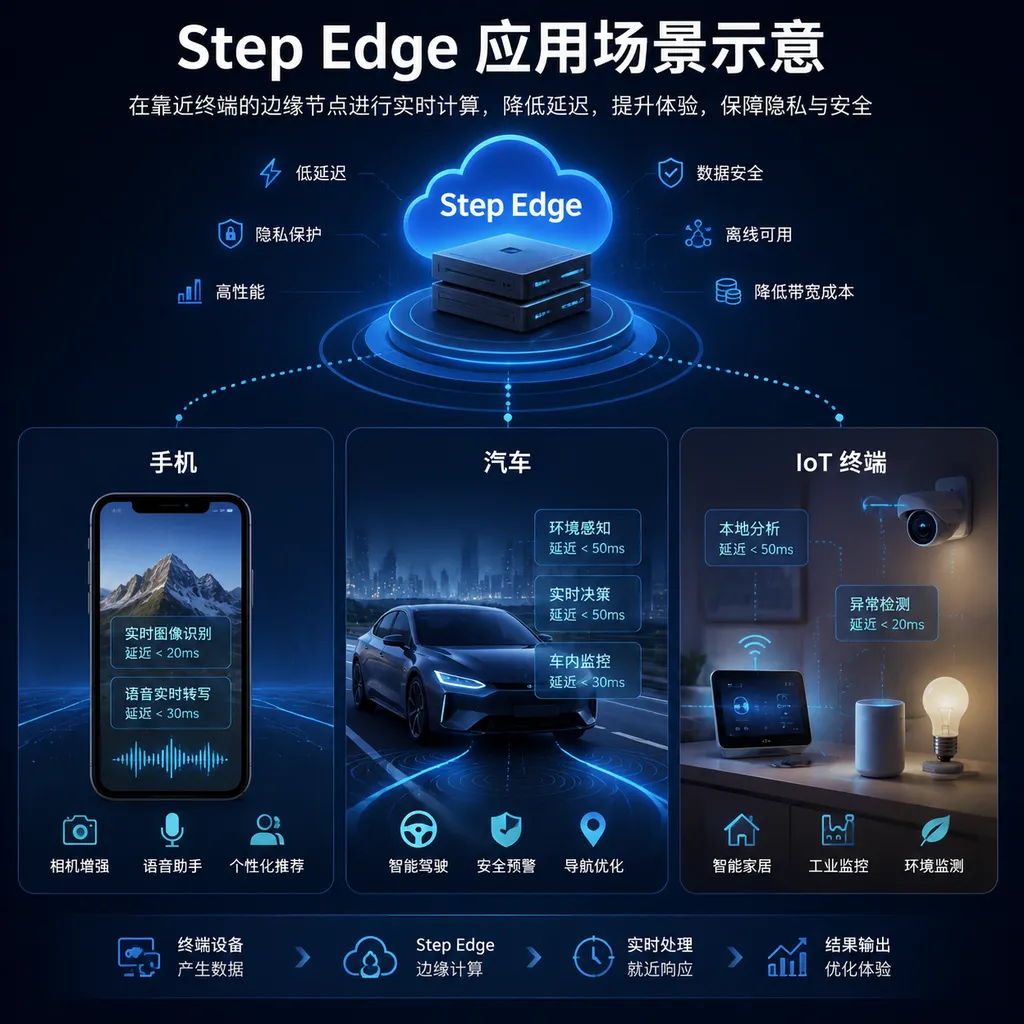
Step Edge supports local on-device tool-call execution with latency as low as 0.1 seconds. This means simple, high-frequency tasks such as “navigate to the office,” “set the AC to 24°C,” “mute,” “next track,” or “send message” no longer need to go through the long chain of “device → network → cloud → network → device.” Instead, they can be handled locally in real time.
Behind this lies an industry pain point that has often been overlooked: over the past year, mainstream large models have generally delivered text generation speeds between 20–80 tokens/s, while even so-called “fast models” typically fall within the 80–150 tokens/s range. In scenarios such as in-car voice systems, mobile translation, and wearables, users only perceive interactions as truly “smooth” when the first-token latency falls below 100ms. No matter how fast the cloud becomes, it cannot escape network RTT delays — edge execution is the real answer.
2. Full-Modality Privacy Protection: Text, Vision, and Voice Stay On-Device
Step Edge emphasizes “full-modality privacy protection”: multimodal data including text, vision, and speech can all be processed locally, with sensitive information never leaving the device.
This capability is practically a baseline requirement in privacy-sensitive sectors such as automotive, finance, healthcare, and children’s devices. Consider a few intuitive examples:
- Conversations with family inside a car, navigation destinations, or verification codes displayed on-screen;
- Payment pages and private chat content shown in mobile apps;
- Voice inputs on smart speakers or children’s smartwatches.
Even when encrypted and transmitted to the cloud, such data still carries compliance and trust costs by nature. The combination of Step Edge Audio and Step Edge GUI enables the complete Agent loop of “listen + understand visually + act” to be executed locally on hardware for the first time.
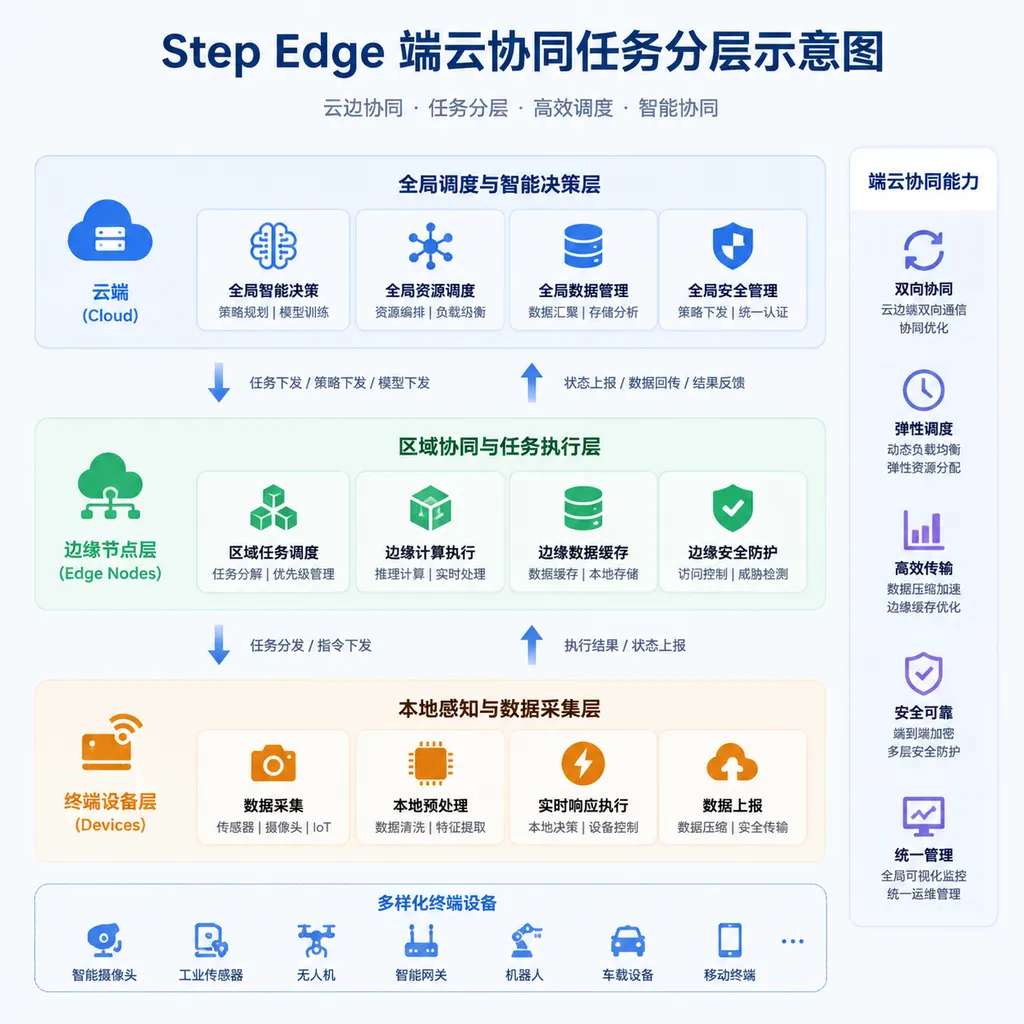
3. Native Edge-Cloud Collaboration: Fast Execution on Device, Deep Reasoning in the Cloud
This is perhaps the most distinctive aspect of StepFun’s messaging this time: native edge-cloud collaboration.
The Step Edge design philosophy is neither “replace the cloud with edge models” nor “do everything in the cloud.” Instead, it clearly divides tasks:
- Edge side handles: simple tasks, high-frequency tasks, and weak/no-network scenarios, prioritizing speed and privacy;
- Cloud side handles: complex reasoning, long-chain Agent workflows, and tasks requiring cross-domain knowledge or large-scale reasoning.
This architecture perfectly complements the open-source Agent foundation model Step 3.5 Flash released by StepFun this February (196-billion-parameter sparse MoE, 350 TPS inference speed, 256K context window): cloud-based Step 3.5 Flash acts as the “planning brain,” while on-device Step Edge acts as the “local hands and feet.” When a user says, “Help me compare prices for the Mac Mini M4 across several e-commerce platforms,” the cloud decomposes intent and plans subtasks, while Step Edge GUI performs the actual app operations and retrieves real-time data on the phone.
Step Inference NPU Engine: Deep Optimization for Terminal Hardware
Models alone are not enough. Phones and in-car systems have far less compute and memory than cloud GPUs. For edge models to truly run efficiently, hardware-level inference optimization is essential.
The Step Edge suite ships alongside the Step Inference NPU Engine, specifically optimized for terminal hardware inference. It further reduces end-to-end latency across text, vision, speech, and other input modalities. Whether this engine can become the “Android low-level layer” of China’s edge AI ecosystem is something worth watching closely.
Given StepFun’s prior collaborations with Geely, OPPO, and Qianli Technology, the Step Inference NPU Engine will likely first integrate deeply with these partners’ chips and SoC platforms — especially in the automotive domain, where the deployment window for L3/L4 autonomous driving is gradually opening.
From Step-GUI Edge to the Step Edge Suite: StepFun’s Edge Roadmap
The launch of Step Edge is not an isolated event, but rather the continuation of StepFun’s broader on-device Agent roadmap:
- February 2025: At the Step UP ecosystem open day, StepFun systematically unveiled its “car + smartphone + IoT + embodied intelligence” industry-wide strategy and announced edge partnerships with Geely, OPPO, AgiBot, TCL, and others;
- Late 2025: The upgraded Step-GUI series was released, including the cloud-based Step-GUI model, the MCP protocol for GUI Agents, and the industry’s first open-source on-device model supporting smartphone deployment — Step-GUI Edge — covering over 200 app scenarios including Taobao, Weibo, Douyin, Xiaohongshu, and Xianyu;
- February 2026: One week after Yin Qi took charge, StepFun released the open-source Agent foundation model Step 3.5 Flash, achieving 350 TPS inference speed and completing the “cloud brain” component of its edge-cloud collaboration strategy;
- July 12, 2026 (today): The Step Edge on-device model suite arrives, simultaneously completing the Audio, GUI, and Gen modality lines and upgrading the edge strategy from “single-point models” to a “full-suite product matrix.”
It can be said that Step Edge is the clearest product implementation yet of StepFun’s “model-hardware integration” strategy. Yin Qi’s dual leadership roles across Qianli Technology and StepFun, along with the completion of a 5-billion-yuan Series B+ funding round, were all laying the groundwork for this moment.
Why Edge AI, and Why Now?
Looking at the broader picture, it becomes clear that throughout the first half of 2026, China’s large-model industry has been shifting focus toward edge AI:
- ByteDance launched a technical preview of the Doubao mobile assistant;
- Zhipu followed up with the open-source AutoGLM;
- Alibaba integrated Qwen deeply into Taobao, Alipay, and Amap, claiming that “AI has grown hands and feet capable of reaching the real world”;
- Moonshot AI’s Kimi K2.5 emphasizes “Agent swarms”;
- StepFun became the first on this front to fully productize a “complete on-device model suite.”
The industry consensus behind this trend is clear: now that cloud models are already sufficiently intelligent and token costs continue to decline, the next bottleneck for AI adoption is no longer “how smart the model is,” but “whether the Agent can actually take action.” To truly act, three issues must be solved — latency, privacy, and cost.
These are exactly the three questions the Step Edge suite aims to answer:
- Latency → 0.1-second local tool calls;
- Privacy → all multimodal data stays on-device;
- Cost → edge devices handle simple high-frequency requests while the cloud handles only complex tasks.
What Developers and Hardware Makers Can Gain
Although the official announcement did not reveal the open-source timeline for the four Step Edge models, StepFun’s open-source cadence over the past year (including Step-Video-T2V, Step-Audio, Step-GUI Edge, and Step 3.5 Flash under MIT/open-source licenses) allows edge Agent ecosystem developers to reasonably expect several things:
- Independent developers: can quickly deploy Agent assistants with visual understanding and instruction execution capabilities in their own apps or hardware using Step Edge GUI + the MCP protocol, following the “10-minute deployment” path previously demonstrated by Step-GUI Edge;
- Phone and car manufacturers: can integrate the Step Edge suite directly into system layers, using the Step Inference NPU Engine for edge acceleration to build native AI features similar to OPPO’s “One-Tap Screen Query” and “One-Tap Universal Search,” or voice Agents for vehicle cockpits;
- IoT and embodied intelligence companies: Step Edge Audio is particularly suited for offline or weak-network voice understanding scenarios, while Step Edge Gen enables local content generation, directly addressing the current limitation where many IoT devices only become “AI-powered” when connected online.
Final Thoughts
The arrival of the Step Edge suite marks a major shift in the battleground for China’s large-model competition — from “cloud parameter leaderboards” toward “real-world edge deployment.”
In this triple leap from “parameter worship” to “intelligence density” to “edge deployment,” StepFun’s announcement sends a clear message to the industry: the next breakout moment for Agents will not happen inside browser tabs, but inside the phones in your hand, the cars you drive, and the earbuds you wear.
And once Agents truly run natively inside these devices, the decisive factor in industry competition will no longer simply be “whose model is larger,” but “whose model can run on hardware, preserve privacy, and make economic sense.”
In that sense, the Step Edge suite is not just another model launch, but the formal rallying call for a full-scale edge AI strategy. In the second half of 2026, the close-quarters battle around on-device Agents has only just begun.
Sources
- StepFun launches the Step Edge on-device model suite for smartphones, vehicles, and other terminal scenarios - IT Home — Official first-hand news on the Step Edge on-device model suite launch, including the four-model lineup and three core highlights.


