
Seoul Pilots Public Data MCP Service: AI Can Directly Connect to 121 Regional Real-Time Data Sources
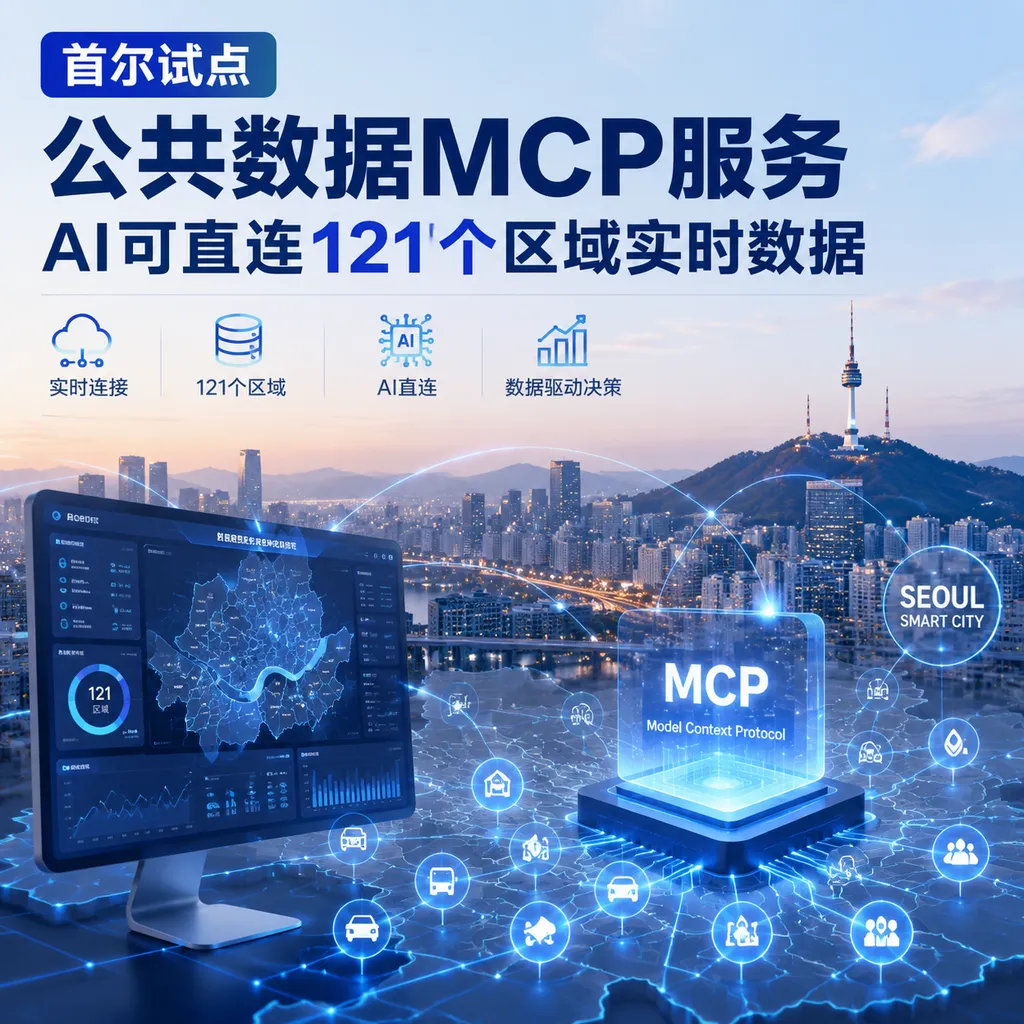
Seoul, South Korea announced on July 12 that it will take the lead in piloting MCP services in the public data sector. AI systems will be able to directly query real-time data from 121 major areas, including pedestrian traffic, transportation, air quality, and shared bicycles. During the pilot period, 100 slots will be available through applications submitted via Kakao’s PlayMCP platform.
Seoul Launches First Public Data MCP Pilot: AI Can Directly Query Real-Time Air Quality, Traffic, and Bike-Sharing Data
Industry Brief | July 12, 2026
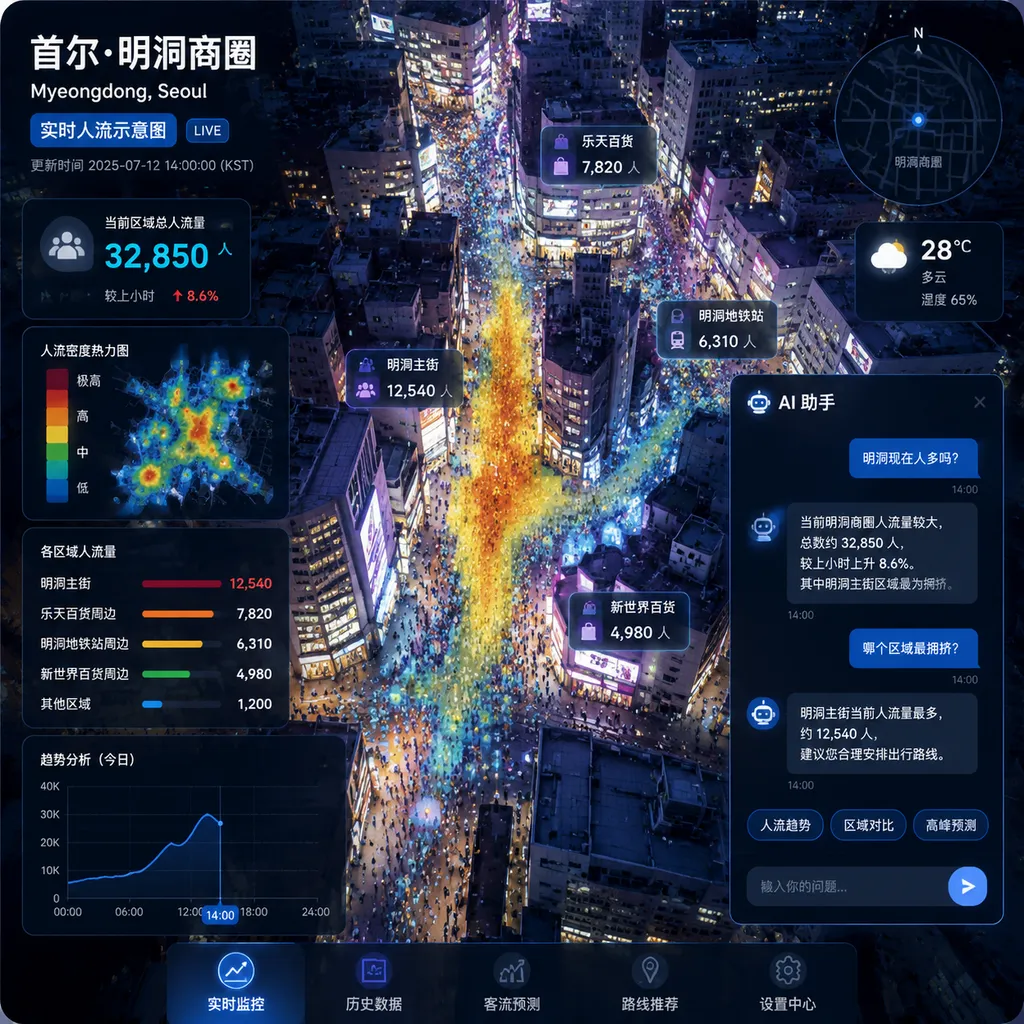
When you ask an AI, “How crowded is Myeongdong right now?”, “What’s the air quality like near the Han River?”, or “How many shared bikes are left near Seoul Forest?” — the answers it gives may no longer come from outdated webpages scraped months ago, but from real-time figures pulled just seconds earlier from the Seoul Metropolitan Government database.
According to Korean media outlet Etnews today, the Seoul Metropolitan Government officially announced on July 12, 2026 that it will become the first city to pilot MCP (Model Context Protocol) services in the public data sector. Following broad MCP adoption by major global AI vendors, this marks the first government-led MCP pilot focused on urban public-data infrastructure, and represents a substantive step forward in East Asia toward “AI agents directly connected to government data.”
1. Overview: Why Seoul Is Doing This
According to information disclosed by the Seoul city government, the core elements of the pilot include:
- Opening public datasets for 121 major districts, covering crowd density, public transportation, weather, air quality, bike-sharing availability (따릉이 / Ttareungi), cultural events, and more;
- Data refresh intervals ranging from “every few seconds” to “up to every 5 minutes,” making it genuinely near real-time data;
- Issuing 100 pilot access slots during the testing phase via Kakao’s PlayMCP platform;
- Gradually extending existing public-data REST APIs into MCP interfaces so AI agents can discover, invoke, and combine these datasets in a standardized way.
The Seoul Metropolitan Government emphasized that the direct motivation behind the pilot is addressing two chronic problems in large language models: outdated training data and hallucinations. Previously, when users asked ChatGPT or Claude highly time-sensitive questions such as “Is traffic bad around Gangnam Station today?”, models often relied on training corpora or secondary information indexed by search engines, resulting in answers that were either months out of date or entirely fabricated.
“MCP is a technology that directly connects AI with public data. Previously, large AI models primarily relied on training databases or internet search results to generate answers, which led to ‘hallucinations’ where incorrect information was treated as fact.” — Seoul Metropolitan Government announcement
2. What Is MCP, and Why It Fits Government Data
MCP (Model Context Protocol) is an open protocol introduced by Anthropic in late 2024 and rapidly adopted in 2025 by major AI companies including OpenAI, Google, and xAI. Its role is often compared to “USB‑C for the AI era” — providing a unified interface between large models and external tools or data sources.
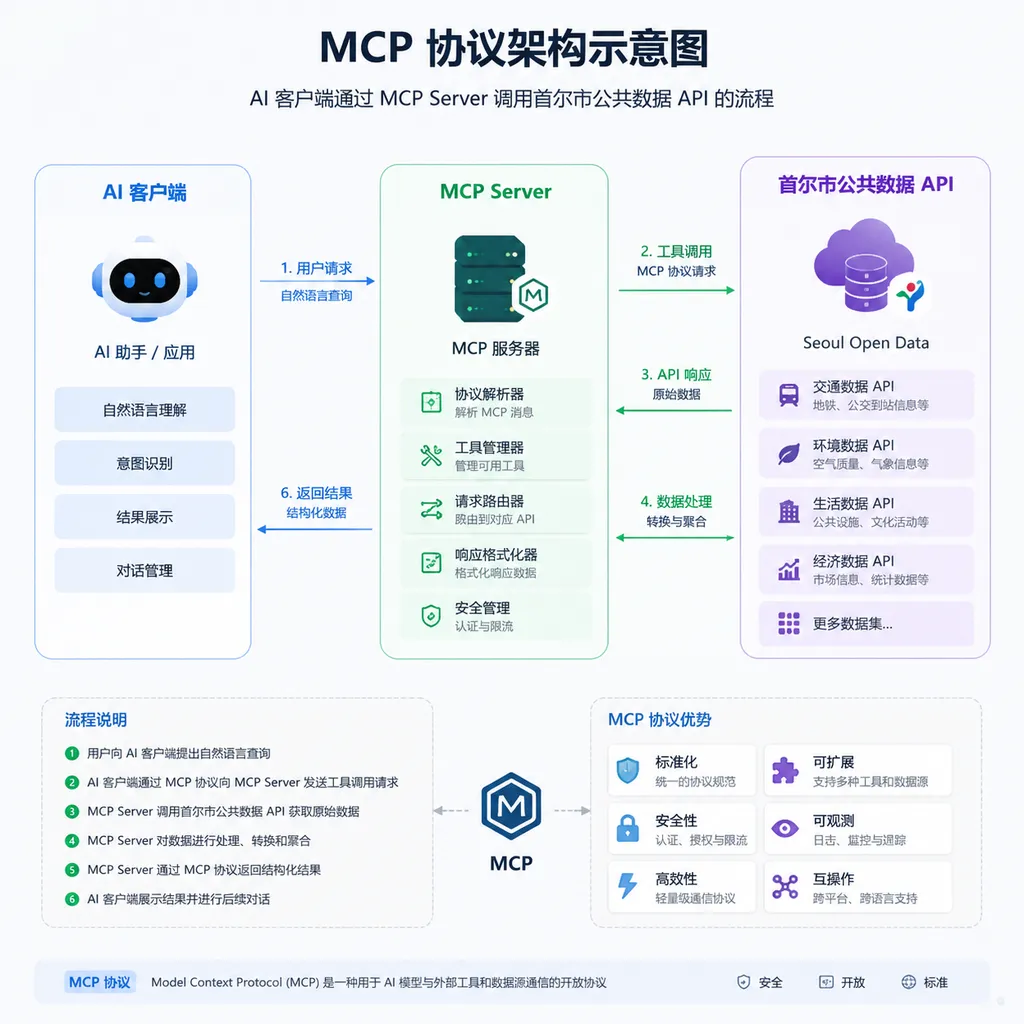
Before MCP, if an AI application wanted access to Seoul’s bus API, bike-sharing API, and air-quality API, developers had to write glue code for each source, handle authentication separately, and manually wrap function-calling schemas. Under MCP:
- Data providers only need to implement an MCP-compliant server exposing “tools” and “resources”;
- AI applications — whether Claude Desktop, Cursor, or custom-built agents — can automatically discover and invoke all compatible MCP services after a one-time protocol integration;
- Authentication, rate limiting, schema descriptions, and response formats are standardized by the protocol itself.
This architecture is naturally well suited to government-data scenarios. The reason is straightforward: public-sector data has long suffered from the problem of “APIs that nobody uses.” Formats vary wildly, documentation quality is inconsistent, and integration barriers are high. As a result, large amounts of publicly available data rarely make it into consumer applications or AI assistants. By converting data from 121 districts into MCP services, Seoul is effectively adding an “AI-friendly plug” to these datasets.
3. What Data Is Included in the Pilot
According to disclosures from the Seoul city government and Etnews, the pilot’s datasets for 121 districts can roughly be grouped into the following categories:
1. Crowd Density (실시간 도시데이터)
- Covers major commercial and tourism hotspots including Myeongdong, Gangnam Station, Hongdae, Dongdaemun, and Han River parks;
- Uses four congestion levels (Relaxed / Normal / Slightly Busy / Busy);
- Data originates from Seoul’s existing “Real-Time City Data” platform, previously available through official apps and web services, and now opened to AI for the first time through MCP.
2. Public Transportation
- Subway arrival times, real-time bus locations, and station congestion;
- Traffic congestion indexes for major roads;
- Taxi demand heat levels.
3. Environmental Data
- Real-time PM2.5 / PM10 / O₃ levels by district;
- Overall Air Quality Index (AQI);
- Temperature, humidity, precipitation probability, and UV index.
4. Ttareungi Bike Sharing (따릉이)
- Real-time bike availability at each station;
- Number of empty docks;
- Aggregated station information for hotspots such as Seoul Forest and Han River parks.
5. Cultural Events
- Daily event listings for cultural facilities across districts;
- Start times and remaining capacity for exhibitions, performances, and festivals.
The Seoul government gave the example that if a user asks Claude, “How many shared bikes are available near Seoul Forest?”, the response will include real-time bike counts at nearby stations instead of generic encyclopedia-style information such as “Seoul Forest is an urban park in eastern Seoul.”
4. Application Process: Through Kakao’s PlayMCP Platform
Notably, Seoul did not build its own application portal for the pilot. Instead, it partnered with Kakao’s PlayMCP platform.
PlayMCP, launched by Kakao in the first half of 2026, is an MCP service distribution and authentication platform positioned somewhat like an “app store for MCP services.” Users can browse, subscribe to, and manage MCP services there, with unified authentication through Kakao accounts.
Details of Seoul’s pilot rollout include:
- Slots available: 100;
- Application channel: Seoul section on the Kakao PlayMCP platform;
- Eligible participants: developers, AI application teams, research institutions, and ordinary citizens;
- Usage method: approved applicants receive an MCP Server endpoint and credentials that can be configured directly in MCP-compatible clients such as Claude Desktop, Cursor, or custom agents.
From an ecosystem perspective, the collaboration is significant: the government side (Seoul) provides authoritative real-time data, the platform side (Kakao) handles distribution and authentication, and the AI side (Anthropic, OpenAI, and others) handles invocation and reasoning. Together they form a relatively complete “AI-enabled public data” loop.
5. Technical Details: From Public APIs to MCP Interfaces
In its announcement, the Seoul government specifically stated that it will “expand existing public-data APIs into MCP interfaces.” Behind that sentence lies substantial engineering work.
Previously, Seoul’s public data was mainly provided through REST/OpenAPI interfaces on data.seoul.go.kr. These APIs targeted traditional web and app developers and generally had the following characteristics:
- One dataset per URL;
- Parameters and responses described in XML/JSON, but without unified schemas;
- API-key-based authentication;
- No AI-oriented “tool description” metadata.
After migration to MCP, the same datasets are exposed as “tools,” each carrying natural-language descriptions, parameter schemas, and example invocations. This allows AI systems to autonomously decide when and how to use tools without manual prompting logic.
Below is a conceptual MCP tool description illustrating how Seoul’s bike-sharing data might look after MCP integration (illustrative only; actual fields will depend on official releases):
{
  "name": "seoul_ttareungi_status",
  "description": "Query real-time remaining bike counts and empty dock availability at nearby Seoul bike-sharing (Ttareungi) stations within a specified area. Data refresh interval is approximately 1 minute.",
  "inputSchema": {
    "type": "object",
    "properties": {
      "area": {
        "type": "string",
        "description": "One of Seoul's 121 major district names, such as 'Seoul Forest', 'Myeongdong', or 'Han River Park - Yeouido'"
      },
      "radius_m": {
        "type": "integer",
        "description": "Search radius in meters, default 500",
        "default": 500
      }
    },
    "required": ["area"]
  }
}
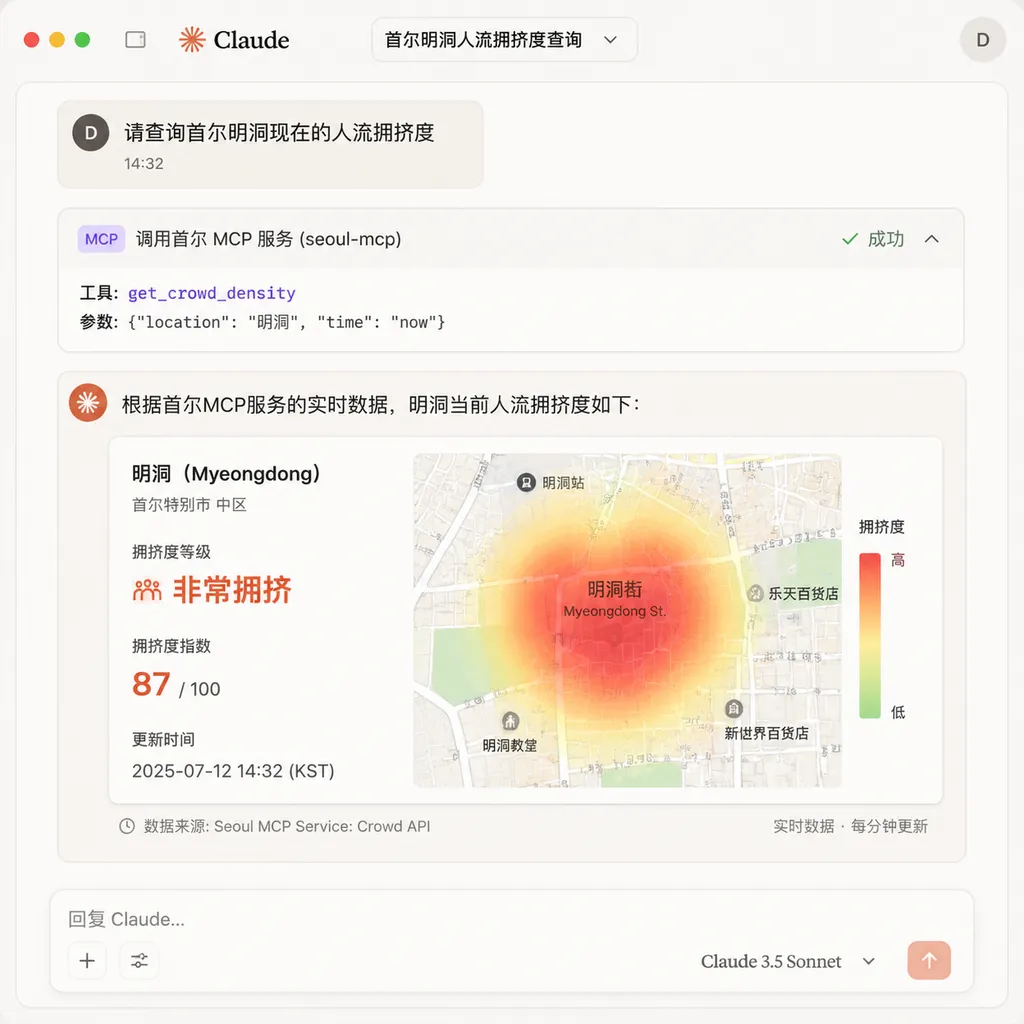
When an AI client receives the question “How many shared bikes are available near Seoul Forest?”, the model can automatically match the description field to the seoul_ttareungi_status tool, construct parameters such as {"area": "Seoul Forest"}, invoke the tool, and then generate a natural-language response based on real-time data. Developers no longer need to hardcode bike-query logic into prompts.
6. Hallucinations, Timeliness, and “Government Data Credibility”
From a broader perspective, Seoul’s pilot addresses one of the sharpest contradictions in current AI deployment:
As models become more capable, users increasingly treat them as universal answer engines; but the more static and training-data-dependent their knowledge is, the more likely they are to fail on highly time-sensitive questions.
Over the past two years, major AI companies have explored multiple approaches:
- Web search: allowing models to retrieve pages in real time, though search results themselves may be outdated or inaccurate;
- RAG (Retrieval-Augmented Generation): retrieving from enterprise or private knowledge bases, which requires companies to maintain their own data pipelines;
- Function Calling: enabling models to invoke predefined developer functions, though every application must implement its own integrations.
MCP offers a fourth approach: directly connecting authoritative data sources to models through a standardized protocol. Among all data sources, government public data is arguably one of the most trustworthy categories — authoritative, near real-time, and broad in coverage.
By MCP-enabling datasets from 121 districts, Seoul is effectively building a “city-scale trusted data layer” for large models. When AI answers “How crowded is Myeongdong right now?”, it no longer relies on a three-month-old blog post, but on official data collected by the Seoul government one minute ago. The implications for tourism, transportation, emergency response, and urban research are substantial.
7. Industry Impact: The Demonstration Effect of City-Scale MCP Services
As of July 2026, the MCP ecosystem has evolved from “vendors racing to support the protocol” into a phase of “vertical deployment.” On the enterprise side, mainstream SaaS platforms such as GitHub, Notion, Linear, and Figma have already launched official MCP servers. On the developer side, third-party MCP services are rapidly emerging in open-source communities. But until now, government and public-service sectors lacked representative real-world deployments.
Seoul’s pilot carries significance on at least three levels:
- A practical path for AI-enabled government data: proving that a gradual approach — existing OpenAPI infrastructure plus an MCP adaptation layer — is viable, meaning other cities do not need to rebuild systems from scratch;
- The value of platform operators: Kakao PlayMCP handles authentication, distribution, and rate limiting, preventing individual data providers from facing thousands of AI clients independently;
- A new citizen–AI–government interaction model: instead of using apps or websites to search for public information, citizens may increasingly ask AI assistants directly, with those assistants calling government MCP services behind the scenes — redefining the shape of e-government products.
If Seoul’s 100-user pilot succeeds, it is easy to imagine major cities in Japan, Singapore, Hong Kong, and Europe launching similar initiatives within the next 6–12 months. Several Chinese cities are also advancing “city large model” projects, and MCP-enabled public-data interfaces may become standard infrastructure in the next phase.
8. Open Questions Worth Watching
As a pilot project, Seoul’s MCP initiative also leaves several important questions open:
- Authentication and quotas: 100 slots are clearly only a stress test — how will rate limiting and pricing work at large scale?
- Data misuse and privacy: could crowd-density data be used for hyper-targeted marketing or surveillance purposes? Will the government publish usage guidelines for MCP services?
- AI client compatibility: implementations differ across Claude, ChatGPT, Gemini, and Grok — how will PlayMCP smooth over these inconsistencies?
- Multilingual support: current announcements primarily target Korean users; whether Chinese, English, and Japanese tool descriptions will also be provided will directly affect non-Korean AI integration experiences;
- Relationship with existing data.seoul.go.kr services: will MCP interfaces coexist with traditional OpenAPI endpoints or gradually replace them?
Answers to these questions will likely emerge over the coming months as pilot feedback accumulates.
9. Conclusion
At first glance, Seoul’s public-data MCP pilot may look like a small experiment involving fewer than a hundred participants. But it touches one of the central pain points in today’s AI applications: how to make models provide accurate, real-time, trustworthy answers. When city-scale public data is exposed directly to large models through standardized protocols, hallucination problems in many everyday scenarios can be significantly reduced.
For developers, this is an important signal: MCP is beginning to move beyond being “an AI-industry buzzword” and into the realm of urban infrastructure. For ordinary users, the way AI answers questions like “Should I wear a mask today?” or “Will I be able to find a bike to ride home right now?” may already be quietly changing.
Seoul has taken the first step. The next question is who follows.
Sources
- AI Will Be Able to Query Real-Time Air Quality and Traffic Information: Seoul to Pilot Public Data MCP Services - IT Home — IT Home’s July 12 report based on original reporting from Korean media outlet Etnews, including pilot scope, application channels, and official statements.


