
Adaptive Recall Arrives: Equipping AI Assistants with MCP-Based Long-Term Memory

Adaptive Recall that surfaced on Show HN has turned long-term memory into a standard MCP service. Any AI assistant that supports MCP can connect to it to retain memories across sessions. Following Mem0 and Letta, this is another step toward protocolizing the memory layer.
Another Memory Solution, But This Time Built Around the MCP Protocol
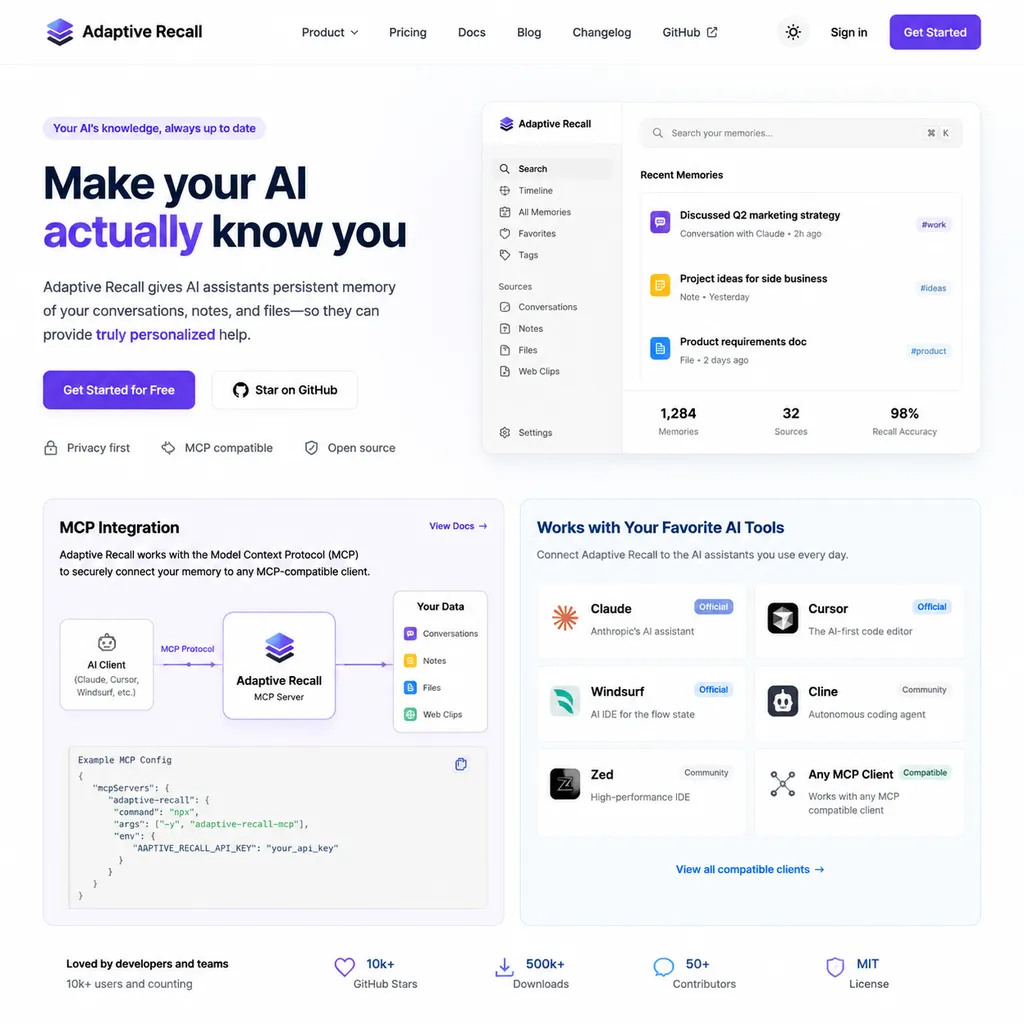
Yesterday, a new project called Adaptive Recall appeared on Hacker News’ Show HN board. Its website describes it as a “persistent memory layer for AI assistants,” built on the Model Context Protocol (MCP). Developers can attach it to MCP-compatible clients like Claude Desktop, Cursor, and Windsurf, allowing assistants to remember what users said, what projects they worked on, and what problems they previously ran into across sessions.
Sound familiar? Mem0, Letta (formerly MemGPT), LangMem, and even AWS’s Bedrock AgentCore Memory released this year are all trying to solve the same problem: giving LLMs an “external hippocampus.” But Adaptive Recall approaches it differently. It doesn’t provide an SDK or framework. Instead, it packages memory capabilities directly as an MCP server that anyone can connect to.
That idea is worth discussing because it reflects a clear trend in AI infrastructure in 2026: memory is shifting from being an “embedded framework feature” into an “independent protocol layer.”
Why Memory Has Been So Hard to Get Right
Here’s a scenario every developer has encountered. You use Claude or ChatGPT to write code and repeatedly tell it things like, “Our project uses the Vue 3 Composition API, don’t write Options API,” or “The database is PostgreSQL 15, don’t use MySQL syntax.” You say it ten times, but in the eleventh new session it has forgotten everything again.
The root problem is the context window. Even with Claude’s 200K context window or Gemini’s million-token window, stuffing in entire conversation histories is impractical. It’s expensive, and model reasoning quality tends to degrade as context grows longer (the industry calls this the “lost in the middle” phenomenon, where models effectively ignore information buried in the middle).
That’s why so many memory solutions have appeared. They generally fall into three categories:
- Framework-embedded: LangMem and Letta deeply integrate with ecosystems like LangChain and LangGraph. You have to adopt their agent frameworks to use their memory capabilities.
- Standalone SDKs: Mem0 is the typical example. It wraps everything in APIs that you manually call inside your agents. Flexible, but it requires glue code.
- Managed services: AWS Bedrock AgentCore Memory and Alibaba Cloud Bailian’s long-term memory system are fully managed cloud offerings with one-click integration, but they lock you into the vendor ecosystem.
Each category has its own drawbacks: framework-based solutions are too invasive, standalone SDKs require significant integration effort, and managed services create vendor lock-in. Adaptive Recall takes a fourth path: protocolization. If your assistant speaks MCP, it can get memory.
What Does the MCP Layer Actually Solve?
MCP was introduced by Anthropic late last year and became widely adopted by mainstream clients in the first half of this year. Its role is similar to “LSP for AI.” LSP decouples editors from language services, while MCP decouples LLM clients from tools and data sources.
Turning memory into an MCP service brings several direct benefits:
- Zero-SDK integration: Mainstream clients like Claude Desktop, Cursor, Cline, Windsurf, and Zed already support MCP natively. Add a single config entry and it works—no code changes required.
- Model agnostic: It doesn’t matter whether the underlying model is GPT-5, Claude Opus 4.8, or DeepSeek V4. The client handles the model; MCP handles the data.
- Composable: You can simultaneously connect memory MCP servers, file MCP servers, database MCP servers, and more, with the assistant calling whichever it needs.
The configuration looks something like this, no different from connecting any other MCP server:
{
  "mcpServers": {
    "adaptive-recall": {
      "command": "npx",
      "args": ["-y", "@adaptive-recall/mcp-server"],
      "env": {
        "RECALL_API_KEY": "your-key-here"
      }
    }
  }
}
For developers, this “configure once, use everywhere” experience is far more pleasant than reconnecting Mem0 every time they switch IDEs.
Tradeoffs in the Technical Implementation
Based on information from the official site and Show HN comments, Adaptive Recall’s architecture is not especially revolutionary. Fundamentally, it still uses the familiar “vector retrieval + LLM extraction” combination. But it makes some notable design choices in the details.
What gets stored: Instead of dumping entire conversations into storage, it asynchronously analyzes each interaction with an LLM and extracts three categories of structured memory: “facts,” “preferences,” and “project context.” This is almost identical to Alibaba Cloud Bailian’s dual-layer “memory variables + memory fragments” design and Bedrock AgentCore’s memory strategies. The industry is clearly converging on this pattern.
How retrieval works: It uses semantic search. Each new user query first goes through vector matching, and the top-K relevant memories are injected into the current context. There’s an important hidden cost here: the more memory you accumulate, the higher the token overhead per conversation. Adaptive Recall does not publish concrete numbers, but industry experience suggests that a “six-month active” memory store could add roughly 2,000–5,000 tokens per interaction. This is not a free lunch.
Where memory lives: This is the biggest difference between Adaptive Recall and systems like Mem0 or Letta. By default, Adaptive Recall is cloud SaaS-based, unlike open-source projects such as mcp-ai-memory that support fully local deployments using Qdrant + Ollama. For privacy-sensitive teams, this is a downside. The company says enterprise self-hosting is supported, but without open source availability, trust remains limited.
Compared to Existing Solutions, Is It Worth Using?
To be fair, Adaptive Recall is not technically superior to everything else. Mem0 is approaching 30k GitHub stars, Letta’s dual-layer virtual memory architecture is academically more sophisticated, and AWS AgentCore comes with enterprise-grade SLA backing. Adaptive Recall cannot match those in the short term.
But it captures an important product insight: developers are tired of writing glue code.
I recently spoke with several friends building AI applications, and the common feedback was that from late 2025 into early 2026, the cognitive burden of AI infrastructure exploded. You need to choose model API aggregation services, agent frameworks, vector databases, memory systems, evaluation tools—every layer has 5–10 competing options. Developers want “plug it in and it works,” not “read three papers before making a decision.”
MCP-style protocolization directly targets that pain point. Just as web developers around 2005 no longer needed to understand the details of HTTP protocols and could simply use Rails routing DSLs, future AI application developers should not be bogged down by prompt templates for memory extraction or vector database selection.
From that perspective, even if Adaptive Recall is technically “Mem0 with an MCP wrapper,” it still has value. Protocolization itself creates value.
One Important Concern: Memory Poisoning
No discussion of memory systems is complete without addressing an unresolved industry problem: memory poisoning.
Suppose a user casually says during one session, “I hate TypeScript.” If the assistant treats that as a permanent preference and stores it in long-term memory, then for the next several months it may avoid suggesting TypeScript-related solutions without the user understanding why. Alibaba Cloud Bailian addresses this by introducing “memory variables” as high-priority calibration points, allowing users to manually define critical fields and prevent temporary information from interfering. Bedrock AgentCore separates “facts,” “preferences,” and “summaries” through configurable memory strategies.
Adaptive Recall’s public documentation currently says little about how it handles this issue. This should be a key evaluation criterion for any memory system: does it provide visualization, editing, and deletion interfaces for memory? Does it distinguish between “stable facts” and “temporary states”? If it blindly stores and recalls everything, problems are inevitable over time.
One More Thing
Adaptive Recall itself is not tied to any particular model. The client can use GPT-5, Claude Opus 4.8, Gemini 3, or DeepSeek V4. If you’re testing in mainland China, aggregation platforms like OpenAI Hub can cover all major models with a single API key and direct connectivity, making them convenient for comparing memory behavior across MCP and multiple models.
Final Thoughts
By 2026, long-term memory is no longer a question of “whether it’s worth building,” but “how to implement it without creating extra friction.” The emergence of Adaptive Recall demonstrates one thing clearly: MCP is becoming the default interface for delivering AI capabilities. In the past, every capability came with its own SDK. Now, in the protocol era, every capability comes with its own MCP server.
For developers, there’s no urgent need to switch solutions if Mem0 is already working well. But if you’re starting a new project or you hate integration overhead, Adaptive Recall deserves a spot on your shortlist. The benefits of protocolization always reward early adopters first.
References
- MorseWayne/mcp-ai-memory (GitHub) — An open-source MCP memory server implementation based on Mem0, supporting local deployment and custom LLMs, useful as an open-source reference point for Adaptive Recall
- AI Agent Beginner’s Guide (Part 4): Overview of Memory Mechanisms (Zhihu) — A systematic overview of agent memory mechanism classifications, implementation approaches, and comparisons of mainstream frameworks, useful as an introduction to memory layer design


