
SenseTime Open-Sources SenseNova-Vision: One Model Does All Visual Tasks

Today, SenseTime open-sourced its SenseNova-Vision unified vision model. A single model covers all tasks including detection, segmentation, depth estimation, and 3D reconstruction, surpassing Google’s Vision Banana on multiple benchmarks. At the same time, 50 million visual instruction datasets were also open-sourced.
SenseTime Open Sources SenseNova-Vision: Ending the Era of "Patchwork Monsters" in Vision Foundation Models
On July 13, SenseTime released SenseNova-Vision — a unified vision foundation model for understanding and generation, with its model, data, and training recipes all open-sourced at once. Don’t scroll away yet — this isn’t another "multi-task packaging" project. What’s really worth noting is that it finally resolves the most awkward issue in the vision foundation model world over the past two years: the so-called "unified vision" models were really just wrappers bundling together detection, segmentation, and depth prediction expert models under one hood. This time, SenseTime has truly rebuilt it from the ground up.
The Conclusion First: This Time It’s Not "Packaged", It’s "Native"
If you’ve seen enough product-launch PPTs, the word "unified" probably doesn’t impress you anymore. Past "unified vision" models were essentially routers with a set of expert networks: an image comes in, the model first classifies the task type, then routes it to the corresponding head for processing. Sounds neat—but if you break it down, the detection model is still a detection model, the segmentation model is still a segmentation model, just sharing one backbone. The ceiling for this model type has long been reached — each task’s representational space is isolated, preventing true knowledge transfer across tasks.
SenseNova-Vision, on the other hand, makes vision a native capability of a general foundation model. Classic tasks such as object detection, image segmentation, depth estimation, and 3D reconstruction are all performed within the same representational space. SenseTime had planted the seed for this back in May, when it released SenseNova U1 — the NEO-Unify architecture cut out both the vision encoder (VE) and the VAE, using two convolutional layers plus GELU to tokenize images directly. At that time, discussions centered on unifying understanding and generation; now, the concept extends naturally to purely visual tasks.
Beating Experts Across Four Key Domains — An Unusual Scorecard
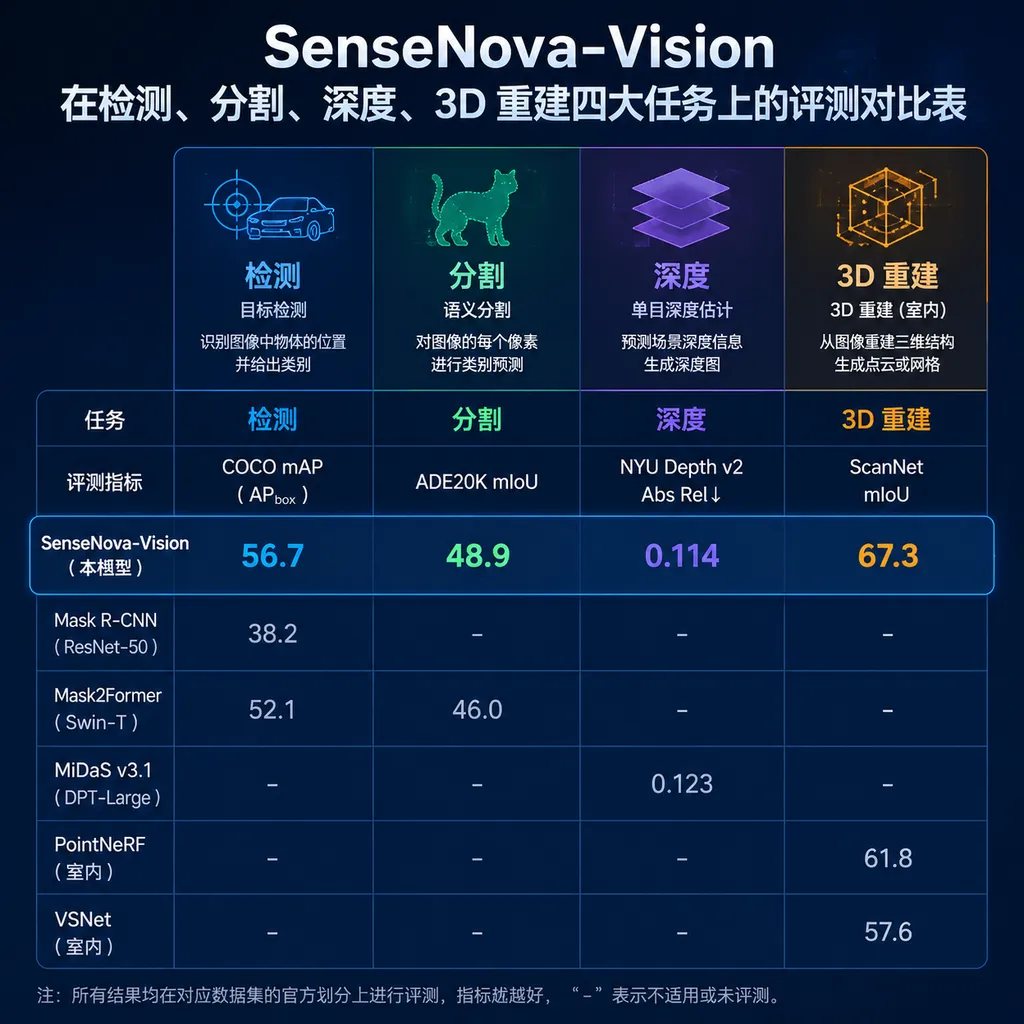
SenseTime’s evaluation approach was blunt: no obfuscation, direct head-to-head comparisons against expert models in each domain.
In structured visual understanding, SenseNova-Vision outperforms similar general models across object detection, referring detection, OCR, and keypoint localization. That’s not too surprising, as large models have already been closing in on expert performance in detection. What really raises eyebrows is its performance in dense small-object detection and long-tail category recognition — two historical strengths of expert models where general models usually crumble. The reasons are straightforward: small-object detection demands strong spatial priors, and long-tail recognition thrives on memorizing vast amounts of labeled data — both easier when using separate heads, but much harder when constrained to unified representations.
In dense geometry prediction, the competition is fiercer — with monsters like Depth Anything V2 dominating depth estimation, and specialized SOTA approaches leading in surface normal prediction. SenseNova-Vision claims parity with geometric specialist models, maintaining stability across indoor and outdoor scenes. That word "stability" carries real weight here: geometric models notoriously fail at cross-domain generalization — an indoor-trained model often collapses in outdoor forest scenes.
The segmentation capabilities include real highlights: reasoning segmentation and generative conversational grounding segmentation (GCG Segmentation). Traditional SAM-family models support interactive segmentation, but can’t comprehend complex instructions like “segment the dog chasing the cat.” SenseNova-Vision, inherently multimodal, handles such reasoning tasks natively.
For multi-view 3D geometry, a single model performs both multi-view point cloud reconstruction and camera pose estimation. That’s the territory previously explored by DUSt3R and MASt3R, so achieving parity or superiority within a unified vision framework is an engineering feat.
Benchmarking Against Vision Banana: A True Generational Leap
The launch materials explicitly name-check Google DeepMind’s Vision Banana — the model that validated the "generation-as-understanding" path for general vision. SenseTime claims a "comprehensive generational advantage" on two counts:
First, SenseNova-Vision overtakes Vision Banana on core metrics — though such claims are common enough in the industry to be of limited standalone value.
The real weight lies in the second point — task coverage. Vision Banana addresses only "two" of the four major categories of vision tasks, whereas SenseNova-Vision spans all: structured understanding, dense geometry, panoptic segmentation, and multi-view 3D. That’s the true definition of a generational leap — not just scoring 2 points higher on a benchmark, but being able to do everything your competitor can do, plus what they cannot.
Against semantically oriented models (like Youtu-VL), the comparison is even simpler — SenseNova-Vision leads comprehensively on fine-grained tasks. No surprise there: semantic-first models abstract away too much detail, making them inherently weaker at pixel-level precision.
The 50 Million-Sample Vision Instruction Corpus — Possibly Even More Valuable Than the Model
One line in the release might be easy to miss: SenseTime simultaneously open-sourced a vision instruction dataset with 50 million samples, tentatively named "S" (likely SenseVerse or similar).
Anyone who’s done multimodal training knows how scarce data is. COCO has just over 100K images, Objects365 about 2M, LVIS around 100K. Publicly available multimodal instruction data for SFT phases barely reaches a few million examples, mostly focused on simple VQA tasks. Fully open-sourcing 50 million samples covering detection, segmentation, depth, and 3D — that’s transformative. It means any team aspiring to build a unified vision foundation model no longer needs to start from scratch collecting data.
In short, SenseTime didn’t just open-source a model — it open-sourced an entire reproducible pipeline.
Technical Reflections
Viewed alongside May’s SenseNova U1, SenseTime’s roadmap becomes clear:
- U1 series — unifies understanding and generation in multimodal models by removing VE and VAE, bridging the representation gap between language and vision with an encoder-free design.
- Vision series — brings native unification across vision sub-tasks, eliminating separate heads so that all visual tasks grow from a shared representation.
Where do these paths converge? In a truly general-purpose visual brain. That’s why SenseTime keeps emphasizing "embodied intelligence" and "robotics" — a model capable of detection, segmentation, depth estimation, 3D reconstruction, image-text understanding, and generation is naturally the ideal perception system for intelligent robots.
Of course, some caveats remain. Post-release, the real test will be community adoption. Three open questions:
- Inference cost — unified models typically infer slower than specialized ones. If YOLO finishes detection in a few milliseconds but SenseNova-Vision takes hundreds, it’s unsuitable for real-time scenarios.
- Fine-tuning difficulty — does altering one task’s behavior disrupt others? This interdependence has historically plagued native unified models.
- Long-tail generalization — strong benchmark results don’t guarantee performance in real-world verticals like industrial inspection or medical imaging. True robustness still needs to be proven.
Open Source Strategy and Ecosystem Impact
Fully open-sourcing both model and data has tangible impact on China’s vision foundation model landscape. Globally, this layer is led by Google (Vision Banana, Gemini) and Meta (DINO, SAM). Domestically, the leaders are Alibaba’s Tongyi, ByteDance’s Seed, and now SenseTime’s SenseNova line. The completeness of this release — model, weights, 50 million samples, and technical report — makes a strong statement: it’s now on the community to pick up the baton.
SenseNova-Vision will soon appear on Hugging Face and SenseTime’s GitHub organization. Developers can quickly verify by downloading it and testing on their own use cases — especially for small-object detection and reasoning segmentation.
OpenAI Hub is also integrating SenseNova APIs, so SenseNova-Vision inference services will likely be accessible via a unified endpoint — a single API key to compare GPT, Claude, Gemini, and SenseTime models side by side on equivalent visual tasks.
In Closing
In early 2024, the vision community was still debating whether to use CLIP or freeze the visual encoder; by mid-2026, it’s debating whether to remove VE and VAE altogether. The pace of change is staggering. SenseNova-Vision’s significance doesn’t lie in topping yet another benchmark — that happens weekly — but in presenting a feasible, reproducible, and deeply native unified approach. If this path proves viable, the old engineering paradigm of "A for detection, B for segmentation, C for depth" may soon be replaced by end-to-end general vision models.
It may appear to be the open-sourcing of one model, but in hindsight, it marks a paradigm shift.
References
- SenseTime releases and open-sources SenseNova-Vision unified vision model, outperforming Vision Banana — IT Home — original report with detailed evaluation data
- SenseTime’s multimodal “efficiency monster” goes open-source and SOTA — Zhihu — technical breakdown of the SenseNova U1 series, helpful for understanding the evolution toward unification
- Hugging Face model page (huggingface.co/sensenova) — official repository for SenseNova model weights and technical reports


