
StepX Star unveils the world’s first agent-based smartphone, STEPX Neo
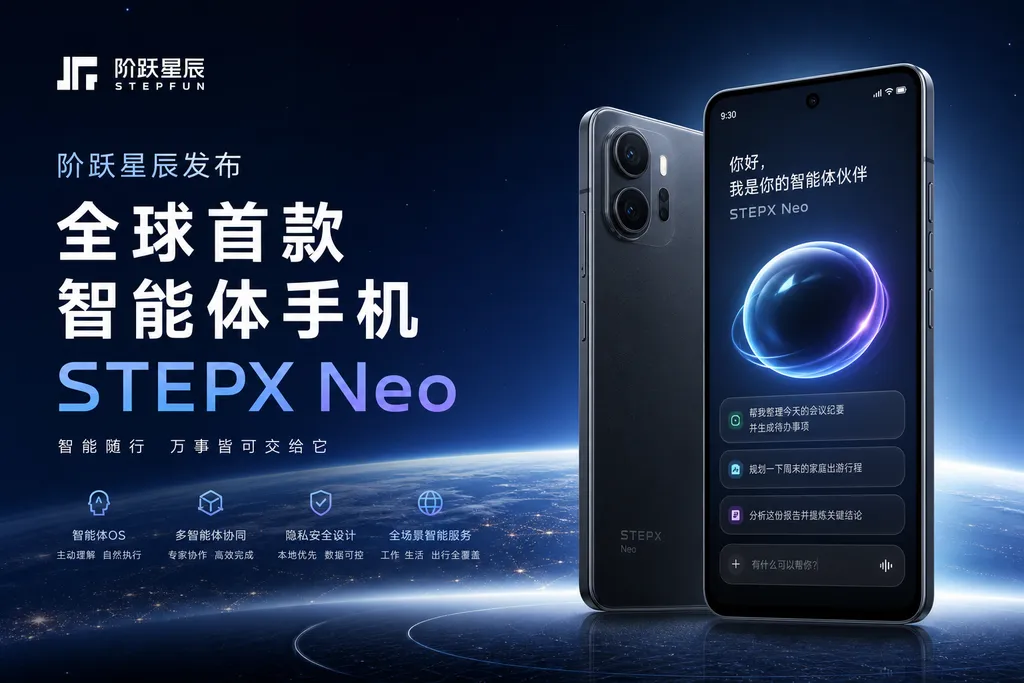
On July 13, StepX and Nubia jointly launched the world’s first smartphone with a native large-model intelligent agent — the **STEPX Neo**. It comes equipped with the **Step AOS** system and the **Amoo** intelligent agent, aiming to redefine the paradigm of smartphone interaction.
StepStar Launches the World's First Agent Smartphone: Step AOS Puts the Agent on the Road for Real
On the afternoon of July 13, StepStar held its Terminal Brand & Agent Strategy Launch Event in Shanghai. Three things were unveiled: an agent-native operating system called Step AOS, a system-level agent called Amoo, and a smartphone called STEPX Neo. The entire event revolved around one core proposition—moving the Agent from demo videos into users’ pockets.
This is the world’s first smartphone defined as “large-model native.” It’s not just a phone with AI features added; rather, the large model functions as the operating system’s central dispatcher, transforming the phone from something that can “talk” into something that can get things done.
Beating OpenAI by a Year
Let’s talk timeline. OpenAI publicly committed to the next generation of AI hardware last year, with Jony Ive’s team working on a device set to hit the market in 2027. StepStar, however, just released a mass-production version in mid-2026—at least a full year ahead of OpenAI.
This wasn’t a spur-of-the-moment move. On July 9, ZTE Senior Vice President and Nubia President Ni Fei hinted on Weibo that the world’s first AI agent smartphone would come from Nubia and debut at the 2026 World Artificial Intelligence Conference. That same day, StepStar officially announced its new-generation agent terminal. Citing insiders, Blue Whale News reported that the phone was manufactured by Huaqin Technology—but today’s event made it clear that Nubia is leading the complete device project, with Huaqin focusing mainly on supply chain support.
In short, this is a three-party partnership between a large-model company (StepStar), a smartphone manufacturer (Nubia), and a major ODM (Huaqin). StepStar provides the system and models; Nubia handles hardware design and channels; Huaqin provides manufacturing. It’s a lighter division of labor than Xiaomi’s or Huawei’s full-stack setups, but with faster execution.
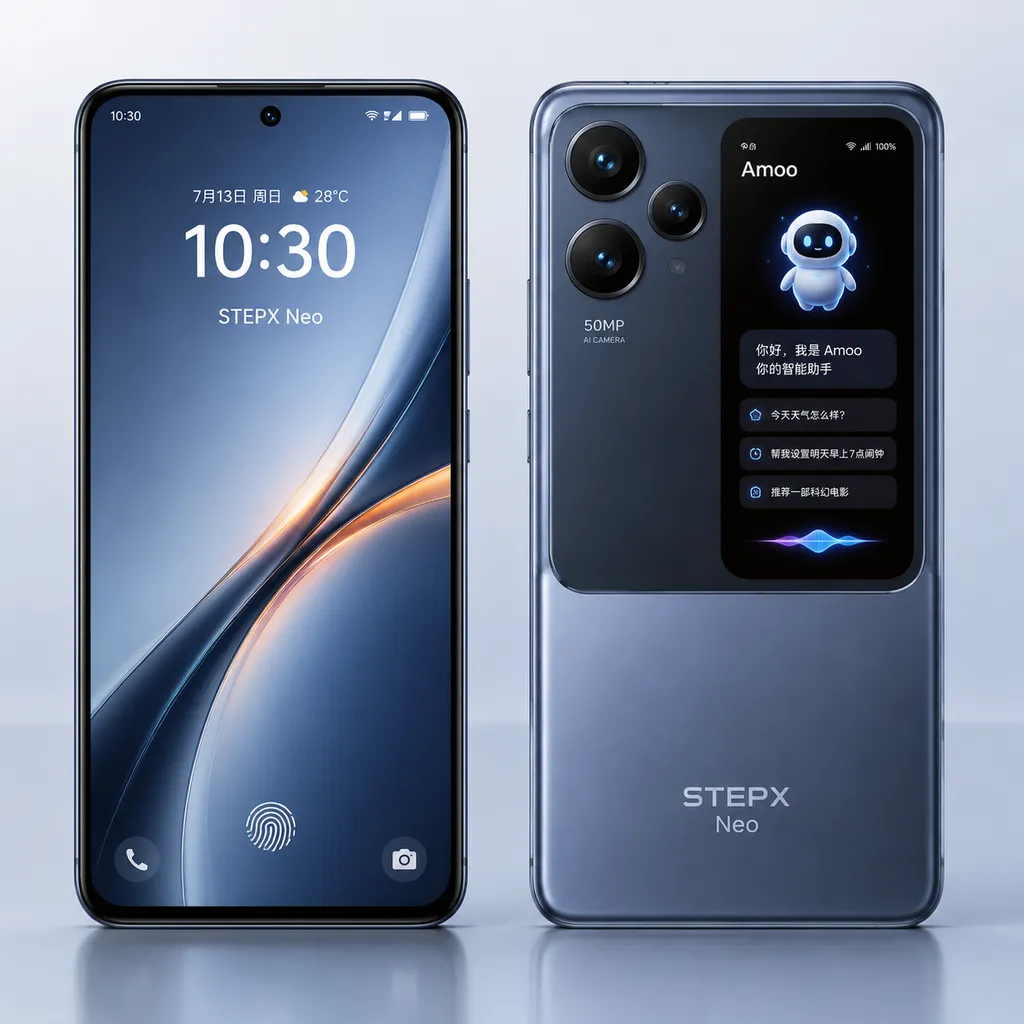
STEPX Neo: The Rear Display Is the Key
The most eye-catching hardware design unveiled was the interactive rear display. This isn’t Nubia’s first time experimenting with a back screen—previous phones like the Nubia Z50S Pro and Z60 Ultra also had them—but those mainly served for notifications and time display. On STEPX Neo, the back display has been redefined as the agent’s always-on interface.
Why add a rear display? The logic is straightforward: if an Agent is truly working on your behalf—ordering food, booking tickets, scheduling meetings—you don’t want it to take over your main screen. The rear display becomes the Agent’s “workbench,” while the main display stays reserved for the user’s own tasks. This division of screens extends “human-agent collaboration” from software to hardware.
The company hasn’t released specific specs or launch dates yet. Based on Nubia’s typical flagship production cycle, sales will likely begin around the 2026 World Artificial Intelligence Conference.
Step AOS: Not Just an Android Skin
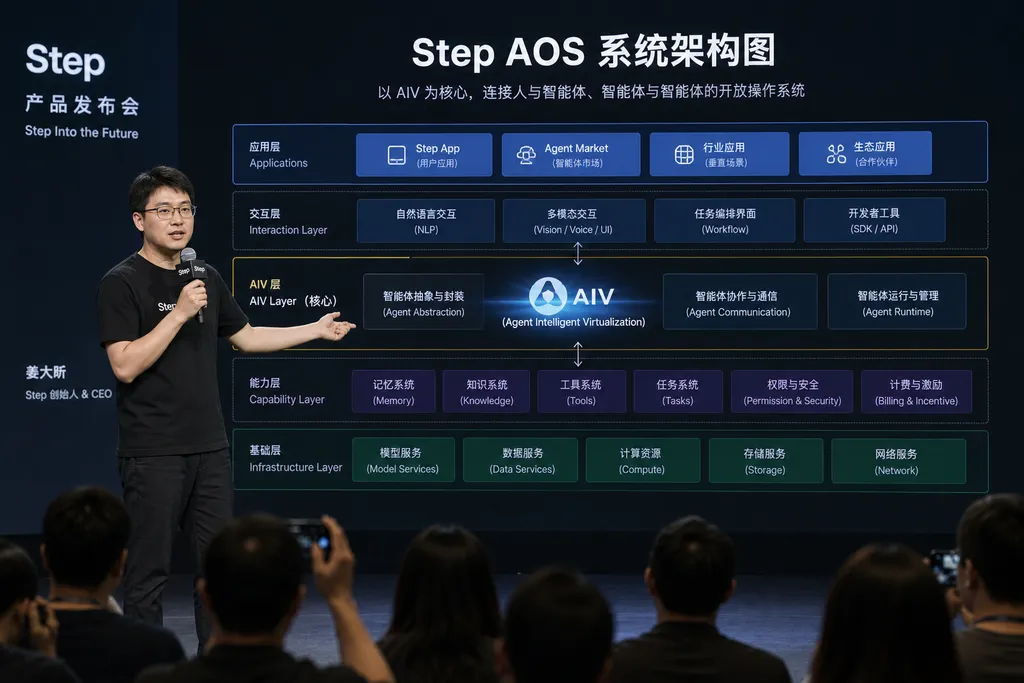
The real highlight is Step AOS. This system isn’t an Android shell with an AI assistant; it embeds large-model scheduling capabilities into the OS layer itself.
Its technical foundation is StepStar’s earlier Step-GUI model series—Agent models trained specifically for graphical interface operations. According to official data, they support task execution across more than 200 app scenarios, and independent developers can adapt new apps in as little as 10 minutes. The open-source on-device version, Step-GUI Edge, runs locally to handle low-latency interface recognition and action generation.
Here’s the key design: cloud-based large model + on-device GUI model collaboration.
- Cloud: runs the main large model for complex reasoning, intent understanding, and multi-step planning
- Device: Step-GUI Edge handles screen comprehension, control recognition, and action execution
This setup addresses a long-standing problem in agent systems—latency. If every interaction had to go back to the cloud, users wouldn’t tolerate it. By moving GUI execution to the device and letting the cloud handle “what to do” while the device handles “how to do it,” responsiveness is transformed.
Compare this with existing solutions: Apple’s Apple Intelligence follows a hybrid model with “small models on-device, large models in the cloud,” but its agent capabilities are mostly limited to system apps. Google’s Gemini on Android behaves more like an assistant and relies on the Assistant API for cross-app actions. Huawei’s Celia Agent depends on intent frameworks and requires app-level integration. StepStar’s Step-GUI approach is bolder—it doesn’t matter whether apps integrate or not; we directly operate your interface through visual + GUI understanding.
The advantage of this approach is robust ecosystem compatibility; the downside is that stability depends on model performance. Once an app redesigns its interface, the Agent might fail. That’s why StepStar brought in a large ecosystem of partners.
Amoo and Its Network
The first batch of ecosystem partners announced covers nearly all major Chinese lifestyle services:
- Local Life: Meituan, Ctrip, Didi, Amap, Baidu Maps
- Work & Content: WPS, CapCut, Weibo
- Payment & Commerce: Alipay, JD.com, Baidu
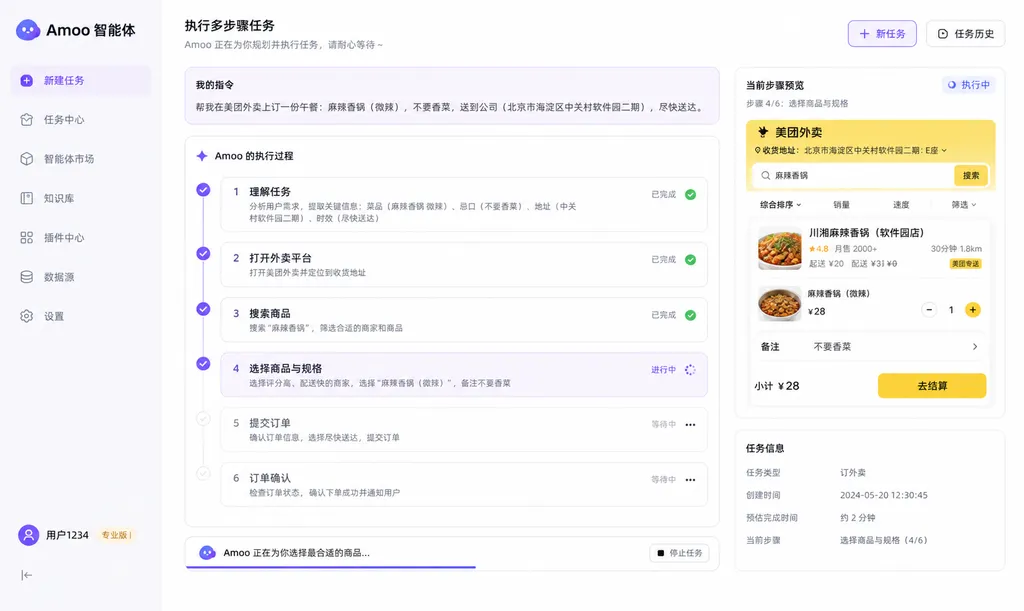
This lineup covers virtually all everyday Agent-use scenarios—ordering food, booking rides, buying tickets, editing documents—offering broader coverage than any previous AI smartphone initiative.
StepStar’s agent is called Amoo. The name suggests an IP-like personality rather than a cold “assistant,” highlighting StepStar’s ongoing push toward emotional, character-driven interaction—an idea reminiscent of its earlier product “Bubble Duck.”
But Amoo differs fundamentally from Bubble Duck: Bubble Duck chatted; Amoo gets things done. This marks a major strategic shift since StepStar consolidated its focus in 2025—pausing the Bubble Duck investment last December, merging teams into “Yuewen” (later rebranded as “StepStar AI”), and now going all-in on the Agent path.
Why StepStar, and Why Now
StepStar was founded in 2023 by Jiang Daxin, former Microsoft Global Vice President. In January this year, SenseTime co-founder and Qianli Technology Chairman Yin Qi became chairman, managing strategic direction. The leadership lineup is compelling—Jiang specializes in models, Yin in vision and devices, CTO Zhu Yibo focuses on infrastructure, and Chief Scientist Zhang Xiangyu leads core research.
Financially, StepStar has completed five funding rounds, the latest in May for about USD 2.5 billion. Investors include Tencent, Lenovo Capital, and Shunwei Capital. In February, foreign media reported that StepStar was considering a Hong Kong IPO to raise around USD 500 million. With healthy cash flow and clear IPO goals, it has the confidence to build hardware.
On the modeling side, StepStar’s open-sourced Step 3.5 Flash in June topped the Artificial Analysis benchmark with an output speed of 409 tokens/s. Speed is one of the most critical metrics for agents—if it takes 30 seconds to decide after you say “book me a restaurant,” the product fails.
Looking back, StepStar’s Step series large-model portfolio already spans language, multimodal, and reasoning capabilities. It previously collaborated with OPPO on “Ask the Screen” and “All-in-One Search,” with Geely and Qianli on AI + automotive, and was featured in MediaTek’s four-layer full-stack AI release in May. Together, these efforts form the technical foundation of STEPX Neo.
The Real Questions Behind Agent Phones
Hype aside, several tough questions remain.
First, the reliability of general-purpose agents is still unproven.
Currently, GUI-based agents have success rates hovering around 60–80%. That sounds okay, but for everyday phone use, it’s fatal. Would you accept a ride-hailing app choosing the wrong driver one out of five times? StepStar’s Step-GUI performs well in lab tests, but how it handles long-tail real-world cases remains to be seen.
Second, the depth of ecosystem integration is uncertain.
How deeply are those “partners” really integrated? If it’s merely “we allow Amoo to operate our app visually,” that’s not much better than no partnership. If it’s “we opened up semantic APIs for Amoo,” that would be meaningful. Based on public information, the former seems more likely.
Third, privacy and security.
An agent capable of operating all your apps touches extremely high levels of permission. What are the confirmation boundaries for payments? Who bears responsibility if the agent orders the wrong food or books the wrong flight? These are product and legal, not technical, problems—and no agent phone can avoid them.
Fourth, the business model.
StepStar is a software company, Nubia is hardware. How do they split profit on a device sale? If they follow Xiaomi’s hardware+services approach, Amoo will likely run on subscriptions, which means its utility must clearly exceed that of free assistants—a tall order.
A Bigger Signal
Zooming out beyond this phone, the signal STEPX Neo sends is bigger than the product itself.
Over the past two years, large-model competition has revolved around “parameters, benchmarks, context length.” But since mid-2025, the battlefield has been shifting toward end-user devices. China’s NDRC recently forecast that AI phones and AI PCs will outsell non-AI devices for the first time this year. Counterpoint projects AI phone penetration to climb from 45% this year to 52% next year. ZTE Chairman Fang Rong also noted last week that “a new generation of AI phones capable of understanding and performing tasks will soon hit the market.”
Everyone now realizes that no matter how powerful your model, monetization happens at the user entry point—and smartphones have been the dominant entry point for the past 15 years.
StepStar’s aggressive move extends the boundary of a “model company” into hardware. Xiaomi, Huawei, and OPPO have all shown this route can work—but this is the first time a model-first company is making that move in reverse. Success will depend on STEPX Neo’s sales and Amoo’s daily active users over the next year.
If it succeeds, the “model company + ODM + brand” triad could become a new industry paradigm—where model companies needn’t build factories and phone makers needn’t self-develop large models.
If it fails, it’ll simply be another concept product—and the Agent’s road to reality remains long.
Either way, July 13, 2026, will be remembered as the day the world’s first agent-native production smartphone left the lab. Whether it truly “puts Agents on the road” depends on that rear display—whether it stays lit, or goes dark.


