
South Korea aims to become the "public school" of the AI world: a nationwide free large model to be launched within the year
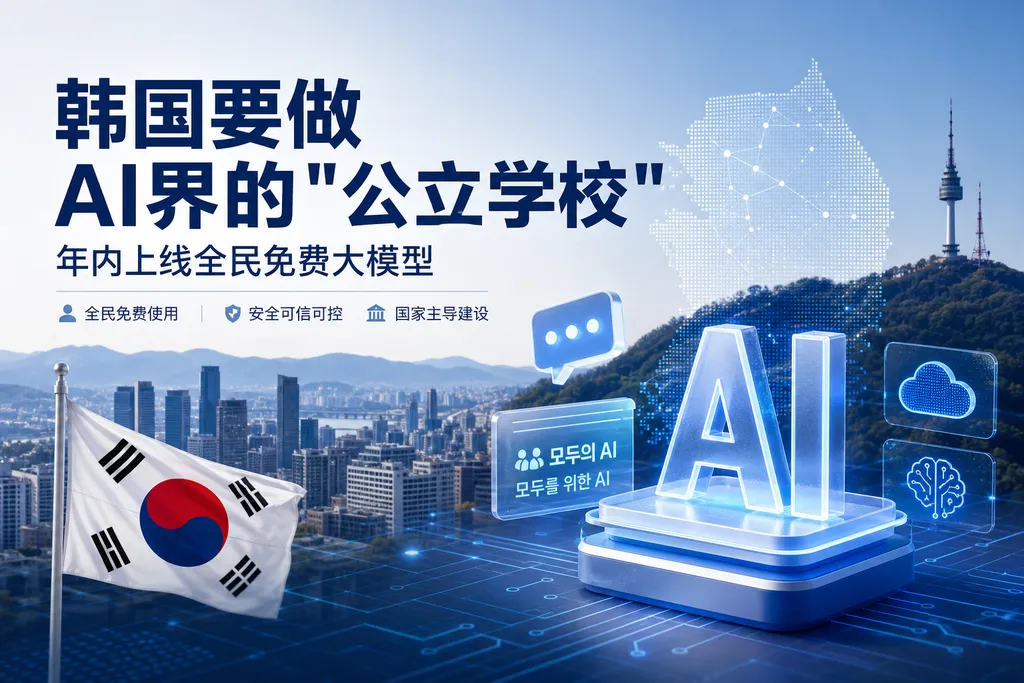
The South Korean Ministry of Science and ICT announced that within the year it will launch a nationwide free general-purpose large language model chat service. Through government procurement, it will require the use of domestically developed models and will provide computing power equivalent to 512 B200 GPUs each year, aiming to bridge the national AI divide and reduce dependence on foreign AI.
The Korean government is really stepping in this time.
On July 13, the Ministry of Science and ICT (MSIT) of South Korea announced through an official notice that it would, via a government tender, launch a universal, free AI chatbot service for the entire population by 2026. In plain language — South Korea is planning to give every citizen an "official ChatGPT," for free, built upon domestic AI models.
This move is rare on a global scale. Over the last two years, most governments’ AI strategies have centered on “regulation,” “subsidies,” and “sovereign models.” But South Korea is the first major player to clearly commit national funding to a free, public-facing AI chat service for all citizens.
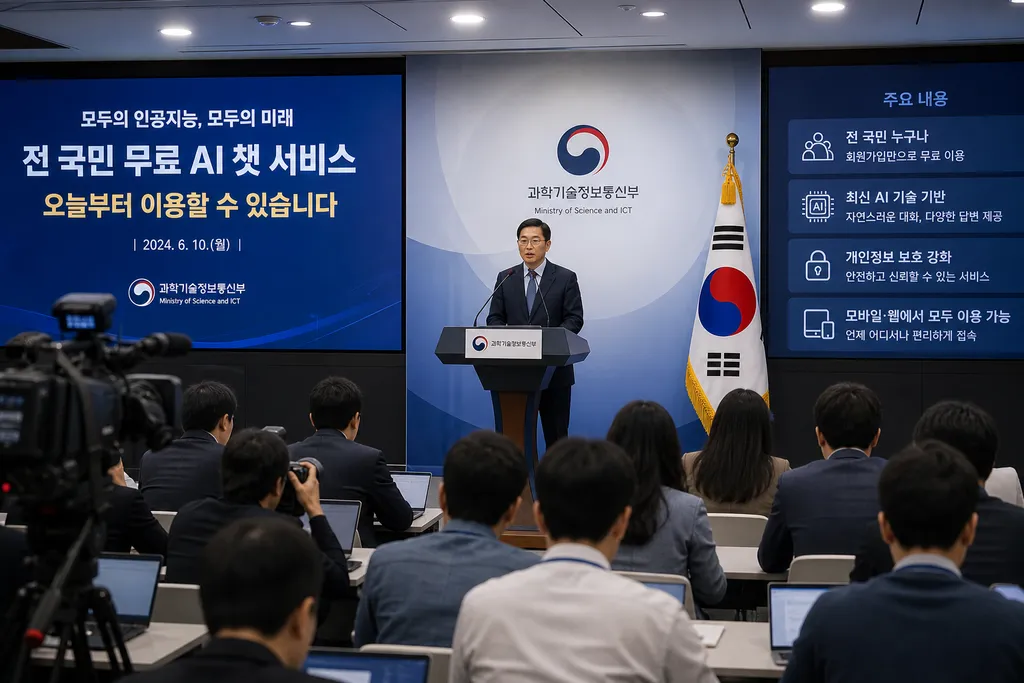
Why now? Why South Korea?
Let’s look at the two official reasons MSIT provided — each packed with information.
First, the AI divide has become measurable. According to the ministry, around one-third of South Korea’s population still cannot use artificial intelligence. Note the wording “cannot use,” not “have not used” — it reflects barriers of cost, language, and accessibility. ChatGPT Plus costs $20 per month, Claude Pro about the same. For elderly citizens, low-income groups, and those living outside the capital region, that’s a concrete obstacle.
Second, foreign dependency is keeping the government up at night. Officials were forthright: most Korean users rely on free tiers of foreign AI services. This reveals two issues — first, data sovereignty is leaking away as Koreans’ queries, writing, and programming run on OpenAI and Anthropic’s servers; second, the quality ceiling of free versions means Korean users’ perception of AI risks being anchored at the “usable but not excellent” level, while profits from paid plans go entirely overseas.
South Korea is also well-equipped for this initiative. Naver’s HyperCLOVA X, LG’s EXAONE, Kakao’s KananaLM, and SKT’s self-developed models form a domestic AI lineup second only to China in East Asia. Naver’s public AI platform already serves over 40 government agencies, and the Seoul Metropolitan Government launched a self-hosted LLM-driven “Chatbot 2.0” last year to handle repetitive administrative tasks. With these projects already tested in enterprise and public sectors, expanding to everyday citizens is a natural next step.
The fine print in the bidding process
Two mandatory conditions in the tender are particularly noteworthy.
First, bidders must primarily use domestically developed AI models. The keyword “primarily” leaves some flexibility — supplementary overseas models are allowed, but the core must be homegrown. That effectively narrows eligibility to Naver, LG, Kakao, and SKT.
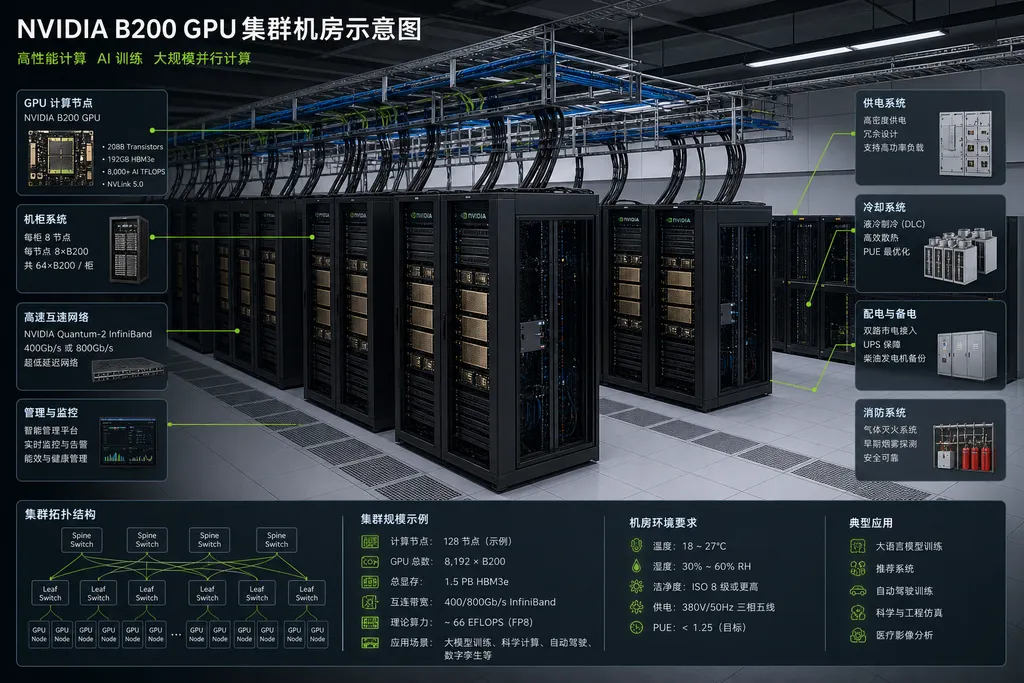
Second, the government will provide annual financial support equivalent to 512 NVIDIA B200 GPUs (or comparable compute). What does 512 B200s mean? A single B200 delivers about 20 PFLOPS of FP8 compute, so 512 GPUs total around 10 EFLOPS. For comparison — Meta trained Llama 3 405B with 16,000 H100s; GPT‑4 is estimated to have used 25,000 A100s. So 512 B200s aren’t nearly enough for training, but they are sufficient for inference and powering a nationwide public service.
In other words, the government is not funding model R&D (that’s up to the industry) — it’s subsidizing operational costs. The logic is straightforward: South Korea doesn’t lack models; it lacks affordable compute resources to make AI accessible to everyone.
How much per year? A rough estimate
Based on current B200 lease rates (about $4–6 per GPU-hour from cloud providers), 512 GPUs would cost roughly $18–26 million annually, or about 13–19 million RMB. Including bandwidth, storage, maintenance, fine-tuning, and moderation, total annual spending would likely reach $30–50 million.
Is that a big number? The MSIT’s 2026 AI budget is reportedly in the several-hundred-million-dollar range. Spending tens of millions on a national AI service is actually efficient — especially if it brings basic AI access to the one-third of citizens who currently lack it.
The current landscape of Korea’s AI market
To understand this move, you need to see the market terrain.
AI consumption among Korean end-users is already heating up. Reports show some Korean AI social platforms are generating monthly revenues in the millions of dollars. Apps integrating mainstream large models are multiplying, and users are used to paying for AI services.
But there are problems:
- Top-tier paying users are already captured by ChatGPT, Claude, and Gemini, leaving local models little room to grow subscription revenue.
- Mid- and long-tail users rarely pay, relying on free foreign models for basic needs.
- Domestic models dominate government and enterprise markets, but those sectors have limited upside.
So, the government’s “AI for all, free for all” initiative is essentially a fiscal backstop to open a route for domestic models into the mainstream consumer sector. Even if the free product isn’t as capable as GPT‑4o, as long as it’s good enough, fast enough, and understands Korean well, it can attract many users currently on ChatGPT’s free plan.
Will it work? My assessment
Here’s my view: the direction is right — success depends on execution.
It’s the right direction because South Korea is addressing a real issue — the AI divide. That’s not a made-up policy slogan; it’s a measurable gap that can be reduced. Making domestic models primary not only protects local industry in the short term but also helps build long-term capabilities for Korean-language and cultural contexts — the logic holds.
The execution challenges come down to three points:
First, the model’s performance must meet user expectations. ChatGPT has raised the bar. If the free domestic chatbot is noticeably weaker than GPT‑4o mini in reasoning or Claude Haiku in coding, users will abandon it within days, wasting public funds.
Second, the user experience must feel consumer-grade. Government projects often fail due to bureaucratic design. Success may depend on consumer-savvy players like Naver or Kakao taking the lead.
Third, the business model must be clear. If everyone uses the free tier, how do you price premium services? How do you differentiate from foreign products? What happens when subsidies end? Without clear answers, the project might fizzle out in a few years.
What this means for developers
For developers, the immediate effect is actually indirect.
The government is funding a public chatbot, not a developer API. So developers who use OpenAI or Claude will likely continue doing so. But second-order effects include:
- Domestic models (HyperCLOVA X, EXAONE, Kanana) may open up more widely — with stable government-backed compute resources, commercialization pressure eases, leaving more room for open-source and developer ecosystem initiatives.
- We can expect a surge in Korean-language AI applications, as free access to baseline capabilities lowers the cost of building higher-level tools.
- More countries may follow suit, especially mid-sized powers with both AI capacity and concerns about foreign reliance.
For developers needing to integrate and benchmark multiple models like GPT, Claude, Gemini, and DeepSeek, tools such as OpenAI Hub allow connecting to major models through one key compatible with the OpenAI API format — avoiding hassles of multiple overseas accounts, payments, or routing. Still, for deep Korean-language work, keeping an eye on domestic models like HyperCLOVA X will be essential.
A signal worth watching
Finally, a more macro-level reflection.
In the past, discussions about “sovereign AI” focused on whether a country should have its own model. Now South Korea has advanced the concept: sovereign AI shouldn’t just exist — it must be accessible to all citizens. This shift from production to consumption may define the next phase of national AI strategy.
The arms race at the model layer — OpenAI, Anthropic, Google, xAI, DeepSeek, Qwen, and others — is already brutal. But the race for AI universality is just beginning. Whoever first enables ordinary citizens to use AI as easily as running tap water will gain a new strategic foothold in the AI era’s social infrastructure.
South Korea has pressed the start button. See you by year’s end.
References
- ITHome: South Korea aims to launch a nationwide free general AI chatbot service this year — Original MSIT announcement and compute support details


